


Joe Studwell’s long awaited book on Africa is now out and Tobi and I are going to do a read-along of it, similar to what we did for Capitalism in the Colonies in late 2024. We will take it two chapters at a time except where the chapters are short enough to combine together.
Hope you will come along for the ride.
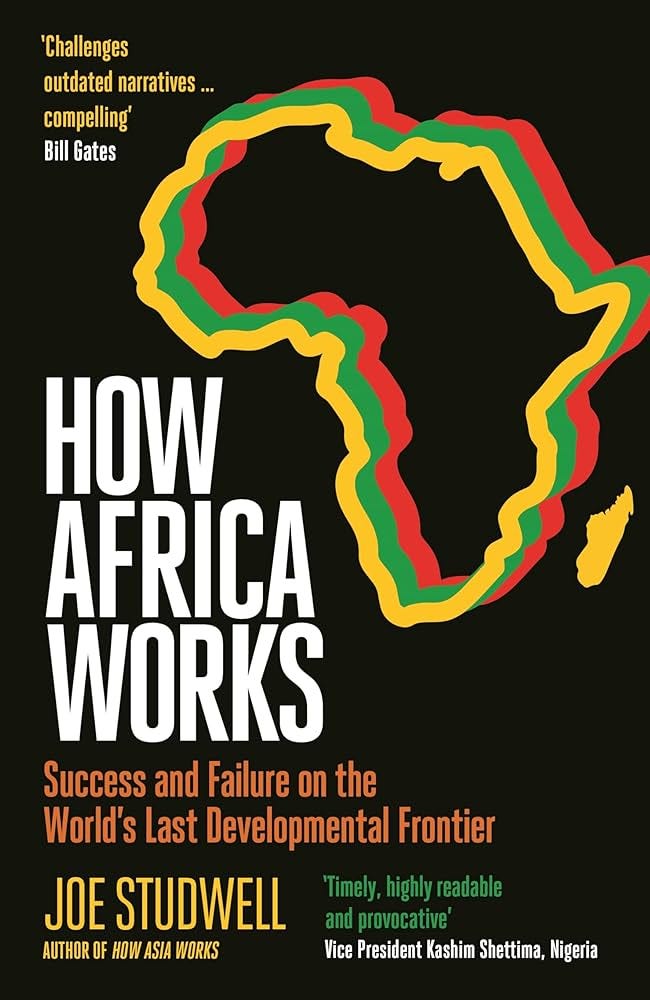
The book's subtitle - Success and Failure on the World's Last Developmental Frontier - explains both the long gestation and the keen anticipation. Few questions in contemporary economics generate quite as much curiosity as what ails Africa and whether it might finally surmount obstacles that have been overcome virtually everywhere else. The opening section, "The Context," surveys the constraints under which the continent has laboured - and which have conspired to keep it poor.
Studwell's argument rests on a chain of three interlocking constraints. The first - and most fundamental - is Africa's chronically low population density, itself the product of uniquely African conditions. This made economic development "all but impossible": without concentrated markets and adequate labour supplies, per capita infrastructure costs remained prohibitive. The second constraint follows from the first: what Studwell calls "low budget colonialism," a colonial model of isolated extractive enclaves, geographically and productively divorced from the broader economy. Post-independence Africa, he writes, "had a lousy inheritance." The third constraint completes the sequence: the developmental deficits bequeathed by the first two - dispersed, uneducated, and politically unorganised societies.
What is notable here is the exogenous framing. Studwell explicitly sidelines the usual suspects - corruption, coups, civil strife - out of his own empirical conviction. These, he argues, are symptoms rather than causes, downstream manifestations of deeper demographic and institutional pathologies. It is a bold methodological choice, one that shifts the analytical burden away from African agency and toward structural inheritance. One imagines this will be catnip to those inclined to view Africa's misfortunes as visited upon it rather than authored by it.
My own thinking on corruption’s role in African underdevelopment has travelled a considerable distance over the years. I began where many begin: treating it as the master variable, the explanation that explained everything. That certainty eroded as I encountered development trajectories - China’s in particular - where corruption was rampant yet growth proceeded apace. The question, I came to realise, was not whether corruption existed but the type of corruption, alongside which economic development can continue and it is, at most, a nuisance or cost of doing business. That is, the corruption itself is dependent on economic growth and not independent of it.
A necessary caveat: my views on African development are refracted almost entirely through Nigeria. This is where my knowledge is most confident, so everything in this read-along should be taken accordingly. Where I have landed on corruption is that it matters enormously - not because it siphons off resources (though it does) but because it distorts the entire decision-making apparatus. The road that gets built is not the one offering the best developmental return; the policy that gets pursued is the one that opens avenues for stealing. Corruption shapes not just how things are done but what gets done at all. It may not explain everything - no single variable can - but it explains a great deal.
The first chapter establishes the demographic constraint - what Studwell calls the single most important factor in understanding Africa's developmental predicament. The continent's population is now the fastest-growing on earth, but this is catch-up growth, not a head start. In 1950, when Africa held roughly 230 million people, Asia already had 1.4 billion.
Why so few people for so long? Studwell points to disease - affecting not just humans but, crucially, animals. The tsetse fly features prominently here, but with a causal chain I had not fully appreciated. By devastating livestock populations, the fly deprived African agriculture of animal manure, which in turn degraded soil fertility over generations, explaining much of the poor soil quality in places like Nigeria today. The tsetse's damage, in other words, compounded: it killed the animals that would have nourished the soil that would have fed the people. I have long been alert to the fly's malign influence on African history, but the manure link was new to me. There is of course malaria, bilharzia and hookworms as other diseases that have menaced the continent in ways that are without parallel elsewhere.
Then there were the elephants. Studwell argues that Africa's vast elephant populations - covering up to 87 per cent of East Africa's total area - posed an enormous obstacle to thinly spread human settlements. The animals ate voraciously and caused immense crop damage; only the arrival of European firearms tipped the balance. It is a striking argument, but my Nigerian lens initially obscured it. In West Africa, the elephant story runs differently as I understand it: it was demand, not defence, that drove the slaughter. Newly wealthy Europeans wanted ivory for piano keys and billiard balls (PDF, page 19), and Hausa traders obliged, running bustling markets in what is now north-eastern Nigeria and Cameroon. The elephants were not pushed back to make room for farms; they were hunted out to furnish European drawing rooms. By the late nineteenth century, this trade was dwindling out as the elephants were hunted to near extinction.
Coincidentally this aligns with what I have encountered in my own research for the public book I’m writing. A. F. Mockler-Ferryman, writing in British Nigeria (1902), describes an ivory trade already in decline: the stored tusks had been sold off, and political instability in the interior meant hunters could no longer pursue elephants "to any great extent." Heinrich Barth, Samuel Ajayi-Crowther and Eduard Vogel all spoke of the ‘ivory trade’ in Nigeria’s middle belt and north east as well. The picture that emerges from West African sources, certainly to me, is not of elephants as existential menace - Studwell's East African framing - but of elephants as a manageable nuisance that became economically valuable once European demand materialised. The threat, such as it was, was incidental.
The final factor is slavery - and here Studwell’s take is quite spicy. His argument is that causality runs from low population density to slavery, not the other way around. Where land is abundant and people scarce, political power orients itself toward the control of bodies rather than territory. "This explains the continent's long history of slavery," he writes. There was little point in fighting over land you could never hope to populate; better to accumulate people and bolster your own numbers. The logic is elegant, but it immediately raises an awkward question: if the entire motivation for capturing people was to augment group strength, why did African polities then export millions of them across the Atlantic?
Studwell's answer loops back to his earlier factors. Citing A. G. Hopkins (a friend of the house here at 1914 Reader), he argues that disease, degraded soils, and competition with elephants raised the opportunity cost of keeping people relative to selling them. The returns on export simply exceeded those on domestic use. This, of course, only deepened the demographic deficit - a vicious cycle in which low population density begat slavery which begat lower population density still. Well, it is certainly a take. It is an argument with obvious appeal to those inclined to see Africa as the victim of cosmic misfortune rather than authorial agency.
It was the great Warren Buffett that once advised that you should buy land because they are not making any more of it. China, as an example, may have more than 1 billion people today but it did have only 100 million people during the Song Dynasty (1100 AD) and 300 million people during the Qing Dynasty (1790 AD). To state the obvious, the land has not been expanding as the population has. Every region on earth was once sparsely populated; Studwell himself notes that Arab and American demand for African slaves arose precisely because those regions were themselves short of labour. Low population density, in other words, was a universal condition at various points in history, not a uniquely African curse. Which makes the proposed response - offloading millions of people to address a shortage of people - look less like economic logic and more like a paradox in need of further explanation.
My provisional sense - this is a read-along, so I reserve the right to change my mind - is that Studwell pushes the demographic thesis too far. Consider his treatment of colonial forced labour. He argues that the end of slavery did not resolve the underlying population deficit which caused it in the first place (his point not mine); colonial regimes therefore resorted to coercion to build railways and staff military campaigns. King Leopold's reign of terror in the Congo is offered as an example. But was Leopold's problem really a shortage of labour? I am not persuaded. The proximate cause of the Congo atrocities was a demand shock, not a supply constraint. John Boyd Dunlop's invention of the inflatable rubber tyre in 1888 set off a global scramble for latex; bicycle factories proliferated, and by the 1890s a third of all US patents were bicycle-related. Leopold saw an opportunity and seized it with extraordinary brutality.
The deeper issue was the nature of the work. Congo’s rubber grew wild in the forests, and harvesting it was gruelling and dangerous: workers had to venture deep into hostile terrain, risking their lives at every turn. At any population density anywhere in the world, that kind of labour commands a premium - you must pay enough to make it worthwhile. Leopold was unwilling to pay, so he resorted to terror. This was not a labour scarcity problem but a wage problem dressed up as one.
We can test this against what happened next. By 1911, a British Vice-Consul visiting the Congo observed that the same people who had recently spent “ten to twenty days monthly in an exhausted forest searching for rubber” were now “left in peace to gain in their own way the money for the payment of the tax.” The labour supply had not magically expanded; the coercion had simply been replaced by compensation. In June 1913, the Congo Reform Association held a final meeting in London, declared victory, and dissolved itself, announcing that “the native of the Congo is once more a free man.”1 The Congolese, it turns out, were perfectly willing and available to work - for a price.
Nigerian history offers similar lessons. When Frederick Lugard set about building railways to extract tin from the Jos Plateau, he advertised for workers on monthly wages and found few takers. The conclusion at the time might easily have been “labour scarcity.” But when the terms were changed to daily contract work - payment for the task completed - workers magically appeared out of nowhere. People wanted control over their own time: they would work until they had earned what they needed, then disappear, returning only when the need arose again. What looked like an absence of labour was in fact a preference for autonomy over an unfamiliar wage structure.
There was also a deeper aversion at play. As I noted in our read-along of Capitalism in the Colonies, slavery had left a stigma on certain forms of work in Nigeria - particularly the large gang labour that railway construction and the likes demanded. The memory of coerced mass labour was still quite fresh and so people simply refused to be assembled in ways that echoed what had come before. Labour supply, once again, was not the binding constraint. History was.
None of this is to dismiss the demographic factor - it was real, and it mattered. My scepticism is around how much explanatory scaffolding can be placed on it. That said, Studwell's argument is not one of despair. His point is that Africa is now, finally, in the “development game”. As population catches up, density thickens markets, enables commerce, and creates the conditions for sustained growth. The constraint, in other words, is lifting.
On that note, let’s continue reading.
- Feyi
A Wrong Start
Joe Studwell has been the most influential writer on economic development in the last decade. His book, How Asia Works, has become the default lens through which development theories and policies are filtered in the popular imagination. Hence, it was no surprise when word got out that he was writing another book - this time about Africa - it became one of the most anticipated books in popular economic writing. I was slightly disappointed when I saw the cover and noticed the book was blurbed by Bill Gates, and Nigeria's current Vice President. Studwell himself confessed to knowing very little about Africa (which is a standard but strange politically correct scholarly caveat emptor now often attached to studying Africa, right before the person proceeds to explain that which they knew nothing about), but was strongly urged to write the book anyway. I do not think this is enough to dislike the book, but it suggests to me that the book is a kind of institutional project that tactfully avoids any direct critique of the current elite structure and policy choices in its subject matter. In this narrative offering of this kind, Africa is always promising, misunderstood, and a victim. But I am open to being convinced by Studwell that this book is truly "How Africa Works" and not "Why Africa is not Working" or "How Africa is not Asia".
The second chapter argues that Africa's growth performance, especially after independence from colonialism, has been plagued by what Studwell calls "the wrong kind of economy". This is a familiar argument with a new name. Starting with the colonial pattern of agricultural investment and specialisation, African economies became dependent on the export of primary products and natural resources without developing local capacity in the kind of domestic production that adds value. Raw agricultural cash crops, minerals, and hydrocarbons are exported largely unprocessed, while the bulk of value added is realised through processing in rich countries. Studwell argues that this kind of economy is strongly linked with some of the constraints holding African economies back.
The first major constraint is how the economy shapes politics through three main channels: authoritarian governance, rent-seeking and corruption, and the risk of civil conflicts. There is no doubt that these three factors have been mainstays in African politics for the past five decades. In a productive economy, the state must tax citizens to survive. This forces a level of accountability; if you tax people, they demand services and a say in government. However, in the "wrong kind" of economy, the state gets its money from selling oil or minerals to foreign companies. Because the government doesn't need the people's money, it doesn't need their consent. This "unearned" income provides the financial muscle to fund a massive security apparatus to suppress dissent rather than negotiate with it.
In a developmental economy, wealth is created by making things more efficiently. In an extractive economy, wealth is "captured" by being close to the person who controls the resource licenses. Economic activity becomes a series of "rents"—fees paid to officials for access to exports, imports, or land. This incentivises the most talented people in society to become lobbyists, bureaucrats, or "fixers" rather than entrepreneurs or engineers. The goal is not to grow the pie, but to grab the biggest slice of the existing one.
Studwell’s most sobering point is that this economic model makes civil war a rational, if horrific, business choice. Because the state is the primary source of wealth (through resource rents), losing political power means losing everything. This raises the stakes of politics to a "life or death" level, making peaceful transitions of power rare. Unlike manufacturing, which requires peace and complex supply chains to function, "the wrong kind of economy" (like alluvial diamonds or timber) can be looted even during a war. This allows rebel groups to fund themselves indefinitely, turning civil conflict into a permanent state of "competitive extraction".
The second major constraint that Studwell identified with the wrong kind of economy is the "enclave effect". He describes this as a legacy of "low budget" colonialism, where economic activity was designed to be geographically and productively isolated from the rest of the economy. He argues that the colonial economy was not designed to nurture a local market and was "divorced" from the broader African population. Investment was concentrated in specific "enclaves" for the exploitation of minerals, hydrocarbons, or agricultural commodities. These sectors operated as "foreign islands" that imported their machinery and technology from abroad and exported raw materials back out, creating almost no secondary industries or "value-added" jobs for local Africans. While the enclaves were capital-intensive and wealthy, they remained surrounded by a "sea" of subsistence farmers and unemployed urban dwellers who gained nothing from the resource wealth.
Studwell believes that the enclave effect was a direct response to the demographic constraints of low population density he discussed in the first chapter. Because it was too expensive to govern sparsely populated lands, European powers focused only on securing the enclaves. He notes that governance was structured to "grab whatever it can at minimum cost". This created what he calls "gatekeeper states," where the government's primary role is to manage the point of exit for resources rather than developing the internal economy.
So far, Studwell remains within the well-trodden terrain of African economic history. Some of the themes he covered are present in our review of Capitalism in the Colonies by Antony Hopkins. For example, on the wrong kind of economy, Professor Hopkins pinpointed when things changed - as I wrote in the review:
The economic landscape of Lagos began to change in the 1880s, leading to a crisis for African merchants. Increased competition from British traders, worsened terms of trade, and colonial interventions chipped away at the profitable business environment that African intermediaries had enjoyed in previous decades. As British companies gained dominance in palm oil, cotton, and other exports, African merchants became sidelined. Global changes in commodity prices and fluctuating demands affected the local economy. British merchants benefitted from favourable trade terms and better access to capital, sometimes to the detriment of African traders. However, as Hopkins himself noted, the struggles of the Lagos economy were caused by the new legitimate commerce not achieving any significant economy of scale
I also argued in that review (please read the entire series) how the fiscal centralisation pursued by the British destroyed the fiscal capacity of many of the small hinterland states, and the absence of any serious economic intensification focused the economy solely on the extractive economy. But Studwell did not write a history book, so I expected to read more about the mechanism that sustains his "wrong kind of economy", and not just how it emerged. This is typical of how economic history is often used in policy analysis. It is summoned to explain the emergence of an unpleasant equilibrium, but explanations for why it persists are usually missing. This is not the case when things go well. Those stories are usually full of the powers of human agency and how the "curse" of history was defied. Institutions and economies are run by people who constantly make policy choices.
If the variable of concern is the structural underperformance of African economies over many decades, then historical explanations must at least offer either why the wrong policy choices are being made or why the constraints remain in the face of the right policy choices. The explanation simply cannot be that "we inherited the wrong kind of economy, and there was nothing to be done about it". However, it is still early days, and Studwell has not gotten into the meat of his argument.
I am looking forward to the rest of it.
- Tobi
![How Africa Works [Chapters 3 - 4]](https://substackcdn.com/image/fetch/$s_!xHks!,w_140,h_140,c_fill,f_webp,q_auto:good,fl_progressive:steep,g_auto/https%3A%2F%2Fsubstack-post-media.s3.amazonaws.com%2Fpublic%2Fimages%2F20a43249-584b-4d90-bb74-50959da61cd8_640x415.jpeg)
This is brilliant! I am at a stage in life where many ‘dots of scattered knowledge’ are gradually coming together. This piece is bringing some illumination and I will join this ride . Thank you!
Absolutely fascinating! Alongside this, should it interest you to write it, I'd love to see your take on Studwell's recent interview with Tyler Cowen, in which Cowen sets himself up as a pessimist with regard to Africa's sustainable growth outlook, and Studwell defends an optimist position.
https://conversationswithtyler.com/episodes/joe-studwell/