


Before turning to Chapter 3, a brief return to corruption. Studwell may have ruled it out as a primary explanatory variable in his introduction, but that distinction turns out to be more rhetorical than substantive. The chapters themselves are full of stories of graft undoing the best-laid plans across the continent. One section in Chapter 2 is even titled “Authoritarianism, Corruption, Conflict” - and what he describes there is almost entirely corruption. He sometimes reaches for polite wording: “ineffective use of resource rents,” or the rather delicate formulation that “Resources, in the end, are a curse, but the curse depends on human agency.” I can live with all of that.
When the book came out, a friend remarked to me: “I really hope he does not take the approach of treating Africa gentler than he treated Asia.” Quite right (who can forget the beating he handed out to Malaysia in How Asia Works?) No one on the continent is served by downplaying the problem. The plain fact is that politicians and officials entrusted with public resources across Africa steal too damn much of it. This becomes all the more visible in the chapter on Botswana - presented as a success story - where corruption is conspicuous by its absence. But more on that in due course.
Divided, Displaced, Uneducated
This chapter extends Studwell's causal chain into the political realm. Low population density did not merely constrain economic development; it also stunted state formation. Africa's vast spaces accommodated a profusion of small, loosely defined, mutually suspicious societies - and, crucially, offered room to flee rather than fight. Unlike in Europe or Asia, where political institutions were forged in the crucible of war, African societies could sidestep conflict altogether, depriving the continent of the grim but effective state-building that comes from military competition (this is a theme I’ve fooled around with in the past). What state development did occur - during the slaving era - produced polities that were brutal and extractive rather than inclusive. Low-budget colonialism then froze political evolution in place until the 1950s.
When Europeans finally departed, they left behind the trappings of democracy but none of its preconditions: elections without institutions, sovereignty without capacity, and two million white settlers claiming twenty million hectares of the best land. Post-independence governments found themselves caught between imported political models they could not afford and entrenched traditional structures they could not dislodge. The predictable result was centralised despotism - civilian or military - whose authority rarely extended beyond the capital. Participatory democracy, Studwell suggests, was never a realistic prospect for countries that had inherited the least educated populations on earth.
From all this, he writes that:
The two biggest political themes in Africa in the early 1960s were, first, that nations created by European colonisers lacked clear national identities and cohesion and, second, that white settler colonies continued to exist in which problems of white minority rule were not confronted.
My mother lived through the final decades of colonial rule in Nigeria. I once asked her how often she saw a white person growing up. Her answer: once a year at most, on Empire Day, if at all. Otherwise, the colonisers were little more than an abstraction - and this was barely an hour from Lagos where she grew up. White settlers were, of course, an unmissable presence in parts of the continent: French settlers in Algeria peaked at nearly a million, and their counterparts in southern Africa shaped the politics of those regions for generations. But what of the vast middle, where Europeans were virtually absent? For these territories, Studwell writes, “African states without settler populations faced extraordinary governance challenges after independence.” The problem, paradoxically, was not the presence of settlers but their absence - and the institutional vacuum it left behind.
On the question of land, Studwell’s argument cuts the other way. Where settlers did exist, they claimed the most fertile land, leaving Africans to fight over what remained. Settler agriculture was oriented toward large-scale, export-focused production - a logic that independence did little to change. The new African elites simply stepped into the shoes of the departed Europeans, perpetuating the marginalisation of smallholders. What ought to have happened, Studwell argues (drawing on his earlier work in How Asia Works), was a sweeping redistribution of land in favour of small farmers. It did not, except in Zimbabwe where it did. So whats holding Zimbabwe back? “If Zimbabwe ever experiences competent rulers, [it] will provide an excellent basis for future development” he writes.
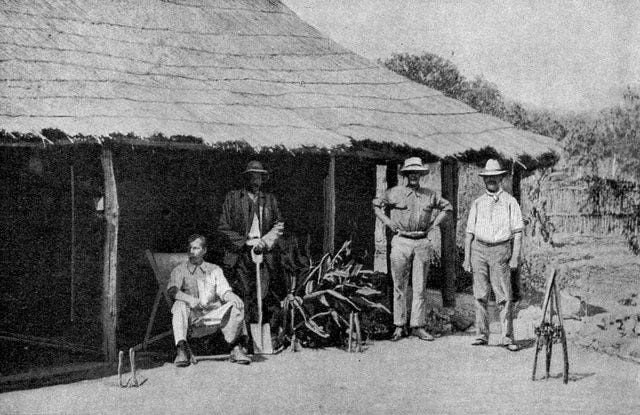
That is, sadly, not a problem unique to Zimbabwe given that African societies were riven by ethnic fragmentation and lacking any cohesive national identity - a recipe, as Studwell frames it, for democratic failure. Civil service posts became personal gifts, cabinet sizes swelled in proportion to the number of ethnic constituencies requiring appeasement, and state resources were treated as private spoils (the book reminded me of WaBenzi!). Attempts to dismantle traditional power structures largely failed; from Mauritania to Mozambique, central governments discovered they could not govern the countryside without chiefs. Patronage and economic rents became the currency of political stability, and the struggle for power grew so all-consuming that development itself was crowded out. By the mid-1990s, thirty-one African countries were simultaneously engulfed in civil war or acute unrest.
One question his land thesis left me with was: if European incursion so altered Africa’s land arrangements - and then froze them in place - what preceded it? On what trajectory was land distribution before the colonisers arrived, and what might it look like today had they never come? I have no tidy answer, only a sense that this was an extraordinarily difficult problem then, and remains so now.
The first complication is that “small landowners” is not a stable category in much of pre-colonial Africa - not because ordinary people did not farm, but because “ownership” looked less like a deed and more like a bunch of nested rights: to clear, cultivate, inherit, lend, graze, settle, or exclude, all mediated through kinship, community, and local political authority. Even Lugard - no sentimentalist, and not remotely embarrassed about empire - conceded how poorly this world fitted into the imperial imagination. In The Dual Mandate he records a Lagos chief insisting, very matter-of-factly: “We have power to dispose of the land; we cannot sell the land; no chief can sell the land.”
The British response was assertion and retreat in equal measure where they exercised control in principle but improvised in practice. Lugard's advice to Whitehall was festina lente - make haste slowly - and on land the colonial state often did not so much reform as dodge the question. Faced with the obvious impossibility of issuing certificates to millions of cultivators without staff or survey, the Colonial Office fell back on ruling through local authorities as nominal delegates of the governor. Joseph Chamberlain - a proponent of muscular imperialism and enthusiast for the forward march of empire - backed down when confronted with the land question on a Gold Coast (Ghana) bill aimed at encouraging individual proprietorship that met political resistance and was quietly shelved.
Was the old system better for ordinary cultivators (Studwell does not say this, it is me thinking aloud)? In some respects, yes because land regimes embedded in community can protect access for the many. In others, no because they can also empower gatekeepers and harden hierarchies. Either way, pre-colonial Africa was not a blank slate awaiting European change (for better or worse); it was already a live political settlement, contested and unequal in its own right.
If the complaint is that colonialism reshaped land in ways that later enabled post-colonial elites to inherit the spoils, then a mischievous implication follows: Studwell may be implicitly wishing for a colonialism that went further - not in extraction, but in forcibly dismantling local hierarchies and redistributing land downward - which is to say, a colonialism rather more expensive and interventionist than the 'low budget' version he elsewhere decries. This is not a defence of colonialism. It is a reminder that “fixing” land has always meant confronting entrenched power - and that neither colonial administrators nor post-colonial elites have rushed to volunteer for that fight. In today’s Nigeria, less than 5 per cent of land is formally titled, and the insecurity this creates isn’t confined to the poor: the World Bank notes that even private-sector investors face pervasive uncertainty around ownership in a system where only about 3 per cent of landmass is registered [PDF, page 11], reflecting a wider regional pattern in sub‑Saharan Africa where only around 10–14 per cent of rural land is formally registered.
Finally, education. Here Studwell is on solid ground. Colonial Africa was a genuine outlier: in 1960, literacy across Sub-Saharan Africa stood at just 16 per cent, there were perhaps 8,000 secondary school graduates per year for a population of 200 million, and the average African who attended school did so for a fraction of the time their South Asian counterpart spent in a classroom. Most colonial governments only began opening schools in earnest a decade before independence - too late to make any serious difference. What has always struck me, reading through colonial records and memoirs from Nigeria and the wider region, is what is conspicuously absent: the simple image of a colonial official visiting a school full of children. I cannot recall a single instance of it. District officers toured markets, adjudicated disputes, counted heads for tax purposes - but schools, where they existed at all, appear to have been beneath notice. Education was not even part of the administrative imagination.
Studwell rightly gives credit where it is due. Post-independence African governments, starting from the lowest educational base on the planet, moved the needle with remarkable speed. Tanzania under Nyerere raised literacy from 10 per cent to three-quarters in a single generation. Female literacy across Sub-Saharan Africa reached 48 per cent by 1995 - surpassing South Asia. University education expanded six-fold in three decades from a handful of institutions in 1960. By the mid-1990s, female secondary enrolment had climbed to 29 per cent in Ghana, 25 per cent in Kenya, and 17 per cent in Nigeria - countries where, at independence, the figure was close to zero. One may quibble with the quality of this expansion, and with how much of the progress has since stalled or even reversed amid economic crisis and state decay. But as a feat of political mobilisation and resource allocation, it was real - and it deserves acknowledgement.
The read-along continues next with Part II of the book, where Studwell turns from the constraints that have held Africa back to the places that have managed to buck the trend: countries that, against the odds, have got development meaningfully right.
- Feyi
The first part of the book provides what Studwell calls "the context" for most of what comes later. These are three chapters where Studwell analysed some of the initial conditions that explain Africa's economic trajectory. This approach helps him impose some discipline and structure on the analysis and also keeps him consistent with the adjunct goal of stripping narrative about Africa of romanticism and fatalism. However, I remain mildly vexed by the first part of this book - particularly by the overall tone. Africa might be neither promising nor hopeless, but it certainly does not need excuses either. It seems to me that Studwell treated Asia as a place with more agency, and rightfully praised countries that exercised policy autonomy to engineer growth. Africa, however, remains a "victim" of history.
Two minor things also bothered me. Studwell routinely downplayed corruption as a factor that held Africa back. However, he dedicated sections in the second chapter to analysing the corrosive influence of corruption, especially in the fiscal management of proceeds from natural resources. I did not mention this in my review because I think it deserves a separate, standalone essay. I suspect this contradiction was a deliberate accident, an outcome of Studwell's purposeful positioning of himself against what he considers the orthodoxy of policy advocacy on economic development. The second thing is education. Studwell considers the educational deficits of African states as the single most damaging inheritance of colonialism. I am pretty sure Feyi already covered this in his review. What I want to highlight is how this is also another one of Studwell's contradictions.
In his famous How Asia Works, and in many subsequent analyses since, Studwell has consistently talked about the "education myth" when comparing the developmental trajectories of Southeast Asia and Africa against Northeast Asian "Tigers" like South Korea and Taiwan. The Philippines, in particular, got short shrift from Studwell in How Asia Works. In the 1950s and 60s, the Philippines had the best educational metrics in Southeast Asia, with literacy and university graduation rates that far exceeded those of South Korea or Taiwan at the time. According to the standard "human capital" theory, the Philippines should have been the region’s leader. At the end of the Second World War, Taiwan had an illiteracy rate of roughly 45%. South Korea was similarly "uneducated" by modern standards. However, these countries focused on Studwell's "policy trifecta" (more on that below), which allowed them to leapfrog the Philippines. To be fair, Studwell never explicitly argued that education is not important, but rather that he views it as a lagging indicator and not a leading driver of economic take-off. This is why it feels rather strange to me to read him claim that the absence of good colonial educational inheritance was part of a coterie of initial binding constraints to Africa's economic take-off.
The second part of the book focused on African economies that Studwell believes deserves mentions, and exemplifies his underlying thesis, which I think warrants restating. Studwell believes economic development happened in Asia (which he apparently believes can be replicated elsewhere) because of three policies. The first is radical land reforms that destroy landlord power, increase productivity of smallholder farmers, raise rural incomes, and create domestic demand. Secondly is a state-led manufacturing drive and export discipline. The third policy is financial repression that channels capital into industry. Part 2 of the book tests how far the African states he spotlights can approximate this sequence, and what failure looks like when they do not.
Chapter 4 opens with Botswana, which Studwell framed as Africa’s most notable developmental anomaly. While much of the continent struggled with instability, Botswana maintained a continuous multi-party democracy and achieved one of the world's highest economic growth rates between 1966 and the early 2000s. Studwell characterises this as a "meritocracy" - where the state functioned with a level of honesty and efficiency rare in post-colonial Africa. Botswana's achievement is political, for it solved the basic post-independence problem of building a stable coalition for national development.
The "success" of Botswana was also rooted in history. At independence in 1966, Botswana was among the poorest countries on Earth. It was landlocked, largely arid, sparsely populated, and dependent on subsistence cattle farming. Infrastructure was minimal; there were fewer than twenty university graduates in the entire country. By conventional measures, Botswana appeared an implausible candidate for success. What distinguished Botswana was not its starting wealth but its "institutional inheritance". Unlike much of Africa, Botswana had not experienced intensive low-budget colonial extraction. The British governed it as a protectorate rather than a settler colony and invested little, but they also disrupted little. Pre-colonial Tswana institutions, especially the kgotla (a deliberative assembly), survived with their legitimacy largely intact. Studwell emphasises that Botswana entered independence with unusually cohesive elites, a relatively homogenous population by African standards, and a political culture that accepted rules and restraint. These conditions did not determine success, but they made certain policy choices politically feasible.
Botswana's economic growth was built on diamonds, which were discovered shortly after independence. Studwell was very explicit that Botswana's economic performance was not driven by diversifying its resource-dependent economy towards industry, but rather by its exceptional management of rent from this natural resource. The government negotiated joint ventures with foreign firms, most notably De Beers, that ensured substantial state ownership and revenue flows. Unlike many resource-rich African states, Botswana did not allow mineral wealth to be siphoned off by foreign companies and their domestic cronies. The government also avoided reckless spending, hyperinflation, and debt accumulation. Revenues were saved, invested in infrastructure, and used to build a competent civil service. Fiscal discipline became institutionalised rather than sporadic. But Studwell argues that this development model has limits that cannot be ignored.
His primary criticism is that Botswana’s elite ignored the smallholder-led agricultural revolution. Rather than supporting high-yield family farming (the Asian model), the government focused on large-scale cattle ranching, which benefited the elite but provided minimal employment for the broader population. The government also did not use its diamond wealth to force the creation of a competitive industrial sector. Consequently, Botswana remains an "enclave economy," where the mining sector generates vast wealth but creates very few jobs, leading to chronic structural unemployment and extreme inequality. Overall, the tenor of Studwell's critique of Botswana is that growth is good, but development is about structural transformation of the economy to industrialisation and high productivity. This seems very agreeable to me, and anyone observing what is happening in the diamond industry will acknowledge the limits of a resource-based growth model. But reading this chapter also made me optimistic about Botswana.
Part of the lore of Studwell's fame is that his description and policy proposal for what works in development stands against the supposed orthodoxy in economics. So it was interesting to read him write about Botswana and contrast it with another popular book on economic development, Why Nations Fail by Nobel Prize winners Daron Acemoglu and James Robinson. In that book, Botswana was a shining star and an unqualified success story. They argue that Botswana succeeded because it developed inclusive political and economic institutions. The post-independence leadership, led by Seretse Khama, maintained traditional Tswana institutions that emphasised consultation and constraints on the power of chiefs, which then evolved into a stable, democratic state. They suggest Botswana was fortunate that British "low budget" colonialism was so hands-off that it didn't fully destroy these indigenous participatory structures.
This institutionalist view gets criticised as too simplistic. And one clear conclusion Studwell could draw (my words, not his) is that Botswana could have been slightly more corrupt, with slightly more chaotic politics and achieved far more remarkable economic success if it followed his prescribed policy sequence. But this conclusion would not persuade me. My reading of Africa's post-colonial economic history suggests poor growth performance owes more to cyclical political distortions than some of the emphasised structural and historical factors. This leads me to believe that although the recipe for better economic performance cannot be as simplistic as "good institutions", the successful implementation of any particular policy sequence is dependent on institutions more than Studwell is willing to admit. For that reason, the institutional resilience that Botswana has shown over the past six decades proves to me that it has a better chance of adapting and keep climbing the development ladder.
Next week, the read-along continues with the story of Mauritius and how Studwell thinks it has fared.
- Tobi
![How Africa Works [Chapters 5 - 6]](https://substackcdn.com/image/fetch/$s_!uXNs!,w_140,h_140,c_fill,f_webp,q_auto:good,fl_progressive:steep,g_auto/https%3A%2F%2Fsubstack-post-media.s3.amazonaws.com%2Fpublic%2Fimages%2F619ddab2-cbc0-49f4-8447-4086d15bf16c_880x460.jpeg)

Thoroughly enjoying the read-along reviews thus far. From Tobi’s tone, he appears more irritated by Studwell’s relatively gentle treatment of certain factors in the book. I understand where he is coming from. He expected the same intensity and analytical rigour that defined How Asia Works to be present in this book as well, and in his view, Joe did not quite deliver that standard.
This review led me to reading your "Silly thoughts on monarchies and democracies".
Your hypothesis that African empires might have arrived at more stable government/institutions if the Europeans had not intervened is interesting. We would never know.
If one applied the thesis as is, ie. empire consolidation can lead to stable governments, what about the British, rather than the Oyo empire, for instance, colonising its neighbours renders the mechanism inoperable?