

A slightly unusual story here in that it begins in Ghana with a Ghanaian. But our protagonist spends almost all of his working life in Nigeria before retiring to Ghana.
Unless something changes (I have a few half-finished profiles where I have run into dead-ends trying to get more material), this is the penultimate chapter of the book (somewhere around 70,000 words so far!)
This chapter is free to read
Introduction: The Parrot’s Work
Chapter 3: Audu With The Big Belly (no paywall)
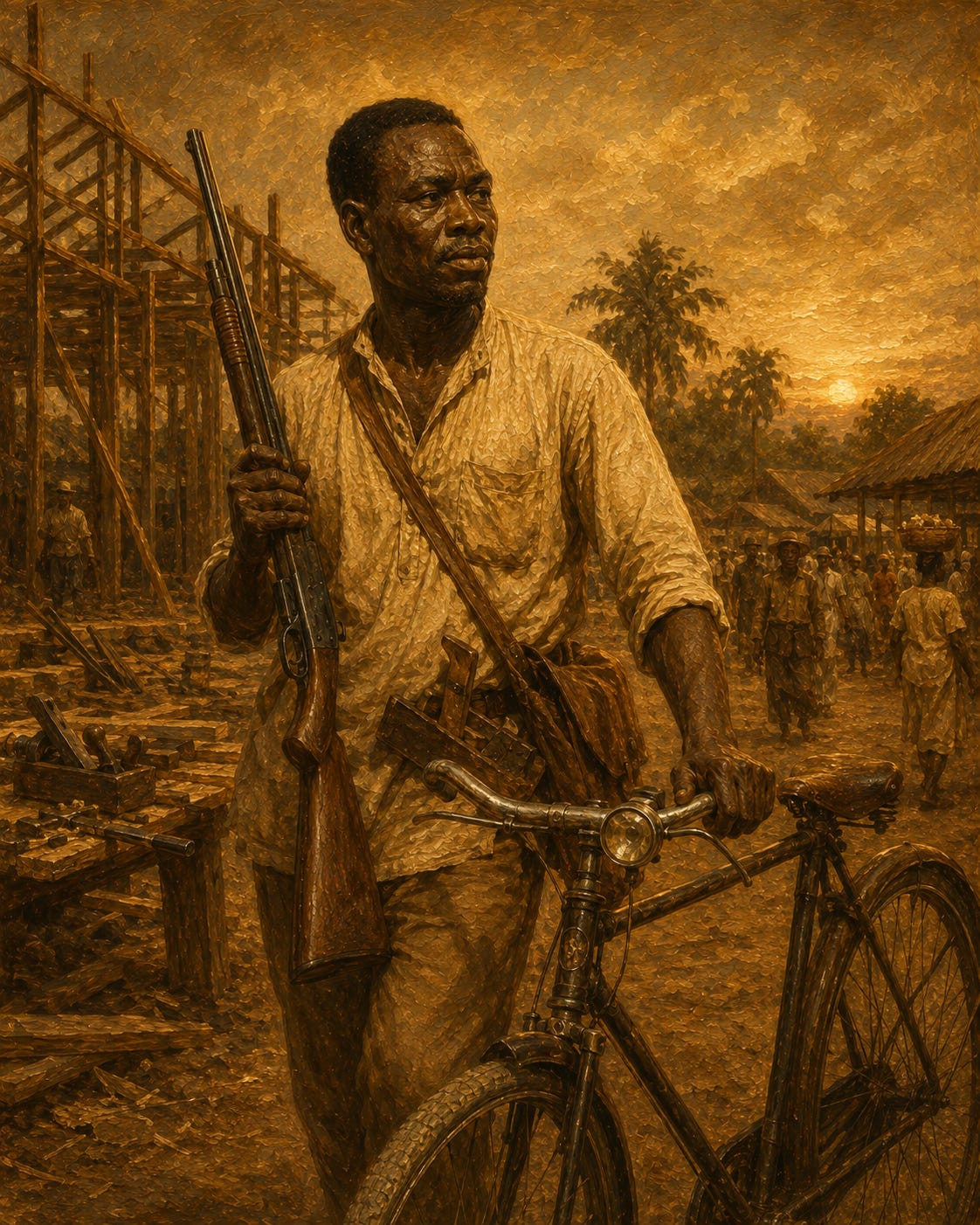
At Okwo Nebo market, fifteen miles out from Abakaliki, the day’s trading was over and the crowd had reduced as it was evening. In one corner of the emptying square a group of eight or ten men had let an argument spiral out of control, and so out came the machetes. The man who saw it happen was standing beside a half-built shed, where he had been putting up a machine house for a cotton gin. He watched for a while, taking its measure, and then decided to go in.
He picked up his shotgun, got onto his push bicycle with the gun held in his right hand, and rode straight into the fight, shouting for his two Afikpo labourers to come behind him. He threw the bicycle down when he reached them, waded into the middle of the men, slapping faces, and pulled three machetes out of three pairs of hands and arrested four of the men. Three others were already on the ground with their bellies opened and their intestines showing. He wrote a hurried note detailing what had happened and sent one labourer off on the bicycle to hand it to the District Commissioner at Abakaliki while he tied up the four prisoners at the shed.
That night, after dark, an old man came to the shed with a group of men and four hundred rods - ten pounds - because one of the tied men was his son. This was Chief Adagba, a warrant chief of Amasaka, and the son was called Eleh. Adagba asked that the money be taken and the men let go. It was refused. The old chief was told that if he were not so old he would himself be reported for offering it. In the morning three policemen and a lance-corporal came out and marched the four men to the station, where they were tried and given nine months imprisonment each. Their people carried the three wounded men away. The man later learned that a local practitioner had managed to save them.
The man with the shotgun and the bicycle held no rank in the police. He had no warrant to arrest anyone and none to turn away a chief’s money. On the establishment of the government of Southern Nigeria, against his name, stood two words. He was the District Carpenter.
I
There is no paper record anywhere that says when he was born. The date came from his father - Thursday, the 29th of July, 1887 - and there is no way to check, because that particular day in that particular year fell on a Friday. He was born at Elmina, on the Gold Coast, in the old town under the shadow of the Portuguese castle the Dutch had taken and the British had bought, and in the Fante custom he was given the name of the day: Ekow, a boy born on Thursday. His father, Cudjoe Adjaye, worked as a trained carpenter. He died while the boy was still small, still at the Wesley School the Methodists ran in the town, and already given over as an apprentice to another carpenter, a man named Kwesi Assampah.
Assampah did not keep still, and so neither did the boy. The two of them went west along the coast into French territory - to Grand Bassam on the Ivory Coast, then down through San Pedro, Droway and Sassandra on the Kroo coast, where the great canoemen of West Africa came from, and back again. At Grand Bassam the master was posted inland and left the boy behind in the keeping of a cousin, and the cousin, “for the love of money,” put him into a French government blacksmith’s shop, and then aboard a government boat called the Maddigow as an engine-boy. The engineer over him was a Senegalese named Momadu, a Muslim, whom Cudjoe remembered half a century later as “a very kind man.” The engine-room job brought him five French dollars each month.
Momadu wanted to keep him and teach him engineering as a trade. Assampah, coming back from the interior, wanted him home, and would not yield, for if he returned to Elmina without the boy, the grandmother would take it that the boy had died. The old master won. The epidemic that then broke out at Grand Bassam, and held the two of them there for two months before they were let go, was in all likelihood yellow fever. The town was a byword for that one disease above all others; the fever emanated from the lagoon and its swamps so regularly, and killed so many, that the French had already begun abandoning Grand Bassam as their colonial capital and were shifting the seat of government inland to get away from it. When at last they reached Elmina it was “only to experience the hardships of life.” Assampah, who had seemed hale on the whole journey home, died two days after they landed. The boy was on his own again, and comforted himself with the flattest proverb he could find: “what cannot be cured must be endured.”
This was the season of the last British war in Asante, and the war is the reason the roads out of Cape Coast were suddenly full of paid work. The Asante kept a Golden Stool that held the soul of their nation, and no one, not even the Asantehene, sat on it. In the spring of 1900 the governor of the Gold Coast came up to Kumasi, demanded a heavy yearly tribute in gold, told the assembled chiefs that their exiled king would never be restored, and asked them to bring out the Golden Stool so that he might sit upon it. They gave him no answer and left. They kept the governor and his wife and a few hundred defenders inside the Kumasi fort; the siege ran for months, through famine and disease, until the governor’s party cut its way out through a stockade and a relief column fought up the muddy roads in the height of the rains to break in. When it was counted afterwards, The War of the Golden Stool had cost over a thousand lives, most of them African. At the end of it Asante was annexed outright.
The relief of Kumasi had depended on carriers as much as on soldiers: the roads were deeply muddy in the rains, food could not be obtained locally, and a column could only go as far and as fast as the men on its supply line could haul its goods. Carriers by the thousand were recruited for it, and a great many did not come back - of the campaign’s dead, far more were carriers and African soldiers than Europeans, though there was no exact count. Into this Chief Coker of Cape Coast was recruiting for the government, and Ekow, an orphan leaning on an old grandmother, went and enlisted. He carried military material up to Prasu, five days to and fro, for half a crown in ration money and ten shillings on his return; then a longer haul, ten days to Kumasi itself, the Asante capital, for twenty shillings. Thirty shillings in total. His grandmother, Amah Abokumah, added a few pounds to it, and with the sum he bought a set of carpentry tools. He carried the tools to Sekondi, found a European building contractor who would take him on at three shillings a day, and worked for three months.
Then he heard that at Elmina carpenters were being drafted for a place called Nigeria.
II
News reached Sekondi that recruiters at Elmina were assembling a party of carpenters for Nigeria. Twelve tradesmen, supervised by a headman, sailed from Cape Coast and reached Old Calabar a week later, on 29 October 1902. They started in the yard of the Public Works Department and moved from there onto a set of new barracks going up on the waterfront - the buildings that would become the headquarters of the Nigeria Regiment. The government’s own report on the year notes that “the construction of new barracks at Old Calabar was begun.”
They had come into a country the British had only just finished taking by force. The year before, a field force had gone up against the Aro, the trading and oracle power whose reach ran across the whole of the south-east, and had burned their way to the shrine at Arochukwu. Trade, which had reduced at the rumour of the expedition, was reviving as the carpenters landed. The barracks they were building at Calabar were the barracks of the expedition army. When they were sent inland in 1903 - by boat through Akassa, Brass, Opobo and Equanga, where they were stopped and made to work for some months before being allowed to go on - they were travelling into territory that had been fought over in the previous eighteen months, to build the houses from which it would now be governed.
At Akwete they were met by the District Commissioner, a man named Sproston, whom Cudjoe would meet twice more down the years - each time both of them a rank higher, the Gold Coast carpenter rising alongside the imperial officer. Sproston found them carriers, and they went overland to Aba, then “thick bush,” held by a single company of the Regiment. On a patch of cleared ground, in palm-leaf shelters run up to house them, they built the first District Commissioner’s bungalow at Aba. The house was still standing when Cudjoe wrote his account fifty years later.
From Aba the party went to Owerri to build another bungalow, and Cudjoe and a fellow named Ashun were sent ahead to Owerrinta to build a pontoon ferry across the Imo River - a day’s journey up-river by boat from Akwete, then transferred to a paddled canoe, then two months building the pontoon, then across and along the trace of a new road being cut to Owerri station. The District Commissioner waiting for them at Owerri was H. M. Douglas, “Handsome Douglas,” or as he was later known: “Black Douglas.” He was “a hard man”. He could afford to; he was a stranger passing through with a trade, not one of the governed.
His superiors praised his performance during the Aro expedition, and in May 1902 he was rewarded with the new District Commissionership at Owerri. What that meant on the ground was road-building by forced labour, courthouses and rest houses thrown up under compulsion, chiefs and elders seized and held as hostages to guarantee the good behaviour of their people, and whole towns burned when a district would not bend. In one campaign after a British medical officer was killed in a mistake for Douglas himself, villages were wiped out and, by the accounts that survive among the people there, some of the dead were buried alive. Even other Europeans in the service found him hard to stomach.
In September 2025, Chisom Ojukwu, the member for Nkwerre constituency, asked the Imo State House of Assembly to remove Douglas’s name from Owerri’s principal road. He listed the accusations against him - compulsory labour, collective punishment and the destruction associated with Eziama, Norie and Ahiara - and argued that the state’s major landmarks should commemorate its own people rather than its colonial officials. The House approved the motion and instructed the relevant agencies to alter the signs and public records. Its chosen replacement was not one of Douglas’s victims but the incumbent governor: the road became Governor Hope Uzodimma Road. Supporters described the change as recognition of Uzodimma’s performance while he was still alive. Douglas House, a short distance away, kept its name.
When the Owerri house was finished, Douglas called the chiefs and the people in to see what the strangers had built in their country. They came in their numbers, men and women, and were sent up to walk through the whole house. The women danced round the verandah and sang, and Cudjoe wrote the song down, in Igbo and in his own English underneath:
Greetings you good people, Ah! Ah!! Brothers, men of Accra, greetings to you.
He worked next at Uyo, Ikotobong, Afikpo and Ikom, as the bungalows of those stations went up one after another; a commanding officer of the Regiment came through Owerri to inspect the troops and the new house while it was still drying; a marine officer who met the pontoon party at Owerrinta would end his career as Director of Marine at Lagos. Everywhere Cudjoe went, the fabric of a government was being nailed together out of imported timber and imported skill.
The wage the coastal carpenters and clerks earned did not stay in the country where they earned it. The government record for 1903 noted a rise in the money-order business at Old Calabar and put it down to “the native clerks and artisans taking greater advantage of the money order system to remit money to their families on the West African Coast.” The men who built the stations were strangers passing through, their families a week’s sail away at Elmina or Cape Coast or Freetown, and the wages they were paid travelled back down the coast by postal order to grandmothers and wives who would never see the houses their sons and husbands had built.
He went back at last to Old Calabar, and was then sent inland once more, further than before. He reached Abakaliki as District Carpenter on the 15th of May, 1909.
III
The station he came to was in the middle of a slow, ugly change of state - from a place held down by soldiers into a place run from an office - and the change was not gentle. The government’s account of that year, surveying the Southern Provinces, complained that its workshops could turn out engine-drivers and fitters and joiners and carpenters but could not find enough trained men to teach the trades. There were not enough like him. The same account records police detachments sharply increased at Abakaliki and Ikom to take the place of military garrisons that had been pulled out for good; the telegraph pushed up through Afikpo towards the station and government jurisdiction spreading wide across Abakaliki, Ogoja and Ikom.
A few months after he arrived, during a visit by the High Provincial Commissioner, Cudjoe was granted a shotgun licence for five shillings, valid for five years. Four years after that he shot his first bush-cow - not with the shotgun but with a rifle a Regiment captain had given to his brother Afan, who would die at Ogoja in 1924. He had become a carpenter with a gun, a bicycle, direct access to the officers, and two labourers of his own to send where he liked. He was no longer, in any working sense, only a carpenter.
IV
And so we return to the market at Nebo: the gin-shed, the four men tied up beside it, the old chief arriving out of the dark with his people behind him. It happened in those first years at Abakaliki, while he was still District Carpenter. A push bicycle, which in that country was like a private motorcar. Two labourers who would follow him into a fight. The ability to write a note that a District Commissioner would read and act on within hours. And enough working knowledge of police and court routine to be sure that four tied men at a shed would produce three constables and a lance-corporal by daybreak. Chief Adagba read the situation and came with four hundred rods to a man he had understood to be a gate to the attention of the government. A warrant chief of the district judged the District Carpenter to be worth ten pounds of his own money and the risk of asking.
The note had already gone down the road by the time he reached the shed, and the four men would be tried at the station and given nine months apiece on the strength of what one man had seen and written down. There was no other account of that evening that the government was ever going to receive: no officer had been there, and nothing that happened at Nebo would reach Abakaliki except through him. Adagba came with four hundred rods to the holder of the only version.
V
In August 1914, still carrying the title of District Carpenter, Cudjoe was sent a telegraph by a Colonel Muir and told to come to Ikom, where the headquarters of the Cross River Expeditionary Force then were. The war that had broken out in Europe that month had an African front along the Cameroons border, a few days’ march to the east, and the Force was one of three British columns pushing into German territory - one attacking from Maiduguri in the north, one up the Benue from Yola, and this one from Ikom on the Cross River. It was a large undertaking for a colony that had just been stripped to feed it: forces stronger than a thousand African soldiers and their officers had gone to the Cameroons, and alongside them close to a hundred civilians pulled out of government departments and the trading firms and attached to the columns for whatever they could do - railway work, political work, and the ordinary business of building and mending that any army in the bush cannot do without. That was how a District Carpenter came to be standing on the German frontier with an expeditionary force. He was attached to it as a useful pair of hands, and was still at Ikom when things went wrong.
On 6 September, a much larger German force overwhelmed the British position at Nsanakang after the defenders exhausted their ammunition. Roughly half the British contingent was lost, including eight of its eleven officers, and the survivors retreated across the border. The defeat briefly allowed German troops enter into Nigeria and gave substance to rumours that British authority was collapsing. Cudjoe narrates the same events from the deck of a boat. “Judging from the bodies floating down-stream, it was a terrible disaster.” A week after the fight, going down towards Abakaliki by way of Obubra on a boat called the Bansara, he counted them himself as they came down on the current: “about 15 or more.”
Nigeria had been stripped almost bare of soldiers for the war, its administrative staff thinned out by the officers who had gone off as volunteers, and the government relied heavily on the men who were left “to maintain order and dispel false rumours.” The rumour running everywhere along the Cross River that autumn was that the British had been beaten and would soon be gone, and the Germans would take the country. The District Officer at Abakaliki, F. H. Ingles, who would later become Resident of Owerri Province, recalled Cudjoe from the Cross River Expeditionary Force. Back at the station, Cudjoe took up a probationary appointment as District Interpreter on 1 October 1914; the change of department became permanent at the beginning of 1915.
VI
Describing the Native Courts of the Southern Provinces, the 1914 colonial report admitted that they had fallen largely under the control of two men each: the Native Court clerk - “an alien to the district on a low salary” - and the interpreter. It was written as a lament about a hybrid institution but it is a plain description of where the power in a Native Court really sat. The court belonged, on paper, to the warrant chiefs the British had appointed. In practice it belonged to the literate stranger and the man who understood more than one language.
That was an arrangement built for abuse, and it was abused. The warrant-chief system rested on a misunderstanding the British never quite cleared up: in much of the south-east there had been no chiefs to speak of before they arrived, no kings and few standing rulers, and so they made some, handing warrants to men they found convenient and calling them chiefs. Native Courts became notorious for turning official authority into abuse of power and position. Arbitrary penalties generated income; office could be used to coerce marriages; and compulsory labour was diverted to the farms of chiefs and court officials.
As we have seen multiple times in this book, translating speech was the least of what the interpreter actually did. He explained a law the people had never heard of, and reported the rumours the officer’s ear could not hear. He read a drumbeat, or a silence, or a sudden movement in a crowd, and told the officer what it meant. He made the written record that everything afterwards would rest on. And - this was the part that divided a good interpreter from a dangerous one - he knew when to say that he did not know. It was an office of knowledge that fell on people as arrests and sentences. A man who wanted to could sell a verdict from that office. Cudjoe, on the evidence he left, did not; but the office and the power in it was real.
In 1915 Cudjoe accompanied R. H. J. Sasse, the District Officer assigned to the police patrol sent out after Chief Endor of Negarabi Igbo Ekureka was killed. The operation ended with the capture of the head chief, Ogbuenyi Kama. In the proceedings that followed, Adoki was sentenced to death, while Kama and several others received sentences of penal servitude. That is his entire record of the case - he gives the outcome and not his own part in reaching it. The interpreter through whom the arrest and the evidence and the sentence had all been carried does not appear anywhere in his account of them.
VII
In February 1916 Cudjoe went out again, with a political officer named Dann, on a patrol against the Ezza, commanded by an assistant commissioner of police named Cavendish. The patrol expelled the Ezza settlements from the Oshiri bank and forced their inhabitants back across the Western Aboine River. Here, in the middle of an account that has been all dates and marches and postings, Cudjoe gives us his own verdict:
In my personal experience I should say this was an awful injustice on the part of the Government against the Ezza tribes.
His reason is not that fighting is wrong, or that the strong should not beat up the weak. The Ezza “had conquered and established themselves on the land before the white man ever opened up the Cross River.” They had built compounds across the field near Onicha towards Uburu before the patrol pushed them back over the river; some had gone through Uburu and settled beyond it, near Nkerefi under Agbani and at Ihenu. On the grounds of established occupation, standing compounds, a settlement older than the government that was now undoing it, he judged the British to be the trespassers, and said so decades later.
Cudjoe’s appeal to prior conquest made sense within an Ezza political culture in which possession had to be made visible and defended. Land acquired by war, labour or military service became permanent through settlement and covenant. The Ogbu Ezekuna fig tree marked some of those agreements and an attack on it challenged the settlement itself. Military preparation was embedded in male initiation and the age-grade system, while farming supplied both the reason for expansion and the means of recovering from its costs. Every Ezza boy, once he had been circumcised, was handed two things: a gun and a hoe.
This type of life came with costs, and the Ezza paid it. Their own accounts remember them living warily even on ground they had won, braced for the reprisal from the people they had conquered. The land Cudjoe watched them driven off was land of exactly that kind - taken, held, farmed, and never quite safe. The particular quarrel he walked into on the Oshiri frontier had been running, on and off, for the better part of a generation before any British officer arrived to have an opinion about it: a long fight over a stretch of ground along the river that the Ezza had set their hearts on and, in the end, largely taken. When the patrol pushed them back across the Aboine, it was reversing, with a machine gun, the last move in a war the Ezza had been winning.
The government record for 1915 lists the Ezza patrol among the only three in the Southern Provinces that year “of any importance or considerable duration” - the other two were against Okigwi and Okwoga - and reports that all three were “brought to a satisfactory conclusion.” The record for 1916 establishes a police patrol in the Ezza country that produced “70 casualties amongst those people” and “a fine of £750,” imposed and paid. Between “satisfactory conclusion” and “awful injustice” lies a distance between the officer writing up the report for London and the interpreter who had stood in the field and watched it done.
The Ezza, for their part, wanted the government gone from Abakaliki, and told the interpreter so more than once. Their feeling was expressed in a saying he recorded: “since the white man have [sic] come out, men have become women, and women the men.” Without the white man in the way, they reckoned, they could have finished driving the Izzi across the Ezekwe River into Ogoja and taken the last of the land they wanted. Chief Okanu Opehu of Umu Ohara asked Cudjoe outright, on several occasions, whether he could find some way to help remove the government from the station. His answer each time was the same: “Impossible, the white man has come to stay as long as men lived.” Meanwhile he rounded off his portrait of the Ezza thus: “very good people, very slow to pick a quarrel, but if you do fall out with them - woe betide you.”
VIII
From 1913, attacks repeatedly disrupted the route between Abakaliki and Obubra, forcing the administration to escort its mail and carriers. Cudjoe also alleged that Ikwo fighters mutilated some of the bodies carried downriver after Nsanakang, prompting officials downstream to organise their recovery and burial. Wartime rumours intensified the hostility and it was an interpreter’s job, as much as a soldier’s, to know how far it had spread and what it was making people do.
Nearly four years into the war in Europe, Cudjoe left Abakaliki on 21 January 1918 with a Nigeria Regiment column bound for Ikwo. The machine around him was substantial: nine patrols and sixteen escorts across the Provinces employing thirty-six officers, fifteen British non-commissioned officers, and 1,381 African infantry, with a detachment of artillery - and “the Ekwi patrol in the Abakaliki district” among the most important of them. This large, expensive, well-gunned operation rested, at its sharpest moments, on one man’s reading of noise coming out of the bush.
The Resident of the province, Copland Crawford - the “Old Man,” who had come along “to see for himself what the Ikwos would do” - sent three friendly chiefs, and eight young Ikwo men who had been picked up near the station, to carry word to the clan that the troops meant no harm and wished only to talk. The emissaries returned the next day without an agreement. The Ikwo, they reported, denied any wish to fight but would neither attend the proposed meeting nor enter into discussion. Crawford and his officers read the answer as defiance. The column had camped a couple of miles from a police post set up on the Ezza border to keep the mail moving safely to and from the station, and every few days an escort had to go down and collect it. Three days after the refusal came back, the platoon sent for the mail was ambushed as it passed through a village called Ohanku; the troops fired volleys into the bush to frighten its owners, brought the mail in, and fell back to camp. A week or so later a Major Lawrence came up with three more companies of soldiers, at which point the column moved on Igboji, the centre of the Ikwo country.
It was on a march out from the camp, half an hour in, that what others thought of the interpreter began to reveal itself. The signal drum began sounding up and down a long belt of bush across an open field. Major Lawrence asked Cudjoe what all the noise meant. He answered that it was calling the people to assemble, “but whether for attack I could not tell.” A woman was brought in, strongly built, about forty, arrested with a man who had dropped his gun and run. The Major put the same question to her. She was not helpful in the direction he wanted; she told them, in effect, that the Ikwo were waiting in the bush opposite and the soldiers should come across and meet them. The Major sent back a message that he would give the clan up to four days to come to him at Igboji, and told her to carry it or go. She went. Minutes later, men burst from the bush to cries of “Ikwo hayi, Ikwo hayi.” They advanced until, at roughly 150 yards, gunfire began on both sides. Cudjoe remembered the effect of the troops’ volleys in a phrase as brutal as the scene: “the Ikwos dropping down like flies.”
That evening Eze, an Amuda Ezza man serving as one of the patrol’s guides, warned Cudjoe that the camp would be attacked after dark. Cudjoe was sceptical. The Ikwo had suffered heavily that morning, and another assault did not make sense to him. Eze insisted that the losses would not deter them: because the troops had not taken the heads of the dead, the fighters would return to avenge them by killing a white officer - or an interpreter. Cudjoe carried the warning first to Dann and then to Lawrence. Asked for his own judgment, he admitted that this was his first journey into Ikwo country and that he could not know what its people would do. The officers discounted the warning but kept the camp alert.
After nightfall, rain and darkness closed over the camp before gunfire, drums, trumpets and shouting broke out on every side. Captain Collins came to Cudjoe’s hut with a lamp, calling, “Interpreter, Interpreter.” Cudjoe was awake on his cot but feigned sleep until Collins touched the bed. The officer wanted to know whether the music announced an imminent charge. Cudjoe refused to turn the sounds they were hearing into any kind of certainty. He said only that the drumming and singing were keeping the fighters from retreating and showed that “they meant business.” Collins instructed him to report any change in the drum pattern and left. Cudjoe returned to bed: “The night was too dark, and to go out during the rapid firing was inviting trouble.”
Two quiet days followed. On the third morning the Ikwo attacked in daylight, advancing beneath cut branches and firing from around 150 yards. Cudjoe called the exchange “a fine show but a waste of precious lives.” During the fighting, Wilton’s men worked around an ambush beside a dried stream and struck it from behind; Cudjoe later understood that many of the Ikwo war leaders had died there. That night, soldiers and officers from the colonial column returned to the site. Cudjoe says they gathered the Ikwo dead, cut off their heads and raised separate mounds over the bodies and the heads.
About a week later three light guns joined the expedition. Organised resistance then collapsed, and the operation became a pursuit across the surrounding country. Cudjoe’s language fractures at this point. He had called the fighting a waste of life and lamented the scale of the Ikwo losses, yet described the men resisting the column as “foolish brutes” and “senseless brutes.” The pity and contempt sit beside each other because his safety lay with the armed column, even while he could see what that column was doing.
At Nsobor, delegates from across Ikwo agreed to peace terms. These included a collective fine of £3,000, due within twenty-one days, and the original company remained behind to oversee its collection. Payment was nearly complete when Lugard reduced the penalty to £1,500. Dann’s reply was written down by Cudjoe: “Reduction reduces me to tears. Dann, Abakaliki.” Any amount collected above the revised figure was returned. Cudjoe closed the episode with a reckoning: it was “a pity” that the Ikwo had sacrificed so many of their young people without inflicting a single casualty on the troops.
IX
One night in 1918, lightning ignited the barracks at Abakaliki. A soldier’s wife and her young daughter died in the blaze. The next morning Chief Okanu Opehu - the same Ezza chief who had asked Cudjoe about removing the government - came to the station, took Cudjoe’s hand, and, still holding it, said: “Urubot” - Robert - “things are moving well.” Cudjoe, confused, asked what the matter was. “Ezeke Una, the Founder of the Ezzas, is not asleep.” Cudjoe laughed, and the chief hushed him: there was no joke about it, the white man was about to go, could he not see that the white man had begun to burn down his own houses? Cudjoe explained the lightning. The chief would have none of the explanation, because it ran against what his diviners had told him. Two accounts of one fire - a discharge of electricity in a storm, and the founder of the Ezza stirring in his anger against the government - and the interpreter standing between them, able to translate every word from the one into the other and unable to make either man’s idea of cause fit inside the other’s head.
The first sitting at Achiagu in 1919 quickly exposed the distance between the procedure Dawson had taught and the court the community made from it. He formally opened the institution, demonstrated one case and returned to the station. Three days later, its messengers delivered roughly eighty convicted people to Abakaliki. Dawson, badly annoyed, sent them straight back and went out himself to review the cases, taking his seat without so much as greeting the sitting members and rebuking them to their faces: the court had not been set up so that the Ezza could send all their undesirables down for the government to feed. Then he opened the record book, found three men charged with stealing a cow, and decided to save them, telling them there was no evidence and asking whether they had really been caught with the animal. Their entire defence was this: “Do you want us to tell lies? We did steal the cow and we have sold it.” He condemned them and had them taken out. He called a second case - five men, another stolen cow - and warned them the last three had been fools. He urged the next set of defendants not to repeat the first group’s mistake. The reward for his trouble was: “We have sold the stolen cow to a stranger whom we cannot trace.” At which the whole court burst out laughing, and Dawson got up and walked out and ordered the lot sent to Abakaliki.
The government’s own report of 1914 had said the courts belonged to the clerks and the interpreters; this is what that admission looked like in practice - an institution that ran only because someone could stand in the middle of two incompatible ideas. Cudjoe stood in that middle for the length of his career. The Ezza in the dock, he noted, would insist on their guilt even against weak evidence, and go smiling to their deaths rather than lie about whether they had done the thing they had been accused of; a stranger, he says, might take them for fools. “Fools, eh?”
X
Cudjoe reached his new posting at Afikpo on 13 December 1929, just as the disturbances had begun in the area. He was following an instruction left for him to join an assistant district officer on tour, and reached the Afikpo Road just as the disturbance did. This was the movement that ran through the whole south-east that winter - thousands of Igbo and Ibibio and Efik women, convinced that the government meant next to tax them as it taxed their men, rising against the warrant chiefs and their courts and, before it was put down, pulling the whole apparatus of native administration off its foundations across the region (more on this to come in the next chapter). It was the largest thing of its kind the colony had seen, and it is why the warrant-chief system that Cudjoe had worked inside for fifteen years did not outlive the decade.
The Ishiagu women joined with women from Okigwi and neighbouring divisions; troops came down from Enugu; arrests were made. Many Ishiagu women were taken, tried, and given six months apiece, with twelve months for two named as ringleaders. By his account, the unrest within Afikpo Division was confined to Ishiagu and Okposi.
The Riots from my personal experience were an unfortunate game played by the men of the affected villages and clans who thought they could incite the women with all sorts of false stories so as to get tax stopped altogether in the country.
Cudjoe believed that men had exploited an assumption that troops would hesitate to use lethal force against female demonstrators, turning the protests into an indirect campaign against taxation. It is also the limit of what his position allowed him to see. The women who had come out across five provinces to bring down the courts do not appear in his page as people with a politics of their own; they appear as an “unfortunate game” that other men were playing.
On tour at Okposi with a District Officer named Chapman, at about nine at night, a middle-aged man walked out of the dark towards the rest house crying “Ogbu’m, Ogbu’m - I am killed, I am killed” - with a wound laid open across his stomach and his intestines showing. The steward and the boys came out with a lamp, got close enough to see the state of him, shouted, and ran. Chapman came fast to the court where Cudjoe was staying, calling “Robert! Robert!” and the two of them worked over the man together with the District Officer’s own blanket and towel and brandy and tinned milk - Chapman saying “we must try all we can to save the man’s life,” unsure whether to push the intestines back in or leave. Chapman admitted that his abandoned medical training had not prepared him for a wound of this severity. They got the man into a hammock and sent him off under escort towards a mission hospital five miles away, and word came back later that he had died near the hospital compound. The killer turned out to be a madman, later found hanged on a tree.
Chapman later thanked Cudjoe in writing. Cudjoe’s response is more revealing: because he was African, he believed the gratitude should have travelled in the opposite direction. Real grief for the wounded stranger, real regard for the officer, and underpinning both of them the trained reflex of someone who has learned where he stands, and who presents his own gratitude the right way before anyone has to correct him. He could call the Ezza patrol an awful injustice and, in the same career, miss the women of Ishiagu entirely. He could grieve a stranger through the night and, at the end of it, apologise for being thanked.
XI
On a Sunday in April 1945, Cudjoe borrowed a rifle and ten rounds from the District Officer, Cardale, having run out of ammunition for his own. He joked that success would oblige the administration to lend him a vehicle large enough to recover the carcass. Before dawn he sent a driver and a hunter ahead and followed on a push bicycle, crossed the Cross River by canoe, and spent the day tracking bush-cow through mud two feet deep, and killed two of them. Villagers came in scores to drag the animals down to the water and float them to the beach; the officers rode down in their cars to see; the truck came behind to carry the beasts up. By evening, people from both the station and the neighbouring villages had crowded around his house. A borrowed rifle, other men’s vehicles, a crowd at the door of an African’s house: the reputation he had built up was very real.
His right to own the rifle at all had come ten years before. When he applied for the licence, the Lieutenant-Governor minuted his approval - “after his 21 years of good service, I shall approve provided the bore of the rifle is other than .303.” The .303 was the calibre of the army’s rifle. A senior African servant of the government might, after twenty-one years, be trusted with a rifle but he might not be trusted with the government’s own rifle. Cudjoe ordered one of a different bore and said nothing.
Then the records. The King George V Jubilee Medal, May 1935. A Certificate of Honour, July 1944. Senior Interpreter, Grade I, from the 1st of October 1947, on the £405–450 salary scale. Retirement on the 10th of March, 1951, at sixty-four, after forty-eight years in the service of the Nigerian government - a span that had begun on a steamer out of Cape Coast when Nigeria was not yet a single country and the man was not yet called Robert.
He admitted that he got a lot of dates wrong in his memoirs and he said why. His house at Abakaliki had burned at eleven o’clock one night in 1922, and his papers with it. “But for the unfortunate destruction of my house, I would have been able to state different months and dates for all I have written.” Retirement carried him back to Elmina, where his career closed where it had opened.
After he had retired to Elmina, Cudjoe sent a former officer, P. F. Grant, a large envelope with his reminiscences inside it. Grant and his wife remembered stories he had told them at Afikpo that were not in the manuscript, and Grant wrote to ask him to write those out as well, and then put them “in the appropriate places.” At Cudjoe’s own suggestion, Grant “slightly amended his draft where the sense was not quite clear” - while insisting that “the phrases, expressions and words used are his own, as will be immediately apparent.”
So the text that survives is neither an untouched African voice nor a British invention, but something made by the two of them across a distance. Cudjoe chose what to tell, narrated it, wrote it down. Grant arranged what came, inserted it where he judged it belonged, and smoothed the places he found unclear. The fire of 1922 had already moved the whole account off paper and onto memory; Grant moved it back onto paper again, in an order of his own choosing. For forty-eight years Cudjoe had stood between British officers and other people’s speech, deciding what an officer needed to hear. In retirement his own speech was gathered up, prompted, arranged and lightly corrected by a former officer, and set in type.
The last act of interpretation in his life was performed on the interpreter.
Please let us know when the book is out. Now I need to get the rest of your books. So well written and enjoyable to read and informative too. My grand father was a court clerk but we never got a story out of him.