

This is the first profile chapter of The Whispering Class: Interpreters as Language Brokers in Colonial Nigeria, the book I’m writing in public, one chapter every month, about interpreters in colonial Nigeria. It was the story of Pascoe that first got me curious about interpreters about six years ago when Fola and I were writing Formation. I felt it was proper to open the book with his story.
If you missed the introductory chapter, it is here - Introduction: The Parrot’s Work
The European nineteenth-century exploration of Africa produced a distinctive literary genre: the heroic memoir. The formula was generally consistent. A European man - British, usually, though the French and Germans had their own variants - ventured into territory marked ‘unknown’ on maps drawn in London or Paris. He endured fevers, treacherous guides, hostile chiefs, and the crushing heat of latitudes his body was never designed to inhabit. He kept a journal. He survived (or, in the most celebrated cases, died romantically, leaving the journal to be published posthumously). And when the book appeared, it starred its author as a solitary figure of courage and science, pushing back the frontiers with nothing but determination, a compass, and the civilising mission of his race.
These books sold enormously. Mungo Park’s account of his Niger journeys went through multiple editions. David Livingstone became a national saint. Henry Morton Stanley’s dispatches from the Congo made him one of the most famous men in the world. The reading public in Britain and Europe consumed these narratives with an appetite that mixed genuine curiosity about distant lands with something more self-congratulatory: the pleasure of watching European superiority confirmed, page after page.
What the genre often obscured was the collective nature of every expedition. The solitary hero on the book’s cover had, in reality, travelled with dozens or sometimes hundreds of African porters, guides, cooks, guards, and interpreters. These men carried the loads, found the food, negotiated the passage, warned of dangers, and frequently saved the explorer’s life. Without them, no expedition would have travelled more than a few miles. Yet in the published accounts, they appeared - when they appeared at all - as anonymous labour, as comic relief, as objects of complaint. Their names, if recorded, were buried in appendices. Their contributions were acknowledged grudgingly or not at all.
The interpreters occupied a particularly strange position in this genre. They were, by definition, indispensable. An explorer who could not communicate was an explorer who could not negotiate safe passage or conduct the diplomatic missions that were often the official justification for the journey. The interpreter stood at the hinge of every encounter, translating intentions, warnings, threats, and opportunities. Travel-writing scholars call these moments ‘contact zones’: spaces where people meet under sharp asymmetries of power. In that genre, the interpreter’s success is paradoxical: the better he does his work, the easier it becomes for the published narrative to make him vanish. And yet precisely because interpreters made the European appear less heroically self-sufficient, they had to be minimised in the telling.
Abubakar Pascoe made it through this machinery of forgetting. Not in the grand manner - no statue, no medal, no chapter in school textbooks - but in the margins of other men’s journals, in the small accumulation of details that, read carefully against the grain, reveal a life so improbable it feels invented. Born free in the Hausa state of Gobir, enslaved by the Fulani jihad, shipped across the Atlantic toward Brazil, intercepted by the Royal Navy, trained as a sailor on British warships, and finally transformed into the indispensable interpreter who guided three major expeditions into the West African interior - Abubakar Pascoe passed through every major engine of his century and emerged, against all reasonable expectation, with his wits intact and his tongue sharp.
He wrote nothing down. Unlike Olaudah Equiano, whose memoir gave voice to the enslaved and became a weapon in the abolitionist arsenal, Abubakar Pascoe left no account of his own. What we know of him comes filtered through the eyes of Europeans who employed him, trusted (and distrusted) him, punished him, needed him, and could never quite decide whether he was servant or colleague, asset or liability. They called him ‘old Pascoe,’ a phrase that carried affection and condescension in equal measure. They complained about his drinking, his women, his thefts. And then, when fever struck or negotiations collapsed or the expedition lost its way in hostile territory, they turned to him. This is the structural problem of writing about Pascoe: the archive speaks loudest where power was loudest. Thus, to recover Pascoe’s story you have to read expedition journals the way you read cross‑examination - watching for the detail the writer didn’t realise he was admitting.
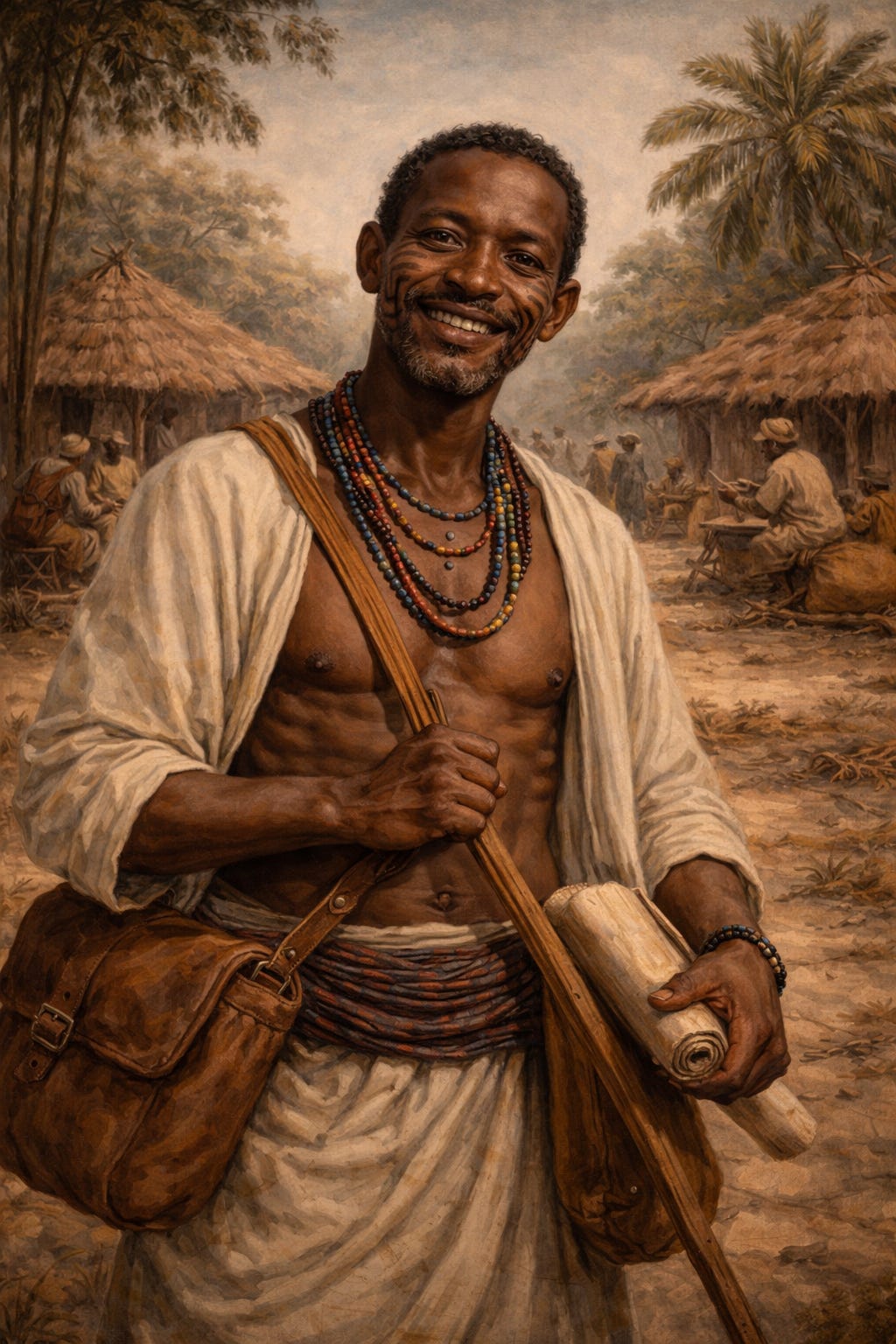
To understand Abubakar Pascoe, you begin in Gobir, a Hausa state perched on the semi-arid edge of the Sahara where the savannah gives way to scrubland. In the late eighteenth century, Gobir’s reputation was martial: cavalry warfare, frontier raids and a capital city called Alkalawa built like a fortress. Gobir was not Kano, with its famous dye pits and its merchants bargaining in a dozen languages. It was not Katsina, famed for Islamic scholarship and the elegant calligraphy of its scribes. Gobir was the kind of place where violence was always near, where the Tuareg raiders from the north and the rival Hausa polities on the margins kept the warrior class permanently employed. Gobir was one of the Hausa Bakwai - the “seven true Hausa states” - and its rulers liked to think of themselves as Hausaland’s northern shield.
Abubakar - the name he originally carried - was born into this landscape around 1795, or perhaps a few years earlier. The record is silent on his family, his childhood, the precise village where he lived his early years. What we can say with confidence is that he grew up in a society where Islam and older Hausa religious practices existed in an uneasy combination, where the ruling elite patronised scholars and consulted diviners, where a man could pray facing Mecca and still wear amulets against evil spirits. This syncretic blend was the normal condition of religion across much of Hausaland. It was also a fault line waiting to crack open.
The crack came in 1804. Usman dan Fodio was a Fulani cleric who had gathered a following of devout Muslims and disenfranchised peasants around his teaching centre in the Gobir countryside. His message was reform: strip away the compromises, purify the faith, replace the corrupt Hausa kings with rulers who would govern according to Islamic law. Gobir’s kings, understandably, saw this as rebellion. After years of tension, Sarki Yunfa - maximum ruler of Gobir - attempted to suppress the movement. Dan Fodio fled, gathered his followers, and declared a jihad. His following cohered around his teaching community at Degel; when the repression intensified, his movement staged a deliberate hijra - a withdrawal that echoed early Islam and made revolt feel like duty. From there, the jihad unfolded less like a single battle than a rolling civil war.
The war that followed is often described as a religious reform movement and political revolution, and it was all of those things. What is less talked about is that it was also an engine of dislocation - a war that burned villages, scattered families, and produced captives by the thousands. Hausa peasants who initially welcomed the chance to rid themselves of vexatious overlords soon discovered that the new Fulani rulers were quite capable of vexation themselves. By October 1808, the jihadists had conquered Alkalawa, killed Sarki Yunfa, and effectively destroyed the old kingdom of Gobir. The Sokoto Caliphate rose on Gobir’s ruins.
Somewhere in this maelstrom, young Abubakar was seized. The historical record cannot tell us the exact date or the name of his captors. What we know is that Fulani raiders took him, bound him, and marched him away from everything he had known. In the economy of the jihad, enslaved human beings were a form of currency, exchangeable for horses, weapons, and supplies. Abubakar thus became currency. In some cases, Muslim networks ransomed captives back across borders of kinship and faith, returning them to families who could pay or communities who would claim them. In others, the chain of sale tightened link by link until the person vanished from every community that might have known his name. Pascoe’s story takes that harsher branch.
