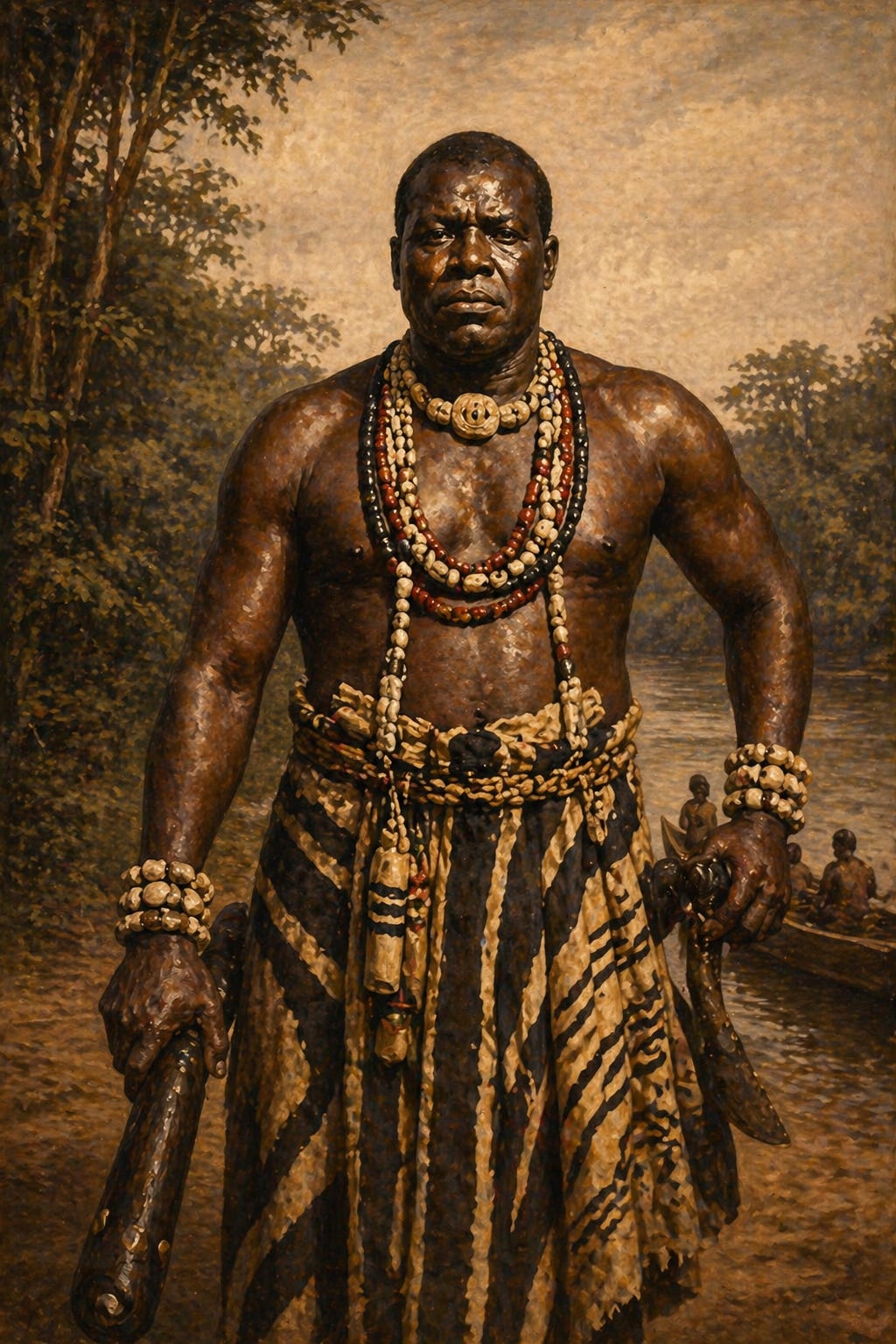
One of the purposes of this book is to show the different directions a life begun in interpreting could take. For the subject of this chapter, the interpreter's role appeared only briefly that it might seem incidental. But that’s the point. The career that followed is a study in how much could be built on such a small foundation, and how far a man could travel from there.
Introduction: The Parrot’s Work
Chapter 3: Audu With The Big Belly
In October 2025, as Warri once again descended into one of its familiar moods of suspicion, Ebikeme Amafini - Secretary of the Ijaw National Congress of the Americas - reached for a name from the colonial past. The immediate quarrel was that Nigeria’s Supreme Court had ordered a fresh electoral ward delineation of Warri Federal Constituency, and the resulting field report showed the Ijaw as the more numerous people in two of the three local government areas. The Itsekiri were displeased. The Urhobo had their own complaints. The governor, Sheriff Oborevwori, had told the feuding parties to “fight after 2031” and asked, with a candour that was both refreshing and appalling, “You want me to speak and lose votes?” Then Amafini issued his advice. The Itsekiri, he said, should “dispense with structures/privileges skewed in their favour during Colonial Agent Dore Numa’s era, which cannot define independent Nigeria.”
There it was. A man dead since 1932, summoned as explanation - shorthand for why the architecture of power in Warri still tilted towards one group at the expense of its neighbours. In the language of present-day grievance, his name still meant structure and privilege. Plenty of dead chiefs are remembered. Far fewer are still politically useful. Fewer still are invoked as shorthand for why the living still do not trust one another.
Who was this man, that a century later his name could still function in this way?
Dore Numa - Dogho in the Itsekiri form, and more fully Omadoghogbone - was born probably in the early 1860s into one of the right families, but not in quite the right way. His father, Numa, was the son of Princess Uwala, a daughter of Olu Erejuwa I; his mother, Ejuonenowo, was the daughter of a man called Ogie, himself the son of an Ologbotsere - the great chiefly line that served as the Olu of Warri’s prime minister. On both sides Dore was well connected. But the connections ran through the female line, which in strict Itsekiri custom weakened or blocked any easy hereditary claim to the higher offices of state. That explains everything that followed. Dore would not come to power by the old road. He would have to find a new one.
Not a great deal is known about his early days. The historical record is largely silent on his childhood, which means you do not have the neat comforts of the modern biographer: no reliable school register, no clear missionary teacher, no clean story of education and advancement. But one detail has survived that is worth more than most. Dore was “brought up and trained” by his aunt, Princess Iye - a woman of the royal side of the Itsekiri order, one of the surviving centres of authority in the long interregnum that had gripped Itsekiri politics since the death of Olu Akengbuwa in 1848. So Dore’s childhood, so far as it can be reconstructed, was not spent at the edge of power. He was also, by all accounts, one of the “elite of society” in his youth, a contemporary of other stylish young Itsekiri men.
The interregnum into which he was born deserves some explanation, because it was the crack in the Itsekiri order through which men like Dore would eventually climb. When Olu Akengbuwa died in 1848, his two sons and heirs died within months of him. The princes and slaves of the dead king seized the capital, Ode-Itsekiri, and for a time prevented anyone else from being installed. None of those who qualified for the throne appeared strong, wealthy and acceptable enough to command popular acclaim. The interregnum that resulted would last until 1936 - nearly ninety years without a crowned Olu. In that vacuum, power migrated and flowed towards trade, force, and whoever could accumulate enough of both to fill the space the monarchy had left behind.
Two great camps formed. On one side stood the royal family group: Princess Iye, Oritsemone, Tsanomi, Numa and later Dore himself. On the other stood the Ologbotsere faction: Idiare, Dudu, Olomu and eventually his son, Nana. This division was a fracture inside the Itsekiri political order itself - an unfinished succession struggle fought out through trade, war and the strategic befriending of foreigners.
Before Dore’s rise, there was Nana Olomu. More than just the man Dore helped to destroy, he was another Itsekiri broker of power, another product of the same violent commercial age, another man formed in the overlap of trade, force and foreign contact.
Nana came from a formidable inheritance. His father, Olomu, had become one of the richest and most feared traders on the Benin River in the turbulent decades when the slave trade had to give way to palm oil, and when commercial rivalry regularly turned into armed conflict. Olomu built the fortress-town of Ebrohimi, amassed war canoes, arms and slaves, and eventually rose to become Governor of the River - the highest functioning office available in the Itsekiri interregnum. In that sense, both the Olomu line and the Numa line were living through the same constitutional fact: the old order was still there, but it no longer distributed power by blood alone. Trade had entered the bloodstream of politics.
The Itsekiri kingdom occupied the north-western extremity of the Niger Delta, a small territory of waterlogged settlements strung along the rivers Benin and Warri. Most of it lay in the mangrove swamp belt. There was very little firm land. The people were traders and fishermen who had dealt first in slaves and then, as the nineteenth century turned, in the palm oil that lubricated the machines of industrial Britain. Their geographical position made them the natural brokers between the Urhobo hinterland, which produced the oil, and the European ships, which bought it. Itsekiri’s possession of firearms - acquired through long contact with European traders - enabled them to dominate the rivers and the trade that ran along them. Competition came from the Ijaw who were equally at home on the water. But even the Ijaw could not displace the Itsekiri from the greater part of the Urhobo trade.
Olomu’s victory over both Oritsemone and Tsanomi in the interregnum wars disturbed an already fragile balance. Numa, Dore’s father, inherited the resulting feud. Dore would carry it forward into a bitter vendetta against Nana, Olomu’s son. They were not men who simply happened to dislike one another but heirs to opposed houses in a long interregnum, standing at the live edge of an unfinished struggle.
Nana himself grew into that inheritance early. By 1876, he was already playing the leading role in his father’s affairs. He defended Olomu before the British consul in a murder case involving Abraka prisoners, and the consul described him that year as “a very intelligent young man and well acquainted with the English language.” The difference - and it would prove decisive - was that Nana used language as part of an existing authority. Dore would turn the act of interpreting itself into a ladder as he came into the 1890s as the younger man of the hostile camp, looking for an opening. The British, in effect, would supply it.
An episode from Dore’s early life that reveals the world he grew up in vividly is worth a quick aside. His younger brother, Atunu Numa, was killed during the Otuekin juju play at Orugbo. Passing by Ogbe-Sobo by canoe on his way up-river to witness the occasion, Atunu unknowingly entered a day of ritual prohibition: the Ogbe-Sobo were sacrificing to their war medicine and would allow no canoe to pass. Warned to turn back, he ignored the order. Some of the men pursued him. Atunu, armed with a rifle, fired and killed two of them. The rest captured him, chained him, and one of the dead men’s relatives killed him with a hatchet while he was still in bonds. News of the murder caused uproar in Warri and at Batere, and preparations for war against Ogbe-Sobo began at once.
In 1891, Dore made the small, decisive move that would reshape his life. The British vice-consul, Henry Gallwey, was travelling through the creeks to Lagos and needed transport. Nana, the established big man, supplied a large gig canoe - but no crew. His reason was practical: once his slaves reached Lagos, where slavery had been abolished, they might run away. Dore stepped into that opening at once. He supplied the men - some thirty “boys” - and earned Gallwey’s gratitude. It was a tiny episode in the grand scheme of Niger Delta politics. But it was the hinge on which Dore’s future turned. Nana, the seated power, protected the logic of his old river household. Dore, the rising rival, seized the chance to be useful to the new power. From that point on, Gallwey did not forget him.
Then came the second turn. Numa died in February 1891, and Dore succeeded as head of the family and leader of the left-bank faction opposed to Nana’s dominance. Gallwey’s judgment on the succession is one of the most revealing single documents in Dore’s career. Numa, he wrote, had been “a particularly weak minded and incapable chief, but his son, who succeeded him, is a very superior man altogether, and in time is likely to improve very materially on his father’s rule and further, he is not afraid of Nana. In addition to all this, he is a very loyal supporter of Her Majesty’s Government - His name is Dore.”