

This chapter takes its time arriving at the action. There is a good reason for that. Not much is known of our interpreter beyond the role he played in the events that follow - but to understand why that role mattered, you first need to see the world he stepped into: the layered sovereignties, the fractured authority, the economy built on human capture, and the linguistic gulf across which all of it had to be negotiated. The context is the story. By the end, I hope you will agree that he deserves his place in it.
Introduction: The Parrot’s Work
These days, Keffi can feel like a town you arrive in by accident. It sits in the long shadow of Nigeria’s federal capital, close enough to Abuja to be pulled into its daily rhythm, a modest market town on the edge of someone else’s importance. It is easy to read it as a minor settlement along the corridor of movement and commerce, known more for the practical business of ordinary life than for the business of history.
But it was not always like that. Long before Abuja redrew Nigeria’s mental map, Keffi’s location made it the sort of place that could not be unimportant. Perched on the rolling grasslands south of the great Hausa heartlands, Keffi sat at a threshold that made it simultaneously indispensable and imperilled. It was close enough to the emirate of Zaria to be pulled into its political orbit, far enough south to survey a patchwork of smaller communities, hill settlements, forest-edge villages, and the long-distance trade routes that connected them all. It was a geography that made it useful and also dangerous. Border towns accumulate power by mediating between stronger states and weaker neighbours; they also accumulate enemies by doing the same work too successfully.
The nineteenth century was the era in which raiding and forced movement became the dominant political technology across the country south of the Hausa heartlands. By the century’s end the province had been “ruined” and depopulated. Fortified strongholds had radiated violence into the surrounding countryside, and caravans of captives had been pushed northwards year after year. This was the landscape Keffi inhabited as a borderland between different ways of producing wealth and authority.
To understand how and why Keffi’s relationship with Zaria became so fraught, and remained so for a century, it helps to see Zaria as something more than a city-state. The old kingdom of Zazzau was the southernmost of the “seven Hausa States” and it was the one whose role was to provide slaves for the others. Zaria’s power in the south was economic, and it was built on human capture.
Keffi, positioned near the southern reach of that influence, became entangled in that system early. Its rulers would repeatedly discover that they could not be fully independent without provoking the north, and could not be fully obedient without losing autonomy and legitimacy at home. That awkwardness - between being a client and trying to be a player - is the tension you can feel running through every recorded encounter in the town’s history. It is also, as we shall see, the tension that would eventually produce a dead British Resident, a fugitive Magaji, and a very fat interpreter whose loose tongue provided the excuse for the conquest of the Sokoto Caliphate.
Keffi’s founding is anchored around the turn of the nineteenth century. A leader named Abdullahi, better known as Abdu Zanga - a Katsina Fulani - gathered a band of cattle-owning Fulani around him at a time when Fulani rule was “rapidly spreading southwards.” He chose a site sheltered by thick bush and defended it with a heavy stockade, a kaffi in Hausa, from which the settlement took its name. Thus Keffi began as a defensible enclosure: a place meant to withstand attack and to project force outward.
Very early, Keffi discovered that it could not choose its own political parent. Abdu Zanga attempted to obtain his title - and, crucially, a flag - directly from Othman Dan Fodio, the Emir of Sokoto. Flags in this context were licences of authority, publicly signalling recognition and allegiance. It was a bold gambit and an attempt to bypass Zaria entirely and claim direct legitimacy from the supreme authority of the Caliphate. It was punished swiftly. Around 1810, Zaria horsemen rode down and destroyed Keffi with fire in “a slave-collecting Razzia.” The lesson was clear that in this region, claims to sovereignty were not policed by mere diplomacy.
The punishment, however, did not settle the matter. When Keffi was rebuilt, it was fortified far beyond a simple stockade. The town was enclosed with a triple wall and a moat - defences significant enough that they were still visible when the British arrived decades later. The architecture made clear that this was a place expecting violence, planning for siege, and ready to hold out against cavalry. If Zaria intended the raid to establish the final verdict on Keffi’s subordination, Keffi’s rulers treated it as the opening salvo of a long contest over autonomy. Abdu Zanga was compelled to hold his title directly from Zaria and to pay annual tribute in slaves, even if the triple walls suggested a town that had learned to submit with one hand while preparing to resist with the other.
From around 1820 onwards, Zaria appointed a kofa - an officer whose role was to inspect and communicate with local authorities in Keffi. The kofa travelled with jekadu - tax collectors - whose periodic tours made the relationship between the two polities material and extractive. The currency of that collection was overwhelmingly human and it transformed Keffi into an “advanced base” for slave raiding into the south. This matters for understanding everything that follows. Keffi became a frontier node and pipeline in a system that converted violence into wealth, and wealth into legitimacy. And pipelines, as a general rule, produce conflicts whenever they are threatened or rerouted.
Chiefs and headmen paid tribute in money and slaves, with specific figures: a slave or more, plus one hundred thousand cowries, sent once a year or sometimes more often. Traders entering the town brought a share of their goods to the Emir. Installation into office required enormous payments - from the Madawaki and Galadima, one million cowries each; from the Wambai and Dallatu, five hundred thousand; and from lesser title-holders, amounts scaled to their position and means. The spoils of any raid were formally divided, with shares due to the emir and senior officials. This was a system of professional incentives in which officials who lived off shares of tribute and shares of raids would naturally resist any political change that threatened those streams.
After a particularly savage battle between Abuja and Zaria, in which three hundred prisoners were killed at the Gate of White Water and their heads mounted on poles along the town wall, the Emir of Abuja spared one captive - the son of the Makama of Zaria. He was given garments and money for his journey and then “handed on to the Sarkin Keffi to be sent back to Zaria, for at that time Keffi was on terms of friendship with both Zaria and Abuja.” Here, Keffi appears as intermediary, courier, and neutral-ish corridor between two enemies, the kind of role that makes a border polity useful and vulnerable to pressure from both directions.
Keffi’s Zaria problem, then, had two faces at once. In one direction, the town was compelled to acknowledge Zaria’s suzerainty through tribute and oversight. In another direction, it could leverage its position as a hinge between Zaria, Abuja, and other southern polities - sometimes as a friend, sometimes as a rival, sometimes as a necessary conduit. That is a recipe for what might be called awkward sovereignty: a condition where a town’s survival depends on constantly renegotiating its degree of dependence, and where the man who controls the terms of that negotiation becomes very powerful.
The most revealing window into Keffi’s internal stress lines comes from its successions. After the third emir, Jibirilu, died in 1859, he was succeeded by his brothers in order of seniority - Mohamadu, then Ahmadu, then Mallam Sidi (also known as Sidi Umoru), who died in 1894. Up to this point, succession appeared orderly, following the recognisable principle of seniority among brothers. Then the rule broke. Sidi Umoru was succeeded by Ibrahima, the ninth son of Abdu Zanga, and the succession thus skipped three brothers - Yamusa, Sulimanu, and Isiaku - all of them older than Ibrahima.
The records do not explicitly say why those older brothers were bypassed but the bare fact of the skip tells several important things at once. First, that Keffi’s political life was not governed by a single, stable succession principle - seniority could matter, until it didn’t. Second, that actors with influence - kingmakers, councillors, or outside patrons - could intervene to reshape the line of succession. And third, when legitimacy is contested or improvised, offices outside the throne can grow disproportionately powerful.
By the time Ibrahima ruled, Keffi had developed what can only be called a dual-power arrangement. The emir sat on his throne, but real authority in the town resided elsewhere - in the hands of a man named Dan Ya Musa, who held the title of Magaji. Ibrahima was a figurehead. Dan Ya Musa was the one who mattered.
The Magaji’s office was, in constitutional terms, that of the accredited agent of the Emir of Zaria, the suzerain to whom Keffi owed its allegiance and its tribute. Read one way, this made Dan Ya Musa a functionary: Zaria’s man in Keffi, a conduit for instructions and a collector of dues. Read another way - the way that actually corresponded to reality - it made him the most powerful person in a town whose emir could not match him in will, in resources, or in the capacity for violence. Keffi’s Zaria problem had become internalised. Zaria was inside Keffi’s power structure, operating through an office that had accrued more real authority than the throne itself. The title of Magaji would later be rendered obsolete under colonial reorganisation, one of many local offices swept away in the imperial tidying-up. But in 1902, it was the office that ran Keffi.
Dan Ya Musa was, by all accounts, a man whose character matched his position. A member of the Keffi royal house by birth, he was still young when the British arrived - under thirty-five - and in the full vigour of his powers. He was not a large man. An eyewitness who knew him well recalled that he stood “not more than five feet two inches at the most,” was dark-skinned, well-proportioned, and “always wore a black beard, but no side-whiskers.” His teeth, the same observer noted with curious precision, “were small and well-formed and he had not lost any.” For a Fulani, he was a fine horseman, a hunter, and a warrior. When crossed, he was possessed of “an extremely fiery temper” and could then be severe. Radiating energy and appetite, he had four wives and many concubines. His hobby, this witness noted with an air of understatement, was war. Each dry season he rode out from his headquarters at Kokona against the surrounding communities, and the horses used to mount his men were paid for in slaves.
He had also set himself against the establishment of British rule - though his resistance up to 1902 had been of the passive rather than the active variety. One colonial historian described him as a “robber chief and slave-raider” who had obtained “complete control” over the weak old king. That phrasing captures something real about how colonial officials perceived the situation. They saw the Magaji as a powerbroker whose authority was rooted in coercion and the slave economy, and whose capacity for independent action unsettled everyone in the vicinity, British and African alike. Before any British officer arrived to issue demands, Keffi was already a place where sovereignty was divided, contested, and brokered. And in a polity where the state already spoke with two tongues, the role of the man who translated between all of them - the interpreter - would prove more consequential than anyone imagined.
If the Magaji’s office connected him to Zaria, it also gave him a platform to act beyond Keffi, sometimes aggressively. Around 1893, a boundary dispute arose between the emirate of Jemaa and the Magaji of Keffi, who claimed the Numana and Ninzam districts as his own. The Magaji did not petition or negotiate. He advanced against Jemaa. He was driven away, but advancing against a neighbouring emirate in a boundary dispute was not the action of a passive local official but of a man who believed he could assert claims through force, or at least through the credible threat of it.
Just as important was how the dispute was settled. It ended only when the Emir Yero of Zaria gave a decision, after both parties appealed to him. Zaria appeared as a court of appeal with the authority to redraw claims between its own subordinates. And yet the episode also revealed the limits of Zaria’s ability to control its own frontier agents: Keffi’s Magaji could push outward until someone pushed back hard enough to make arbitration necessary.
Even at its most routinised, slave-raiding on this frontier was rarely presented as raiding at all. The sub-emirates that held their titles from Zaria - Keffi among them - had begun as extraction outposts and then, belatedly, tried to look like administrations. Each emirate was parcelled out in lots among office-holders, who in turn divided villages among retainers serving as jekadu. All of them lived at the respective capitals, drawing sustenance from a system of levies elastic enough to include not only a share of crops and livestock but “even of children of the pagans.” Where communities proved less tractable, officials manufactured justifications to attack, to carry off the young and the able-bodied, and to dispatch them northwards in time for the annual tribute. In other words, slaving could be made to wear the costume of taxation, and violence could be made to wear the costume of law. By the end of the nineteenth century, this machinery had consumed itself: depopulation was so complete that the Fulani retainers had been forced to turn their own hands to farming the emptied lands around their towns.
This matters for what abolition was up against in 1902. The British did not arrive to a clean distinction between war and taxation, or between tribute and kidnapping. Raiding was still going on up to 1902. It only began to buckle when frontier rulers made formal submission to the new government, a process that cut across the old Zaria-centred hierarchy and interrupted the raiding careers that were remaking the map by force. In the same breath, the colonial administration was tightening its frame around Keffi: early Residents commenced exploration and by July 1902 the provincial headquarters was transferred to Keffi itself - an administrative relocation that was also a declaration that this borderland would now be watched and disciplined from the inside.
The British clampdown felt, to many office-holders, less like moral reform than like an attack on the very possibility of wealth that depended upon the slave trade. Chiefs went raiding the surrounding communities, captured people, and brought them back to sell to wealthy merchants and traders, receiving in exchange money and fine robes. Those merchants then took their human cargo further afield - into Nupe and Ilorin country - and sold them there, returning with all manner of goods: horse harnesses, muskets, and gunpowder, which could be sold again at further profit. The price of a strong young captive could reach two hundred thousand cowries. And therefore, when the British came, “those men who had been earning a rich living by this trade saw their prosperity vanish, and they became poor men.”
Abolition was also experienced from the other end as a restoration. The British arrival was framed as an act of divine mercy because it “put an end to all raids.” The communities that had fled to forests and hilltops during a century in which flight had been their primary survival strategy began to come down. Those who had been carried off as slaves were, in some cases, restored to their homes. Thus the end of raiding was not an abstract reform but a physical reshuffling of bodies back into places, a reversal of the demographic engineering that the slaving frontier had been perfecting for generations.
The colonial administrative records offer a parallel, if considerably more self-congratulatory, version of the same transition. The province at the century’s end is depicted as a landscape of ruin and depopulation; then comes Sir Frederick Lugard, and - in the telling of his own administrators - people scatter back to their lands and farms, and even slaves filter home from as far away as Sokoto and Kano. Lugard was, at this point, barely two years into his tenure as High Commissioner of the Protectorate of Northern Nigeria. Installed on New Year’s Day 1900 at Lokoja, a river-town at the confluence of the Niger and Benue, he governed a vast territory of some twenty-four million souls with a total of nine political officers, a shoestring budget underwritten mostly by customs revenue from the south, and the small but determined West African Frontier Force (WAFF) he had himself helped to create. His Protectorate was, in truth, a paper claim - a set of theoretical boundaries drawn from international treaties of very little significance to the actual rulers and people on the ground.
One of his very first acts had been a legal proclamation abolishing slavery - an important political statement but, as of that date, a largely meaningless edict, since he had no power to enforce it beyond the immediate reach of his garrisons. Still, the proclamation served its purpose: it publicly identified the new power in the country as the ally of the oppressed, and it placed every slaving emir on notice that their revenue model now had an expiry date, even if nobody yet knew when it would arrive.
But clampdowns create adaptations, and this frontier had always been fluent in adaptation. You cannot raid as openly once the Resident is in town and the headquarters has moved closer - but you can bargain, delay, redefine, outsource, and above all insist on your own interpretation of what the new rules mean in practice.
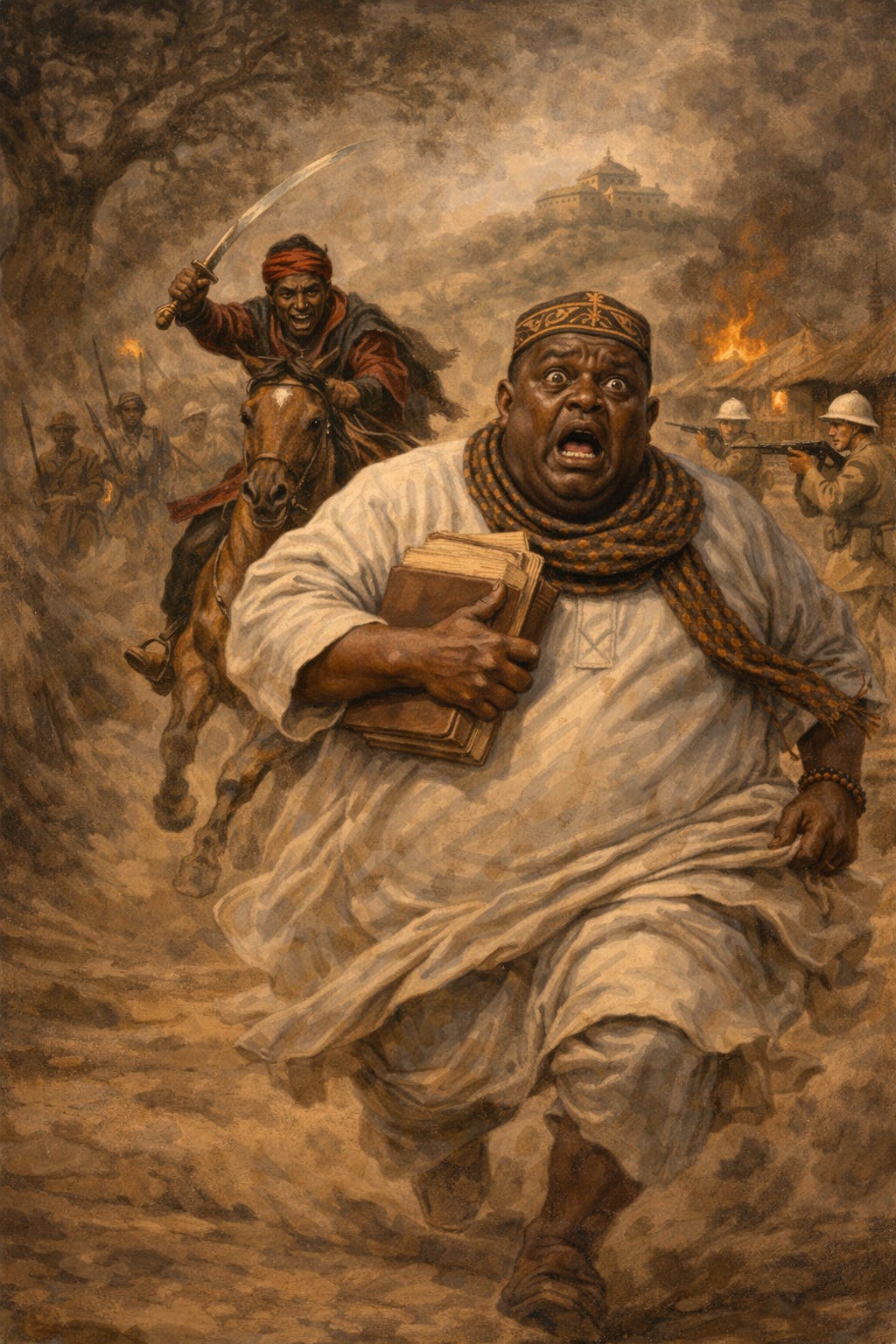
That was the combustible backdrop to the slavery conversation in Keffi in 1902. Abolition, as the British presented it, was a direct intervention into the frontier’s revenue model and coercive toolkit, and therefore into the Magaji’s power. A man whose authority rested on controlling movement - of tribute, of captives, of horses bought with human beings - would have heard anti-slaving demands as an existential threat. Into this arrangement walked three men whose collision with Dan Ya Musa would change the course of Nigerian history.
The first was Captain George William Moloney, the British Resident for Nassarawa Province - a man described by his own contemporaries as possessing strong character and a determination to act. Moloney was a military officer before he was an administrator, and he carried on his body the proof of it: a gunshot wound to the thigh sustained during the Akassa raid of 1895, when the Brassmen of Nembe stormed the Royal Niger Company’s headquarters on the Niger Delta coast. The wound had left him permanently crippled, and by the time he reached Keffi he was carried about in a hammock - a detail that would matter enormously on the day he needed to summon troops in a hurry. Yet a lame leg had not dulled his appetite for action. Just weeks before the events that would end his life, Moloney had led the expedition that subdued Abuja in August 1902, arresting the Madawaki and breaking the brigandage that had made the trade routes south of Keffi impassable. To the locals he was known as “Mai Launi” - the Coloured One - a pun on his name and a nod to the strangeness of the white man in their midst. Moloney was under immense pressure from Lugard to bring Keffi to heel and end the slave raiding. But unlike the fire-and-sword approach favoured by some of his fellow Residents, he initially believed in a diplomatic solution - that the Magaji could be brought into the fold through persuasion rather than force.
Accompanying him was his Assistant Resident, a man named Gustavus William Webster, whom the locals in Keffi came to call “Mallam Bature” - the learned European. Webster, during Moloney’s absences on campaign, had managed to cultivate a genuine friendship with Dan Ya Musa, visiting him regularly at his headquarters in Kokona and earning a reputation among the townspeople as a protector. The people of Keffi, one eyewitness recalled, knew him well, liked him, and regarded him as their guardian. But between these two British officers and the Magaji stood a third figure - the indispensable and treacherous intermediary through whom all communication had to pass.
This was Audu TimTim, Moloney’s chief Government Agent and interpreter. His nickname, TimTim, meant a leather pouffe - because he was, as one contemporary put it, “a very fat man with no neck” who looked exactly like one. The physical description is memorable, but it was the least important thing about Audu. He was, by the most charitable account available, “a liar and a rogue and utterly without scruples.” He set himself the task of playing Moloney off against the Magaji and vice versa - telling each party things designed to inflame suspicion of the other, manufacturing grievances where none existed, and exploiting the linguistic gulf between the British officers and the Fulani court for his own enrichment and influence. In a town where sovereignty was already fractured and communication between rulers already treacherous, the man who controlled the words between all parties would hold a terrible, decisive power.
By half past ten on the Friday 3 October morning, Keffi was already doing what Keffi always did on a Friday: turning politics into public theatre. This was the town’s weekly gathering-point, the day when the Magaji - who normally kept his household eight miles away at Kokona - would ride in to salute, attend the central mosque, and remind everyone which authority truly carried weight in this town. It was also the day the Emir and the leading men sat most visibly inside the architecture of rule: palace, square, mosque, and crowd arranged in their familiar pattern like a diagram of power.
Captain Moloney chose that day deliberately. He had already sent word to the Emir of Keffi, the aged Ibrahima, with a plan: on Friday, “if God wills,” the Emir was to meet the Magaji at the Jama’ar Gayyam gate because there was work to be done. The message read as both invitation and warning. The barracks sat outside the gate, some distance from the palace precinct. Moloney wanted a conversation about power and policy, but the staging of it mattered. This was the British Resident trying to pull the most dangerous local actor in Nassarawa Province into a controlled, visible setting.
Moloney was carried in his hammock down to the Emir’s palace, with Audu TimTim and a second messenger named Musa Gana walking alongside. Soldiers accompanied them as escorts, with some left behind on guard at the Resident’s quarters. When the party arrived at the palace entrance - the Council Chamber, the formal hall that served as the threshold of the Emir’s private compound - they found the place already crowded with men. The Emir dismounted from his horse, passed through the Chamber, and went into his private quarters. Then he came back out and they all moved to the open square in front of the palace. On one side stood the Emir’s residence. On the other, barely a hundred and fifty yards away, stood the Magaji’s. A chair was placed for Moloney. The Emir sat on a mat. Soldiers took up a position near the gateway. Webster was there too. A crowd began to gather. The geometry of the morning was set: all the principals of Keffi’s fractured sovereignty arranged within conversational distance of one another.
Moloney immediately asked - through TimTim - where the Magaji was. The Emir’s reply was that this was his town, not the Magaji’s, and whatever the white man wanted he should say it to the Emir and it would be done. Moloney did not take the opening. Instead, he turned to his interpreter and asked whether the Emir was speaking the truth. TimTim’s answer exposed the dual-power reality of Keffi in a single sentence: in this town, he said, people feared the Magaji more than the Emir. Moloney pressed on. He told the Emir, in effect, that he wanted the Magaji because the Emir was old and the job required a younger supervisor, a sentence that would have landed badly in any court, but especially in one where dignity was a political resource and an insult to the king’s capacity was an insult to the king.
From the gate they moved into the square. The messengers were dispatched to summon Dan Ya Musa. He refused to come.
In the account dictated by Sergeant Major Usman Umaisha - Webster’s groom, who was present throughout and gave his testimony in 1937 with a memory that later investigators found remarkably consistent with local oral tradition - TimTim’s duplicity had begun long before the fatal Friday. It was already in motion when Moloney first arrived in Keffi. At the start, Umaisha recalled, the Magaji had treated Moloney with great courtesy, even moving his household out of Keffi town to Kokona and returning only on Fridays. Then, one day, Dan Ya Musa asked TimTim a simple, practical question: what does your white man like and dislike? TimTim’s reply was to sow a seed of panic. He told the Magaji that the real reason Moloney had come was to capture him. Then he went to Moloney and told him the Magaji would murder him one day.
Read slowly, that is not a mistranslation. That is the deliberate planting of two incompatible stories about the same relationship, designed to make each side see the other as a mortal threat.
By Friday morning, that earlier poisoning of the well became operational sabotage. Once the Emir had gone through the Council Chamber into his private quarters, Moloney told TimTim to go to the Magaji’s house and summon him. TimTim went off and came back: the Magaji refused. Moloney sent him again with the same message - he was here to discuss work, nothing more. TimTim went off and came back again: still a refusal. But here Umaisha inserts the accusation that transforms the entire episode. In fact, he said, TimTim had never gone into the Magaji’s presence at all. The messages that Moloney believed were being delivered and rejected were being invented by the interpreter in the space between two compounds, a hundred and fifty yards of open ground that had become an abyss of manufactured meaning.
Then TimTim gave Moloney the line that mattered most. The whole town had assembled, he said, and the people believed Moloney had come to arrest the Magaji because he had soldiers with him. Moloney - trying to avoid a confrontation and to let the Magaji come without losing face - did the thing that made the rest of the day possible. He dismissed the soldiers. They marched away to barracks. The armed protection that might have prevented what followed was sent back on the strength of a single sentence spoken by a man who had been lying all morning.
This was the structural cruelty of the interpreter’s position in Keffi. TimTim only had to manipulate protocol and perception: they think you came to arrest him; let your soldiers go so he will come. It sounded like de-escalation but in reality it was disarmament. After the soldiers left, those who remained in the square could be counted on two hands: Moloney and Webster; TimTim; Musa Gana; two messengers named Tabba, and Abdu Kiri; a man called Jika Akur; the two grooms - Umaisha himself and Moloney’s own - and a boy. The Resident, his assistant, and a handful of unarmed staff, sitting in an open square in a town whose most powerful man had just been told, by the man he trusted least, that the white man had come to destroy him.
And then the Magaji’s own intelligence network lit up. Dan Ya Musa, it turned out, was not entirely blind to what was being said in the square. He had a boy named Auta Maidungu - someone he trusted for a particular reason: the boy understood English. The Magaji had posted Auta in the doorway of the Council Chamber to listen and report what passed between the white men. It was a small precaution with enormous implications. It meant that a parallel translation channel existed.
Now Auta went to his master and asked a devastating question: did you see TimTim? Did he come and deliver any message? The Magaji said he had not. Auta told him that Moloney had sent messages three times, and each time TimTim had returned to the white man claiming the Magaji refused. Worse: TimTim had been putting specific, provocative words into the Magaji’s mouth - something to the effect that Moloney had brought soldiers to arrest him, so why should he leave his house? And then the final piece: because of this, Moloney had dismissed his soldiers back to barracks. The Magaji’s reply, in Umaisha’s narrative, is the sound of a man realising he has been played in public. “So this is what Audu Timtim has said.” Then he gave the vow that turns the story from misunderstanding to intention: TimTim had lied in this fashion to him before, he said. Today, by God’s grace, his lies would end - TimTim “and his White Man.” The line was both personal and political. TimTim’s lies were not merely insults but actions with consequences: they had manipulated the Magaji’s honour, placed him in open conflict with the Resident, and - perhaps most unforgivable in a court society built on reputation - made him look as though he was refusing a summons out of fear.
At roughly the same time, Webster tried to intervene. He was the one person with a genuine chance of calming the Magaji. One eyewitness who knew both men insisted that the official stories which painted Webster as blundering into private quarters or being manhandled by the Magaji’s guards were wrong, because Webster knew the Magaji’s house intimately and was always welcome there. But when Webster went to the Magaji’s compound to reconcile the parties, he found the entrance hall packed with young men armed with flintlocks. That was the moment Webster understood what was coming. He ran back, mounted his horse, and rode hard for the barracks, about three miles away. The distance was decisive. Three miles, with horses and confusion and orders needing to be given before armed men could march back to the palace square, was a very long way when the clock had already started.
Meanwhile, the meeting in the square had turned into a public standoff. Another eyewitness recalled the scene as an exercise in accumulating heat. Moloney had been carried down in his hammock and helped out, limping. Eleven o’clock passed. The Emir sent word that those gathered were tiring of the game of waiting. Still no Magaji. At one point Moloney himself wanted to go and fetch Dan Ya Musa in person, but the Emir prevented him - perhaps recognising that if the Resident entered the Magaji’s compound, the meeting would cease to be a negotiation and become a confrontation. Every minute added heat. Every delayed reply, every rumour circulating through the crowd, was another opportunity for TimTim’s earlier framing - he fears arrest; the Resident is about to seize him; the soldiers are proof - to harden into established fact inside people’s minds.
In Umaisha’s account, after Webster rode for help, Moloney decided to return to his quarters. His carriers lifted him into the hammock and began to move. They got as far as the Friday Mosque - less than a hundred yards from the Council Chamber - when the Magaji appeared on horseback. That image is almost unbearably consequential. The Resident, unable to walk quickly, carried on a cloth bed. His escort already dismissed. His assistant galloping for help three miles away. The crowd within shouting distance. And the Magaji arriving mounted - on his war-horse, a stallion called Dan Ashalu - accompanied by armed riders and footmen, in a space already poisoned by language.
The carriers panicked. They dropped the hammock and fled into the mosque. Umaisha and the others ran into the mosque too and peered out from the sanctuary. What they saw next they could not fully interpret, because the one man whose job was to interpret had already begun to run.
Umaisha says the Magaji came close to Moloney and spoke with him, though the men in the mosque could not hear what passed between them. This suggests a final chance, a short exchange in which violence might still have been avoided. But the exchange, if it happened, was fatally compromised by the same absence that had brought them here. Moloney needed language. He needed a trusted bridge between English and Hausa - and the bridge was either absent, corrupt, or both. Then the Magaji withdrew briefly towards the Tudun Kofa - the broad open space where riders showed their horses’ paces on ceremonial occasions - and the people watching believed he had gone away. Then he reappeared at full gallop.
Another eyewitness remembered the sequence differently: the Magaji rode out through the archway of his house on Dan Ashalu, approached the Emir to give the traditional salute with his spears, and then a shot rang out. He recalled later that the Magaji always carried two pistols and never parted from them - one hidden under his left armpit beneath his gown, the other kept in a pouch on his right hip, concealed by the folds of his clothing. The shot that brought Moloney down, this witness believed, came from the revolver on the right hip.
The two accounts can be read together without forcing them. The sequence may have been: approach, brief exchange of words, withdrawal, return at speed, shot. Or: approach, salute, withdrawal to gather himself and set his men, return at full gallop, pistol and impact. Either way, what both men agreed on was the result. Moloney was killed in the open, in front of witnesses, in the midst of Friday’s gathered crowd. Umaisha’s phrase is stark: the Magaji rode him down. When the dust settled enough for the men in the mosque to see, they saw Moloney’s head on the ground. Soldiers began firing. Bullets fell into the crowd. People were killed and wounded. Someone in the Magaji’s retinue fired an arrow that struck the Emir in the foot, adding injury and humiliation to the panic. Webster took refuge in the mosque. And in the middle of it all, Audu TimTim ran.
Here the sources converge on the story’s bitter irony: the man who had manufactured the crisis did not survive it.
As soon as Moloney fell, TimTim bolted from the square in the direction of the barracks and Moloney’s house. The Magaji shouted an order that is revealing in its selectiveness: “Do not touch Mallam Bature.” It was a command that protected Webster - the man with whom he had real personal relations - even as he killed the Resident and turned to pursue the interpreter. Dan Ya Musa was not simply losing control in blind fury. He was choosing targets.
Umaisha’s narrative gives us the same instinct in another form. After Moloney was killed, the Magaji cried out: “Where is Audu Timtim?” He was told TimTim was on the road to the barracks. The Magaji went after him. The chase ended in Ungwar Alkali, near the house of Asamudu, the Alkali - chief judge - of Keffi. Both testimonies fix the kill-site around the same landmark: a baobab tree that was still standing when Umaisha dictated his account thirty-five years later. The Magaji caught TimTim as he was trying to scramble up the rise by the baobab. One account recalls that Dan Ya Musa, wheeling his horse, slashed TimTim across the belly with the knife-edge of his fighting stirrups and ripped open his bowels. A man named Barga - a slave of one Adamu Mai-Doka - then cut off TimTim’s head. Umaisha does not linger on the detail. He simply says the Magaji killed TimTim on the spot. But he adds a decisive tactical note: at the very moment the Magaji overtook his quarry, the soldiers Webster had gone to summon were coming up the road and began firing their rifles. The Magaji escaped anyway.
The geography of Keffi had done its work one final time. The troops were too far away to arrive in time to prevent either killing, but close enough to witness the second - close enough to fire at a fleeing Magaji, yet not close enough to hit him. In the chaos that followed, another man threw Moloney’s head down a well outside the gate of the mosque. It was a final act of desecration that the British would neither forget nor forgive. In the days after, they tried to pin the violence to fixed points in the landscape. A tall white wooden cross was planted in the public square outside the mosque to mark the spot where Moloney fell. And above the town, on the summit of a high hill overlooking the older settlement on the plain below, a solitary grave was dug and enclosed by a circular wall - Moloney’s resting-place, set apart on the skyline like both a warning and a claim of ownership over the country that had swallowed him.
That hill can still be seen today. The locals know it as Pyanku Hill, but it is more widely called Moloney Hill - or, in the way that Nigerian English softens and domesticates colonial relics, “Maloney Hill” - and it rises at the edge of Keffi behind the Emir’s palace, looming over the town with the quiet insistence of unfinished business. The grave at the top is a physical place you can still climb up to, and it remains part of Keffi’s public memory in a remarkably literal way. As recently as 2020, Nasarawa State’s commissioner for information, culture, and tourism visited the site with ministry officials, and the Emir of Keffi spoke openly about having renovated the tomb and wanting a museum built to preserve the town’s historical artefacts. A hundred and eighteen years after a crippled British Resident was carried in a hammock to a meeting that killed him, the hill where he was buried is still being tended - a reminder that in Keffi, the past is not something that happened long ago.
Once TimTim was dead, Dan Ya Musa swung his horse round and rode back through and around the town, then out towards Kokona. He gathered his women, about forty of them, his horses - some seventy in number - and six herds of cattle, and set off north. At Keffin Shanu, he stopped long enough to cut the telegraph wire with his sword, severing the British system’s nerve in a single stroke.
In Keffi itself, the Friday rhythm had been shattered beyond repair. The Resident was dead. The interpreter was dead. The Emir was wounded. The crowd had been fired into. The Assistant Resident was still somewhere on the road between palace and barracks, a few miles of distance that had suddenly become the difference between life and death.
TimTim’s choices - whether you frame them as corruption, self-dealing, personal grievance, or a half-baked political scheme - shaped the conditions in which violence became the rational outcome for a man like Dan Ya Musa: public humiliation, fear of arrest, the loss of face, and the sudden discovery that the Resident had dismissed his soldiers. When the Magaji rode into that square, he was acting inside a story TimTim had already written for both sides - one in which the only safe move left was to strike first.
By evening, the Magaji was on the run.
The phrase “butterfly effect” belongs to a much later century. It entered popular science through the meteorologist Edward Lorenz, whose work in the early 1960s on weather systems showed how tiny differences in starting conditions could produce wildly different outcomes; by 1972 he had given the idea its enduring image when he asked whether the flap of a butterfly’s wings in Brazil might set off a tornado in Texas. In its simplest form, the theory means that in a complex system, a seemingly trivial disturbance at the beginning can alter everything that comes after.
None of the people in Keffi that Friday could have imagined that an episode which began in mistrust, and manipulated speech would open a road to the destruction of one of the great Islamic states of nineteenth-century Africa. Yet that is what happened. The killings at Keffi were local and intensely personal but their consequences were imperial. A chain of self-interested manipulations performed by one fat man in a dusty square, became one of those small initial disturbances whose effects widened far beyond the men who first felt them.
To Lugard, sitting in Lokoja, Keffi did not look like an isolated outrage. The southern approach to Zaria had delivered an earlier lesson in blood. Before Moloney, there had been David Carnegie - the younger son of the Earl of Northesk, an adventurer who had previously crossed the deserts of Western Australia and written a book about it, and who had come to Nigeria as an Assistant Resident with plenty of enthusiasm. He was killed by a poisoned arrow in a skirmish with the local Tawaris in November 1900 near Uma’isha, in the same belt of highway robbery and armed disorder that later produced the killing of the missionary Bako and the British messenger whose deaths had brought Moloney against Abuja in August 1902, in a direct response to the atmosphere of lawlessness. Carnegie’s death thus gave Keffi a history before Keffi. By the time Moloney was murdered, British authority in this region was losing ground to the frontier of raiding, brigandage, and contested sovereignty. In other words, when Keffi erupted, Lugard did not see a freak incident but further proof that hesitation on the southern marches invited defiance.
His official language after the event is revealing. In the report he wrote to the Colonial Secretary the following year, Lugard recounted how Moloney had attempted to bring the Magaji to “an amicable understanding,” only to fall victim “through the treachery of his interpreter.” The crime, Lugard wrote, “called aloud for punishment” - not least because Moloney had been “unarmed and dependent on crutches” when he was butchered. But the next sentence is the hinge on which the wider story swings. Lugard added that the Magaji had fled to Kano, where his “cordial reception” by the Emir “was one of the immediate causes of the advance on that town by the British troops.” In other words, Keffi did not merely horrify Lugard. It furnished him with the language of necessity.
That does not mean he had suddenly discovered an ambition he had never previously entertained. The British high command in Northern Nigeria had been circling the Kano–Sokoto problem for years, while London hesitated over the cost and risk of a major campaign so soon after the exhausting Boer War. One careful study of Lugard’s career shows how, after Moloney’s death, he hardened sharply against conciliation, warning that those who still urged diplomacy risked “the murder of all the British in Northern Nigeria.” The same study demonstrated that London only reluctantly accepted action against Kano as “inevitable.” Keffi, then, was not the birth of Lugard’s larger design. It was the opening he needed to present that design as unavoidable - to transform what had been an ambition into what looked like a duty.
The Magaji’s own movements helped make Lugard’s case for him. After escaping Keffi he fled northward and was sheltered by the Emir of Zaria, though he lost much of his property in the flight. Later he went on to Kano, where the Emir Aliyu Babba - nicknamed Mai Sango after the devastating explosive weapon he had deployed to lethal effect during the Kano civil war - gave the fugitive Magaji a state welcome and rode through the city with him on a horse. This was the same Aliyu Babba whom Lugard's hawkish Resident in Zaria, Captain Abadie, had already been accusing of assembling an army to attack the British garrison - a claim that was largely invented, but which the Magaji's triumphal reception now made considerably easier to sell. That reception converted a murder into a diplomatic fact. Once Kano chose to publicly honour the man who had killed a British Resident, Lugard could argue that the issue was no longer Keffi alone. It had become a test of whether British authority in Northern Nigeria meant anything at all. Within days of Moloney’s death, the old Sultan of Sokoto, Abdurahman, also died, an event that might reasonably have prompted Lugard to pause, to open discussions with the new Sultan on a clean slate. But Lugard carried on as if nothing had changed, and did not even reach out to the successor, Muhammad Attahiru I.
By January 1903, Lugard was ready to mount expeditions against Kano and Sokoto without informing the Colonial Office. He planned to commence the expedition and present its success as a fait accompli - forcing the government to support him if things went wrong, to save British prestige. When the plans were somehow leaked to the Reuters wire service and appeared in British newspapers, the blindsided Colonial Office was furious. Sir Charles Dilke raised the issue in Parliament, demanding assurances that Kano would not be attacked. Telegrams flew back and forth between Nigeria and London in which Lugard hinted at his plans without fully revealing them, preserving plausible deniability for himself. In the end, the determined High Commissioner ordered Colonel Thomas Morland to take over seven hundred infantry soldiers, twenty-four British officers, four Maxim guns, and four 75-millimetre artillery pieces, and march from Zaria to Kano. Before embarking on the journey to join Morland, Lugard took some time to write his will.
The campaign moved with startling speed after that. The troops marched on the 29th of January 1903. Kano - the great walled city that visitors had called the Manchester of Tropical Africa for its manufacturing and thriving commerce - fell in February. Sokoto fell in March. If you race through the chronology, the velocity is almost bewildering. Five months from a murdered Resident to the conquest of an empire.
Then came the reckoning. Sultan Attahiru I began his eastward withdrawal, joined by the irreconcilable chiefs who would not accept the new order. Among them was Dan Ya Musa. The Magaji of Keffi had found his way to Burmi, where the last stand of the old Caliphate would be made. The final engagement came on the 27th of July 1903 - the bloodiest battle the British had so far faced in Northern Nigeria, raging from eleven in the morning until six in the evening, with Attahiru himself leading the resistance of ten thousand men. When the dust settled, the ex-Sultan was dead. And among the fallen, the records note with the economy of a closing file, was “the Magaji of Keffi, who had killed Captain Moloney.”
A meeting that should have ended in a public scolding or at worst a controlled arrest instead widened into a chain of events that ended, within ten months, at Burmi with the destruction of the last armed resistance of the independent Caliphate. The Sokoto Caliphate did not fall because one interpreter lied. It fell because a lie at the right point in a tense and overextended political system helped trigger the sequence that turned British desire into British action. Keffi was the hinge on which that sequence swung.
Lugard himself drew the institutional lesson in language more explicit than any historian later needed to supply. Writing about the malpractices of native agents and the “guilt of the agent Awudu,” he concluded that “the absence of honest native interpreters and agents is the curse of the country,” that “the only remedy is for Residents to learn Hausa,” and that he intended to make not only promotion but even “the retention of seniors” dependent on passing the language examination. The policy that followed was administrative prophylaxis: if the empire was going to survive on the frontier, it had to hear for itself. It was, in its own grim way, the most consequential memorial that Audu TimTim would ever receive - not a grave, not a marker, but a language examination, mandated by the High Commissioner of Northern Nigeria.
And yet TimTim himself remains a strangely fugitive figure. We can recover his nickname, his girth, his job, his death, the fear and disgust he inspired in those who remembered him. We can place him in the square, in the Council Chamber, on the road to the barracks, under the baobab tree where the Magaji finally caught him. But beyond that he slips away. The archive that records the collapse of an empire leaves only scraps for the interpreter who helped precipitate it. A later British district officer who spent years at Keffi collecting oral testimony about the murder found that “the person invariably blamed for the affair was Abdu Tintin [sic], Moloney’s head messenger who was also his interpreter.” That was the verdict of the town itself - not the official British narrative of a stubborn Magaji resisting civilisation, but the local memory of a man who had lied to both sides, manufactured a crisis for his own purposes, and been cut down for it under a tree that was still standing thirty-five years later.
TimTim altered the course of Nigerian history and then vanished into it, preserved less as a person than as a warning: that on a frontier ruled by layered sovereignties and mutual suspicion, the man who controls the meaning of words may briefly hold more power than the men who carry the guns - and that the tongue, as the Hausa proverb has it, has no bones, but it is strong enough to break a man.
Well done! And then came the pivot to Indirect Rule and with that the shoring up of that same recently defeated patrimonial authority as a useful tool for colonial governance. With that too necessarily went a ‘go-slow’ on the abolition of ‘the economy of human capture’ and a slow conversion to ‘legitimate commerce’ (palm oil/cocoa and later oil). For the British commerce was ‘legitimate’ as long as it was subordinated to the imperial economy. But not industry. Industrialization was forbidden and completely out of the question. Over time, Indirect Rule produced a wealthy indigenous rentier elite also committed to commerce but to industry not so much. So here we are.
Permit me to go on a tangent, but what makes me saddest when I read this story is that if you change the nomenclatures used a bit, you could be writing about the situation in Nigeria in 2026.
Men with arms (that we now call bandits and herdsmen) are currently sacking and depopulating entire regions of the country with impunity. The government's claim to sovereignty and control is largely paper based. Humans are still stolen from their homes to be sold for profit (being sold back to their loved ones instead of slavers).
To my mind, it seems like the problem was that the mindset of our elites never changed but the colonial system of constitutional democracy seemed to have restrained them, but that veneer now largely seem to have disappeared after 60 odd years of independence and we are back to where we were before anyone came to intervene in our situation.