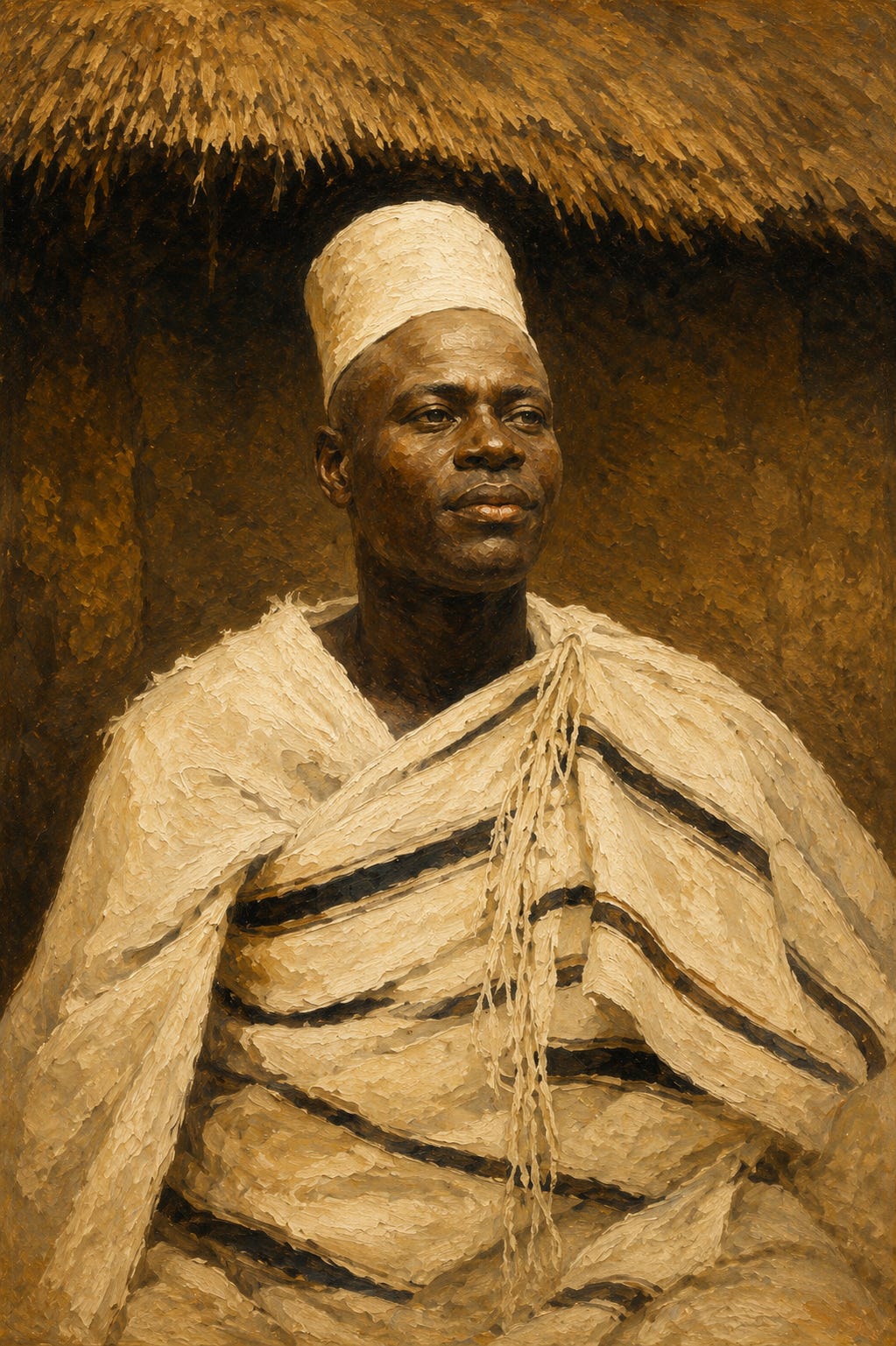
If you read the opinion piece that Fola Fagbule and I wrote in The Daily Telegraph last November, you would have come across the name of today’s character profile as something of a passing reference. I finally get the chance to write about him, at length, as I’ve been hoping to do for a few years.
Introduction: The Parrot’s Work
Chapter 3: Audu With The Big Belly
In 1964, in a storeroom at Mkar in central Nigeria, a Tiv labourer sweeping out boxes and old paper picked up a document whose cover termites had already started to eat. He set it to one side. Later, doing yard work for the principal of the secondary school down the road in Gboko, he produced it and asked: should this be thrown away with the rest of the rubbish?
The principal opened it. The first line, in Tiv, read: “It was almost twenty years ago when I first contemplated writing this book.” The next page was a torn cover sheet, hand-printed, that said AKIGA’S HISTORY, and beneath it, in ink, History of the Tiv By Akiga. As luck would have it, one of the teachers at the school was a man named Ezekiel Akiga - a son of the author. Together they decided the document should not go in the bin. In September 1964 they carried it to the library of the University of Ibadan and deposited it there, where it sat, quietly, for the next half-century.
The rescue from the rubbish was not the first time the text had been saved, nor the last. A dozen years earlier, in 1952, an American anthropologist working at the same Mkar mission station had come across another copy and had it typed out with the help of a Tiv typist. The paper survived through a relay of fragile custodies - a copyist here, a sympathetic principal there, a son who recognised his father’s name, a university shelf - each handing it on before it could be completely damaged. A history of a people who built their world on speech very nearly perished as a pile of insect-eaten paper. It kept being passed, hand to hand, by people who happened to be in the right place at the right time.
What had nearly gone into the dustbin was the longest book a Tiv man had yet written about the Tiv: some 380 pages of typescript, around 190,000 words, finished in manuscript in 1935. Its author was Benjamin Akighirga ‘Akiga’ Sai, a mission houseboy turned evangelist, translator, witness and historian. He had set down the genealogies and the clans, the names of plants and the preparation of food, the marriage customs and the rituals, the arrival of the white men with their wire and their guns and their courts - and, more dangerously, the conduct of the chiefs those white men appointed. He wrote it so that the new generation of Tiv who could read might read it and tell those who could not.
For seventy years, almost nobody read what he actually wrote. What they read was a different book. In 1939 the International African Institute published, through Oxford, an English version edited and annotated by a colonial education officer named Rupert East. It was a genuine act of preservation and a genuine act of reduction. East cut the text by more than a third, rearranged it, supplied his own notes and headings, and conceded with disarming honesty that he had chosen what to keep “not so much for their intrinsic merit as for their general interest to Europeans.” He also changed the title. History of the Tiv became Akiga’s Story: The Tiv Tribe as Seen by One of Its Members. In four words, the author became an informant.
Only in 2015, when the rescued typescript was finally translated whole - no section omitted, the order left as Akiga laid it down - did the full book reach the world. The half-century between the rubbish bin and the complete translation is, in a way, the subject of this chapter. So is the quarter-century before it, when a one-eyed boy given away to a mission learned to read the new system of wire and court and Bible, and to explain it, in both directions, to people who could not.
That is what the manuscript contained: a memory of conquest. Telegraph poles going up through the bush and being cut down again. A market quarrel that became a massacre. A burning trading store on the Benue. Chiefs put on a train to Kaduna and shown the size of the thing that now ruled them. Wives seized, taxes counted on tally sticks, a gallows, a Bible rendered into a language that had never had one. To understand why a Tiv man came to write all this down in the first place, you have to begin with the wire and the fire.