

First, the usual throat-clearing.
The Financial Times have done another big piece on Aliko Dangote, in which he is given almost free rein to make all sorts of claims about what he is doing and plans to do. What is always missing is what he has actually done. But we will come to that.
The author of the newest piece is David Pilling. I should stress that I know Mr. Pilling and he is a great guy - not flattery. I should also disclose that not very long ago I was the beneficiary of a rather handsome meal in London, courtesy of Mr. Pilling himself. On any other topic I would simply send him a WhatsApp and spare you readers another rant. But on the subject of Aliko Dangote, and the Nigerian (low quality) billionaire class in general, I insist on conducting my disagreements in public. This is the topic I feel most strongly about, for reasons that begin and end with the long and very dark history of Nigeria.
Were someone to make me Maximum Ruler of Nigeria for a single day, one of my first acts would be to give Aliko Dangote to any African country that wants him. (None do, but the offer stands.) A nation need only ask, and I will arrange delivery to the location of their choice, completely free of charge. I will dismantle and ship all his cement plants along with him, and throw in a $100 million ‘acclimatisation payment’ so his new country can settle him in properly. The only condition is that he can never be returned to Nigeria.

So you say you are a catalyst?
Lately Dangote has taken to claiming he is on some mission to ‘industrialise Africa’. The claim is now making its way into the media, repeated so often that you can tell it is destined to become one of those catchphrases designed to stop people from thinking.
The facts are these. Dangote began importing and selling cement in Nigeria in 1981; the operation became Dangote Cement in 1992; and in 2000 it began ‘manufacturing’ cement in Nigeria. Cement is the foundation of modern civilisation, and if a man tells you he is going to industrialise a giant continent, you would expect some sign of it across three decades. Dangote is not an unknown quantity. He has a very clear track record - of behaviour, of business practices, and most importantly, of the things he does not do.
The part of the interview I really want to focus on is this:
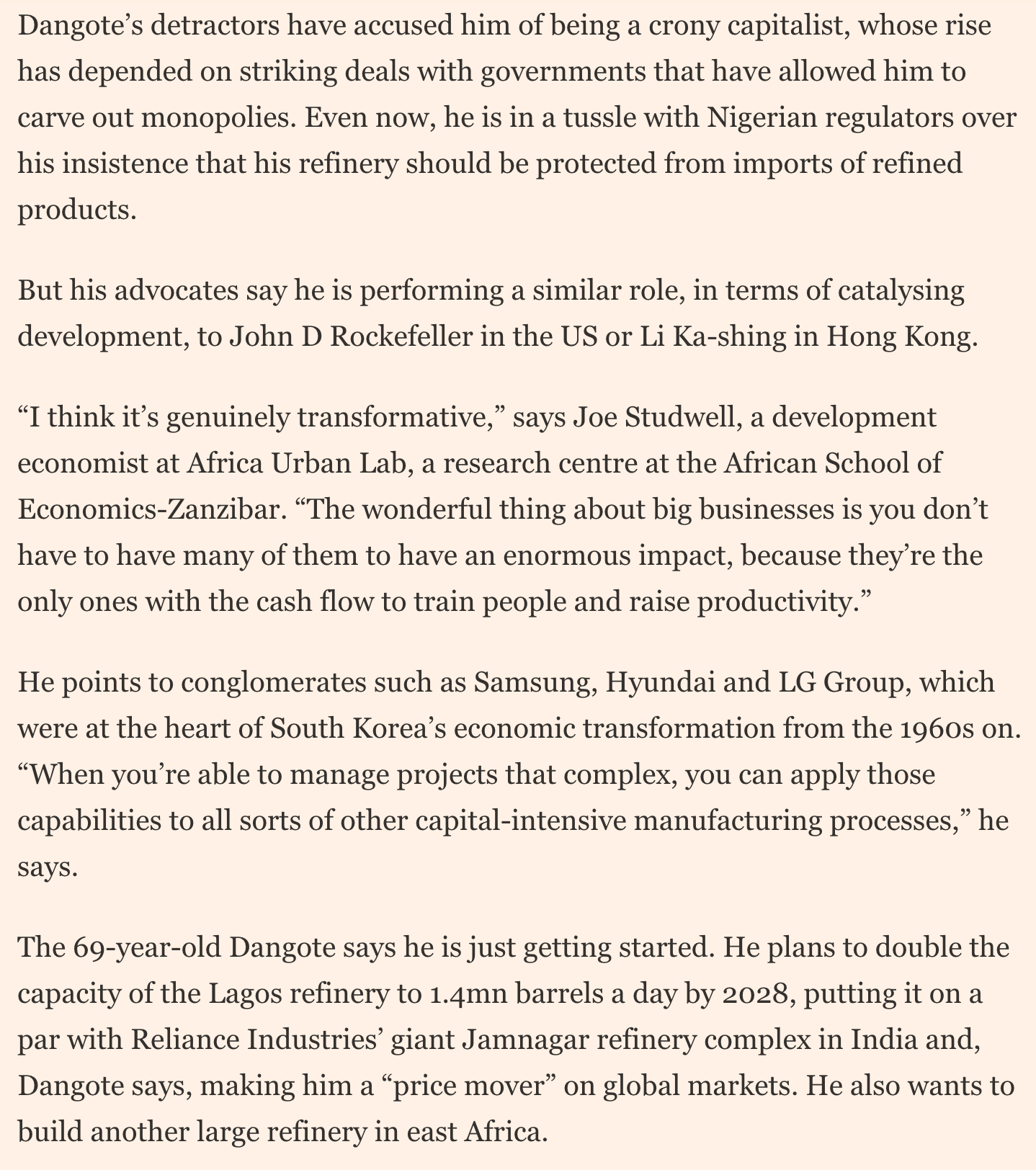
I think he is worse than a crony capitalist actually. He is a malign psychological influence on Nigeria (which is why I now think it is important to respond to these pieces publicly) whose goals and practices are completely misaligned with those of any country serious about economic development.
Later in the piece, Professor Ken Opalo raises the question which is the main subject of this piece and Dangote’s claims about industrialisation:
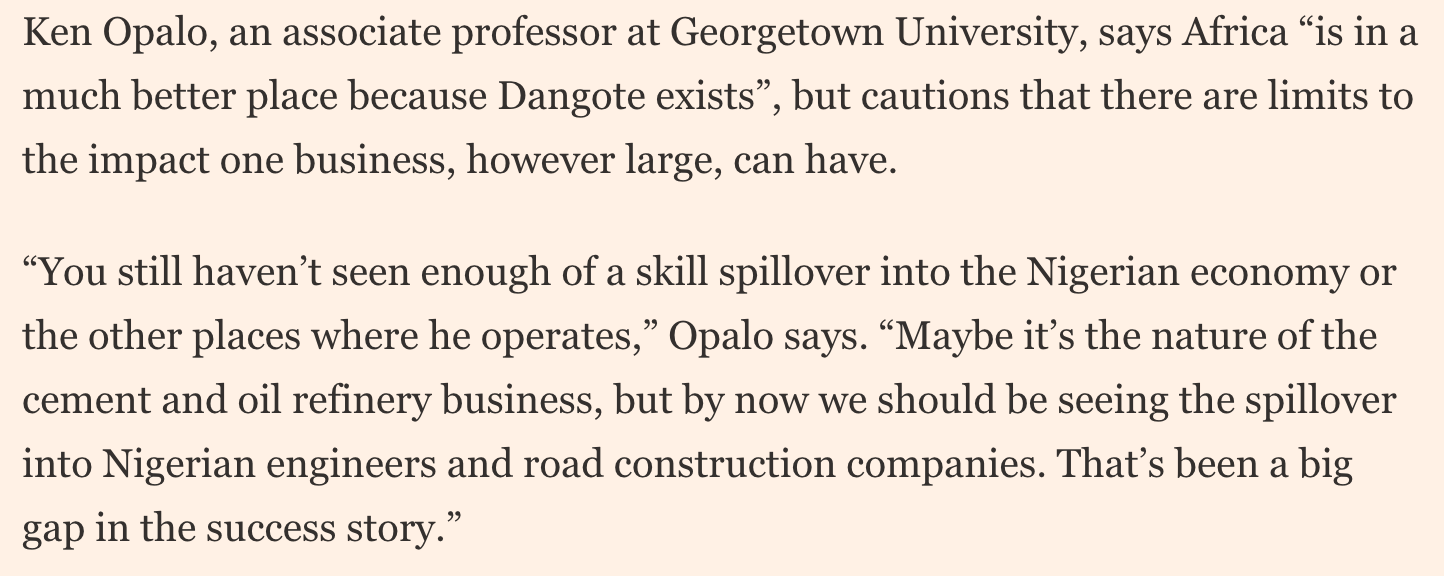
The situation is far worse than Professor Opalo imagines.
The Rockefeller Comparison
If I had a dollar for each time John D. Rockefeller’s name was invoked as a comparison to Dangote, I’d be as rich as Rockefeller himself now. Industrialising a country or society is not just about what you yourself do, it’s also about the things you seed in the wider economy.
Rockefeller incorporated Standard Oil in 1870, alongside William Rockefeller, Samuel Andrews, Henry Flagler, Stephen Harkness and others. By 1872 it had swallowed nearly every refining firm in Cleveland, two New York refineries besides, and already ran its own cooperage, storage tanks, warehouses, and plants turning out paint and glue. It was a capability machine, spanning everything from refining to finance to R&D (Dangote spends nothing on R&D). And when people joined Standard Oil and later left, they went off to seed businesses across the economy - which is to say, they became part of the American industrialisation story.
Joseph S. Cullinan joined in 1882, rose to managerial level, and left in 1895. He founded Petroleum Iron Works, making steel oil-storage tanks, then founded the company that became Texaco and helped build the Texas oil industry.
Standard Oil hired Herman Frasch to solve ‘sour oil’ and bought his process and his company along with him. It put him in charge of what is described as the first experimental research programme in the American petroleum industry. He went on to build the Frasch process for sulphur mining and became president of Union Sulphur, which grew into the world’s leading sulphur-mining firm.
John L. Severance (cool name!) graduated from Oberlin College in 1885 and joined Standard Oil. He left in 1892 and founded a string of companies, among them Linde Air Products - which survives today as Linde plc, now headquartered in the United Kingdom with $33 billion in revenues.
How about Edward M. Wilhoit? He joined Standard Oil as an oil wagon driver in 1882 and stayed eight years. He left to establish E.M. Oil Company, which grew to a hundred fuel distribution stations and a refinery of its own.
Louis Blaustein arrived in New York as an immigrant in 1883 and got straight into the oil business, selling kerosene by the can. He later joined Standard Oil and climbed to an executive position before accumulating enough capital to strike out on his own in 1910, founding the American Oil Company - later Amoco, today part of BP.
Edward T. Bedford was a Standard Oil executive and director. In 1902, while still within the Standard Oil world, he founded Corn Products Refining Company, which later became CPC International and is now associated with Ingredion. He resigned from active Standard Oil management in 1909 to devote himself to Corn Products.
Henry H. Rogers joined Standard after Rockefeller bought Charles Pratt & Co. He became a major Standard figure and later moved heavily into gas, copper, steel, banking and railroads. Rogers and William Rockefeller were part of the group that created Amalgamated Copper in 1899, and Rogers later built the Virginian Railway.
I could go on all day with dozens of other examples but you get the picture by now. One more example that is not a person. Chesebrough Manufacturing, maker of Vaseline, became part of Standard Oil in the early 1880s and regained independence after the 1911 breakup.
The Rockefeller comparison is useful only if we take it seriously. And taken seriously, it poses a simple question to anyone who draws it: after nearly three decades of Dangote Cement, where are the Cullinans, the Blausteins, the Bedfords, the Frasches? Where is the talent that cut its teeth inside Dangote Cement and carried that capability out into the wider economy? Where is the Dangote Mafia? Where are the bright young engineers, trained at Dangote Cement, who have gone on to found the cement-adjacent Nigerian firms - in refractories, admixtures, aggregates technology, cement chemicals, quarry systems, kiln services, plant automation, waste-heat recovery?
The truth is there are none, because Dangote manufactures cement only in the very loosest sense of the word. As I have documented at length, the company buys technology from China and sells it to Nigerians at a markup. The actual technical work is left to the Chinese to figure out. Nobody comes out of Dangote Cement having learned anything worth knowing.

So here is a challenge for the FT, and for all the media who like to write endlessly about Dangote industrialising Nigeria: take a camera crew into any Dangote Cement plant and film the manufacturing process. Manufacturers showing off how they make things is an ordinary courtesy in most societies. It is not something you ever see with Dangote Cement. (I know someone who has been inside one of the plants, and when they described what they saw in there, we had a good laugh about it.) This story is already being repeated with the refinery (as it was with urea) because Dangote only has one mode as a businessman.
Talent Hoover
And it gets worse, because the truth runs in the opposite direction to the legend. Dangote Cement is not a talent incubator at all. It is a talent importer. Far from training up engineers and sending them out to enrich the wider economy, the company has perfected the reverse habit: taking ready-made talent off its competitors.
Its visible senior operating bench has been assembled by repeatedly hiring mature cement professionals from Lafarge, WAPCO, Ashaka, Blue Circle, and from across the wider LafargeHolcim, Holcim, ACC, Ambuja, Scancem and Cemex universe. The expertise that runs Dangote Cement was paid for, fully formed, by somebody else.
I compiled this table a while ago for another article I wanted to write (the things I do for you eh?) but this is a good place to use it:
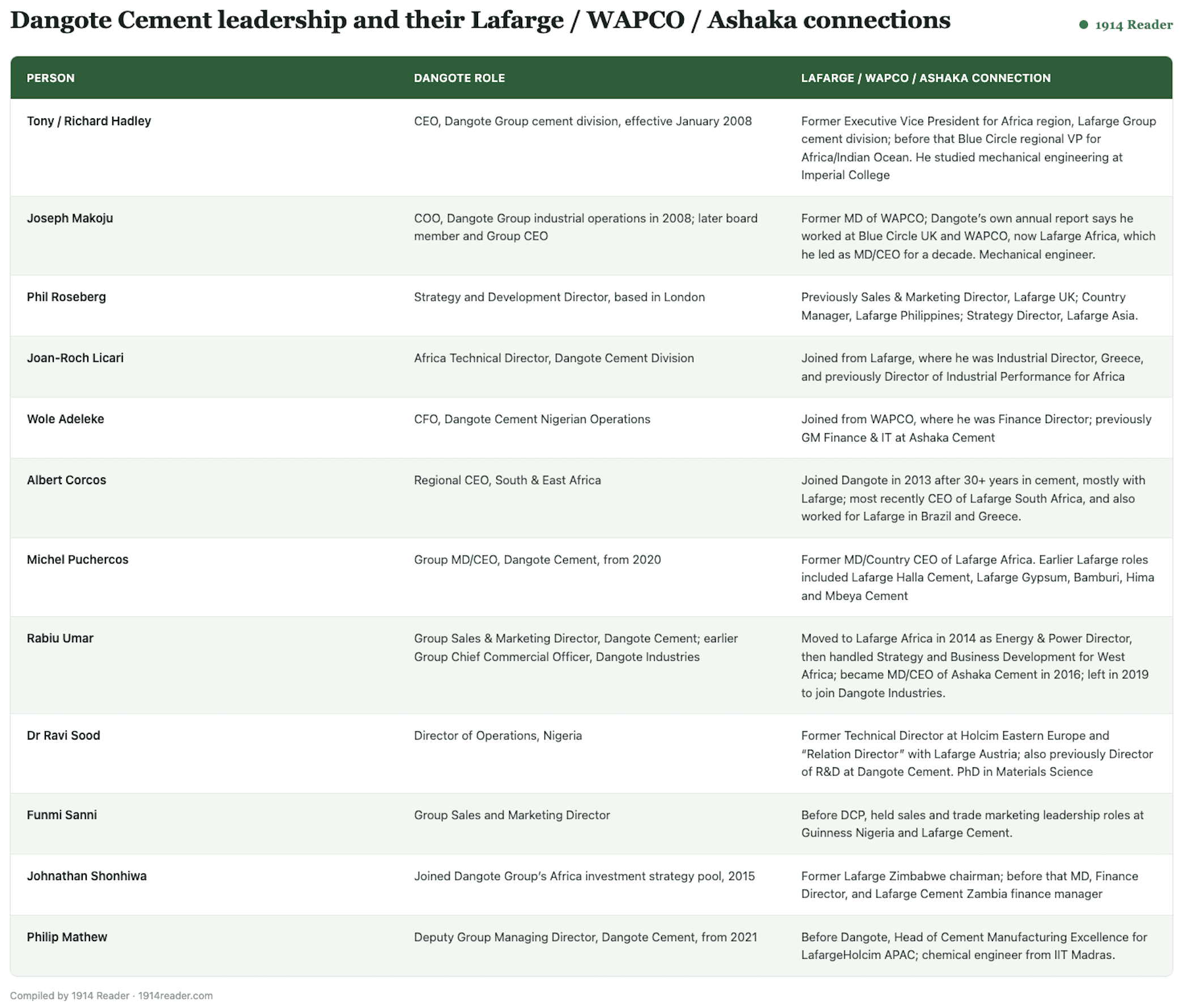
These are just the ones I could find, and only at the most senior level. There are surely many more in the middle ranks. None of which should surprise anyone. At no point in his long career as an ‘industrialist’ has Dangote shown the slightest interest in technology ownership or mastery, in research and development, in innovation, or in actual problem-solving. His focus has always been narrower and surer: find something already innovated elsewhere, for which demand has already been proven, secure government backing to shut out its importation, and then squeeze every last drop of margin from the privileged position that results.
No Nigerian, living or dead, has benefitted more from Nigeria than Dangote. He has amassed the greatest fortune the country has ever seen (the Nigerian government sold Nigerians off to him as a package and captive market. Sound familiar?) In return for this singular opportunity, he has bequeathed it no technology, no innovation, no diaspora of talent. He owns almost all of his companies outright. Nobody but Dangote is going to get rich from the coming Dangote Refinery IPO - though he does pay some dividends to his fanboys, who then proceed to sing his praises to the heavens.
Aliko Dangote is not going to industrialise Nigeria, let alone Africa. He is not Rockefeller, and he is no Asian Tiger. He is simply a very sharp-elbowed and ruthless businessman who is concerned with himself and himself alone, and who will do damage to his own country - or yours - the moment he feels you are standing in his way.
Those are the facts. So when you see a statement like the one below - engineered to railroad you into accepting it as truth by the sheer force of repetition - remember that the only part of it that survives contact with the evidence is “he’s made money”
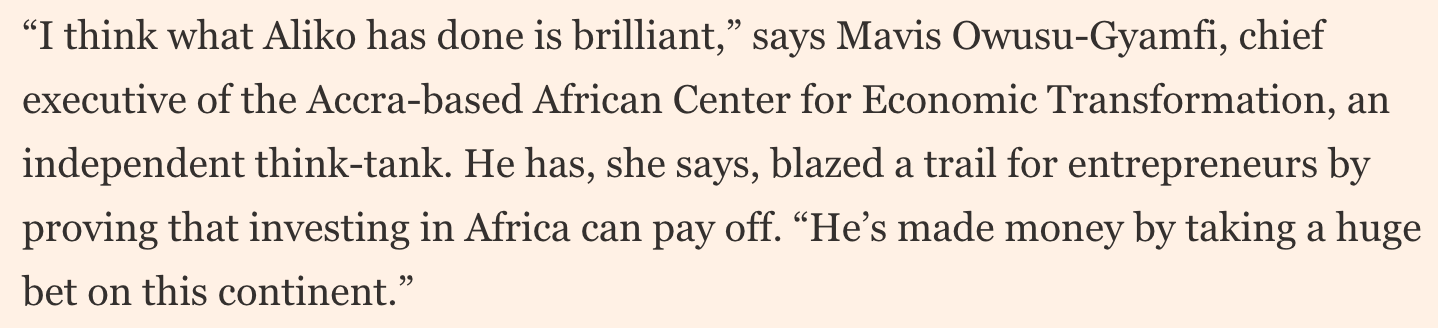
If you must have a hero, look elsewhere for one.
Cullinan, Frasch, Blaustein and others didn't leave Standard Oil to be generous. They left because they and the firm had built something worth leveraging, and a competitive market outside was willing to reward the leverage. For Dangote, the question isn't just "where is the diaspora", it's what would have created the pressure to build something worth diffusing in the first place.
It's worth noting what Dangote has clearly figured out: reading the political landscape accurately, building protection that proved durable, scaling at a pace most firms don't manage. Those are real capabilities. The sadder part of the Rockefeller comparison is the counterfactual: what if the same drive and scale were applied to competitive markets, with performance conditions?
Political protection without competitive discipline removes the pressure to build something worth diffusing. There's nothing to leverage out, because there was never an incentive to build it in. The talent, as you observe, was imported.
The Asian Tiger line is worth following further. The chaebol were also politically connected and protected. What was different was the attached export condition. Korean firms had to prove they could compete internationally, or they would lose the licence. That external discipline created the capability-investment pressure that the domestic market couldn't generate.
The harder part of that comparison is whether the condition was the cause or whether governments able to impose and hold it were already different in kind. A Nigerian state that could enforce an export-performance requirement on Dangote would be a different kind of state from the one that issued the licence.
That gap is the harder problem, and probably the one Opalo's question is really pushing at.
Yet to read it. But I'll quickly drop this comment - Dangote for President 😁
Edit: Finally read it. Yes. Dangote has his issues no doubt. Major issues. But the main reason why I'm a fanboy is primarily because of the topic hechooses to highlight - The Industrialization of the African Continent.
The Industrialization of Africa is an imperative. It's something that we must do if we're to be taken seriously. The descendants of people whose ancestors were conquered en masse because of the industrial revolution should not be sitting back and be thinking of laissez faire economics. Industrialization is a must.
Prior to Dangote, barely anyone in Africa was talking about it. Everyone was stuck on the whole neoliberal kool aid of "let the market decide".
Now with someone like Dangote preaching the industrialization imperative left, right, and center it has now become top of mind. And people, like you, can now analyse his approach and point out where his failings are.
Ultimately, if we're looking at progress towards industrialisation, Dangote's presence is a plus. Not a minus. It might be a plus 1 as opposed to plus 5, but it is still a plus regardless. Better to have a Dangote refinery that isn't optimal than to have no refinery at all. At least with the refinery on ground, we can talk of policy choices to steer it in the right direction. You won't have that if there is nothing on ground and we were all waiting for "the market to decide".