

Welcome to all our new subscribers and readers. This unvarnished newsletter about Nigerians in Nigeria and around the world goes out every Saturday morning at 10am UK time.
This week on main, Tobi argued that Africa’s development depends on building competitive, capability-growing firms within a political economy that rewards productive risk-taking over rent-seeking. I wrote a response to the FT piece celebrating Aliko Dangote as an industrialist pointing out what has so far been missing from the story. And in keeping with the same theme, a new Chinese cement giant has arrived in Nigeria. I trace their journey from technology acquisition to mastery and why it is a test for Nigeria.
Enjoy the week’s selection below
Nigerian Media
Sachetisation eventually comes for everything in a poor country. It is the turn of powerbanks:
With electricity shortages and limited charging points frustrating residents in some areas of Kano State, and the country in general, a group of youths in Kwanar Ungogo have innovatively devised a new way to ease the burden on residents while earning a living. Backed by Mopo Company, a team of young agents under the supervision of Area Manager Zainab Shuaib now operates a power bank rental service in the community. At the outlet visited by our reporter, three agents manage the day-to-day rental operations, each equipped with more than 70 power banks, while a dedicated charging station located within the neighbourhood ensures that returned devices are recharged and made ready for the next customer.
For just N300, customers can rent a power bank for 24 hours long enough to charge a mobile phone four or five times. What initially appeared to many residents as an unfamiliar innovation has quickly gained acceptance, attracting customers not only from Kwanar Ungogo but also neighbouring communities such as Dawanau and Rijiyar Lemo.
A visit to the outlet by Weekend Trust showed a steady stream of customers tropping to the place. Some came to return power banks borrowed the previous day, while others waited patiently to rent a fully charged power bank. Before handing over a device, one of the agents verifies the customers’ details and activates the power bank through a mobile application. Without that activation, the device can’t be used. Returned units were later taken to the company’s charging station, where they were recharged before being returned to circulation.
I’m guessing he posted the video online to make some Elon money?
The Anambra State Police Command has said that the man behind the viral security claims circulated on social media, alleging that a military helicopter dropped unknown items in a bush between Nimo and Adazi-Nnukwu communities in Anaocha Local Government Area of the state, has been arrested.
Recall that the claims, which spread rapidly on Thursday, raised concerns among residents and triggered public anxiety over possible security threats in the area.
In response, the police dismissed the report, describing it as a “false alarm” capable of causing unnecessary panic and undermining public confidence in the state’s security network.
However, in a statement issued on Friday, the command’s spokesperson, SP Tochukwu Ikenga, said the suspect behind the claims was arrested by residents of the affected communities, led by the President-General, on Thursday.
Ikenga said the suspect is currently in custody, adding that investigations revealed he recorded the video from a house.
He said, “The individual who recorded and circulated the video has been arrested and interrogated. He is currently being held in custody.
“Investigations revealed that he recorded the video from a house near CKP and was nowhere near the location he claimed in the video.
“During interrogation, he admitted that he never saw any helicopter land and that he fabricated the story based on hearsay.
Buildings collapsing are now so frequent that the only place you will find the stories below the headlines. And note the highlighted part below for added effect:
Tragedy struck in Lagos when a three-storey building located in the Alakija axis, Amuwo-Odofin Local Government Area, collapsed, which has thrown the entire area into panic mode.
As of press time, the number of casualties could not be ascertained, as there are victims said to be trapped under the rubble.
According to reports, the incident occurred unexpectedly and sent shockwaves through the community, as residents and passers-by rushed to the scene in fear of possible casualties and further structural failure.
An eyewitness account stated that the building suddenly collapsed at about 11:40 a.m. on Thursday. The incident disrupted normal activities in the neighbourhood, with people fleeing surrounding buildings for safety.
How much do pistols cost in Okrika?
The Rivers State Police Command has thwarted an alleged attempt to transport an illegal firearm in Port Harcourt, arresting a suspect after officers discovered a Browning pistol concealed inside a loaf of bread during a routine stop-and-search operation.
The unusual recovery, described by the police as evidence of the increasingly sophisticated tactics employed by criminal elements, occurred along Azikiwe Road near the Red Cross Junction in Port Harcourt.
According to a statement issued on Friday by the Police Public Relations Officer, ASP Agabe Blessing Kaborlo, the operation was carried out by operatives of the command acting on the directives of the Commissioner of Police, CP Olugbenga Adepoju.
The statement explained that officers intercepted a vehicle during a routine security check and conducted a thorough search of the occupants.
During the search, a Browning pistol was allegedly found ingeniously concealed inside a loaf of bread belonging to one Braya Nanas, a male resident of New Road, Borikiri, who was travelling as a passenger in the vehicle.
Police said preliminary investigations revealed that the firearm had no visible serial number, a development that has raised concerns over its origin and possible intended use.
The suspect was said to have admitted ownership of the weapon during interrogation, allegedly telling investigators that he purchased the pistol in Okrika for the sum of N800,000.
This is the problem with podcasts (yes, I’m aware I’m also a podcaster). Once people see a Shure microphone and are given a comfortable chair to sit on, they start saying all sorts. I propose that podcasts should be recorded standing as a way of curbing this menace:
Nigerian lawyer and businessman Olufemi (Femi) Afolabi-Brown, has explained why he believes a man who intends to practise polygamy should wait about 25 years before marrying a second wife.
Afolabi-Brown, who is married to media personality Morayo Afolabi-Brown, shared his views during an episode of The Brown Couch Podcast, where he argued that a significant age gap between wives could help reduce rivalry and conflict in polygamous homes.
According to him, a man who marries his first wife at 25 should ideally wait until about age 50 before taking a second wife.
He said such a gap would ensure that the children from both marriages belong to different generations, making it easier for them to coexist peacefully.
“Your first wife ought to be a lot older than your second wife. You can marry your second partner at age 50 if you first marry one at age 25.
“So the first child’s children become like the older brothers, uncles and aunts to the younger ones. They are not of the same generation, so there will never be rivalry between them,” he said.
Afolabi-Brown argued that marrying a second wife only a few years after the first often creates unnecessary tension within the family.
Stuff like this shouldn’t be funny so why then am I laughing?
A United Kingdom-based Nigerian, Emmanuel Opeyemi Makinde, has a Federal Capital Territory, FCT, High Court that his travel agent, Mr Waliyu Aderibigbe Shitta, fraudulently added an unknown woman to his visa application in 2022 as his wife.
Opeyemi, while testifying in his evidence-in-chief before the court presided by Justice Ademuyiwa Oyeyipo, stated that the travel agent added one Miss Dolapo Afusat Yusuf, as his legally married wife without his knowledge.
He disclosed that the agent was introduced to him by his pastor, Mr Aregbesola Sanyanolu of Celestial Church of Christ, Jerusalem Parish, Ado-Ekiti.
Opeyemi further informed the court that your information provided by the agent later created serious problems for him with the UK authorities when he decided to bring his wife to the United Kingdom.
The travel agent, Shitta, is standing trial before the court for allegedly arranging a fraudulent marriage for Miss Dolapo Afusat Yusuf in order to facilitate her travel abroad, using Opeyemi’s identity.
Opeyemi told the court, “Throughout my dealings with the defendant, I consistently informed him (Shitta) that I was single for the purpose of my UK student visa application. After my wife completed her studies in 2024, I submitted an application for her to join me in the United Kingdom.
“One day while I was at work, I received an email from the UK Home Office requesting that I provide official evidence demonstrating that my partner’s previous marriage had been officially dissolved by the relevant court.
“I immediately sent a voice note to the defendant together with a screenshot of the Home Office email, explaining the consequences of the message I had received. After viewing the message, he blocked me on WhatsApp.
“I then contacted my pastor and informed him that we needed to report the defendant to the authorities. However, my pastor stopped responding to my messages and calls.
Non-Nigerian Media
File this under incredible things are happening:
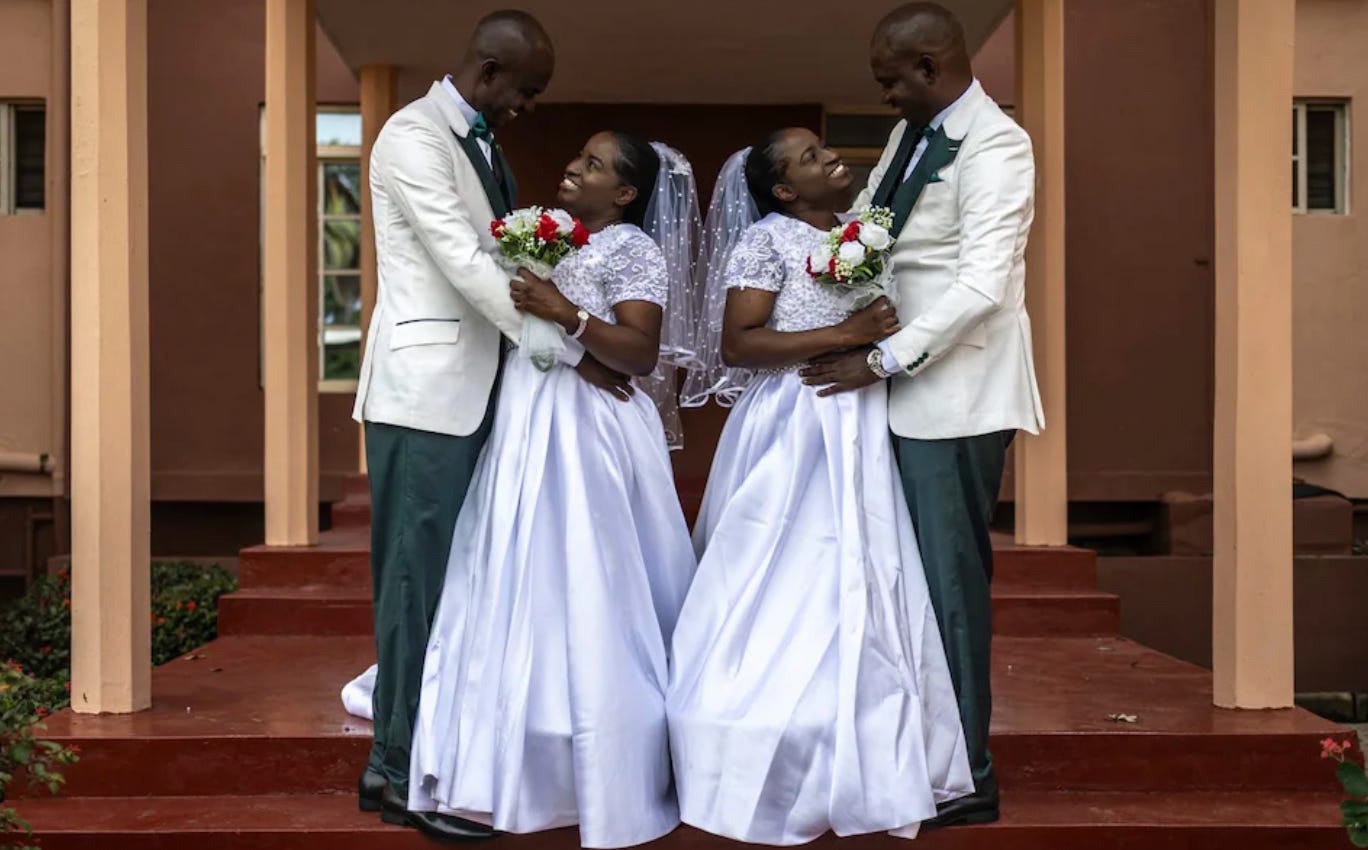
Twin Nigerian brothers have married identical twin sisters with matching names, and said each couple now hopes to give birth to twin children.
Taiwo and Kehinde Oguntoye married sisters Taiwo and Kehinde Adediran in the south-west city of Ibadan.
The match was made confusing for onlookers and guests because under local convention twins are given set first names, meaning the sets of siblings bear the same monikers.
The older child is called Taiwo, meaning “the one that tests the world”, while the younger is called Kehinde, meaning “the one that came after”, the BBC reported.
Guests celebrated as Taiwo Oguntoye married Taiwo Adediran and Kehinde Oguntoye married Kehinde Adediran.
“We know many twins, but this marriage feels like it was arranged by God. We have always dreamed of marrying twins,” Taiwo Oguntoye told BBC Yoruba on his wedding day.
“With God’s grace, we pray for twins in our first and second children. That is our heart’s desire.”
The brothers are fraternal non-identical twins, who are online travel influencers and style themselves as the most famous twins in African tourism.
The Yoruba people, who live in south-west Nigeria, are said to bear an unusually high number of twins and they are highly prized in families.
The couples reportedly met a decade ago, when all four were studying at the University of Ibadan.
Who was Diezani Allison-Madueke’s lawyer in her recent corruption trial?
Mark Bowen, a solicitor at Shearman Bowen, represented Diezani Alison-Madueke, a former Nigerian oil minister. His client was cleared of taking bribes from oil and gas industry figures seeking contracts in Nigeria to fund what the National Crime Agency alleged was a “life of luxury”. After a six-month trial a jury at Southwark crown court in London found her not guilty of six charges.
What were the biggest hurdles you had to overcome in this case?
The evidence served by the prosecution in the UK’s biggest bribery trial was vast. Getting on top of it and ensuring my client’s defence was properly presented was a huge and difficult task.
The ghastly garri is now enjoying some obviously paid for PR in the New York Times. Sad:
Across the African continent and its diaspora, a swallow is a starch that often begins as a grain, tuber or root that’s steamed, then crushed and pounded into an elastic dough. This process renders the starch pliable enough to mold and use for scooping broth or sauce from bowl to mouth. This version, known as garri or ẹ̀bà in Yorùbá, relies on cassava, a staple root vegetable across tropical regions of West and Central Africa, the Caribbean and South America, Among the many ways cassava is prepared, it’s milled into white flour, also called garri (or gari) across West and Central Africa, and farofa in Brazil, with granules ranging in size from fine to coarse. Yellow garri is a variety from the coastal Niger Delta region of Southeast Nigeria, where the garri is toasted with red palm oil to lend a unique pop of pale orange. Although most swallows are served unseasoned, this recipe has been enriched with a bit of red palm oil for a mild, floral taste. Enjoy garri alongside eru, okra soup with shrimp and greens, ègúsí soup and topped with ọbẹ̀ onírù or any braised meat.

You really have to wonder what on earth is going on in Nigeria and West Africa:
Not much remains today of the walls, ramparts and moats that once surrounded Benin City in southern Nigeria. Yet for centuries these giant earthworks—second in length only to China’s Great Wall among man-made structures—bespoke a mighty civilisation whose authority extended across much of west Africa. By the standards of pre-colonial Africa, the Benin state was exceptionally strong: erecting the wall in a single dry season might have required mobilising as many as 5,000 men, each working ten hours a day. But as the empire withered and eventually succumbed to British invaders in the late 19th century, most of the earthworks vanished. So did those of many other fortified towns across west Africa.
Now they are returning. Since the mid-2010s, as jihadist insurgencies have spread across northern Nigeria and the Sahel, defensive earthworks have risen up around towns and cities. Many are so extensive they are clearly visible in satellite images. According to new research by Olivier Walther and Steven Radil, geographers at the University of Florida, all urban centres in north-east Nigeria with populations of more than 10,000 are now secured by trenches. Most big towns there and in the Lake Chad basin are surrounded by sand berms up to three metres high.
Unlike those of the former Benin empire, the new walls and moats are a sign of state weakness. In Nigeria, the army began digging trenches with the help of the American government shortly after the notorious “Chibok Girls” kidnapping by jihadists in 2014. The goal, says an American contractor involved in the initiative, was to protect civilians and “hold the line” against jihadist advances. Militants in the Sahel typically carry out attacks using light vehicles such as motorcycles or pickup trucks. Trenches and berms are a simple, low-tech way to slow them down.
A Scotsman went to Nigeria and came back a believer:
I arrived in Lagos with a mixture of curiosity and expectation, but nothing quite prepares you for the scale and energy of Nigeria until you experience it first-hand. From the plane, Lagos stretches endlessly, a vast expanding landscape that mirrors a country growing rapidly in both population and economic ambition.
That ambition is immediately visible. Nigeria remains rich in natural resources, with oil and gas dominating revenues and exports, yet there is a clear shift under way. Increasingly, the conversation is moving towards minerals, agriculture, and most notably, technology as the drivers of future growth.
This shift was on full display at the Bluechip Data & AI Summit 2026. The event opened with the national anthem, sung by thousands of attendees with a genuine sense of pride and a collective statement of the belief in the country’s future.
[…]
Yet what stood out most was not the presence of these challenges, but the response to them. The resilience and optimism in Nigeria felt distinctive. The country’s young population is energetic, digitally connected and increasingly well educated.
That conviction was evident throughout the week. Founders spoke confidently about competing in global markets. Engineers discussed scaling infrastructure solutions, and entrepreneurs described ambitions to build businesses capable of lasting impact. There is a strong desire to succeed and create enduring value.
News from Germany:
A German court jailed 12 members of a Nigerian organized crime ring on Thursday for their part in so-called “love scams” and money laundering.
The court in Munich said those convicted were aged between 34 and 55 and were sentenced to prison terms ranging from three years and four months to eight-and-a-half years.
They were found guilty of involvement in an international network that was used to run romance-related scams and then illegally launder the proceeds.
The scammers used fake identities, for example posing as a U.S. soldier stationed in the Middle East, to approach victims on social media or dating apps and dupe them into believing they were in a personal or romantic relationship.
The victims were then asked to make money transfers to help with fictitious medical, travel or customs costs.
The court said the victims were mostly “women, elderly people or people with disabilities.”
The money was then transferred to an organization called “Neo Black Movement of Africa,” also known as “Black Axe,” based in Nigeria but active worldwide.
The origin story of Yikodeen:
A delayed national service assignment prompted Nigerian entrepreneur Yinka Atunde to pivot from a planned career in technology to launch a safety footwear company, Yikodeen, which recently secured a $1.5 million investment to expand its operations across West Africa, according to Business Insider Africa.
Lagos-based Yikodeen received funding from Aruwa Capital Management in 2025. The investment will support the company’s growth as demand for locally manufactured industrial products in sectors including construction, manufacturing, oil, and gas increases.
Atunde, a computer science graduate of Babcock University, told the outlet that his career plans changed in 2015 after delays to Nigeria’s National Youth Service Corps program gave him time to reconsider his next steps.
“I literally had nothing going on, and I kept asking myself what I actually wanted to do with my life,” Atunde said.
Instead of pursuing graduate studies abroad or accepting a technology role, Atunde enrolled in footwear production courses in Italy and later gained experience working in Nigerian factories before launching Yikodeen in 2016.
The company initially produced about 20 pairs of shoes a day using refurbished equipment, the publication reports. Atunde said one of the company’s earliest challenges was convincing customers that Nigerian-made safety footwear could meet the quality standards of imported brands.
“We were spending heavily on testing and certification without knowing if it would even lead to orders. It was a long, uncertain process, but we just kept pushing.”
Yikodeen has since expanded its manufacturing capacity to approximately 500 pairs of safety footwear per day and now employs more than 150 workers.
You may recall the story of Franklin Nwadialo (BTH - 90) who went back to the US in 2024 knowing he had committed fraud there:
A 42-year-old Nigerian national was sentenced late yesterday in U.S. District Court in Tacoma to five years in prison for his scheme to steal some $3.5 million from eight different victims via an online romance scam, announced First Assistant U.S. Attorney Charles Neil Floyd. Franklin Ikechukwu Nwadialo was arrested at an airport in Texas upon his arrival in the U.S. in 2024. He was indicted in December 2023 for 14 counts of wire fraud connected to his romance fraud scheme. At the sentencing hearing U.S. District Judge Tiffany M. Cartwright called the crime “devastating,” noting that it is “not an exaggeration to say it ruined lives—not only financial lives” but also from the nonmonetary harms the victims endured, such as “shame, depression, and isolation from their own family.”
“This defendant preyed on those already suffering from the loss of loved ones or other heartbreak. For some 15 years he upended the lives of people he never met,” said First Assistant U.S. Attorney Neil Floyd. “He spun tale after tale to gain the victims’ trust and their money – even claiming to run a non-profit providing services for autistic children. No scheme was too low for these conspirators.”
“For years, Mr. Nwadialo preyed on vulnerable victims looking for relationships online, gained their trust, and told them lies to steal their life savings totaling millions of dollars,” said W. Mike Harrington, Special Agent in Charge of the FBI Seattle field office. “Fortunately, although he operated his romance scams from overseas, Mr. Nwadialo ultimately traveled to the United States where he could be arrested and held accountable for his crimes here in the Western District of Washington.”
United States Attorney’s Office
And a quick stop in Seattle:
A 48-year-old former Bellevue, Washington woman was ordered into custody yesterday to serve five months in prison for stealing the Social Security benefits intended for a disabled minor – a member of the Snoqualmie Tribe, announced First Assistant U.S. Attorney Charles Neil Floyd. Akeatha Diane Akintola pleaded guilty yesterday to theft of public funds for the $17,638 she stole from the tribal member. At the sentencing hearing, Magistrate Judge S. Kate Vaughan said she was struck by the fact that Akintola “targeted a vulnerable victim” – there is “no one more vulnerable” than the victim in this case. The crime was an “ethical breach beyond imagining,” Judge Vaughan said.
According to records filed in the case, Akintola became a social worker for the Snoqualmie Tribe in January 2023. In September 2023, Akintola applied by telephone to be the Social Security Representative Payee for a minor child with intellectual disabilities who was a ward of the Tribe. The child’s mother had died leaving survivor benefits to the child. The Tribe prohibits its social workers from becoming a representative payee for any child under its care. Nevertheless, Akintola used the child’s Social Security number and her own to apply to be the minor child’s representative payee and, once appointed as such, had the benefits intended for the child deposited into a bank account she controlled. Akintola spent the money that was deposited in the account for her own benefit, including a purchase at a North Bend retailer.
In July 2024, after Akintola had been collecting the benefits for at least five months, she went with her supervisor to the Social Security Administration to determine what had happened to the victim’s funds. When Social Security reported that Akintola was the representative payee, Akintola denied it to her supervisor. She resigned from her position with the Snoqualmie Tribe the next day.
United States Attorney’s Office