

Anyone who has been reading us lately will have noticed an obsession around technology mastery as a central plank of economic development. Development, note - not growth, which is a very different thing. By mastery I mean the ability of African countries to acquire a technology, understand it, master it, repair it when it breaks, and then extend and expand it as they see fit. Buying the technology is only the first page of the story. It is when you reach the part where you actually own the knowledge - when you can rebuild the thing yourself - that you can be said to be cooking with gas.
To Save The Qing
Zhang Zhidong was a conservative mandarin trying to save the Qing state from what he was certain was its coming death. His remedy was to strengthen the state with schools, factories, weapons, railways, and Western technology. The late Qing era had a phrase for that belief - ‘Chinese learning as essence, Western learning for practical use’, 中学为体,西学为用. In his 1898 Quanxuepian, or Exhortation to Learning, he argued that China should keep its Confucian moral and political foundations while taking on Western science, industry, military methods and technical education. This was, to his mind, a kind of defensive modernisation where you learn just enough from the barbarians to avoid being dominated by them.
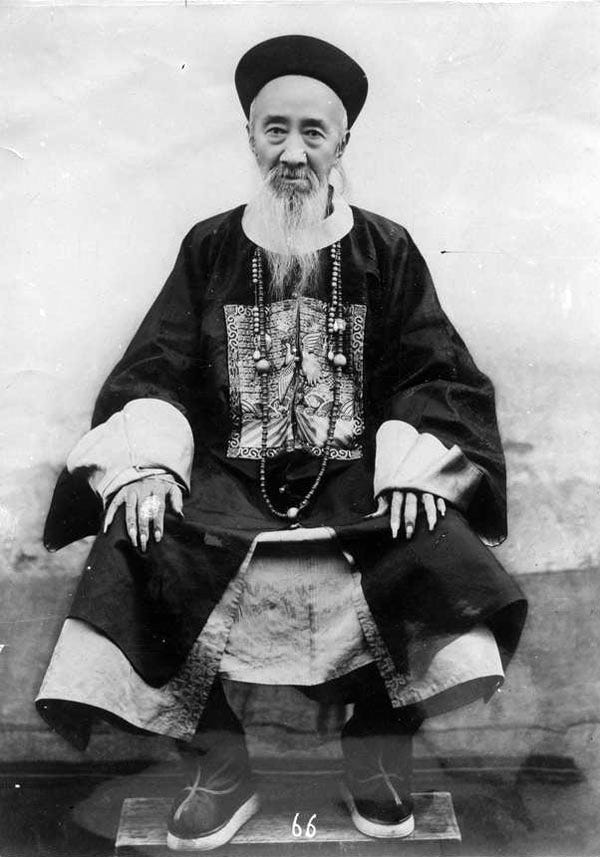
Zhang arrived in Hubei in 1889 as Viceroy of Huguang, governing the Hubei-Hunan region. Hubei sits in central China on the Yangtze river, and it has a long habit of being the place the country’s political and industrial transformations pass through. It became one of the laboratories of Zhang’s programme where he pushed railways, mining, ironworks and factories - and out of it came the Hanyang Iron Works, the Daye iron mine, the province’s early railways, and the supporting industries around them. This was a serious attempt to build modern heavy industry in the middle of China.
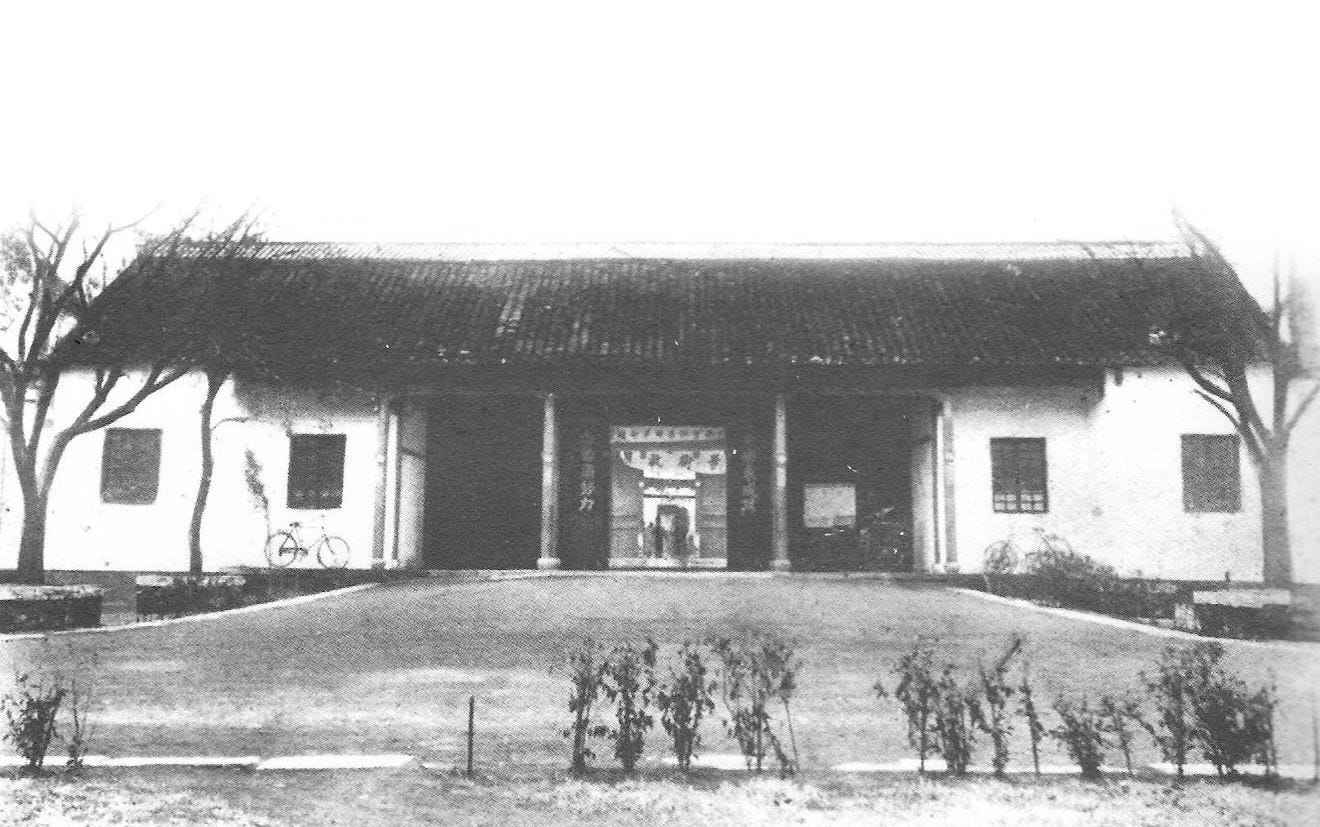
Around 1907, Zhang backed the Hubei Cement Factory at Huangshi, one of China's earliest modern cement plants and part of the same ecosystem of iron and machinery. The Qing government's construction of the Yuehan railway called for large quantities of cement, and Zhang wanted to turn that demand to the advantage of a domestic cement industry. Officials surveyed sites, found good raw material in the Huangshi area, and in 1907 the entrepreneur Cheng Zufu accepted an invitation to run the plant.
Four years later, the Wuchang Uprising of October 1911 broke out in Hubei and became the opening shot of the Xinhai Revolution that ended the Qing dynasty.
Zhang never mistook industrialisation as just some procurement exercise. Foreign machines without trained people, he thought, would only deepen dependency - so alongside the factories he built a dense web of schools across Hubei: for languages, mathematics, mining, military science, agriculture, the industrial crafts, and the training of teachers. The Ziqiang Institute, which he founded in 1893, began with foreign languages, science, mathematics and commerce, and over time bent towards Western languages in particular - English, French, German, Russian and eventually Japanese. At the Hubei Industrial School the curriculum was steam engines, lathes, drawing, casting, blacksmithing, copper and wood work, glass and the rest, with the students moving between the classroom and the workshop floor. “When discussing China’s national industry, Zhang Zhidong cannot be forgotten when talking about heavy industry”, Mao would later say of him.
Buy American
In 1946, the Hubei Cement Factory bought cement-making equipment from Allis-Chalmers, the American heavy-industrial machinery group. If Allis-Chalmers sounds familiar to regular readers, that is because it is the same company behind Hyundai's rapid skills upgrade in cement manufacturing in South Korea in 1964. Hubei bought two large wet-process rotary kilns, each 3.5 metres by 145 metres, with supporting equipment besides, all of it housed in a plant designed by another American firm, the McDonald Construction Company. The kit and the plant together, in a place called Huangshi, earned it the name 'Far East No. 1'.
The technology Hubei acquired was built around the rotary kiln, one of the decisive machines of modern cement-making. A rotary kiln is a long steel cylinder, tilted slightly and turning slowly, lined on the inside with a heat-resistant material so the steel itself does not melt. Raw material goes in at the high end; intense heat comes in from the low end. As the cylinder turns, the material tumbles slowly down towards the flame, drying out, then heating, then baking until it chemically breaks down, and finally fusing into hard nodules. Those nodules are called clinker. When you grind the clinker together with gypsum and a few other materials, you get cement.
Thomas Russell Crampton patented an early rotary kiln in Britain in 1877, and Frederick Ransome improved on it later. But it was the United States that turned the rotary kiln into a machine for producing cement at real scale. José de Navarro bought the American rights in 1889 and helped get successful production going at Coplay, Pennsylvania. By 1905 the largest kilns had grown enormously, and by 1907 the United States was making roughly half the world’s cement. Thomas Edison appears in this story too. Around 1899 he carried ideas across from ore milling into cement, and his most important contribution to the industry was a longer kiln that produced more for the same effort - his version of the kiln was about 150 feet, against a standard of 60 to 80 feet at the time.
What Hubei bought, in other words, was the visible end product of a deep and developed ecosystem.
Make it your own…
After 1949, with the Communist Party victorious, the Far East No. 1 plant became part of the industrial base of the new People’s Republic. Its cement went into the country’s landmark projects - the Great Hall of the People, the Yangtze River bridges at Wuhan and Nanjing, the Three Gorges scheme. Being called on again and again for work of that importance forced the company to build the things such work demands: reliability, standards, engineering competence, quality control.
The turning point came in the 1970s. In 1975 the firm, by now Huaxin, designed and built its own third wet-process kiln - later known as the ‘Huaxin-type kiln’. It entered production in the late 1970s, and the design went on to be used widely across China and exported in more than twenty production lines. Then, through the 1990s and 2000s, Huaxin moved from the older wet process to the more advanced dry process. Its new 2,000-tonne-a-day clinker line fired up successfully in 1994, marking the shift; its 6,000-tonne-a-day dry-process line at Wuxue broke ground in 2004 and started up in 2005.
[A side note on names. I don't read or speak Mandarin, so I am leaning on translation tools for the Mandarin sources. Here is what I can piece together. The company was founded in 1907 as the Daye Hubei Cement Factory, the one referred to above. It was renamed Huaji Hubei Cement Factory in 1914; moved to Hunan during the war in 1940 and became the Huazhong Cement Factory; and then in 1943, Huazhong merged with Kunming Cement to form Huaxin Cement Co., Ltd - which is where the Huaxin name first appears. So if you are wondering why I switched from Hubei to Huaxin above, that is the reason. Corrections from anyone who reads the sources better than my software does are welcome.]
… and win awards
In 2023, Huaxin’s Huangshi plant won the World Cement Association’s Innovation Award. The headline feat was a cement line that burns more than 2,000 tonnes a day of ordinary household rubbish - the most municipal waste consumed by any cement line anywhere in the world. The impressive part is that the rubbish comes in wet, which makes it harder to burn. Pulling that off meant designing a new version of the chamber where the raw material is heated before it reaches the main kiln, so that the waste stays in the heat long enough to burn away completely.
The upshot is clinker made with far lower carbon emissions, driven by heavy use of rubbish and other substitutes in place of conventional fuel; a method for pulling marketable potassium salts out of the dust the kiln would otherwise throw away; and a way of taking the waste heat thrown off by the process, together with the leftover rock from quarrying, and turning both into low-carbon building blocks. For each item, the plant found another use for something it was previously wasting.
The Huangshi plant is the first in China to build a kiln line above 14,000 tonnes a day entirely at home, with no foreign suppliers involved - the world’s largest preheater tower, clinker cooler and coal-grinding system among them, all developed for the job. The company that in 1946 had to buy two kilns from Allis-Chalmers of America now designs and builds the biggest line of its kind on earth by itself.
In 2024, Huaxin’s Chongde plant won another WCA Innovation Award, this time for using machine learning to optimise difficult alternative fuels, especially high-moisture municipal solid waste. The project is a self-developed industrial-intelligence system covering advanced process control, intelligent material handling, online cement-quality control, and equipment monitoring, all aimed at stabilising production while using high levels of refuse-derived fuel.
The Holcim Investment
Holcim first bought into Huaxin in March 1999, through its Dutch vehicle Holchin B.V. The Swiss group was still referred to as Holderbank at the time, but this is the same corporate lineage later known as Holcim. Huaxin issued 77 million B-shares to Holchin B.V., making it Huaxin’s second-largest shareholder with 23.45%.
The stake then increased in stages. In April 2005, Holchin bought another 8.7613 million B-shares through a block trade, taking its holding to 26.11%. In February 2008, Holchin subscribed for 75.2 million new A-shares at RMB 26.95 per share, raising its stake to 39.88% and becoming Huaxin’s largest shareholder. This transaction value was reported at about US$282 million.
The context is that by the late 1990s and 2000s, China was entering a long infrastructure, urbanisation and construction boom. Cement demand was exploding. Holcim buying a stake in an established listed Chinese producer gave it a route into the market without having to build everything from scratch or fight local politics alone.
There was another strategic reason: Huaxin became Holcim’s main China platform. In 2003, Holcim sold its interest in Suzhou Golden Cat Cement to Huaxin, saying Huaxin was well positioned in Hubei and Jiangsu. Later, after the Lafarge-Holcim merger, LafargeHolcim sold most of its non-listed Chinese cement assets to Huaxin, explicitly saying this would streamline its China operations, reduce debt, simplify the local structure and leverage Huaxin’s scale and capabilities.
For Huaxin, the reasons for accepting Holcim’s investment were three-fold. First it needed capital as it was expanding aggressively and needed equity, not just debt. By 2007, it was building new dry-process clinker lines, grinding stations and regional capacity. Second, the balance sheet was stretched. By September 2007, Huaxin’s consolidated asset-liability ratio had reached 71.06%. The 2008 share issue raised about RMB 2.006 billion net, and the rating agency estimated that the capital raise would reduce the asset-liability ratio to about 56.82%. It was growing fast but debt-funded growth had limits. Third, Holcim brought capabilities Huaxin wanted. Since becoming a strategic investor in 1999, Holchin/Holcim has positively affected Huaxin’s corporate governance, financial management, internal controls and technical R&D.
In summary, Huaxin took Swiss capital and global cement know-how, embedded it in a Chinese industrial company, kept its own brand and management base, expanded aggressively, absorbed the technology, and eventually became strong enough to buy assets from the same global group.
Huaxin in Africa
In 2025, Huaxin reported revenue of about RMB 35.35 billion - roughly US$4.9 billion - with overseas revenue of about RMB 11.80 billion. It sold some 61.96 million tonnes of cement and clinker, 160.69 million tonnes of aggregates, and 28.32 million cubic metres of concrete.
Huaxin Cement is now formally Huaxin Building Materials Group Co., Ltd. The name change was completed in 2025, with the Hong Kong stock short name changed from “HUAXIN CEMENT” to “HX BLDG MAT” from 4 December 2025. The company said the change reflected a shift from a cement-centred business to a broader building-materials platform covering cement, aggregates, concrete, environmental services, new materials, engineering equipment, and overseas operations.
Earlier, on 29 August 2025, Huaxin bought 83.81% of Lafarge Africa Plc for US$773 million - and with it four large Nigerian cement plants, 10.6 million tonnes of annual capacity, and concrete, aggregates and environmental-treatment businesses besides. The deal took Huaxin's overseas footprint to fourteen countries and its overseas cement capacity past 40 million tonnes a year, the largest of any Chinese cement company. Huaxin’s domestic Chinese market is structurally pressured. Its 2025 annual report describes a Chinese cement sector facing weak demand, low capacity utilisation, price pressure, and policy pressure to reduce inefficient capacity. International expansion is a way of escaping a shrinking and overbuilt home market.
A few days ago, Huaxin held an event in Lagos to unveil the new name it has given Lafarge Africa: HBM. The guest of honour was David Umahi, Nigeria’s works minister, who delivered the keynote. It was his remarks, rather than the rebrand, that went on to dominate the coverage:
The Federal Government has intensified pressure on cement manufacturers to reduce the cost of cement, warning that the current pricing regime is placing a heavy burden on ongoing infrastructure projects and triggering growing demands from contractors for contract variations.
Minister of Works, Senator David Umahi, stated this on Sunday while delivering a keynote address at the unveiling of the new corporate identity of Lafarge Africa, which has now been rebranded as HBM following its acquisition by the Chinese-based HUAXIN Group.
This was disclosed in a statement issued by the minister’s Senior Special Assistant, Media, Francis Nwaze, on Monday.
Speaking before industry leaders, investors and stakeholders at the Lagos Continental Hotel, Lagos, Umahi said the government would begin formal engagements with cement manufacturers from July 1 to address what he described as the persistent challenge of high cement prices.
The minister stressed that manufacturers must take responsibility for reducing costs rather than expecting the government to continually adjust project contracts to reflect rising material prices.
The statement read, “The Minister of Works, Senator Engr. David Umahi, CON, has called on cement manufacturers across the country to immediately reduce the price of cement, insisting that the current cost of the product is placing pressure on ongoing infrastructure projects and increasing demands for contract variations.
“I want to insist that Lafarge now HBM and other manufacturers of cement should reduce their prices. We shall be engaging on this from July 1, 2026. Manufacturer of Cement must reduce their prices because the contractors are chocking me to review their contracts. But nobody is reviewing anybody’s contract. It’s the manufacturers of cement that should review their cost.”
Ah well. Welcome to Nigeria, I guess.
The Test
Nigeria has always imported its technology, from aircraft to refineries, telecoms systems, trains, power turbines, drilling rigs, cement plants, and software platforms. For decades the country has had cutting-edge machinery of every kind sitting on its soil. But exposure is not mastery, as I have said before and will keep saying. A country can host the most advanced machines in the world for fifty years and still never grasp the knowledge that built them.
And cement, as I never tire of repeating, is one of the basic materials of civilisation, with concrete being the most used substance on earth after water. Whoever masters cement technology is indispensable to housing, roads, bridges, power systems, and cities. This is a far more serious matter than asking HBM to sell cheaper cement (I’m sure they’ll do that without even being asked).
What you cannot do is legislate technology into a country. Sign all the local-content laws you like; if there is no capacity to absorb the knowledge, the knowledge won’t stay. Nigeria not long ago came in contact with cutting-edge cement technology through Sinoma, the Chinese engineering and equipment champion that builds plants the world over. Dangote and others converted that technological innovation to fatter margins and pocketed them. The technology itself was left exactly where they found it - untouched and unlearned.
Now comes another contact, and a different type. Where Sinoma builds the plants and hands them over to the new owner, Huaxin owns and operates cement plants, and various building-materials businesses. The capability that began life in America and then found its way to a Hubei river town, has now arrived in Nigeria.
What Nigeria does with this new contact is the only question that matters, and the track record is not encouraging. Whether anything is learned from it this time is, as ever, entirely up to the country.
Absolutely excellent! We have much to learn from the broadest possible comparative histories of Development (not ‘Growth’). If I may add a point on ‘process knowledge’ and ‘learning by doing: Sometimes these are portrayed as enhanced dexterity derived from repeated practical hands-on experience in the production process--best captured in the phrase ‘muscle memory.’ These concepts go back to the 1950s and the work of Michael Polanyi on what he called ‘tacit knowledge.’ He took the concept in a psychological/philosophical direction whereas the Japanese applied it in the famous Toyota Production System. They proved that process knowledge differs from tacit knowledge/muscle memory and is in fact a highly analyticalprocess of learning. It requires abstracting the principles behind previously ‘blind’ processes and then using these principles to improve the processes of production. It's far from being merely a matter of ‘learning by doing.’ The everyday work process itself becomes a research laboratory and as a result is continuously improved in real time. Thus the Japanese found a way to make ‘tacit’ knowledge explicit--to move it from ‘muscle’ to ‘mind’--and to consciously incorporate this into frequent technological upgradings of the production process--aka ‘kaizen.’ This is the key to the Japanese/South Korean and now Chinese production system. For this to work you need a well-educated work force with a solid foundation in advanced high school mathematics/physics in which the East Asian school systems famously outperform the entire world. It turns out that for ‘learning by doing’ to work, dexterity alone won't get you there. Not only engineers but also workers need calculus!
Love reading and learning from you Feyi