

This week I wrote a piece comparing Edo with Lagos and why they could not possibly be the same. No, not that Edo.
Enjoy the week’s selection below
Nigerian Media
Abuja has been experiencing water problems for a few weeks now. They were the last bastion of public water supply in Nigeria and now you can see signs of them coming down to the lowest common denominator of Nigeria:
The African Natural Resources and Mines Limited (ANRML) has dug solar-powered boreholes to its host communities in Gujeni, Kagarko Local Government of Kaduna State.
The projects, delivered in Gujeni and Chakwama communities, include four solar-powered boreholes designed to provide potable water to settlements where access has remained a daily struggle.
Weekend Trust had reported how the communities were neglected following vandalism of boreholes constructed by the company, with the stream they rely on contaminated.
Also, one of the communities, Marabaun Babu said the company did not extend its community project to them despite sitting in its opposite direction and feeling the negative impact of its operations.
Speaking during the commissioning, Director of the company, Professor John Ndanufa Akanya, said the intervention followed direct engagement with host communities and an assessment of urgent needs.
“We met with them to identify their priority needs,” he said. “They initially wanted a classroom, but I insisted that water must come first because survival depends on it.”
The District Head of Gujeni said the population relying on the borehole remains high, especially in Babu settlement where a large number of workers live.
“The queue is too much,” he said. “This community is very large, and many people depend on this water.”
The confrontation between humans and nature in Nigeria is often very unpleasant:
One person has been confirmed dead and another declared missing following an attack by a wild elephant in Innayin Community in Oyo State.
PUNCH Online learnt that the incident occurred around 3:30 pm on Thursday when residents reported the elephant’s sudden appearance.
The state police command’s spokesperson, DSP Ayanlade Olayinka, disclosed this in a statement.
He said operatives, in collaboration with local vigilantes and hunters, responded promptly after receiving a distress call from the community.
“The Oyo State Police Command wishes to inform members of the public of an unfortunate incident that occurred on Thursday, 23rd April 2026, at about 1530HRS, involving the invasion of Innayin Community by a wild elephant.
“Upon receiving a distress call, police operatives, in collaboration with local vigilantes and hunters, swiftly mobilised to the scene. On arrival, the lifeless body of one Ibrahim Tijani ‘M’, aged 45 years, was discovered in a nearby bush with injuries consistent with an animal attack,” the statement read.
Olayinka added that the victim’s remains had been evacuated to the General Hospital, Iwere-Ile, for examination and preservation.
He said another resident, Alhaji Muhammadu Bingin, 50, was reported missing after an encounter with the animal.
“During ongoing search operations, another individual, identified as Alhaji Muhammadu Bingin ‘M’, aged 50 years, was reported missing after an encounter with the same animal. Intensive efforts are currently underway to locate him,” the statement added.
We talk a lot about the way babies are sold in Nigeria in this newsletter. Now here is an unexpected but predictable consequence: orphanages running out of children:
A quiet but disturbing shift is unfolding in Nigeria’s child welfare system – one that is leaving orphanages emptier and raising fresh concerns about an underground trade in human lives.
At first glance, the reduced number of children in some orphanages might suggest progress — fewer abandoned babies, stronger family structures, improved social responsibility. But beneath the surface lies a far more troubling reality.
According to the Chief Executive Officer of Holyland Homes, Owerrinta, Abia State, Dr Gideon Ijeoma Nwandire, the decline is not a sign of societal improvement but evidence of a dangerous trend: the commercialization of newborns.
“What we are hearing is that many young girls who get pregnant now sell their babies. It has become a business,” he said, his voice heavy with concern.
For decades, orphanages relied largely on infants abandoned due to poverty, stigma, or unwanted pregnancies. Those children, though victims of circumstance, often found refuge in care homes where they were nurtured, educated, and sometimes adopted into new families.
Today, that pathway is shrinking. Instead of abandonment, babies are increasingly being diverted into informal and often illegal networks, where they are exchanged for money — out of desperation, exploitation, or greed.
The result is a troubling paradox: orphanages are running low on children even as economic hardship deepens across communities.
“This is not because things are getting better,” Dr Nwandire stressed. “It’s because something worse is happening quietly.”
In fact more teenage girls are now into baby factory craze where they are impregnated and harboured in illegal baby homes popularly known as baby factories.
When they give birth, they sell off their babies to the operators of such illegal homes often at ridiculous amounts. The innocent babies are sold out to buyers for different purposes including rituals.
And elsewhere but related:
The Edo State Government said it has arrested one Grace Uwadia for operating an illegal orphanage, “Uwadia Children Home,” in Afuze, Owan East Local Government Area.
The Commissioner for Women Affairs and Social Development, Euginia Abdallah, who confirmed Uwadia’s arrest on Thursday, said it was prompted by an alleged adoption scam.
She said Uwadia had been handed over to the Edo State Police Command for further investigation and prosecution, while ministry officials had begun efforts to extend the search for similar illegal facilities in other parts of the state.
She explained that the incident was triggered by a formal complaint from a victim, identified as Monday Akpaduma, who approached the ministry after noticing irregularities in an adoption process.
A senior official of the ministry, who did not want to be mentioned because of a lack of authorisation, said Akpaduma alleged that he initially applied to adopt a child through the orphanage and paid N250,000 as a processing fee.
“After prolonged delays, he was allegedly informed that the adoption fee had been increased to N2m by the ministry, a claim that raised his suspicion and prompted him to report directly to the ministry,” the official said.
News from Mapo Customary Court:
A man identified as Tijani has taken his wife, Nafisatu, to Grade A Customary Court, Court 2, sitting at Mapo in Ibadan, Oyo State, for divorce, citing irreconcilable differences.
Tijani accused Nafisatu of being quarrelsome and had failed to show him love or care.
He further claimed that she betrayed his trust by engaging in extramarital affairs, which, according to him, caused a breakdown in their relationship.
He added that tensions in their marriage got to a peak when one of Nafisatu’s lovers publicly slapped him.
Tijani also stated that the same man, on another occasion, attempted to hit him with a car.
The plaintiff stated that he walked out of their marriage after concluding that the defendant and her lover wanted him dead.
Can you just change your birth date because of a quarrel with your twin brother? It would appear so:
Hours after announcing that he would officially change his date of birth, Nigerian music star and one-half of the defunct P-Square fame, Peter Okoye, made good his promise, signaling their long dispute may have now assumed perpetuity.
Early this week, the 44-year-old singer had declared in a post on X, that he will now celebrate his birthday on November 30 — abandoning November 18, the date he has shared for decades with his twin brother
“Dear Family, Friends, and Fans, I’m making it official. November 18th is no longer my birthday celebration date. Please note that I will not be accepting any messages or gifts on that day,” he wrote.
“My birthday will now be celebrated on November 30th. This is a personal decision, and I truly appreciate your understanding. Thank you all.”
His post sparked widespread reactions, with many fans, observers online questioning his decision. He immediately fired back, insisting the outrage is misplaced.
In a post shared on Tuesday via his X handle, the former member of P-Square expressed surprise at the level of backlash trailing what he described as a personal choice.
The singer who now goes by Mr. P has been having a running battle with his twin brother, Paul Okoye, aka Rudeboy, and elder brother cum manager, Jude. In June 2025, Peter explicitly stated that he had severed ties with his family, especially his brothers.
“We are no longer family at this point! Family is blood-related, but the real family is loyalty. Like I said, ‘don’t let family be the reason you’re drowning in silence.
Non-Nigerian Media
Yewande Komolafe is now in a wheelchair and is rediscovering New York all over again:
In December 2023, I endured a long hospitalization marred with medical errors. I returned to my Brooklyn home in late June 2024 as a bilateral below-the-knee amputee. My only remaining digit was my left thumb. A wheelchair has been my primary means of engaging with the world since.
From the moment I left the hospital, I felt like a tourist in my body and in New York, my home of nearly two decades. Creating connections and seeking belonging feels like navigating a foreign landscape governed by new rules.
Even when I couldn’t travel because of an existing chronic illness, before my hospitalization, I found adventure in my backyard. I spent my days off practicing Arabic at Sahadi’s, a Middle Eastern grocer on Atlantic Avenue; picnicking on a blanket in Prospect Park; or riding a bike along the East River, seeking novelty and thrill in my everyday. New York had always made sense to me, having been raised in Lagos, Nigeria — another audacious, crowded, loud and overstimulating city.
Travel begins for me now by powering on my electric wheelchair with my residual thumb. My palm moves back to rest on its joystick, and the chair ever so gently propels me forward. Just as I learned to drive my first car, a 1996 white Honda Civic coupe with a manual transmission, I am learning to put faith in a new way of moving through the world.
But there is much that impedes my forward progress. Steps. Thresholds. Ledges. Closed doors. The gap between the platform and the train? An uncrossable chasm.
Whole neighborhoods I once frequented, obstructed with craggy sidewalks and never-ending construction, are impossible to steer through. When I leave the house, I run a mental list of the establishments I can access.
Yinka Ilori has an installation at Milan Design Week:
In Milan, his installation — designed for Veuve Clicquot, the champagne house famous for its yellow branding — is bedecked with a pair of sofas beneath an enormous sphere, with upturned hands grasping orbs of light reaching towards a mirrored ceiling, all drenched in a vivid, egg-yolk yellow. “It’s a colour that says, we’re in this together,” Ilori’s recorded voice booms into space. “You might catch a glimpse of yourself in the reflection and others too. Strangers, maybe? But for the moment, you’re sharing the same light, the same space, the same energy.”
In person, Ilori recalls how he used to imagine the council estate where he lived painted hot pink, with chequered bollards and bouncy speed bumps. The theme of chasing the sun immediately sparks memories of his London youth. “I spent my summers chasing the sun with my siblings and my friends in the estate… going on our bikes to Tower Bridge to watch David Blaine in a box.” This referring to the magician who spent 44 days suspended above the Thames in 2003.
Ilori’s overflowing optimism is a product of his upbringing. Born in north London to Nigerian parents, he shared a bedroom with three siblings in a tiny flat on Essex Road, in a home where negativity was off-limits. “It was forbidden to speak ill of anyone or anything,” he says. “[My parents] really believed in energy — what you put out is what you receive. This idea of affirmation, joy and community was something I was very much encouraged to embody as a young kid.”
You may have seen on Instagram the two fellas who drove across Africa on a three-wheeler:
Sheila, the silver three-wheeler — one of the last Reliant Robins to be built — was acquired specifically for the adventure. Jenks and Scott set off in October with a can of fuel and a few essential supplies strapped to Sheila’s small roof, and a large amount of blind hope that they would somehow make it to Cape Town, South Africa, near the bottom of the world.
“No power steering, no air con, and it doesn’t do well up hills or down them. It is the most unsuitable car for probably any journey,” Jenks said in an unkind assessment of Sheila’s abilities. “We made friends with the designer of this car, and he’s scared to take it any more than 20 miles.”
Jenks and Scott ignored all the advice and took Sheila on the epic journey over four-and-a-half months that cost in the region of $40,000 to $50,000, Jenks said. They had help from sponsors and crowd funding, and documented the journey on an Instagram page that pulled in nearly 100,000 followers under the title: “14,000 miles, 3 wheels, 0 common sense.”
They arrived in Benin during an attempted coup. They skirted through northern Nigeria as the U.S. launched airstrikes on Islamic State targets. They were given a military escort for about 300 miles (480 kilometers) through a region of separatist violence in Cameroon.
“Imagine this car in a military convoy,” Jenks said.
Food & Wine have released their top 10 global restaurants list and the winner is none other than…
Set into the corner of a Brutalist building on the Strand, Ikoyi calls what it serves “spice-based cuisine.” The phrase doesn't adequately describe the cooking, yet it’s hard to think of an easier way to sum it up. One thing Ikoyi is not, as co-founders Iré Hassan-Odukale and Jeremy Chan have often had to explain, is a West African restaurant — at least not entirely. It’s named after the Lagos neighborhood where Hassan-Odukale grew up, and you’ll find that region’s fingerprints all over the tasting menu: sorghum, ogbono seeds, palm wine, baobab, and, of course, those spices, like uda pods and alligator pepper. But chef Chan uses these flavors as a framework for seasonal British produce and proteins — rhubarb, shell peas, Scottish scallops, Devon beef — all while throwing in more than occasional nods to East Asia. Aged turbot is paired with egusi miso; sweetbreads with heirloom grits. Suya spice, the nutty, aromatic blend that coats Nigeria’s most iconic street food, makes its way into everything from smoked squab to rich chocolate ganache. One signature course is a rendition of jollof rice done only how Ikoyi can: smoked with oak chips and draped in lush shellfish custard.
Listen to our podcast with Iré Hassan-Odukale from last year.
British teenagers being blackmailed by Nigerian scammers online is back in the news. I will remind you over the coming weeks but Carlos Barragán’s upcoming Yahoo Boys is a must-read on this topic. You can preorder on Amazon:
The boy told them he only had £20, and they forced him to buy an Apple Gift Card. Easy to buy, harder to trace. They can be spent quickly on phones, accessories, games or subscriptions – or sold on.
Despite that, the threats continued. The £20 was not enough.
The criminal demanded £50, so the boy went to his mother for help. She describes him as “distraught” in that moment.
“Thankfully, the panic was stronger than the embarrassment, which meant he told me as soon as it happened,” she said. “Every child is different, my other child might not have shared this and might have internalised it. But he came to me immediately.”
His mother sprang into action, blocking the scammer and contacting Nationwide, the local police force and Apple.
She said she mainly contacted authorities because she wanted them to understand the number of teenagers who might be affected.
While she says that Apple did not respond, the police and Nationwide took it “seriously”, she says, tracing the email address to a user in Nigeria.
Recent data suggest that her son’s experience is far from unique.
Polling of more than 2,000 consumers from Nationwide suggests that secondary school and university students are targeted by scammers nearly twice a week on average.
Malik Afegbua is doing something after my heart:
Malik Afegbua is a Nigerian filmmaker using AI to preserve history for future generations by recording conversations with older generations.
Inside Demas Nwoko’s self-built home in Delta state:
At 90 years old, Nigerian architect Demas Nwoko’s legacy extends beyond his art—it’s embedded in the walls of his rural sanctuary in Idumuje-Ugboko, a historic town in the north of Nigeria’s Delta State. To get there, one must drive through a landscape marked with red laterite, palm groves, and low, spreading trees that cast uneven shadows. Houses rise modestly from the earth, some coated in clay, others bare, revealing sunbaked brick and timber. Bold geometric patterns mark some walls, and carved wooden doors hint at the pride of their makers. Off of a curved path, Nwoko’s home comes into view.
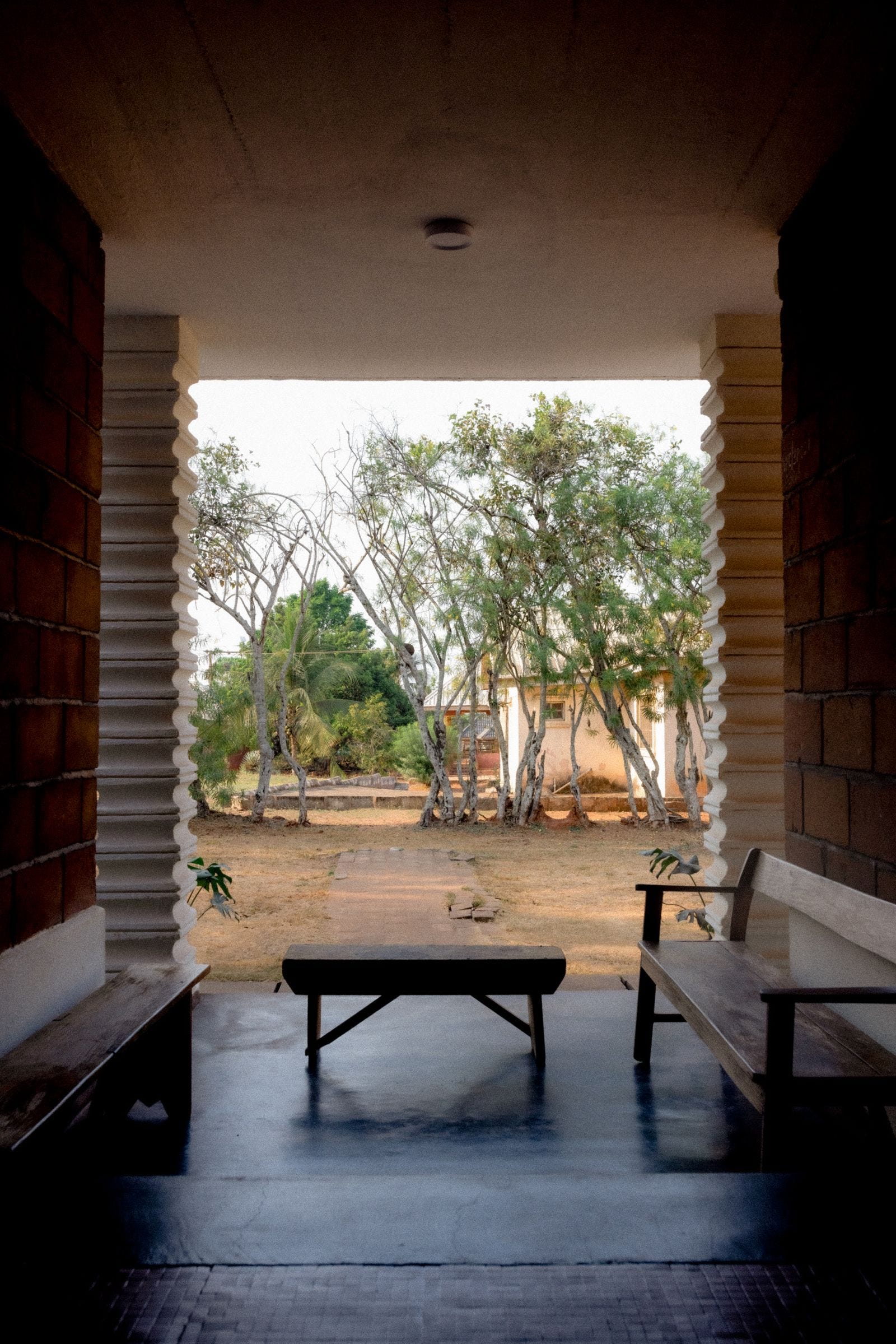
News from Kentucky:
Officials in Mt. Sterling reported on Tuesday that a man was arrested for allegedly scamming a Kentucky woman for years out of more than $500,000.
The Mt. Sterling Police Department (MSPD) posted on Facebook that on April 20, a search warrant was carried out on the 200 block of Richmond Avenue in Mt. Sterling with ties to “an investigation that began in New York.”
Authorities said that “an elderly woman” had been the victim of a “romance scam.” When her son, who lived in Clayton, New York, reported it to the police, the romance scam escalated to an extortion attempt where the alleged scammer said he’d hired someone to kill her son and demanded money in exchange for his safety.
Mt. Sterling law enforcement wrote that the romance scam was reported to New York investigators, and the suspect, Ephraim Udouso, identified as a Nigerian national in an arrest citation, was arrested Monday on Richmond Avenue with the help of the FBI and the Department of Homeland Security.
Udouso, 43, was charged with extortion of more than $10,000, in addition to an unrelated warrant out of Jessamine County. He’s set to appear in Montgomery County District Court at 11 a.m. on Thursday, April 23.
Nigerian doctors in America do an annual outreach in Jackson, Mississippi:
The Association of Nigerian Physicians in America held its annual medical and social outreach event in Jackson on Saturday.
The nonprofit event offered attendees free medical care, including dental, vision, family medicine, pediatrics and mental health services. Organizers say the goal is to help those in need, especially those who may not have health insurance or who are underinsured.
“We have social workers that can guide them, housing evaluations, employment screenings — things that they need,” said Tobe Momah, a University of Mississippi Medical Center family physician and the event organizer. “We have opportunities for them to even sign up for medical insurance here today from different companies that are coming.”
The event also provided free food, clothing and shoes. Legal guidance was also available for attendees. Organizers say the annual event is designed to remove barriers to care while addressing broader community needs.
The outreach was held at Mount Galilee Missionary Baptist Church on Julienne Street. Momah said event partners included UMMC Family Medicine, the Jackson Free Clinic, the Magnolia Dental Association, and the Magnolia Bar Association. He said more than 100 people came to receive assistance.