

Apologies for the clickbait headline (we are always trying new ways to draw in readers here). If you came here because of the political slogan in Nigerian politics that helped Godwin Obaseki win re-election in Edo state a few years ago, I am going to have to disappoint you. By Edo here, I mean Edo as in old Tokyo of Tokugawa Japan.
You want to be left alone? It will never happen
In the nineteenth century, the notion that a state could be left to itself was a fantasy. You could shut your doors and mind your business, and still someone would turn up demanding something. Within a few years of each other, Lagos and Edo Japan received precisely such visits, delivered by the steamship - the cutting-edge technology of the age. Both societies were confronted by the same brutal fact that, as some nations had acquired engines, the old protections of distance, wind, lagoon, custom, and diplomacy were no longer enough.
The steamship was, in effect, the mobile demonstration of an industrial system. To get it to work, you needed coal supply, metallurgy, precision engineering, naval artillery, global logistics, and treaty-backed commercial expansion. More than anything else, what they did was to help countries that possessed this technology to get around the helplessness of relying on the wind for sea navigation. The natural consequence of that was the shrinking of distances that put a bigger chunk of the world in play. The US President, Millard Fillmore (who?) put this plainly in a letter to the Emperor of Japan in 1852 when he said “our steamships can go from California to Japan in eighteen days”. The line was meant to sound friendly, really, it was a warning to Japan that distance had shrunk and time had been compressed and as such, the Pacific was no longer a vast emptiness protecting Japan from strangers. That is to say, Fillmore’s was a boast backed by technology.
Lagos faced this same reckoning from the other side of the world. In Professor Hopkins’ Capitalism in the Colonies, he described the attack of 1851 as the first of three shocks through which Britain forced the issue of the slave trade, bombarded the town, and established the consular presence that would precede annexation ten years later. Lagos at the time was no backwater. It was a port city and the commercial hinge between the Atlantic and the Yoruba interior - the kind of place imperial power would not leave alone.
The principle behind steamship technology was simple. Coal heated water; water became steam; steam drove an engine; the engine turned paddle wheels or, by the 1840s, a screw propeller. But the consequences were not simple. Sailors had always been skilful, brave, and experienced, but they were still negotiating with the wind. The steamship changed that negotiation. A steam vessel could move against unfavourable winds, hold its position, tow other ships, enter awkward coastal waters, leave without waiting for a tide, and return when it chose. The enabling technology was James Watt's improved steam engine, which after 1769 made continuous mechanical power practical.
By mid-century the technology was still transitional. Many steam warships kept their masts and sails because coal was expensive, bulky, and not always to hand. One dependence had been swapped for another - the wind for coal. This is why coaling stations became a thing, and why ports turned into filling pumps for the machine. The screw propeller began to replace the paddle wheel in the 1840s, partly because paddle wheels were clumsy in heavy seas and vulnerable in battle. Royal Navy experience had shown that the wheels and their covers interfered with broadside gunnery and could be shattered by enemy fire. The steamship was not invincible but against most coastal towns, it did not need to be.
Those who experienced the technology at the time found it astonishing. Charles Dickens crossed the Atlantic in 1842 on the Cunard steam packet Britannia, a vessel of about 1,200 tons carrying Her Majesty's mails. In American Notes, he described an American steamboat as resembling a "child's Noah's ark," its machinery awkwardly visible, an "unwieldy carcase" in which "a part of the machinery is always above this deck; where the connecting-rod, in a strong and lofty frame, is seen working away like an iron top-sawyer." The tone is comic but you can detect his anxiety underneath it. Steam travel was noisy, hot, dirty, mechanical, and frankly terrifying. The countries that possessed this technology at scale were not random. They were the industrial and maritime powers: Britain first of all, but also the United States, France, Russia and the Netherlands.
Black Ships on the horizon
On 8 July 1853, residents near Uraga saw four foreign warships enter the harbour. Two were coal-burning steamships towing two sailing sloops. No sail was visible on the steamers. What announced them was black smoke. The Japanese had not been entirely ignorant of steam. Dutch contacts and Japanese castaways had brought fragments of information about the outside world. But there is a difference between hearing about a machine and watching one enter your waters under its own power. One eyewitness remembered people speculating about “burning ships on the horizon.” Later memory would call them the Black Ships - kurofune, 黒船 - “black ships of evil mien.”
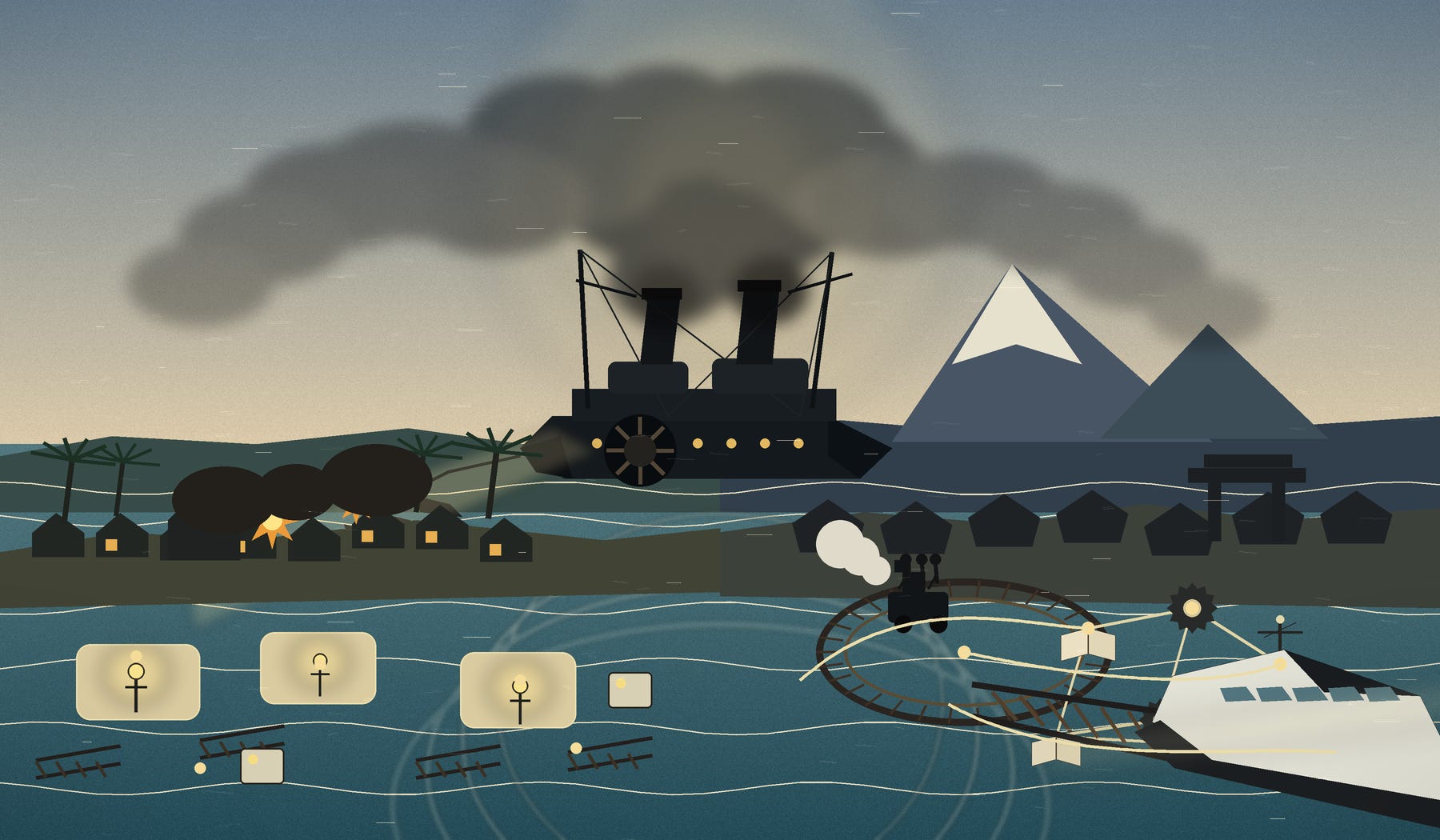
The British force at Lagos two years earlier belonged to the same technological world, even if it used steam differently. Perry's ships staged a theatre of coercive diplomacy before a sovereign state. Lagos faced towing, landing, shelling, burning, and the political replacement of King Kosoko. Contemporary reports describe HMS Bloodhound towing eighteen boats belonging to five British ships across the bar. After hours of cannon fire, the town was set alight, the guns were spiked, and Kosoko was driven out. Lagosians called it Ogun Ahoyaya - the Boiling Battle - or Ogun Agidingbi, an onomatopoeic memory of cannon fire (say it slowly and stress the last three letters.) Whereas in Japan, people saw black smoke and moving ships where no sail seemed to be doing the work, in Lagos, the lesson was more immediate and destructive. Later in 1862, Oshodi Tapa - the former slave turned statesman - painted an almost cinematic picture. Looking at steamships in Lagos harbour, Oshodi understood that the town had crossed a line: “This is no longer a native town,” he observed, “it is a white man’s. We could never do this.”
Both societies met an adversary who used steamship technology as leverage. One saw black smoke; the other heard loud noise. Both were presented in moral language that ran parallel with hard strategic and commercial aims - Lagos was framed through anti-slavery, Japan through friendship and the humane treatment of shipwrecked sailors. Lagos suffered regime change by proxy: Kosoko, already in a prolonged succession struggle, was physically removed and replaced by Akitoye, the British-backed claimant. Japan suffered something subtler but eventually more consequential: regime delegitimation. Perry did not remove the shogun, but he helped make the shogunate look incapable of performing its most basic duty of defending the realm. That crisis helped feed the collapse of the Tokugawa order fifteen years later, and subsequently the Meiji Restoration.
Where the story diverges, however, is when you view it as societies confronting modernisation and what to do about it. Both societies saw modernity. The difference was who had the responsibility, and the machinery, for converting that shock into institutions. That is, the difference was less the shock and more of the ‘receiver’ of that shock. Lagos was a port-city polity; Japan was a country-sized polity with a dense governing order. In mid-century Lagos, political authority, commerce, military force, and the slave trade were deeply entangled, especially around the court-commercial networks that sustained Kosoko and his allies. Later Lagos would produce a different elite - Saro merchants, professionals, clergy, journalists - but by then the institutional framework was increasingly colonial.
Japan’s political shell remained samurai but at the same time, the Tokugawa order had domain administrations, literate personnel, and a nationwide network of goods and information. That meant the Japanese response to humiliation could be led by a territorial, military-administrative class asking, “How do we preserve sovereignty?” In Lagos, the more immediate question for elites was more like, “How do we survive and bargain inside a changing Atlantic order?”
All Aboard the Perry Train
My favourite story about this confrontation with modernity, and the divergent responses to it, comes from the “gift” Commodore Perry presented to Japanese officials on his return trip in 1854. It was a fully operational miniature steam railway - a quarter-scale model built by Norris Works, with 350 feet of eighteen-gauge track, an engine, a tender, and a passenger car. It ran on a circular track a little over a hundred metres long. The passenger car was so small that Japanese officials could not sit inside. They rode on the roof. Pointedly, this was a working American locomotive, built by an American manufacturer, displayed as a symbol of mechanical civilisation. Like the steamship, this was American technological theatre designed to awe the Japanese. Another major Perry gift was the telegraph and when you take all three together, he and the Americans were essentially saying - the ocean could now be crossed without waiting for the wind, land could be crossed without relying on animal power, and information could move faster than any person or horse. The steamship and the locomotive were members of the same technological family. Both used heat, water, pressure, pistons, metal, coal, and precision engineering to turn stored energy into motion. The steamship compressed oceans; the railway compressed continents. The telegraph compressed time itself.
Strictly speaking, Perry’s was not the first railway model seen in Japan; the Russian admiral Yevfimiy Putyatin had shown one at Nagasaki in 1853. But Perry’s demonstration was the one that became theatre as staged before shogunate officials, tied to American demands, and remembered as part of the Black Ships encounter.
The Japanese received the gift with curiosity and awe. An official's diary described the train as moving "as though it were flying" - you can imagine how that felt - and called the experience "most enjoyable." Kawada Hachinosuke, a shogunate retainer, recorded and sketched the locomotive, then rode it not for amusement but out of "scientific inquiry." From the American point of view, "it was a spectacle not a little ludicrous to behold a dignified mandarin whirling around the circular road at the rate of twenty miles an hour, with his loose robes flying in the wind. As he clung with a desperate hold to the edge of the roof grinning with intense interest." Japan had no public railway at the time. The Meiji government would not open the Tokyo-Yokohama line until 1872.
An awesome wonder
Lagos got its own rude introduction to modern technology. Within a decade of the bombardment, students were being taught the principles of electricity. Public lectures by 1865 included “Electricity, as connected with the Electric Telegraph and as a source of Mechanical power.” CMS Grammar School, founded in 1859 was teaching “Natural Philosophy,” electricity included, by 1862. In 1886, HMS Raleigh arrived with electric projectors and the Lagos Observer reported a “brilliant electric display” illuminating part of the island. During Queen Victoria’s jubilee the following year, HMS Royalist was to play its electric light on the capital between 9 and 10 p.m. The point, in each case, was British technological advancement on display.
The more striking moment came in 1894, when the Lagos Weekly Record argued that electricity would not only reduce burglary but “open up a new line of industrial pursuit to our youths in the shape of electric engineering,” with apprentices trained in the principles of the science. The intent was there but whether it could be acted on, was a different matter entirely.
The telegraph arrived alongside. The West African cable was laid between June and September 1886 by the cable ship Scotia and the steamship Britannia, connecting Cape Verde, The Gambia, Sierra Leone, the Gold Coast, Lagos, Brass and Bonny to Britain’s imperial communications network. By 1893, government offices in Lagos had telephone service, later extended to Ilorin and Jebba.
In Japan, Perry’s model railway displayed what steam could do on land. In Lagos, naval searchlights displayed what electricity could do at night. Both were demonstrations of power disguised as wonder. As with Japan’s introduction to the telegraph, Lagos saw that the distance between Marina and Whitehall had been shortened by the telegraph.
Lagosians absorbed technology in many ways. They read about it, lectured about it, bought it, protested over it, wrote newspaper editorials about it, lit churches with it, applied for home connections, rode the railway, worked in railway workshops, and used the press to debate modernity. The paper linked above even says Africans had varying levels of access to electricity from 1898, including streets, churches, homes and public spaces. But what Lagos did not possess was control over the technological learning process. You cannot properly master technology simply by admiring it. You need a system for that.
Capability and absorption
Japan imported railway technology and then moved toward domestic technical mastery. Japan’s first domestically manufactured steam locomotive was completed in 1893 at the Kobe Works of the Imperial Government Railway. Tokugawa Japan had domain schools for samurai, private academies, and terakoya schools for commoners. These schools taught reading, writing, arithmetic, and practical skills. Adult male literacy in late Tokugawa Japan is estimated at roughly 40–50%, and many terakoya became the basis for Meiji primary schools. Railways require clerks, surveyors, accountants, mechanics, draughtsmen, translators, timetablers, engineers, station managers, guards, and disciplined maintenance staff. Japan had an existing social base from which such people could be produced.
Further, Japan’s elite treated technology as a question of sovereignty. The railway was absorbed into the Meiji slogan of rich country, strong army and was driven by the strategic need to build a strong modern state capable of resisting colonisation. The aforementioned first railway between Tokyo and Yokohama opened in 1872 with foreign loans, foreign materials, and foreign engineers. British influence was especially strong in the first government railways, while other foreign engineers worked in different regions. But the important point is that Japan aimed from the beginning to take over construction and operation itself - it planned from the outset to master the technology and achieved broad operational independence in less than twenty years. Meiji Japan pursued large-scale state-led codification of technical knowledge in Japanese; 74 percent of translators of technical books between 1870 and 1885 were government employees and vernacular codification lowered technology-access costs.
It sent students abroad, hired foreign engineers, built training schools, and then replaced foreign expertise with Japanese expertise. An engineering school at Osaka Station was established in 1877 to train railway construction personnel, and its graduates helped build Japan’s first Japanese-designed and Japanese-built mountain tunnel in 1880.
Contrasted with Lagos, we can see that the same technology can produce very different outcomes depending on who controls its absorption (or lack thereof). The problem was that in Lagos the machinery of conversion was missing. In Japan, wonder could become policy; policy could become institutions; institutions could become capability. In Lagos, wonder became urban service, commercial infrastructure and colonial spectacle.
Full circle
When Perry displayed his miniature railway in 1854, the Americans meant it as a lesson in hierarchy, and that it was. The United States had engines; Japan had curiosity. The Americans had the railway; the Japanese had not yet built one. The more important fact was not Japanese ignorance but Japanese capacity. Within a generation, Japan had opened its first railway. Within two, it was manufacturing locomotives. In the twentieth century it built the Shinkansen.
Texas has a proposed high-speed rail project between Dallas and Houston, planned around Shinkansen technology from JR Central. A 2024 U.S.-Japan fact sheet welcomed Amtrak’s leadership of the project and confirmed it would use “Shinkansen technologies” from Central Japan Railway, connecting the two cities - roughly 240 miles - in about ninety minutes. Texas Central’s CEO said the train could “revolutionize rail travel in the southern U.S.” (The project remains troubled: in 2025, the U.S. Department of Transportation terminated a $63.9 million grant tied to the corridor. But that only deepens the irony.)
Kawasaki has been supplying rail cars to New York City Transit since the 1980s. In February 2025, it announced an additional order of 435 R211 subway cars from the MTA, worth about $1.3 billion. The full R211 order came to 1,610 cars, worth $4.5 billion, which Kawasaki described as its largest rail contract ever. New York approved a further $1.507 billion for 378 Kawasaki R268 cars. Governor Kathy Hochul called them “state-of-the-art.” The irony is plain enough. The country once awed by a miniature American locomotive has become one of the countries from which America now seeks railway expertise.
Edo no be Lagos
Many societies saw Western technology in the nineteenth century. Lagos saw it early, and did not simply stare. Its newspapers explained electricity. Its residents attended lectures, protested taxes, demanded lighting, imagined electric engineering apprenticeships, rode trains, worked in workshops, and debated modernity in public. The problem was not a lack of curiosity but one of control.
Japan’s advantage was not that its elites were uniquely enchanted by machines. It was that the shock fell on a society with a machinery for conversion via domain schools, terakoya, samurai administrators, translators, ministries, workshops, and eventually a central state determined to turn foreign knowledge into Japanese capability. As I have written elsewhere, the Meiji state confronted modernity by rewriting the past into the future.
Technical knowledge had to be translated, standardised, named, printed, taught, and repeated before it could become common property. A machine is not absorbed when a few elites can buy it from China or admire it. It is absorbed when a society can describe it, repair it, teach it, improve it, finance it, regulate it, and eventually stop asking foreigners for permission to use it.
That is the Nigerian lesson. Every age has its Black Ships. In the nineteenth century it was steam. Today it may be artificial intelligence, energy systems, biotechnology, semiconductors, or whatever else is coming over the horizon. The question is not whether Nigerian elites can see the future. They almost certainly can. The question is whether the country has the public infrastructure of thought to digest it: schools, books, libraries, archives, newspapers, technical colleges, translation, children’s literature, civic education, and the habits of self-education that can allow knowledge to travel beyond a tiny class. Self-strengthening1 is a whole-of-society effort.
Without that, modernity arrives as a series of enclaves. A port here. A fintech or a clever app there. A data centre. A gated estate. A government pilot scheme. A foreign scholarship. All useful and profitable, and sometimes impressive - but not transformative at national scale. Wonder without codification becomes spectacle. Imported tools without institutions become status goods. Curiosity without a learning system becomes consumption.

Perry’s little train became something else in Japan because Japan built a path from shock to mastery. Alas, the steamships at Lagos carried a different message. Power had shifted, and Lagos would now be modernised on someone else’s terms.
Edo no be Lagos. How could it be? The real work of receiving technology is done before the technology arrives through discipline and the habits of collective learning. Japan had done more of that work. Lagos had not. So when modernity arrived, Japan could begin the long business of making it its own.
The ships did not make Japan ready or Lagos unready. They only exposed the work each society had already done - and the work it had not.
I’m indebted to Professor Robotham for this wonderfully clarifying phrase and for other ideas in this post
Particularly appreciate your documenting the fact that many 19thC Lagosians understood the significance of the tech challenge and made efforts to address it, then as now. But the society as a whole failed. Politics!
Mr Feyi, I always look forward to your writings. I must say today's piece didn't disappoint.