

A very happy new year to you all and welcome back to BTH. I trust that your holidays were eventful but not too Detty to the point where you are at risk of appearing in this newsletter.
Won’t bore you with links to all the pieces we published during the break except for these two - Tobi’s book review essay on capitalism and regulation and my piece on defensive capacity in Nigeria’s cement industry and what to do about it. We have a lot planned and lined up for 1914 Reader this year which we hope we can execute on. Thank you for your consistent support through 2025.
Enjoy the usual selection below.
Nigerian Media
Nigerian farming is in a real crisis and has no easy fixes:
Farmers have described 2025 as the worst year for their livelihoods in a decade. Most villages recorded low harvests despite high production costs, while the value of their output plummeted due to a sharp drop in food prices during the harvest season.
Many farmers, who spoke to Weekend Trust, said their losses in 2025 were enormous, particularly because of the significant capital invested in production.
Solomon Yohana, a rice farmer in Lafia, Nasarawa State, said he lost a significant amount of money on his rice investment this year.
He said, “As I speak with you now, there are villages where paddy is sold at N15,000 per bag (100kg) but nobody is buying because of the cost of transportation and poor market. Farmers are really suffering. This Christmas, many could not buy anything tangible to celebrate. How many bags of rice would they have to sell to buy one goat or pay for beef?
“Many of these farmers borrowed money with the hope of repaying after the harvest, but prices are dropping every day. Last week, millet was bought at N21,000 at Agyaragu market. In Lafia and Doma, a pickup truck of cassava is N80,000, but the farmer has to pay N30,000 for transport alone, minus labour. How much is left for the farmer?”
I am actually surprised there are still donkeys to skin in Nigeria. Chinese demand more or less decimated them about a decade ago:
The Nigeria Customs Service, Federal Operations Unit, Zone D, Bauchi, has intercepted 718 pieces of donkey skins worth over N24m, allegedly being smuggled out of the country.
The Zonal Comptroller, Abdullahi Kaila, disclosed this on Tuesday during a media briefing on the unit’s anti-smuggling activities at the command’s headquarters in Bauchi.
Kaila stated, “The cumulative Duty Paid Value (DPV) of the seized items stands at N24,313,217.00.”
He noted that the arrest aligns with the directive of the Comptroller-General of Customs, Bashir Adewale, to enforce a zero-tolerance stance against the illegal trade in endangered species.
“This operation is part of our broader mandate to combat illegal wildlife trade and enforce the Federal Government’s ban on the exportation of donkey skins,” he said.
Claims about hair maintenance:
The old tradition of visiting the salon, washing, drying and styling of hair is fading gradually as the cost of living keeps skyrocketing and purchasing power reducing.
Economy&Lifestyle has discovered that apart from cutting hair, maintaining natural hair to save cost, many with relaxed hair have improvised various low cost means to maintain their hair styles. Some women now use detergents, liquid soap for dishes to replace hair shampoo, kerosene and canfur mixtures as relaxers among other things.Explaining the reason for such action, Mrs Theresa Kingsley, a small business owner said: “Do you know the latest price of shampoo and conditioner?
“Even the price of a relaxer is high. Before, with N150 or N200, you can get a good relaxer. The opposite is the case now. A small bottle of good shampoo goes for N3,000 to N20,000.If you buy one of N500 it will turn to water within two days.
“I decided to use detergent or liquid wash for myself and my daughter. Sometimes I use soda bar soap which cleanses my hair better compared to liquid wash.
“My daughter doesn’t visit the salon anymore because I created time to plait her hair to cut costs.I have decided to go on a low hair cut next year to save myself from all this hair drama.”
Good piece on the US airstrikes by HumAngle, who do good work reporting on northern Nigeria:
“It was the first time we heard what a bomb sounded like in this community,” Musa said. “Many of us couldn’t sleep throughout the night.”
Aliyu Garba, a local chief in Jabo, expressed concerns over how some locals have collected the relics of the explosive materials from the strike scene, saying some of the shrapnel might detonate or harm them. “It was as big as a car’s gearbox,” he said, describing one of the broken explosives found on the ground.
Garba added that they have lived in the community peacefully for years, praying that this new event would not bring calamity to them. Locals reiterated that they have not noticed any form of terrorist activities in the area for years, let alone the Islamic State operations that might call for such an airstrike.
According to Armed Conflict Location & Event Data (ACLED) records covering 2010 to 2025, Tambuwal LGA has experienced only a handful of violent incidents, primarily involving small-scale attacks and abductions by criminal groups. The dataset records no previous incidents involving airstrikes, heavy artillery, or aerial bombardment in the area. In the past 15 years, for instance, only seven significant events were recorded in the LGA, and none happened in the Jabo town.
Amotekun at work:
The Osun State Security Network Agency, codenamed Amotekun Corps, has arrested three suspects over the alleged theft of 97 goats in Ila-Orangun, Osun State.
The suspects were identified as 34 year old Ajayi Tope, an indigene of Ila-Orangun, as well as 46 year old Babalola Afeez and 46 year old Tajudeen Isiaka, both from Ado-Ekiti in Ekiti State.
According to a statement by the Spokesperson, Yusuf Idowu Abass on Friday, the trio were arrested at about midnight on December 31, 2025, by operatives of the Osun Amotekun Corps attached to the Ila-Orangun Command.
The arrest followed complaints by residents of Ila-Orangun over the persistent disappearance of goats within the community.
According to the Corps, “operatives acted on the reports by placing the suspected perpetrators under surveillance in order to track their movements.
“The suspects were eventually apprehended when they allegedly returned to the town late at night to steal more goats and were arrested on the spot.
Non-Nigerian Media
23 minute video on the history of Transsion - makers of Tecno phones - in Africa. An interesting part (around 16mins in) is where they talk about how they solved the problem of their phone cameras not taking good photos of black people. They simply got someone to take surreptitious photos of Africans and sent back to Guangzhou for analysis:
Crazy story of a guy here in the UK who tried to dodge paying child support by getting his friend to go take a paternity test on his behalf:
Raphael Duyile asked his friend Lanre Balogonn – who runs a celebrity chauffeuring firm – to fraudulently take the DNA test for him at a health centre in the borough.
Woolwich Crown Court heard that Duyile, 33, wanted to stop paying child support to the mother, Chanel Weekes, after his family fell out with her and he started having “financial difficulties”.
When the fraudulent paternity test results came back negative, Duyile brazenly sent a text to Ms Weekes telling her she had “some explaining to do”.
However, investigators uncovered Duyile and Balogonn’s deception – and they have now been handed suspended jail sentences for conspiracy to defraud.
[…]
“He is very remorseful.”
The barrister said his client, who has previous convictions for driving offences, now runs a successful business that allows him to support several members of his family.
His firm, So Suave Chauffeurs, is popular with the rich and famous, who value it for its “discretion”, Mr Hannaford added.
Posts on the company’s Instagram page show celebrity clients including superstar singer Akon, Love Island stars Indiyah Polack and Dami Hope and the rapper Tion Wayne.
The court also heard about the good work the firm has carried out, including sponsoring the construction of a well in an impoverished area of Nigeria.
FT piece on President Bola Tinubu’s order for Police to stop protecting “VIPs”. Will it hold this time? Don’t hold your breath:
Some years ago, Moshood Jimoh, a police spokesperson, boasted about the force’s role in protecting VIPs, saying the then-governor of Rivers State, Nyesom Wike, had no fewer than 221 police officers assigned to him, including 54 inspectors, 134 police sergeants and 24 police corporals. The country’s 35 other governors enjoyed similar service, Jimoh said.
Looks like Oluwadamilola Bamigboye is in big trouble, to put it midly:
A man and a woman are facing charges after allegedly trying to flee federal authorities while an agent was trapped in the vehicle with them.
The agent said he was afraid of being “abducted” when the woman drove to a police station despite him saying he was law enforcement and demanding she stop.
A criminal complaint filed in federal court says the incident began on Dec. 10 at Plymouth apartment complex when Homeland Security Investigation (HSI) agents were searching for Oluwadamilola Ogooluwa Bamigboye, who had overstayed his student visa.
The agents were surveilling the apartment building where he lived, as well as his vehicle, which was parked nearby.
While staking out the complex, agents say they saw an SUV park next to Bamigboye’s vehicle. They reportedly recognized Bamigboye as a passenger in the front seat of the SUV.
The woman driving the SUV was later identified as Rekeya Lionesha Lee Frazier.
A celebrated Nigerian scholar pleads guilty to fraud:
A former nonprofit leader accused of stealing more than $1 million from an organization that served low-income children and their families has agreed to plead guilty to federal charges, court records show.
Nkechy Ezeh, the founder and former CEO of the Early Learning Neighborhood Collaborative, has agreed to plead guilty to conspiracy to commit wire fraud and tax evasion. Under the plea deal, Ezeh will pay an estimated $1.4 million in restitution and nearly $400,000 in back taxes to the IRS.
ELNC, which has since shut down, worked to prepare at-risk preschoolers for kindergarten in Kent County, Kalamazoo and Battle Creek. For more than a decade, ELNC supported more nearly 8,000 children and their families, court documents show.
Ezeh conspired with the ELNC’s bookkeeper, Sharon Kay Killebrew, to embezzle more than $1 million from the nonprofit — nearly bankrupting the organization and forcing it to close and stop serving at-risk preschoolers. Ezeh instructed Killebrew to create nearly $500,000 worth of fraudulent invoices which she then used her position at the CEO to approve.
“They left almost no stone unturned in their quest to siphon money,” federal prosecutors wrote in Killebrew’s sentencing memorandum in November.
Ezeh’s schemes eventually became more elaborate. She created two additional daycare businesses — one of which was a registered nonprofit — to funnel hundreds of thousands of dollars to herself, Killebrew and unnamed others for work that they did not do. Ezeh also used ELNC funds to finance personal travel for herself and others to Hawaii, Nigeria and Liberia.
From an article about how recovering criminal assets is challenging in practice:
At Southwark crown court a record £101.5 million confiscation order was imposed on Ibori in July 2023, more than a decade after his conviction for laundering into the UK funds that he stole from the Nigerian people. Yet recovery remains “elusive” with a series of court appeals.
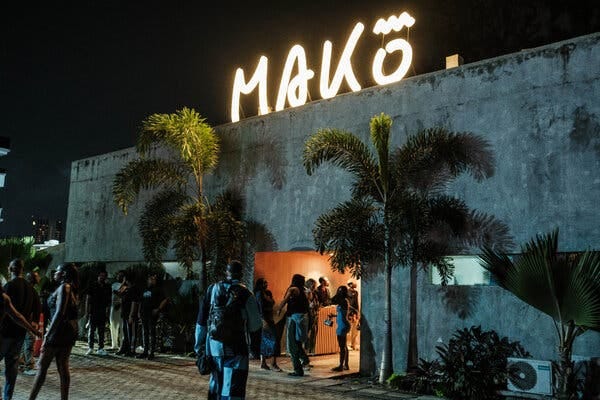
Terrific piece on Detty December by Ruth MacLean. I think it should be safe to say that Detty December suffered some reputational damage this iteration and work needs to be done to repair that if it is to continue as an export product:
But there are many who can’t afford even that. As the ravers left, climbing into their S.U.V.s and Ubers, they were trailed by candy hawkers and beggars asking to be “blessed” with a few cents.
Seasonal blessings of the monetary kind were on Pastor Bolaji Idowu’s mind not long afterward at his 15,000-capacity megachurch, Harvesters.
“The person who turned paper into dollars, God bless you!” he said, referring to the inventor of banknotes, as he instructed everyone to video themselves singing during the worship service and post the clips on social media.
Whatever the season, Sundays for Lagos’s Christians are for church, and Harvesters was hosting its annual carol service, a high-octane stage production where the biblical met the bombastic and the Detty December spirit took a holy turn.
The Nativity was reimagined as a political thriller: Soldiers in uniform marched to a commander’s bark — “Soldiers of Christ, attention!” — while a terrified Herod stalked the stage, desperate to snuff out a “coup” by the newborn “Governor,” but frequently getting distracted by a love interest played by Nollywood actress Bimbo Ademoye. A mash-up of “The Lion Sleeps Tonight” and “Little Drummer Boy” dissolved into “O Come All Ye Faithful,” led by funky drummers in military hats with purple plumes.
I don’t know who this is but sharing anyway:
“Bachelor Nation alum Brianna Thorbourne is engaged!
Thorbourne, 27, who appeared on seasons 27 of The Bachelor, shared the news on Instagram on Tuesday, Dec. 30. In the post, she revealed that the proposal took place in Lagos, Nigeria.
“Turns out, 2025 saved its best surprise for last 💍 I’ve become left handed yall!!!!” she wrote in the post’s caption, which accompanied a video montage of the special moment.”
“She went on to express her appreciation for her fiancé, Anthony Harris Jr, whom she met at Pepi Sonuga’s wedding in July 2025.”
Good piece on the Lakurawa terror group who were targeted by the US bombings in December:
Deep fear has long pervaded the arid savannah plains and highlands of north-western Nigeria - even before the US air strikes on the Islamist militants who have made this area their base on Christmas night.
The heavily armed jihadists, who dress in camouflage and wear vibrant turbans, have lived in camps in Tangaza, a remote area of Sokoto state near the border with Niger, for several years.
They belong to a group called Lakurawa and hail from areas north of Nigeria in the Sahel.
Locals in Tangaza, a community made up of mainly moderate Muslims, believe they come from Niger and Mali - and are terrified of them.
Recently, both US and Nigerian authorities have said the militants are affiliated to Islamic State (IS) groups in the Sahel - though IS has not linked itself to any of the group’s activities or announced ties to Lakurawa as it has done with other groups in the region that it backs.
When the BBC visited Nukuru, one of several remote villages in Tangaza around 10km (six miles) from where the US missiles struck, most people were deeply suspicious and did not want to talk about Lakurawa - fearing reprisal if they spoke.
It was only after assurances that their identities would be kept anonymous that some men agreed to be interviewed, speaking in hushed tones.
Some lithium updates:
Chariot Resources Limited has executed a non-binding memorandum of understanding (MOU) with Shanghai GreatPower Nickel & Cobalt Materials Co. Ltd., a prominent China-based battery materials producer, to explore collaboration across its prospective Nigerian lithium portfolio.
The MOU outlines potential offtake for up to 200,000 tonnes per annum of spodumene concentrate – the principal ore of lithium - from one of Chariot’s four Nigerian projects and included options for development financing, credit lines, and offtake prepayments to accelerate exploration and production.
The parties will also evaluate the possibility of building a lithium processing facility in Nigeria to upgrade run-of-mine ore into concentrate onsite, potentially incorporating sustainable practices such as electric mining equipment and solar-plus-storage microgrids for site power.
Shanghai GreatPower operates multiple facilities in China producing battery-grade materials including lithium carbonate, bringing significant technical and supply chain expertise to the partnership. The company’s major customers include LG Energy Solution, a battery company headquartered in Seoul, South Korea which holds a 4.02 per cent stake in GreatPower.