

Economic development depends on enterprise. Firms mobilise capital, organise production, and turn ambition into output. Even in countries where the state claims credit for transformation, private businesses remain indispensable. They build factories, develop technologies, and create employment at a scale no government can replicate. A productive and ambitious business sector is a necessary precondition for development.
Yet enterprise alone does not produce markets. Competition does not arise naturally from private initiative, nor does it sustain itself without governance. Underdevelopment is often defined by a regulatory philosophy hostile to private firms, a reality that forces businesses to organise to mitigate the risks of government hostility. Firms have long cooperated to gain political leverage, and such elite competition is often beneficial. However, when private firms coordinate to solve a problem—even if that problem is a predatory state—they do not necessarily create an open, competitive, or innovative political economy.
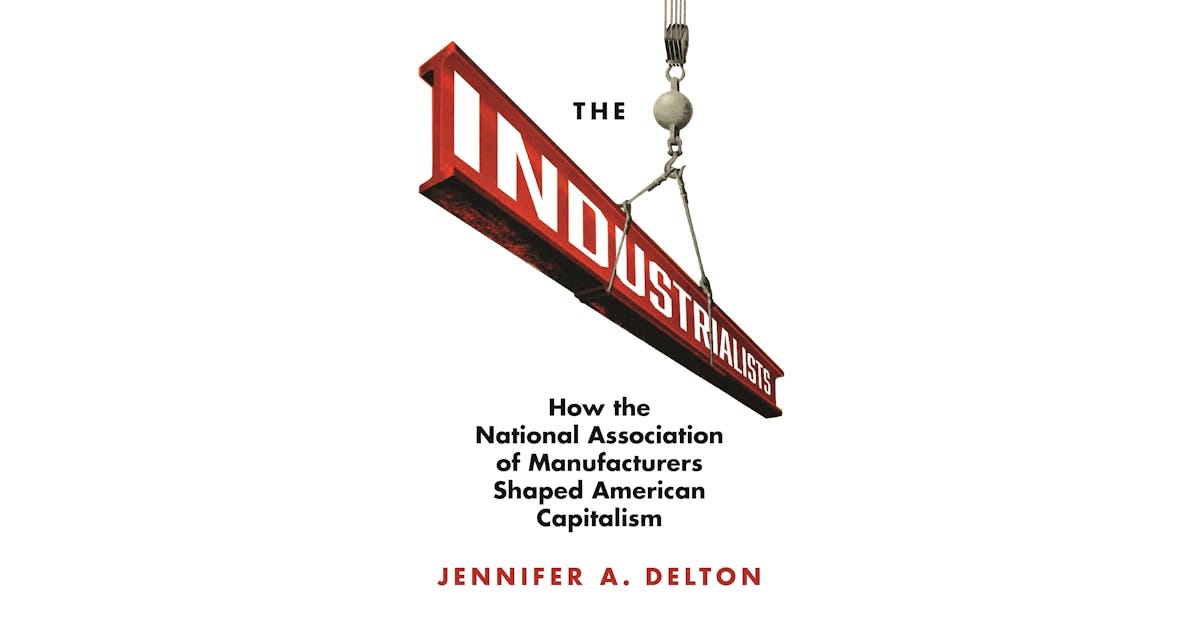
Jennifer Delton’s The Industrialists: How the National Association of Manufacturers Shaped American Capitalism traces how American manufacturers, confronted by surplus, volatility, and labour unrest, built one of the most powerful business lobbies in modern history. The National Association of Manufacturers (NAM) spoke the language of free enterprise, but its actions reveal a more complicated reality. Through coordination, lobbying, and sustained ideological work, it helped organise American capitalism, blurring the boundary between stabilising markets and restraining them.
This study is neither an attack on capitalism nor a simple antitrust morality tale. It explores how private enterprise interacts with the state, and how the fate of markets depends on that relationship. The industrialists the author writes about were builders as much as blockers. They created the institutions, standards, and infrastructure that expanded production and trade, yet they also worked tirelessly to insulate themselves from competition. The result was a form of capitalism that thrived not because markets were free, but because they were carefully managed.
Delton demonstrates that markets are political achievements rather than natural phenomena. They do not survive on rhetoric alone. When governments kowtow to organised business groups, productivity and consumer welfare rarely follow. Conversely, when regulators are informed, independent, and willing to confront power, markets remain open and productive. This history provides a corrective to a persistent illusion: that businesses are the natural defenders of markets. In reality, that task has always belonged to the state.
Forged in Surplus
Material excess, rather than ideological zeal, gave birth to the National Association of Manufacturers. By the final decades of the nineteenth century, the United States had become the most productive industrial economy in the world. Advances in steelmaking, mechanisation, rail transport, and electrical power had transformed output. Factories produced faster than markets could absorb; capacity expanded relentlessly, but demand lagged.
By the early 1890s, the industrial problem shifted from scarcity to glut. Steel mills, machine shops, and textile factories faced falling prices and volatile orders. Overbuilt railroads cut freight rates in destructive cycles, while warehouses filled with unsold goods. The depression of 1893 exposed the fragility of this growth, as prices collapsed, wages fell, and firms heavily invested in fixed capital faced bankruptcy. The book describes an economy paralysed by too much enterprise rather than a lack of it.
Industrial output had outpaced both population and purchasing power. Firms that thrived during expansion faced ruin under competition. As one manufacturer noted at the time, American industry had “outstripped its own market”. Excess capacity turned rivalry into a zero-sum struggle, and price cutting became a threat to survival rather than a spur to efficiency.
Manufacturers began to organise specifically to survive these conditions. The 1895 Cincinnati meeting that founded the NAM brought together hundreds of industrialists who sought to rescue capitalism from its own instability. Overproduction, labour unrest, and political agitation created a sense that individual firms could no longer manage the risks of modern industry alone.
The author shows that this turn towards coordination was a rational response rather than a conspiratorial one. Manufacturers sought information, predictability, and a collective voice. They required data on costs, output, and freight rates; they demanded uniform standards and shared rules. In a rapidly consolidating economy where firms operated across state lines, organisation appeared necessary.
NAM functioned as an instrument of adaptation, marking the shift from nineteenth-century individual enterprise to twentieth-century corporate capitalism. Its founders believed that unrestrained competition in a surplus environment was destructive, arguing instead that cooperation could restore order. The association’s early language was defensive: it presented itself as a guardian of industry and a steward of a productive system at risk of tearing itself apart.
Cooperative Competition
The managed competition model emerged from a broader intellectual effort to reconcile mass production with economic stability. By the early twentieth century, reformers argued that the primary threat to modern capitalism was disorder rather than monopoly. Unregulated rivalry wasted resources, destabilised prices, and punished efficient firms. Cooperation promised a more rational alternative.
Arthur Jerome Eddy provided one of the most influential expressions of this view in a book called The New Competition. Eddy rejected “cut-throat competition” as a relic, arguing that large-scale industry required transparency. In his vision, firms should share information on costs and demand—not to deceive consumers, but to prevent destructive price wars. Competition was to be civilised rather than abolished.
Louis Brandeis, who was a lawyer and later a justice of the Supreme Court, advanced a similar argument from a different political position. Even though he distrusted monopoly, he also doubted the virtues of unrestrained rivalry. Brandeis believed that “sunlight” could discipline markets through open price systems and shared standards. “Regulated competition,” as he conceived it, would combine efficiency with fairness under public oversight.
The association absorbed this language and adapted it to industrial practice. Its committees gathered statistics on production, promoted uniform accounting, and set standard contracts. These efforts reduced uncertainty and lowered transaction costs, while strengthening its role as an organiser of industry-wide behaviour.
At this stage, coordination was a tool for efficiency rather than a cover for monopoly. Progressive Era policymakers often encouraged these arrangements, believing that informed coordination could substitute for brute competition. Because antitrust enforcement was uneven, the boundaries between permissible cooperation and illegal restraint remained ill-defined.
By the 1920s, NAM’s activities shifted from data collection to collective control. Members relied on the association to set prices and wages, and those who broke ranks risked isolation. The author attributes this shift to incentives: in an environment of persistent overcapacity, restraint was safer than rivalry.
Crucially, the state failed to impose clear limits. Regulators lacked both the capacity and the resolve to police the boundary between cooperation and collusion. Reformers who championed cooperation underestimated how easily private coordination could escape public control. The result was an economy in which private associations organised markets that should have been governed by neutral rules.
Upgrading for Exports
Foreign trade provided the necessary direction for industrial coordination. For NAM leaders, export markets offered a release valve for domestic overcapacity and a path towards stability. From its inception, the association treated international commerce as a central solution to the problems of modern production.
The author details the massive infrastructure built to pursue this goal. By the turn of the century, the association had established committees on foreign trade and transportation, circulated market intelligence, and published handbooks for foreign sales. As she writes, the lobby “created a dense web of institutions” that made export promotion a permanent feature of organised industry.
This effort was a pragmatic response to British global dominance. At the time, British firms controlled shipping lanes, marine insurance, and world finance. For American industry, exporting meant competing within a global system whose rules and standards had been shaped elsewhere.
NAM responded by encouraging members to adopt uniform specifications and international norms. It pressed for precision measurement and reliable grading so that American goods could be accepted abroad without dispute. The book shows how legal reformers were used to harmonise commercial practices across the United States, supporting uniform laws for negotiable instruments and contracts. These reforms integrated a fragmented domestic market into a coherent platform for export.
The association also helped shape the American state’s commercial apparatus, lobbying for the creation of the Department of Commerce to promote trade and set standards. This partnership marked a sustained effort to align private enterprise with state capacity. The results were tangible: American goods became more reliable, more standardised, and more competitive globally.
Yet the export project exposed a persistent contradiction. While NAM championed openness abroad, it defended protection at home. Tariffs remained central to the business model of its members, even as they demanded access to foreign markets. The same capacity used to compete with the British overseas was deployed to limit competition within the United States.
Freedom for Employers, Discipline for Workers
Industrial stability required control over the workforce just as much as it required predictable prices. To the leaders of the NAM, the unionisation of labour was another source of uncertainty to be contained.
The association treated organised labour as a threat to managerial authority. Strikes disrupted production and undermined the predictability manufacturers sought. Consequently, opposition to unions was framed as a defence of “freedom”—the right of employers to manage without interference. Workers were portrayed as individuals whose liberty was compromised by collective action.
This logic drove the “open shop” movement. Leaders insisted that compulsory union membership violated personal freedom, but in practice, the open shop preserved employer discretion while weakening workers’ bargaining power. By acting collectively, firms could confront labour as a unified front rather than as isolated actors.
The New Deal shattered this arrangement. Federal legislation in the 1930s recognised unions and established collective bargaining as a legal right. The association opposed the Wagner Act vigorously, warning that it would politicise industry. When legal challenges failed, the leadership shifted from outright resistance to containment, seeking to narrow the boundaries of labour’s influence.
This strategy culminated in the Taft–Hartley Act of 1947, which restricted strike activity and allowed states to adopt right-to-work laws. The act did not abolish unions, but it preserved managerial control. Delton’s account makes clear that this was an extension of market logic: just as manufacturers managed competition among themselves, they sought to manage conflict with workers.
The resulting labour market reflected the priorities of organised industry. Wages rose during growth, but bargaining power remained constrained. As with product markets, the issue was the imbalance between organised private power and public oversight. By mid-century, the NAM had established a settlement that privileged stability over contestation, entrenching asymmetries of power that lasted for decades.
The Propaganda Machine
By the late 1930s, the lobby realised that economic power required cultural reinforcement to remain sustainable. If markets were to be managed in the interests of organised industry, that arrangement had to appear natural and virtuous.
NAM launched one of the most extensive private propaganda efforts in American history, seeking to “educate” the public through films, radio programmes, and school materials. It promoted a vision where private enterprise and individual freedom were inseparable, effectively recasting the language of markets as the language of liberty.
This campaign was carefully calibrated to praise the activities of the business sector while warning against regulation. Government intervention was portrayed as coercive; private coordination was framed as voluntary. Eventually, the distinction between defending markets and defending specific firms quietly disappeared.
The book is particularly effective in showing how the lobby targeted education and the clergy to link capitalism to moral order. Radio broadcasts told stories of entrepreneurs whose success depended on stability rather than rivalry. By mid-century, this vocabulary had entered everyday political speech, making regulation look like an attack on national values.
Ideological success was the necessary complement to organisational power. Having learned to coordinate production and labour, the association coordinated ideas. This created a political environment where regulators faced both technical obstacles and cultural resistance. Market discipline became harder to justify when regulation was successfully cast as an attack on “freedom.”
Markets are not defended by rhetoric; they are defended by institutions willing to distinguish between enterprise and entrenchment. This propaganda blurred that distinction deliberately. In doing so, it weakened the case for regulation at the very moment when organised private power made it most necessary.
Crisis and Neoliberal Revival
The post-war settlement eventually buckled under the weight of the 1970s economic crisis. As inflation rose and competition from Europe and Japan intensified, the stability that coordination had once promised appeared brittle.
The association entered this period in a weakened state, facing declining membership and internal divisions. It reoriented its strategy towards political mobilisation, relocating to Washington to lead a younger, more ideological faction. This shift marked the embrace of neoliberalism. Regulation was recast as distortion, and labour protections were portrayed as inefficient.
This rhetorical turn did not reflect a newfound faith in competition but a desire to escape oversight. NAM’s influence during this period was substantial, shaping the policy agenda of the Reagan administration. Tax cuts and deregulation echoed themes promoted for decades. Its ideological project had successfully entered the mainstream.
Yet this victory masked a deeper failure. As regulation receded, American manufacturing did not revive. Financial markets expanded while industrial capacity eroded. The association that claimed to represent the future of American industry now presided over its contraction.
The author argues that this was the inevitable consequence of a long-standing pattern. The lobby had always sought insulation rather than contestability. When global competition intensified, that insulation proved ineffective. The removal of regulatory constraints failed to restore dynamism because the underlying problem was not excessive competition, but insufficient adaptation.
The neoliberal turn revealed the limits of ideology divorced from discipline. NAM successfully reshaped the language of capitalism but could not reverse the structural decline of its sector. The association emerged as both victor and casualty: triumphant in ideas, but diminished in substance.
Liberalisation For Thee, Protection For Me
A persistent contradiction runs through the history of NAM: the demand for access to foreign consumers alongside the treatment of domestic liberalisation as an existential threat. The lobby wanted the benefits of global trade without the risks of local competition.
The research shows that the baseline position was always protection. In the run-up to the Smoot–Hawley Tariff of 1930, the association publicly backed the act, insisting it would “relieve business” from the volatility of general revisions. Its instinct was to preserve protection and treat openness as a risk.
The contradiction sharpened with the New Deal’s Reciprocal Trade Agreements Act of 1934. Signed by President Franklin Roosevelt and driven intellectually and politically by Secretary of State Cordell Hull, this act shifted trade liberalisation to the executive branch. Hull, the person most responsible for the law, held a worldview tied to an internationalist belief that closed borders bred conflict. NAM, however, saw this as a “slippery slope.” The act represented a major transfer of authority away from Congress, reducing the ability of business associations to win protection through political pressure.
Most manufacturers lived by the domestic market. Protection functioned as an internal constitution of industry, keeping margins predictable and making coordination easier than rivalry. Free trade abroad was a “national ambition”; free trade at home was a “loss of control.”
Who Defends Markets?
The Industrialists challenged the comforting idea that business interests naturally yield a competitive market equilibrium that always leads to progress. The more demanding truth is that markets survive when power, regardless of who wields it, is disciplined. In the case of NAM, the same institutional strength that facilitated industrial expansion also enabled the lobby to restrain competition and shape policy to its own advantage.
For someone like me, who is always looking through the lens of developing economies, this history raises a fundamental question: who defends markets? Nigerians were recently treated to the spectacle of an industry regulator hounded out of his job. It was an episode that depicted the businessman as a patriotic hero fighting against a corrupt and overreaching regulator. Firms in developing countries do business in very difficult environments. Governments are often corrupt and do not make the necessary public investments. Regulations are also often predatory and cause political distortion to domestic markets. Governments also lack the competence to solve complex socioeconomic problems, and only seem to have the capacity to exercise blunt negative powers. Hence, for many people, developing economies will be better served if the pendulum of power and influence swings in favour of private firms instead of governments. I am sympathetic to the spirit of this sentiment.
However, what we need to be reminded of is that private firms are not mere benefactors, but also architects of the rent-seeking equilibrium that we have in many developing countries today. What the history of NAM has showed is that firms are incentivised to defend profits, however they come. The job of defending markets is still best done by competent, informed, and courageous public institutions.
Absolutely fantastic essay. We tend not to read each other's essays until they are published and readers are not going to believe what I just said when they read my next piece out in a few days. But it's true :)
This incredible piece shows why American companies struggle to understand the regulatory framework or environment in a place like Europe. GDPR is a good example of this issue but as the saying goes that power corrupts and absolute power corrupts absolutely. It’s also interesting to see that growth and regulation are not mutually exclusive but can both combine to create a force for the longer term overall “good”. Thank you for sharing!