

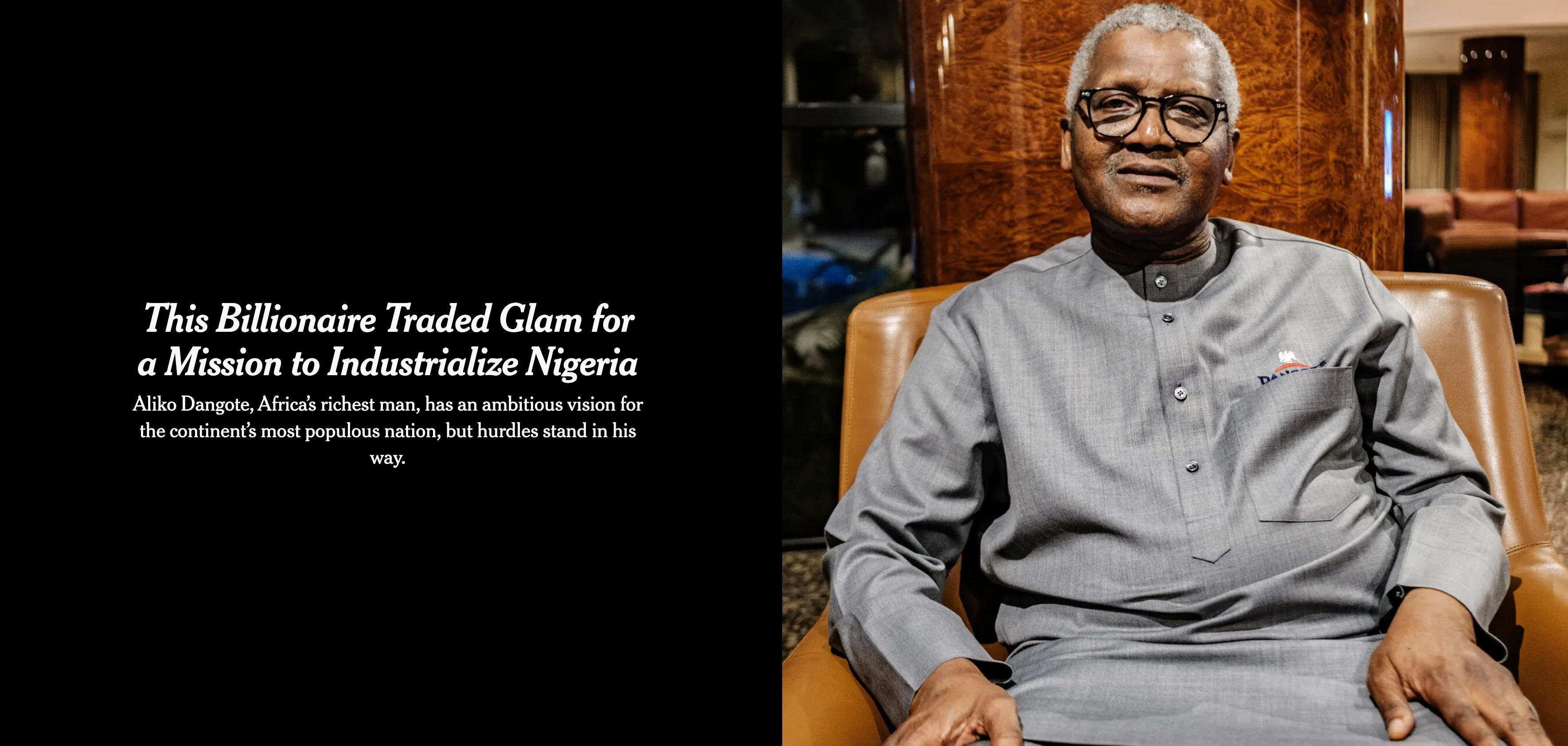
The New York Times has published a new feature on Aliko Dangote, and I will confess it caught me off guard. Not because the subject is unworthy of attention, but because the piece is, on closer inspection, a largely unnecessary one - and a telling illustration of the perils of Dangote coverage, where his word is received rather than examined, and where the most basic checks appear to have gone unmade.
Caveats
A couple of caveats before proceeding. The New York Times produces excellent Nigeria coverage - spanning arts, economics, politics, and much else besides. They send fine journalists to the country, people who do their work with genuine care, and their Nigeria reporting is one of the main reasons I maintain my subscription. Were they to stop covering Nigeria, it would be a real loss. So this is not a broadside against their Nigeria work in general - I simply think they have been taken in by a con.
Second: anyone who has followed my writing over the years will know that I am what you might fairly describe as a dedicated Dangote hater. I do not admire the man or his methods, and I have documented at some length why I feel this way. Nothing personal - but my consistent assessment of him has been that, on balance, he is a net negative for Nigeria. If that is not a view you can sit with, this is a reasonable point to stop reading.
Basic Errors
Let’s start with the article’s basic errors. Not long into the piece it says this:
Already, his refinery is producing 650,000 barrels of crude oil per day.
This is, of course, a category error. A refinery does not produce crude oil; it processes and refines crude oil into finished products - petrol, diesel, jet fuel, and so on. The figure of "650,000 bpd" refers to crude throughput capacity, not crude production. I am willing to treat this as a slip of the pen, so let’s move on.
However the very next sentence after that says:
Mr. Dangote says that output will be double in the next year.
All the reporting around Dangote's expansion plans points to a total capacity of 1.4 million bpd - but on a multi-year build timeline, not "next year." Just last week, Reuters reported that the company expects to complete the expansion within three years, quoting Dangote himself. The Times could have either sought clarification on a claim of this magnitude, or simply fact-checked it independently - because the idea of doubling capacity in a single year fails even the most basic smell test.
Another claim in reference to the land on which the refinery is built in Lagos:
He pushed on, clearing the land and backfilling it with 65 million tons of sand.
This is a material technical error. Right there on the Dangote Refinery “About Us” page is “65 million cubic metres of sand filling costing approximately 300 million to elevate the height by 1.5 metres”. (You can see the same number used by S&P Global). Cubic metres is the physical space the sand takes up while tons is what it weighs. The Times actually understates the effort claimed by Dangote - 65 million cubic metres of sand works at around 104 million tons while 65 million tons of sand will take up around 41 million cubic metres of space. They are absolutely not the same thing.
Next this:
He imported 10,250 trucks from China after he couldn’t find a Nigerian firm with a big enough inventory, then built a jetty for ships to unload them, he said.
I fear that this is how Dangote urban legends are born. It was widely reported last year that the company had imported 4,000 CNG trucks for logistics (though I did not count them). The 10,250 appears in reports as a stated fleet/operations target rather than an import figure. Have an additional 6,000+ trucks really been imported? Alas, now that it is in The Times, it will harden into “fact.”
Almost any construction site in the country is scattered with bags of Dangote-branded cement; grocery shelves are stocked with Dangote-branded flour and sugar
What flour? It has been at least seven years since Dangote exited the flour business.
This next part is not so much an error as something to confuse the reader:
The poor state of Nigeria’s roads is one challenge of getting crude to the refinery. A bigger challenge, Mr. Dangote said, is corruption. Middlemen reroute crude, with trucks sometimes disappearing across the border where thieves sell the fuel and pocket the cash.
The refinery has a private port/jetty (the article itself notes this) and crude supply is commonly discussed in terms of cargoes/shipments not road trucking. The trucks disappearing across the border and “thieves sell the fuel” describes refined product smuggling, not crude oil logistics. These are not the same things.
More Serious Challenges
Ok, enough nitpicking around errors. Let’s get into more substantive matters in the piece. The piece is structurally a profile of Dangote but it foregrounds his self-description as someone who must “rescue the country.” In the article’s framing, this “rescue” is a self-evident good thing. But in industrial policy, national champion projects can be both productive and politically distortionary. If you’re going to use such language, you should at the very least also quantify costs, privileges, and market power.
The refinery employs 30,000 people, about 80 percent of whom are Nigerian. Many managerial positions are held by international workers, which Mr. Dangote said would change in time as he trained more locals. His expansion plans will increase the work force to about 65,000 people, he said.
In fairness to The Times, this is quoting him directly but this is another example of not bringing any scepticism to the things he says. A capital-intensive refinery is not a mass-employment machine. If the piece wants to link this project to Nigeria’s 40–50 million jobs challenge (which it does), it must separate permanent headcount from contractors and construction-phase labour, and then compare against the scale of national need.
Globally, refineries of meaningful size often employ hundreds to low-thousands, not tens of thousands permanently. Example: a 139,000 bpd U.S. refinery cited by Reuters employs 600 workers and 300 contractors. The new 615,000 bpd Al Zour Refinery in Kuwait employed 1,393 people at the end of May 2024 [PDF, page 13]. During construction employment numbers are of course a lot higher but refineries just don’t employ large numbers in this way. Again, this reads like Dangote throwing out stuff and it passing into the paper of record unchecked.
Something else that really rankled with me was the framing of “monopolist” as if it were a personality trait. It says “critics complain Mr. Dangote has a near-monopoly on many of the staples of life” and also says “long criticized as a monopolist in the industries he focuses on”. The question here is not ‘is Dangote a nice man?’ It’s one of industrial organisation and what happens if one man controls refining plus critical logistics plus direct supply, what happens to entry, pricing power, and political leverage?
This is not theoretical, it’s something we have seen over two decades in cement where he is - more correctly - the leader of an oligopoly as I (and others) have documented extensively. At the very least, a question should be asked as to what the future holds about a well documented issue in the media.
To ensure that I’m being fair, I am going to quote this section in full before making my point:
Long criticized as a monopolist in the industries he focuses on, the man whose grandfather made his fortune in peanut trading doesn’t want to stop with oil, or even with Nigeria. Mr. Dangote wants to break into the steel industry, to spread electricity to more people, to build more ports — to industrialize all of Africa.
His role model for future expansion is the Indian multinational conglomerate Tata Group, which produces things like black tea and semiconductors.
His factories, he said, will also help curb joblessness amid Africa’s youth boom. In Nigeria, the most populous nation on the continent, 40 to 50 million people will need jobs by 2030, according to the World Bank.
Already, his refinery is producing 650,000 barrels of crude oil per day. Mr. Dangote says that output will be double in the next year.
He announced over the weekend plans to list shares in the refinery locally. But first, he needs to solve infrastructure problems and address corruption in the oil industry, both of which stand in the way of bringing enough of the nation’s ample supply to his refinery, he said.
The share listing is framed here as an act of civic virtue - placed alongside job creation, production, infrastructure development, and anti-corruption efforts in the oil sector. One does wonder how the man finds time to sleep, so tirelessly devoted is he to the betterment of Nigerian lives, and with so little in it for himself.
There is a precedent worth raising. When Dangote Cement listed on the Nigerian Stock Exchange in 2010 - by way of introduction - its sheer scale materially reshaped the market. Reuters described it as a ₦2.1 trillion listing that lifted the exchange’s total market capitalisation by roughly a third. At the point of listing, the company’s free float fell well short of the exchange’s stated minimum, and so the NSE granted the company time to sell down to 20 per cent in order to comply. Company executives indicated this would be achieved through a global offering, with GDRs as one option. Within weeks, Dangote was telling Reuters the company would issue a London-listed GDR and pursue a fuller London listing in stages. Contemporary market commentary also stated that a London sale was being pursued because the Nigerian market was not deep enough to absorb the volume of shares needed to meet the free-float threshold without adverse pricing effects.
Yet years later the exchange had waived the free-float requirement at listing and the company remained below the required minimum despite periodic sell-downs. In 2019 the company was in talks with banks and declared the London listing would happen in 2020. When 2020 came around, it said the listing wouldn’t happen in the short to medium term.
The end result is a company that has been “listed” for the best part of two decades while remaining dominated by its controlling shareholder - Dangote Cement’s own annual report for 2015 [PDF, page 110] shows Dangote Industries Limited held 91 per cent of the issued shares (with Aliko Dangote as the ultimate owner). A decade later in the 2024 accounts, he still owns 87 per cent of the company [PDF, page 130].
The Times, in reaching for the share listing as evidence of Dangote’s good faith, might have found this history instructive as an illustration of the wide gap between what is promised and what is actually delivered.
Perhaps the most vexatious for me was this bit:
He built cement factories, first across Nigeria, then in Senegal, Ethiopia, Tanzania and beyond.
That sentence is doing a lot of myth-making work, because it blurs local ownership with local technological capability. In heavy industry, "building" a cement plant is rarely a literal description. It is better understood as the orchestration of a supply chain of specialised competences: process design; kiln and mill engineering; quarry planning; automation and control systems; procurement; civil works; installation; commissioning; and training. In Dangote Cement's case, that technical expertise has repeatedly and entirely been contracted out to Sinoma International Engineering, a Chinese cement plant engineering giant, something I have documented at length:

This matters because there is no evidence whatsoever that Dangote Cement can construct a cement plant on its own - not after two decades of operating under government protection. There is no evidence of domesticated engineering capacity or indigenous technical know-how. None whatsoever. Dangote has financed, sponsored, and owns these assets; that much is not in dispute. But the claim that this represents "proving the continent is capable of large-scale industrialization done by one of its own" becomes extremely slippery when the engineering is repeatedly turnkey-imported. The question worth pressing is this: what exactly is being proven - African industrial capability, or African ability to mobilise capital and political leverage in order to purchase capability from elsewhere?
That distinction matters because the real development prize is not cement tonnage but capability accumulation and the domestication of know-how such that local firms can progressively take on more of the high-value work, whether that is process design, optimisation, equipment manufacture, digital control, decarbonisation technologies, or, in time, technology export.
The lack of care about technological development or innovation (Dangote Cement does not even sell ready-mix cement) is ironically revealed in a flippant quote he gave in the interview. The Times notes Dangote's scepticism about "newfangled technology," comparing AI hype to early Nokia phones and offering the observation that "this field is getting, you know, out of hand." The line is presented as a piece of colour, but it sits awkwardly in an era when cement producers around the world are deploying digital tools - AI and advanced process controls among them - to reduce fuel consumption and emissions in operating plants. Last year, Reuters reported on AI tools being used alongside industrial control systems at live cement facilities to achieve exactly those ends.
If you are serious about turning a protected domestic champion into a globally competitive industrial group - particularly while invoking Tata as a role model - you do not get to dismiss enabling technologies as a passing fad. You either build the learning systems, or you do not.
Conclusion
As I said at the outset, my overriding reaction is one of surprise - that a paper of The Times's standing would allow itself to become, in effect, a megaphone for Dangote's image-laundering. The disappointments do not end there. The protracted dispute between a private company and its regulator is collapsed into a simple morality play. When Dangote publicly named a regulator's children's schools at a press conference, The Times treated this as a piece of colourful, gloves-off theatre. It then went further, adopting his moral vocabulary wholesale - "mafia," "corruption" - for what is, at its core, a battle over who controls supply, pricing, and regulatory discretion in a newly liberalised downstream market.
The article should have mentioned the regulator’s mandate and what the policy dispute was even if only one sentence. Without that, readers are being asked to take sides in a commercial dispute using moral language.
There were all sorts of other weird framings in the article. The piece opens with this:
The richest man in Africa works from a construction trailer in a dusty parking lot.
The billionaire, Aliko Dangote, said he once had multiple homes in several countries, a nightlife of fancy parties, a Rolls-Royce and a Ferrari. Then, roughly two decades ago, he got serious about industrialization, he said.
Then later on it says this:
His workday often continues at his home, where on a recent evening Mr. Dangote, in a gray caftan and pants with the Dangote Group logo on it, nestled in a brown leather couch pit in his living room. A box of Rice Krispies was on a dining room table, and the TV was tuned to CNN. He nibbled dates as he met with workers who oversee operations for his three corporate jets.
So we have The Times first setting up an austerity/moral-sacrifice framing then supplies evidence that the “glam” didn’t disappear, the Rolls Royce just became three private jets and “lavish company parties.” This is not to moralise about private jets - he can afford them and is free to buy as many as he wants but the monkish industrial arc once again looks like myth-making on his behalf.
Perhaps this was always intended as a profile piece and there is nothing inherently wrong with that as a form. But when the subject is a politically entangled “national champion” whose fortunes are bound up with state policy, market design, and regulatory discretion, the genre carries a particular risk of becoming a kind of certification. Done carelessly, it converts self-serving narration into internationally validated fact, exports homegrown hagiography (there was so much of this in the piece) to a global audience, and transforms genuinely contested questions - about subsidies and tax expenditures, barriers to entry, regulatory capture, capability transfer - into an uplifting morality tale about sacrifice and the rescuing of a nation.
Once a paper of The Times’s authority lends its imprimatur to that framing, it hardens into an inert reference point for other commentators. Nigeria does not need fewer profiles. It needs fewer myths. And whatever else he is - shrewd, disciplined, and formidably effective at extracting advantage from the systems he inhabits - Dangote is really not that guy.
The Times article was clearly a puff piece that any discerning reader would easily detect. I've followed your Dangote "hating" over the years and agree with a lot of the analysis. My thoughts are around what the counterfactual sans Dangote would have been, given the political economy of Nigeria. This is, of course, impossible to answer, but if evidence from Otedola's "making it big" is anything to go by, the average rich Nigerian man is hardly sacrificing his rent-seeking wealth to take on the arduous task of building a refinery. For taking on this risky effort, I believe Dangote has, at the very least, earned the right to a lap of honour in the NYT. You, of course, are also well within your rights to critique it.
A textbook case of 'Growth' without Development