

One of the points I’ve made repeatedly since the start of the F.O.O.D thesis is how Nigeria’s leading entrepreneurs have effectively outsourced innovation to other countries. No matter how much money they make from a protected market, innovation is just someone else’s problem.
The IMF have a new paper out on the role of research and development on crop productivity in sub-saharan Africa (I must thank Deji for sending it my way) that I think is worth reflecting on as it relates to some of the issues that continue to ail Nigeria in myriad ways. The paper’s core claim is that climate instability makes crop yields more volatile, and that volatility has real costs (lower average yields, more food insecurity, knock-on macro pressure). It frames agricultural R&D as “a vital risk mitigation strategy” because it helps countries identify climate‑resilient crop varieties, assess adaptive farming practices, anticipate environmental shifts, and get actionable knowledge to farmers.
The authors examine how rainfall and temperature instability affect cereal yields across a large panel of sub-Saharan African countries and whether agricultural R&D, infrastructure, and finance can dampen these effects. They find consistent evidence that countries investing more in agricultural science and technology - measured by R&D spending as a share of agricultural GDP and the number of agricultural researchers per farmer - experience much lower sensitivity of crop yield volatility to climate shocks.
Why R&D?
What is the mechanism by which R&D shows itself as important to farming? Obviously this papers makes the case but how might one explain it to someone who has not read the paper and instinctively views R&D spending as a waste of money?
The way the authors go about proving this importance is by using an interaction model: they estimate how much climate instability (rainfall/temperature volatility) raises crop-yield instability, and whether that effect shrinks when R&D is higher. How do they measure instability? This is mainly captured as five-year rolling standard deviations of rainfall and temperature deviations from country-specific trends. In plain language, they work out what is “normal” rainfall and temperature for each country over many years, then look at how much actual rain and temperature differ from that normal. These differences are the “deviations.” They then look at these deviations over five-year periods and calculate how wildly they swing up and down; the statistical measure for this swing is called the “standard deviation.” A bigger standard deviation means more instability in the climate.
Using “five-year rolling” means they always look at the latest five years (e.g., 2000–2004, then 2001–2005, and so on) to track how unstable the climate is over time rather than just in a single year. They also repeat the exercise using monthly data to check their results are solid and to better pick up changes in when the rains arrive within each year, not just how much rain falls in total.
As the weather swings, so do harvests swing, according to their findings. When rain and temperature jump around a lot from year to year (climate instability), farmers’ harvests also jump around a lot from year to year (yield instability). But the real damage is done over time - when harvests are very up-and-down like this, the average harvest over time tends to be lower, so farmers and countries end up with less food overall.
They then go on to say that countries that spend more on agricultural research and have more agricultural scientists are better at protecting farmers against crazy weather; in other words the relationship between wild weather and wild harvests becomes weaker in those places. The finding that was really surprising to me was that, by contrast, just having more irrigation, more fertiliser, or more bank loans does not consistently show the same strong “protective” effect across countries.
The authors calculate that there is a sort of “minimum useful level” of research spending needed before it really starts to stabilise harvests, and only a minority of sub‑Saharan African countries have reached that level so far. And what is this minimum level? Somewhere between 0.7 and 1.6 percent of agricultural GDP and they note this lines up with the long‑standing NEPAD recommendation that countries should invest at least 1 percent of agricultural GDP in agricultural research.
For Nigeria, what do numbers like this come to? In 2024, agriculture came to something like 21% of total GDP (PDF, page 9). That works out to around N56 trillion (total GDP was N269 trillion), when you add up crop production (N51trn), livestock (N2.8trn), forestry (N460bn) and fishing (N2.3trn). The recommended range does fall between N395 billion (0.7%) and N904 billion (1.6%). In dollar terms, using an exchange rate of N1,419 to $1, this range works out at between $279 million and $637 million. For a country like Nigeria, those are really big numbers and note that these should be spent annually.
What is R&D?
But let’s say the money could be somehow mobilised, what exactly is R&D spending in their formulation? In plain English, R&D is the organised work (money + skilled people) that creates new agricultural knowledge and turns it into usable things - new seed varieties, better pest/disease control, improved farming practices, etc. The paper’s concrete examples of what that looks like include research to develop climate‑resilient seeds and related agronomic innovations. This is not general farm support but the money going into formal agricultural research systems and researchers, not general farm support.
Their main indicator of R&D spending is “agricultural research spending as a percentage of agricultural value added (agricultural GDP)” as we already established but a secondary indicator they lean on is “number of agricultural researchers per 100,000 farmers” as a proxy for R&D effort and capacity.
What we can learn from tornadoes
How do African countries like Nigeria get to this type of R&D spending? The main challenge is clearly one of mobilising resources. As poor as Nigeria is, between the public and private sectors, it can still muster $300 million a year to spend on something important (if it considers it important). Given how fickle and low productivity Nigerian agriculture is, and how food insecure so many Nigerians are, the reason to spend money on agriculture R&D could not be more obvious.
In the very first instalment of the F.O.O.D series, we saw that BUA Foods, the country’s largest company, mainly concerns itself with specific food items that would typically be imported. And as I said at the time, more important was what was not on the list of items it sells. You can think of it as import substituting food items that come pre-loaded with the R&D spending already done by someone else. This can be a shortcut (especially to making money, as we see so often in Nigeria) but it can only take you so far.
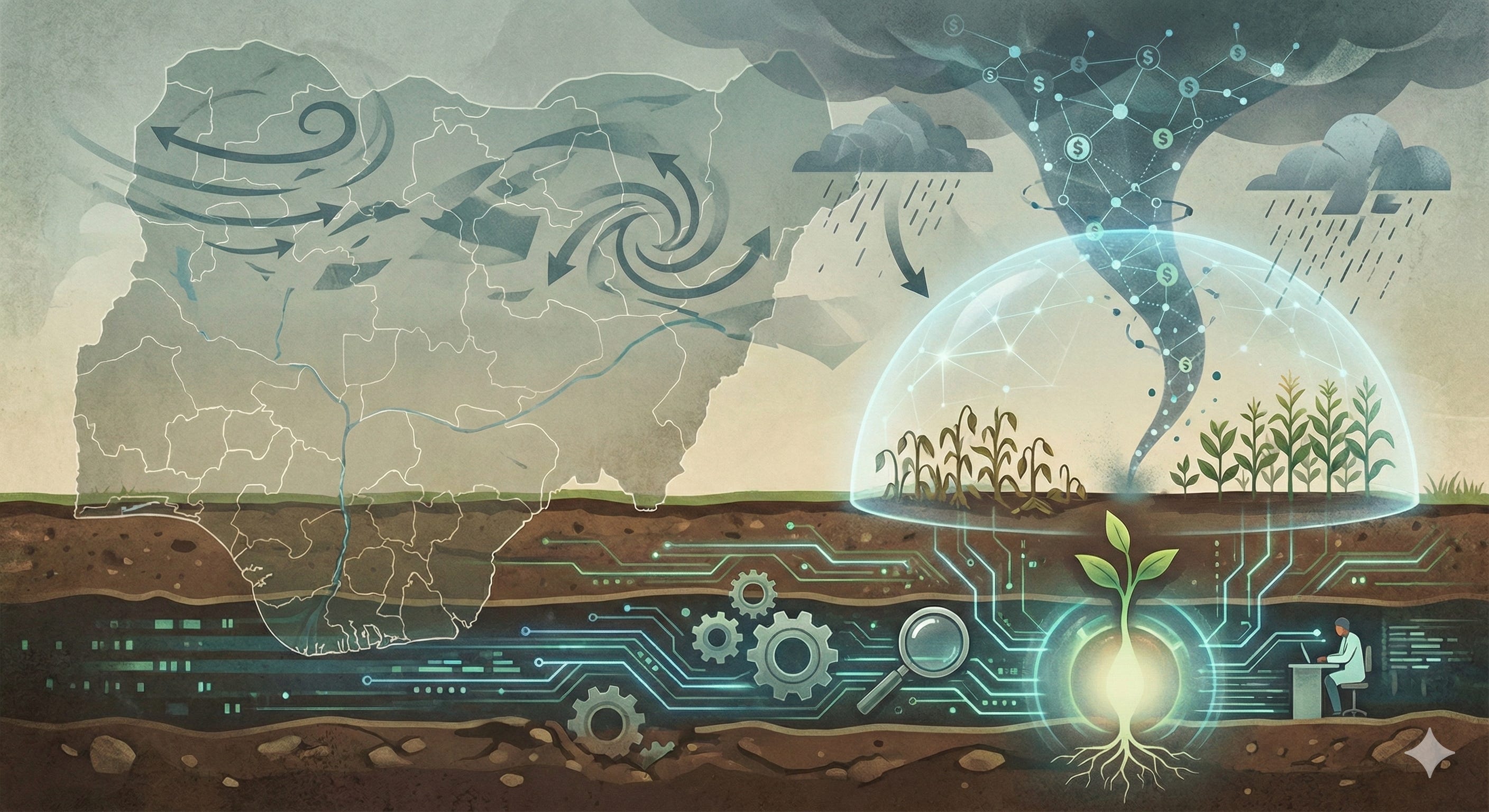
The interaction of various geographical factors in different parts of the world can produce vastly different outcomes even when, on the face of it, things appear to be the same everywhere. A key factor required for tornadoes to develop, for instance, is wide level plains which is present in many countries across the world. Yet, there are more tornadoes (<1,200 per annum) in the United States alone than the rest of the world combined. The reason for this is that even though the conditions for tornadoes exist around the world, the United States suffers from a “perfect storm” of geography that essentially exists nowhere else on Earth. The U.S. is the only place where you get high-altitude dry air (Rockies), low-level tropical moisture (Gulf), and cold polar air (Canada) colliding unobstructed over a flat surface.
No one else on Earth has the incentive to invest in the research needed to properly understand and mitigate tornadoes. Similarly, there are factors peculiar to Nigerian soil - specifically how weather and geography interact with that land - that determine the country’s agricultural output. You can call this “useless knowledge,” as it is of practically no value to anyone but Nigeria. No one is going to figure this out for you. You have to do it yourself. If Nigerian soil requires a cultivation method that works nowhere else, that is not a disadvantage; it is a monopoly. If you master it, no American agribusiness can swoop in and outcompete you because their “universal” methods will fail on your specific soil.
Research and development is the cost of acquiring this type of specific knowledge. And there is no way around it.
What we don’t know
There’s a story I read a few weeks ago that I’ve not stopped thinking about. Some farmers in Kano suffered devastating losses after their sugarcane plantations were attacked by pests. There’s nothing new about pests destroying crops in Nigeria, of course, but the circumstances in which this particular story unfolded left me scratching my head. Here’s how Daily Trust reported it (emphasis mine):
Farmers who spoke to Weekend Trust in the affected areas described the situation as devastating, saying they only discovered the damage at harvest time.
They estimated losses from the worm attack at N2 billion, warning that many may not return to farming next season if urgent action is not taken.
“We didn’t notice anything until we started harvesting. And by that time it was too late. The worms had eaten deep into almost every sugarcane farm in Dan Hassan, Garin Kaya, Tofa and Gamadan. We never expected the damage to be this bad,” Malam Kawu Hayi, a sugarcane farmer from Kura said.
[…]
“From all indications, if this continues, we may soon run out of sugarcane. The situation is beyond what farmers can handle. This type of worm attack is new to us and only a coordinated response can save the situation,” he noted.
This pest had been doing damage quietly to the crop and the farmers were none the wiser. The farmers don’t know what the pest is and if there’s someone out there who knows, the mechanism to turn that knowledge into action is non-existent (as stated above, R&D = organised work).
A culture of R&D
The IMF paper goes on to list a number of recommendations. Expanding the number of agricultural researchers, since the interaction between climate shocks and researcher availability is a key channel that stabilises yields. Building and funding public research institutes and extension systems that can translate research into farmer‑usable technologies. Increasing and stabilising public budget allocations to agricultural R&D, with explicit recognition that current funding is volatile. Encouraging more private R&D. Embedding R&D within a broader strategy that combines “intangible” investments (science and technology, extension, digital tools) with “tangible” ones (irrigation, machinery, fertiliser), rather than treating research as a standalone silo.
These are all reasonable suggestions, but I will only add that the emergence of a genuine culture of knowledge acquisition and research will simplify every challenge the nation faces.
Those who have been fortunate enough to benefit from Nigeria as it currently operates must be clear-eyed enough to know that the status quo is suboptimal, unstable, and ultimately self-limiting. For the sake of a more secure future, they must move beyond simply making money from a protected market and instead throw their resources at the research and development that can fundamentally alter the country’s trajectory. This is the price of future stability. No foreign institution will solve Nigeria’s specific problems - the unique challenges of its climate, its soil, and its pests.
The outsourcing of the fundamental work of innovation must stop. Acquire the knowledge, master the domain, and secure the future.
Thank you for another illuminating piece.
You wrote: “Those who have been fortunate enough to benefit from Nigeria as it currently operates must be clear-eyed enough to know that the status quo is suboptimal, unstable, and ultimately self-limiting.”
They should!
Fantastic breakdown of why R&D can't be outsourced. The tornado analogy really clicked for me because it shows how location-specific problems need location-specific expertise. I've seen similiar patterns in tech infrastructure where companies think they can just import solutions, but then local network conditions or power grids behave totally different. That IMF finding about the 1% threshold being where stabilization kicks in is kinda wild tho, makes it less about if but when countries commit.