

Not long after I finished this piece and scheduled it, I saw the news that the ban on exports had been extended for another year. I don’t much care for this policy so I’m just going to leave it as it is below.
Happy end-of-six-month-shea-nut-export-ban day to all who celebrate.
For those who missed the original announcement, or who have simply had other things on their mind since August, a full account of how things got here can be found in our earlier piece.

The export ban on raw shea nuts was advertised as temporary with the aim of curbing informal trade, boosting local processing and protecting and growing Nigeria’s shea industry. So what’s happened since then? Let’s do a quick run down
September 2025
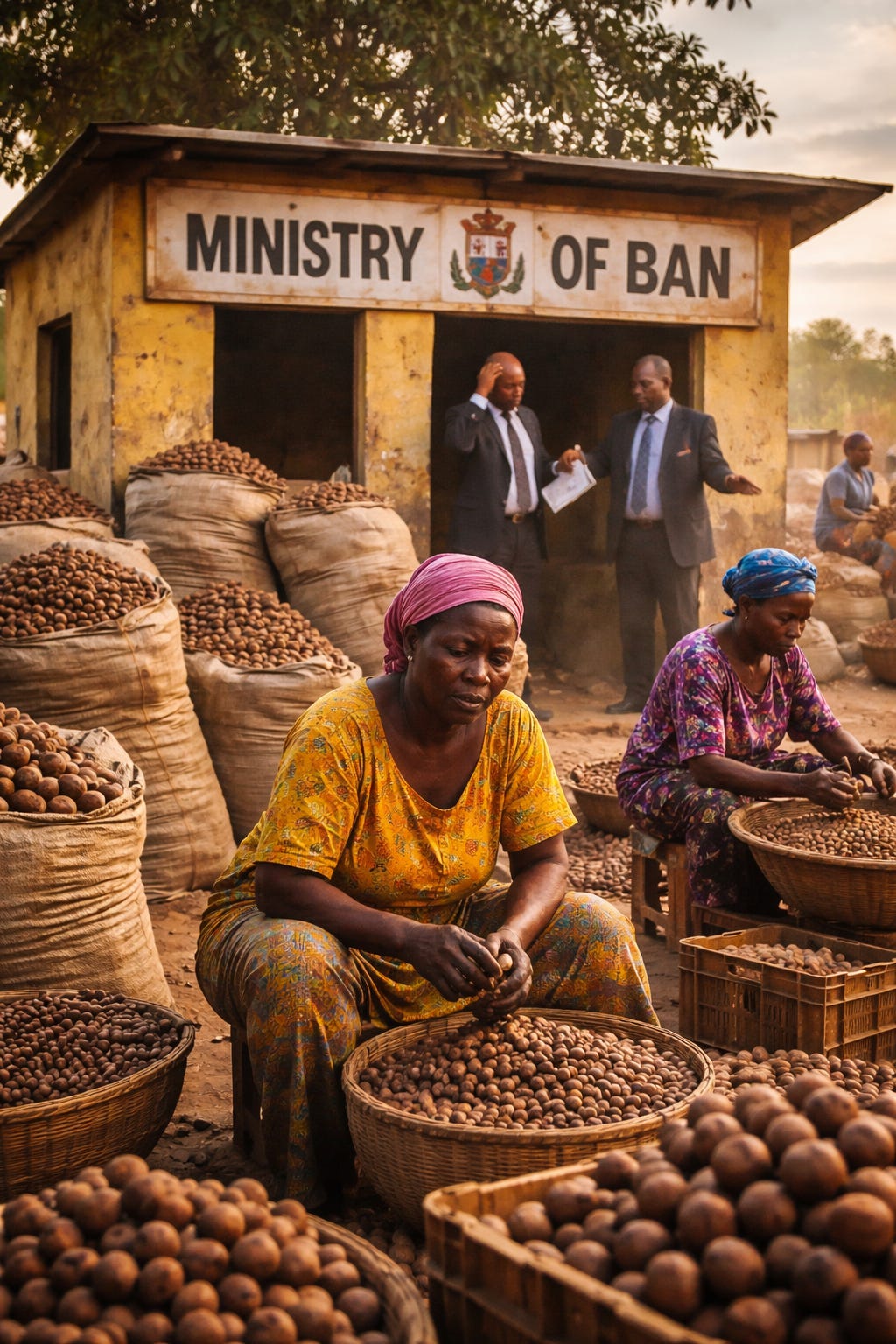
Reports described a ban that arrived without warning: orders cancelled, exports halted, and collectors’ incomes collapsing at harvest season. One particular story illustrated the damage: 25kg that had fetched roughly ₦35,000 before the ban was now worth ₦15,000. That pay cut fell hardest on the rural women collectors at the bottom of the chain, who have neither the reserves nor the leverage to wait things out.
By mid-September, the Centre for the Promotion of Private Enterprise (CPPE) and allied voices argued that the ban had triggered price falls exceeding 30 per cent, eroding incomes and putting exporters at risk of contract default - and called for a phased approach that honoured existing agreements. The underlying problem was that the value chain runs on credit, contracts, and accumulated trust.
October 2025
By October, the story had moved from the scale of the price fall to its structural consequences. The Guardian again reported market disruption and a price collapse, alongside two distinct knock-on risks: exporters facing legal and reputational exposure from contracts they could no longer fulfil, and the looming threat of loan defaults among players who had financed procurement and aggregation through bank credit.
The CPPE's Muda Yusuf warned that abrupt policy shifts of this kind send negative signals to investors broadly and that a ban that penalises primary producers to benefit processors does not create shared growth.
November 2025
By November, the regional picture had become relevant. Ecofin reported that Burkina Faso - another major shea producer - had indefinitely suspended shea-nut exports for the 2025–2026 season, citing the difficulty local processors faced in securing raw materials despite existing priority-access measures. The suspension followed a significant enforcement operation: on 22 November, the country's Mobile Brigade for Control and Fraud Repression announced the interception and seizure of more than 1,800 tonnes of shea nuts, with officials attributing the shortfall to systematic smuggling across borders and transport without proper documentation. The seized stocks were to be resold to processors to fund the Patriotic Support Fund (sorry, LOL).
Burkina Faso's ministry of industry and commerce also indicated it would tighten border controls in response. The broader context is one of declining output: according to the country's National Institute of Statistics and Demography, shea butter shipments (the main processed derivative) fell 26 per cent over the five years to 2024, from around 22,700 tonnes to under 17,000.
December 2025
By December, a fuller accounting of the ban's effects had emerged. African Business reported that the immediate impact on prices was sharp: shea nut prices fell more than 33 per cent in the weeks following the ban, from $798 per tonne to $532, before partially recovering to around $654 - still roughly 18 per cent below pre-ban levels. The BBC had reported that the ban's timing, mid-harvest, contributed to a fall in demand that local processing capacity could not absorb; the government's own figures point to an installed processing capacity of 160,000 metric tonnes, but utilisation rates at existing facilities were running at between 35% and 50%.
The consequences were uneven. Buying agents and rural collectors bore the sharpest losses - one Minna-based agent described being forced to sell stock at half his purchase price to limit further exposure. Some domestic processors, by contrast, used the price slump to build up raw material stocks and expand operations, which aligns with the policy's stated objectives. European processors, particularly in Germany, experienced initial supply disruptions before redirecting procurement to Ghana, Burkina Faso, and Mali at higher prices.
February 2026
This month, the policy reached the cliff-edge and there have been a number of reports on how things have gone so far. The Ministry of Industry, Trade and Investment convened a stakeholders' validation session in Abuja at which the minister, Jumoke Oduwole, confirmed that the ministry would brief President Tinubu on the ban's impact across the value chain - covering local producers, exporters, and foreign exchange earnings - before any decision on extension or deferral was taken. She said that the ministry had already reviewed submissions internally and conducted engagements with representatives across the shea sector, and that the president would receive a factual and balanced assessment to guide further action. The minister of agriculture, Abubakar Kyari, urged stakeholders to provide evidence-based input and stressed that policies should be assessed on measurable impact.
As the ban approaches its original six-month term, competing narratives have grown louder. Tellingly, only one official declared it an unambiguous success: Minister of State for Industry John Enoh, who held it up as a model of disciplined industrial policy. He claimed that Nigeria had effectively ceased to be a raw shea nut exporter and had become an exporter of shea butter; that crushing capacity had risen to nearly 300,000 metric tonnes annually; that farmer incomes had risen significantly; and that shea butter exports had increased by 250 per cent within a single year.
The most comprehensive ground-level account came from TheCable, which went out to speak directly with processors, aggregators, exporters, and collectors as the ban approached its end (click through and read the report which includes a few photos). Nigeria has only six shea processing factories, with a combined operational capacity well below the country's annual production of roughly 600,000 tonnes. One major processor, Alpha Shea, was running at 30 per cent of its 20,000-tonne annual capacity. Ladgroup, another significant processor, was under receivership due to debts owed to the Nigerian Export-Import Bank. Nut prices had fallen from around ₦1.2 million per tonne to as low as ₦600,000 before partially recovering to between ₦800,000 and ₦1 million - still below the levels at which aggregators holding pre-ban stock were willing to sell to local processors, creating a standoff in warehouses.
At least 13 companies were reported to be holding valid export contracts they could not fulfil, with some having taken bank loans to procure stock now sitting unsold. The NASPAN president, Muhammed Kontagora, estimated that roughly 200,000 metric tonnes had been smuggled out through porous borders since the ban took effect. Foreign processors with trapped stocks were negotiating toll-crushing arrangements with local facilities to recover some value. The Global Shea Alliance told TheCable that its members had responded by diversifying sourcing to other origins, at higher cost, and that in some cases the ability to meet delivery timelines had been compromised - with at least one major buyer, AAK of Sweden, reported to be exploring mango seed butter as a long-term alternative to shea.
A BusinessDay report offered a slightly different reading of the same period. Citing an industry report titled "Keeping Value at Home," it noted that crude shea oil exports had risen 5 per cent year-on-year, from ₦1.25 billion in the third quarter of 2024 to ₦1.31 billion in the same period of 2025 - early evidence, it argued, of a gradual shift toward domestic value addition. The report made the underlying economic logic that collectors and primary processors together capture roughly 33 per cent of profit in the global shea value chain, while foreign marketers and retailers control 67 per cent, meaning that raw nut exports systematically transfer the highest-margin activity abroad.
Where BusinessDay pointed to aggregate export figures as a sign of policy traction, TheCable found processing facilities operating well below capacity, warehouses holding unsold stock, and aggregators unwilling or unable to transact at prices local processors could afford. The 5 per cent rise in crude shea oil exports is real, but it is also small relative to the disruption documented elsewhere in the chain - and BusinessDay's own analysis noted that scaling beyond primary processing into higher-value fractionated products like stearin and olein would require capital investment and policy consistency that the six-month horizon of the ban could not plausibly deliver.
The Nation added a dimension that had received little attention in earlier coverage: the market access problem may prove more durable than the processing gap. Exporters pointed out that buyers of raw shea nuts and buyers of processed shea butter are not the same customers - meaning that companies forced to pivot by the ban were rebuilding their sales pipelines from scratch, against competitors who had used the intervening months to deepen their own supply arrangements. Processing facilities in Southeast Asia had expanded during the period, and industry figures warned that once international buyers establish alternative supply chains, recovering lost ground becomes structurally harder. The broader point, made by analysts in the piece, was that between 70 per cent and 90 per cent of Nigeria's annual shea output had historically left the country in raw form, with the highest-value refining - into stearin, olein, and cocoa butter equivalents - taking place in European and Asian facilities; the ban had not yet changed that underlying architecture, and would not do so without the kind of capital investment and logistics infrastructure that six months could not conjure.
Finally The Guardian reported that the decision on the export ban was far from settled - and that there was disagreement within the cabinet itself. Ministers of State for Industry and Agriculture were said to favour retaining or extending the ban, while the Minister of Industry, Trade and Investment leaned toward a more graduated approach. The government has apparently ruled out unconditional export resumption from the outset, meaning the question was not whether to maintain some form of restriction but what form it would take. One proposal in circulation was a backward integration licensing model, under which export rights would be tied to demonstrated investment in local processing. The paper also reported that foreign interests, whose cosmetics industries depend on West African shea supply, had intensified lobbying pressure on governments across the region to retreat from restrictive policies, with much of it channelled through farmers' groups. On prices, the paper noted that the per-kilogramme price had fallen from around ₦850 to ₦570 at the ban's onset before recovering to approximately ₦1,000 - roughly 18 per cent above the pre-ban average, suggesting the market had reached a new equilibrium, though at whose expense along the chain remained contested.
Conclusion
Six months on, the shea ban has delivered an uncomfortable verdict that even a commodity that barely registers in anyone’s consciousness is fiendishly difficult to design policy for - and that is before accounting for the fact that Nigerian policymakers have rarely been accused of being conscientious technocrats.
The underlying ambition was not indefensible. Nigeria should not indefinitely play the role of raw-material supplier while the high-margin processing happens abroad. But what this episode demonstrates is that industrial policy is not just a slogan directed at a value chain like an incantation.
The people who got hit first were the rural women collectors as everyone predicted. When a policy shock arrives mid-harvest and demand collapses, these women do not have working capital, warehouses, or legal recourse. They cannot hold inventory in a village the way an aggregator holds stock in a warehouse, and they cannot renegotiate contracts they never had in the first place. The export ban policy, in effect, turned them into shock absorbers that bore the volatility for someone further up the chain to claim some value addition.
There is a broader pattern here. Banning things is the easiest lever the Nigerian state can pull, and it is beginning to look like the only trick it has. Bans are seductive because they create the appearance of control: with a single directive you can declare that value will now stay at home. But that sort of thing, of course, creates incentives for smuggling through porous borders and for waivers and special permissions at chokepoints.
The government’s own behaviour through this period suggests it did not anticipate how quickly the real economy would push back. The last-minute stakeholder consultations, the conflicting signals within cabinet, the hedging between extension and deferral, and the solitary minister declaring victory with heroic statistics - all of it very unserious. None of this is surprising. If anything it is reassuring in some darkly funny way that the Nigerian government has once again lived down to expectation in the policy detail.
Which brings us to a simple test of seriousness. If some form of restriction continues beyond today, it cannot continue as a ban dressed as an industrial strategy. The warning signs are already there that the global market will move on without Nigeria if it becomes an unreliable cog in the global value chain.
As I said six months, this policy is hardly worth the trouble beyond the experimental value of a controlled policy experiment. If shea could descend into this level of chaos, you can imagine how the new “industrial policy” floating around was concocted (short review - it is not a good policy).
I only feel sorry for the poor women who have borne the brunt of all this.
The one trick pony government continues to fall short of expectations.
Will we ever see policies that are thoughtful, consistent, and truly effective?
Really disappointing. 😔