

It is a generally accepted fact that human capital is important for economic development. Human capital in this context refers to the productive skills that a country’s population possesses. The education system of a country is also recognised as the first step towards acquiring such skills, although productive skills are also accumulated through work experience. Countries with weak education systems are therefore seen as poorly equipped to climb the development ladder.
For decades, multilateral institutions and development agencies, working with national policymakers, interpreted investment in human capital to mean expanding access to schooling. Increasing enrolment, building schools, and extending years of education became the central policy response. This approach reflected a broad consensus in development thinking. Yet despite large and sustained investments, the expansion of schooling did not translate into commensurate gains in productive skills or improvements in development outcomes.
Skilling is not Schooling
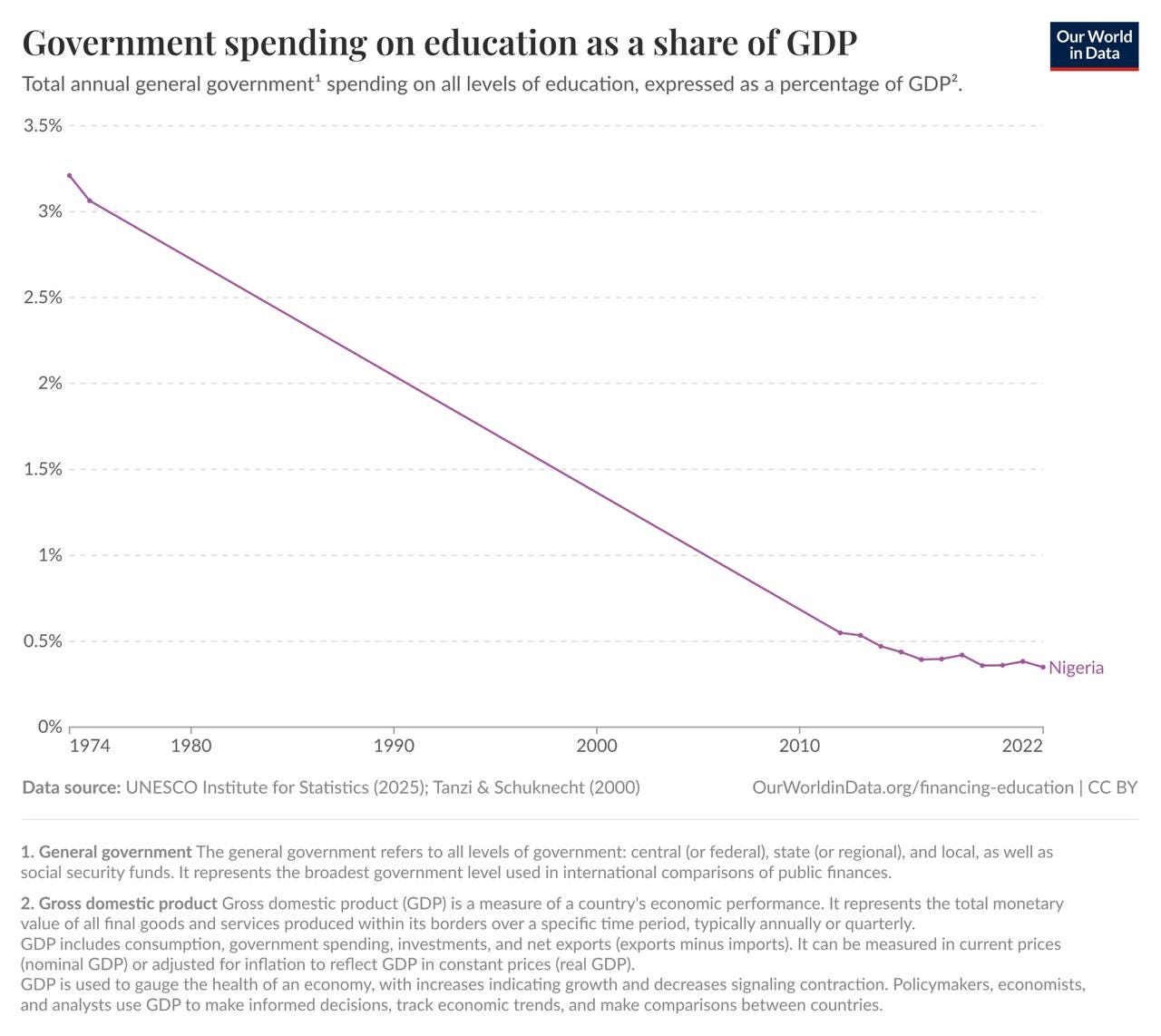
It is sometimes argued that the failure of education to deliver development reflects insufficient spending or incomplete expansion of access. The evidence suggests otherwise. Even where schooling expanded rapidly, and education budgets rose, learning outcomes often remained weak. This points to a more fundamental issue: years spent in school are not the same thing as skills acquired.
Eric Hanushek and Ludger Woessmann, drawing on international data spanning decades, showed that economic growth is closely linked to cognitive skills, not to enrolment rates or average years of schooling.1 Countries whose populations acquire basic literacy and numeracy grow faster and sustain that growth for longer. Countries that expand schooling without improving learning do not.
The implication is straightforward. Schooling is an input into human capital formation, but it is not human capital itself. What matters is whether education systems succeed in imparting usable skills. Where they do not, additional spending produces little return. More classrooms, more teachers, and longer school cycles raise participation, but they do not automatically raise productivity.
Charlie Robertson reaches a similar conclusion from a historical perspective. Looking across countries that successfully escaped poverty, he shows that mass basic skills, particularly literacy, consistently preceded sustained growth.2 By contrast, countries that expanded formal education without ensuring learning saw limited economic payoff. The lesson is not that education spending is unimportant, but that its effectiveness depends entirely on whether it results in real skill acquisition.
Charlie Robertson on Fertility, Electricity and Literacy

Three years on from The Time-Travelling Economist, we sit down with Charlie Robertson to ask: how has the shifting global landscape altered his outlook? From demographic booms to education surges, which countries are now on his radar? Why does he see 2042 as a pivotal year for Nigeria - and what explains his tempered view on Thailand’s trajectory?
So what does the education research literature mean by skills? Skills refer to basic cognitive capabilities, particularly literacy and numeracy, that allow individuals to function productively in a modern economy. These are not advanced or elite skills. They are the minimum abilities required to follow instructions, apply rules, and adapt to routine tasks across a wide range of jobs.
The distinction matters because schooling and skills do not always move together. Expanding access to education increases time spent in classrooms, but it does not guarantee that students acquire these basic capabilities. Where education systems prioritise attendance, progression, and certification over learning, additional spending raises participation without raising productivity. In such settings, the problem is not insufficient investment, but the weak connection between schooling and learning.
Schooling is Good Politics
If basic skills matter for development, and if expanding schooling does not reliably produce them, the next question is why education systems failed to deliver learning despite decades of reform and investment. The answer is political incentives.
Expanding access to education was relatively easy to sustain politically. It produced outcomes that were visible and immediate. New schools could be opened, enrolment figures could be published, and years of schooling could be counted. These measures signalled progress and commitment, both domestically and internationally. They also spread benefits broadly, without forcing difficult choices about who should succeed and who should not.
Learning, by contrast, posed a different set of challenges. Improving learning outcomes required closer scrutiny of classroom practice and clearer standards of performance. It meant changing how teachers were recruited, monitored, and rewarded. It also meant accepting that some students would advance while others would not, based on what they had actually learned. These changes introduced conflict and uncertainty into systems that otherwise offered predictable pathways and stable expectations.
Research on education governance shows that, in this context, education systems gravitated towards arrangements that reduced friction rather than raised learning. Students progressed through grades even when learning was weak. Examinations sorted candidates but did not consistently reveal what they knew or did not know. Teachers were evaluated on attendance, seniority, and compliance with administrative rules, not on student outcomes. These features were not incidental. They made systems easier to manage and less politically contentious.3
Preferences over education policy reinforced this pattern. Policies that expanded access or raised pass rates attracted broad support because they preserved existing hierarchies and minimised disruption. Policies that aimed to improve learning were more divisive. Better learning changes relative positions. It increases competition and weakens the protective value of credentials. For many actors, including those who benefit from the current system, this uncertainty was unwelcome. As a result, reforms that directly targeted learning often faced resistance, dilution, or quiet abandonment.4
Over time, this produced an equilibrium in which schooling expanded while learning lagged. Education systems delivered what was politically rewarded and avoided what was politically costly. The gap between time spent in school and skills acquired was therefore not a temporary failure of implementation, but a stable outcome of how education systems were structured and governed.
Compliance Over Competence
The political logic that shaped modern education systems did not emerge by accident. It reflects the historical origins of mass schooling itself. Long before education was framed as a driver of productivity or growth, it was understood by political elites as a means of shaping behaviour and maintaining social order.
When states first intervened systematically in education, their primary concern was not skills formation but stability. Schooling was seen as a forward-looking tool, one that could reduce future unrest by instilling discipline, obedience, and respect for authority at an early age. Primary education was particularly attractive because it targeted children when habits and attitudes were most malleable. Curricula emphasised moral instruction and proper conduct. Classroom structures reinforced hierarchy and routine. Literacy and numeracy were taught, but often as secondary objectives.5
This origin matters because institutions carry their purposes forward. Education systems built around discipline and compliance developed routines, hierarchies, and expectations that proved durable even as official goals changed. As schooling expanded and societies became wealthier and more politically inclusive, the structure of education systems remained largely intact. They continued to value order, predictability, and control over learning that might disrupt established patterns.
Contemporary preferences over education policy reflect this inheritance. Policies that expand access or raise certification rates fit comfortably within systems designed to manage populations and allocate status without provoking conflict. They preserve familiar pathways and stable expectations. By contrast, policies that genuinely improve learning challenge these arrangements. Better learning sharpens distinctions, alters rankings, and weakens the protective role of credentials. It introduces uncertainty into systems that were never designed to accommodate it.6
Seen in this light, resistance to learning-focused reform is not simply a matter of short-term politics or vested interests. It reflects deeper assumptions about what education is for. Even where there is broad agreement that learning outcomes are weak, there is far less agreement on reforms that would make success contingent on what students actually know and can do. The preference for schooling without learning is therefore not an anomaly, it is consistent with the original logic of mass education and the institutional forms that grew out of it.
This helps explain why education systems have proven so resistant to change. Efforts to reorient schooling towards learning confront not only administrative constraints, but also long-standing expectations about discipline, progression, and social order. As a result, the expansion of education has been easier to sustain than its transformation.
Reform Must Reckon with Incentives
The expansion of schooling was one of the most ambitious public projects of the past century. It was pursued in the belief that education would build human capital and support development. Yet the evidence shows that this expansion did not reliably produce the basic skills that growth depends on. Time spent in school increased, but learning often did not.
This outcome was not the result of ignorance or poor intentions. Education systems responded to the incentives they faced. Policies that expanded access were easier to sustain than those that improved learning. Credentials became more important than capabilities. Over time, schooling became detached from skill acquisition.
Understanding this gap matters because it reframes the challenge. The problem is not simply that education systems need more resources or better policy design. It is that learning has rarely been the central objective around which these systems were built. Until that changes, expanding schooling will continue to fall short of its promise, and education will remain a weak foundation for human capital, and hence, development.
The Basic Skills Gap - IMF paper by Erik Hanushek and Ludger Woessmann
The Time-Travelling Economist - Charlie Robertson
The Politics of Education in Developing Countries: From Schooling to Learning - Sam Hickey and Naomi Hossain
Understanding Education Policy Preferences by Lee Crawfurd, Susannah Hares, Ana Minardi, and Justin Sandefur. This recent paper tinspired me to write this essay.
See the excellent book Raised To Obey by Agustina Paglayan
See note 4 above