

This week, along with a friend, we did a quick and dirty analysis of what listed companies in Nigeria pay their employees. The findings may or may not surprise you.
Enjoy the usual selection below
Nigerian Media
Let’s check in on cassava prices:
For Engineer Okpachu Odeh, a retired mechanical engineer and lecturer who returned to farming in Ohimini Local Government Area of Benue State, cassava farming was supposed to be a profitable venture.
Like many farmers, he borrowed money and invested heavily in cassava production, encouraged by the high prices of the crop in the years before 2024.
But his optimism soon turned to despair as the price of cassava and garri gradually crashed, falling from over N35,000 per basin to about N5,000 in his community.
Odeh said the situation had left many farmers, including himself, struggling to recover their investments.
“We were initially happy with the price of cassava, but unfortunately, two years back, the cassava prices and garri crashed from over N35,000 per basin to now N5,000 in my community,” Odeh said.
He noted that the sharp fall in prices had left farmers who borrowed money to cultivate cassava in serious financial distress, with some unable to repay their loans.
“People borrowed money to plant cassava massively. And you can imagine the disappointment. I know of friends who are dying from payment of the loans that they took. So, this is actually a hope awakened,” he said.
So much to unpack here. 10 years?
Residents of Igboora in Ibarapa Central Local Government Area and Ayete, Tapa and Igangan in Ibarapa North Local Government Area of Oyo State have lamented prolonged power outages, saying their communities have been without regular electricity for about a decade.
The residents, who separately spoke with PUNCH Metro on Thursday, said the prolonged blackout had adversely affected businesses, schools, healthcare, security and development across the communities.
A civil servant and indigene of Igboora, Olaoye Emmanuel Olatayo, said electricity supply to the community had been epileptic for as long as he could remember, adding that Igboora had been in darkness for about 10 years.
Olaoye said the situation had forced some residents whose businesses depended on electricity to relocate.
He said, “Many of our people who are supposed to have one business or the other have to travel away from home because of electricity. It has really impacted many businesses negatively.”
He added that community leaders had made several efforts to address the situation, including sending a delegation to meet the then Minister of Power, Adebayo Adelabu, who reportedly promised to look into the matter.
“Unfortunately, nothing changed till today,” he said.
Olaoye also attributed the prolonged outage partly to the alleged vandalism and theft of electricity cables serving the community.
He said, “Many poles were erected in the bush instead of being on the roadside, where passers-by can easily monitor them. It’s also not easy for the security team to mount surveillance on these poles and cables.”
Just a suggestion from the EFCC:
The Chairman of the Economic and Financial Crimes Commission, EFCC, Mr Ola Olukoyede, has expressed concern over the involvement of some religious figures in financial crimes in the country.
Olukoyede said this on Wednesday at the 2026 Second Council Meeting of the Nigeria Inter-Religious Council (NIREC) in Abuja, with the theme, “Shared Sacred Flourishing in Nigeria.”
The EFCC chairman noted that pastors, imams, bishops, sheikhs and other religious leaders were among persons investigated, prosecuted and convicted for such offences.
He added that the commission’s case files contained numerous suspects identified by religious titles, with some already convicted and serving prison sentences.
“So many case files, pastor, imam indicted for financial crimes. And some of them are even badly convicted, and they are in jail,” Olukoyede said.
He observed that despite their convictions and imprisonment, some of the individuals continued to be addressed by their religious titles.
“And while in jail, they still refer to them as pastor and imam,” he said.
Olukoyede therefore advocated a review of the manner in which religious titles were conferred on individuals, saying titles should not become a shield against accountability.
“I advocated for a review of the titles we give to men of God. Maybe, if it is possible for us to remove those titles, pastor and imam.
“If it is possible for us to remove that title: pastor, Imam, bishop, sheik. And you know what? I have my case files full of these titles,” he said.
This will be a return to a very dark past:
A quiet but radical shift is reshaping Nigeria’s formal employment landscape.
Trapped under the weight of soaring operational costs, high inflation and dwindling consumer purchasing power, Economy&Lifestyle has discovered that businesses across major commercial hubs are abandoning traditional fixed salary structures.
Instead, many employers are now moving their workers, entirely or partially, to commission-based remuneration models, shifting the burden of low sales directly onto their staff.
From retail outlets to tech startups and manufacturing firms, the narrative is uniform: if you do not bring in revenue, you do not get paid.
The survival switch
Years back, monthly base pay was the golden standard of employment security in Nigeria.
However, as business patronage slows to a crawl, companies say maintaining a high wage bill is no longer sustainable.
“We had no choice,” says Mr. David Amaechi , the Managing Director of a mid-sized consumer electronics retail chain.
“Our foot traffic has dropped by more than 40 percent compared to last year.
“People are prioritizing food and fuel over gadgets.
Not sure I understand the maths here but love wins:
“After 50 years apart, we are married today”; “After 50 years apart, here we are today—we are married”. These were some of the joyful words of Abubakar Sadiq Ladan, the groom, and his bride, Hajiya Fatsuma Umar Kulani, at their wedding recently in Bauchi.
Abubakar Sadiq Ladan, aged 70, and Hajiya Fatsuma Umar Kulani, aged 60, who is a former Manager of Programmes at the Nigerian Television Authority (NTA), Bauchi, have finally married after being separated for 50 years.
This is not an ordinary marriage. In fact, it is a particularly unusual and remarkable one, considering their ages and the fact that they reunited after 50 years, having first met and fallen in love when they were young. By the grace of God, their reunion has now culminated in a marriage with a remarkable history.
The marriage ceremony took place at the Juma’at Mosque in Kwallaga, Bauchi city, Bauchi State, on September 19th, 2026.
After the wedding ceremony, Journalists around, interviewed the groom, Abubakar Sadiq Ladan, who was visibly happy and excited on what was a historic day for both of them.
His excitement was so overwhelming that, at some points during the interview, he struggled to find the words to express himself.
The bride, 60-year-old Hajiya Fatsuma Umar Kulani, also spoke about her surprise at how events had unfolded. She said she had never imagined that such a day would come in her life. At one point, after her previous marriage ended, she had even believed that she would never marry again, especially because she had grown older.
Apparently there is “Scottish Loud”:
Abia State Police Command has arrested a 49-year-old suspected drug dealer, Prince Chukwudi Eguzouwa, a native of Ahiabubi, Isiala Ngwa North Local Government Area of Abia State.
The Police Command also said it recovered bags containing substances suspected to be Cannabis Sativa, “Scottish Loud,” methamphetamine, cocaine and other hard drugs.
A press release by the Police Public Relations Officer, DSP Maureen Chinaka, said the raid on the home of the suspected drug kingpin was carried out in line with the directive of the Commissioner of Police, Abia State Command, CP Wilfred Afolabi, and the vision of the Inspector-General of Police on intelligence-led policing.
Incredible story that just left me speechless:
A 38-year-old man, identified as Mike Oje, was reportedly beaten to death by his neighbour in Mowe, Ogun State, following an alleged disagreement over his interaction with the neighbour’s three-year-old child.
The Guardian learnt that Oje was hugging and playing with the child, an action which made the father allegedly become upset, accusing him of engaging in what he considered “rough play.”
Spokesperson of the Ogun State Police Command, DSP Oluseyi Babaseyi, confirmed this to newsmen in a statement in Abeokuta on Friday
Babaseyi said that upon the father’s reaction, neighbours reportedly picked up a bamboo stick and started to beat Oje.
He said that due to the severe beating, the victim allegedly collapsed during the assault and later died from injuries sustained.
Babaseyi said that the suspect, on realising the situation, fled the area with his family following the incident and was said to be hiding in an unknown place.
Non-Nigerian Media
The ‘Black Mentor’ has been sentenced to 4 years in prison:
Brad Schimel, First Assistant United States Attorney for the Eastern District of Wisconsin, announced that on September 18, 2026, Joseph James Nantomah (aka “The Black Mentor”) (age 49), was sentenced to 48 months’ incarceration for committing an investment fraud scheme that resulted in a loss of more than $2,700,000 to investors across the country and abroad.
According to court records, Joseph Nantomah entered the United States on a visitor’s visa from Nigeria in 2016. Within a few years, he had cultivated a false online persona alleging that he had built a multi-million-dollar real estate enterprise. Nantomah gave himself the moniker, “The Black Mentor,” and hosted conferences and classes in which he purported to share his knowledge of building success in the United States with people he duped into paying for his classes. Nantomah then used these classes to convince his “students” to “invest” in Nantomah’s real estate business.
Nantomah’s online presence, his “Wealth Flow” conferences, and his claims of growing a successful real estate business were all part of his scheme to defraud. Between May 2020 and December 2024, Nantomah stole $2,762,798.37 from at least 39 victims. Nantomah targeted mostly Nigerian immigrants and people who were members of his church. Drawing on their shared cultural heritage and their belief in the American Dream, Nantomah convinced them to send him millions of dollars that he claimed he would invest in real estate. He promised significant returns on investment. In reality, Nantomah had no legitimate business or knowledge in real estate. He spent the majority of his victims’ funds on a lavish lifestyle that included private jets, luxury cars, expensive jewelry, and a yacht. Nantomah also spent significant sums of his victims’ money cultivating his false online persona, including purchasing an honorary doctorate degree for himself and his wife and paying celebrities to attend his conferences.
United States Attorney’s Office
Adaobi Tricia Nwaubani has a piece in The Times on slavery reparations:
I am Nigerian. I now have British residency under the global talent scheme and, if all goes to plan, I will eventually become British. This presents me with a small philosophical inconvenience: does citizenship mean inheriting not only a nation’s privileges but also its historical obligations?
This month, a Jamaican government delegation lodged its slavery reparations petition at Buckingham Palace. Britain, we are repeatedly reminded, has sins to answer for: slavery, colonialism, the exploitation of African and Caribbean peoples and the extraction of wealth that distorted societies. Across Africa and the Caribbean, governments, activists and campaigners have increasingly demanded reparations. Britain must pay, we are told — but when I become British, do I become one of the people who must pay?
Many of us from former colonies have an interesting relationship with Britain. We are happy to inherit its passport, its universities, its National Health Service, its legal protections and the impressive travelling privileges of British citizenship. But when the inheritance reaches the less attractive cupboard labelled “History”, we sometimes behave as if inheritance is optional. The good things belong to all citizens while the bad things belong to a mysterious people called “the British”, who died several generations ago but somehow still maintain a current account at the Treasury.
If Britain were persuaded to pay hundreds of billions or trillions in reparations, the cheque would not be found under the King’s mattress. The money would come from tax rises, borrowing, reduced public spending or some combination of the three. The Nigerian nurse in Birmingham would contribute. So would the Jamaican bus driver in London, the Ghanaian engineer in Manchester, the British-born child of Caribbean parents — and, eventually, so would I.
Bloomberg invited me on the Next Africa podcast to talk about the Dangote Refinery IPO. My segment starts around 14mins in:
Africa’s richest man, Aliko Dangote, has finally launched the much anticipated IPO of part of his refinery business, and it's generated so much hype that many investment apps were overwhelmed by demand. The company hopes to raise as much as $2 billion from retail investors and with a minimum investment of just $4, the firm hopes ordinary Africans will buy shares. On today’s special episode, Deputy Managing Editor for Africa Neil Munshi joins Jennifer Zabasajja. They hear from Bloomberg's Lagos based reporter Yinka Ibukun about the mood among Nigerians, and then speak to analyst Feyi Fawehinmi about why he’s not convinced by the hype.
Horrific story:
The parents of a 14-year-old British boy who died after taking a poison purchased from the Canadian chef Kenneth Law have told a court how his loss “shattered our lives”.
Grieving UK relatives were among those to give victim impact statements to a court, after Law admitted aiding the deaths of 79 Britons and 14 Canadians.
He was caught following a Times investigation in 2023 that exposed him for selling a lethal poison to suicidal people around the world.
Law, a hotel cook, sat in the dock in Ontario, Canada, on Wednesday as a succession of parents spoke about the deaths of their children.
[…]
A 21-year-old Briton died in her mother’s arms after taking Law’s poison. Faith Ike-Elechi, who had moved to the UK with her family from Nigeria at three years old, screamed after taking the poison, causing her mother, Faith George, to rush to her bedroom.
Her mother’s victim impact statement said: “She was sitting on the floor appearing helpless. The only words she repeatedly said were: ‘I’m sorry, I drank it.’
“Those words will remain with me for the rest of my life. I held my daughter in my arms, tears streaming [from] my eyes while we desperately waited for the paramedics to arrive.”
That feeling of always wanting to recreate Nigerian food abroad:
Years later, I traded Oyo, Nigeria, for Lubbock, Texas. I expected winter to feel different. I expected grocery stores to feel different. I expected church to feel different. I didn’t expect my kitchen to feel so empty.
One Saturday afternoon, homesick and craving the taste of Sunday after church, I decided to make jollof rice.
I tied on an apron, set a pot on the stove, and reached for onions, tomatoes, peppers, and rice almost without thinking. My hands remembered what my heart missed. I chopped onions until my eyes watered, blended tomatoes and peppers, browned the tomato mixture until the oil separated, and stirred in the rice exactly the way I had watched my mother and grandmother do for years.
Soon my apartment smelled like home. For the first time in weeks, I wasn’t thinking about how far away Nigeria was.
I was thinking about lunch behind the mission house.
When I finally lifted the lid, I laughed. The pot was overflowing.
I looked around my apartment. One small table. One chair. One plate drying beside the sink.
There wasn’t a congregation waiting outside. There wasn’t another family stopping by after church. There wasn’t even a roommate.
Just me.
I stood there laughing at myself as I filled container after container with leftover rice. By the time I finished, my refrigerator looked like it was preparing to feed a choir. For nearly a week, breakfast, lunch, and dinner all tasted like Sunday afternoon in Oyo.
To use or not to use a Nigerian accent?
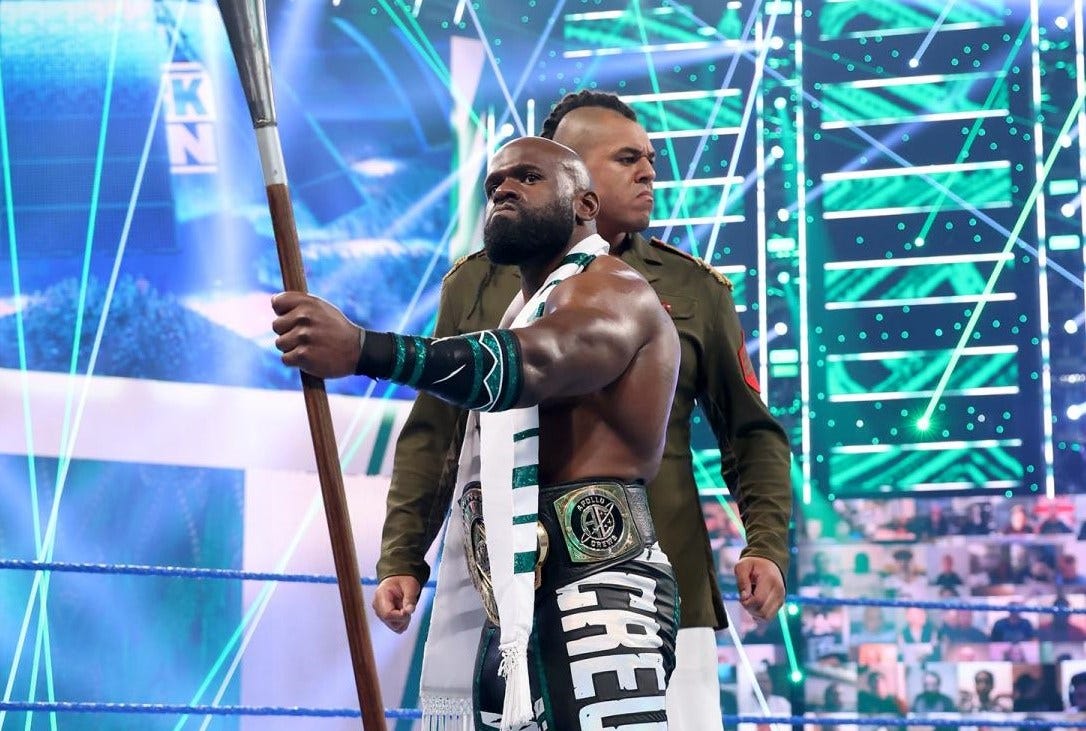
In January 2021, with WWE running out of their “ThunderDome” set-up a year into the pandemic, Apollo Crews turned heel for the first time in his time with the company. It was a feud with then Intercontinental champion Big E, and started promisingly enough, with Crews showing a new attitude and referring to his Nigerian ancestry.
Apollo briefly used a Nigerian accent while quoting his grandfather on his first night as his villainous character (which also featured an unannounced Trick Williams as a member of his “elite Nigerian guard”). But when Crews next appeared the following Friday on SmackDown, he delivered his entire promo that way.
It led to jokes, concern about returning to wrestling roots in ethnic and racial stereotypes, and charges of racism.
It also didn’t do Crews any favors in the long-run. He briefly held the IC title, but that was really the gimmick’s only program. Crews (and his sidekick/head of his , Commander Azeez) were drafted to Raw in late 2021, and then Apollo appeared alone — and sans accent — in NXT for a spell before spending the last couple years of WWE run as a main roster enhancement talent. Following his post-WrestleMania 42 release, he’s been working elsewhere under his pre-WWE name, Uhaa Nation.
Another illegal voter:
Federal prosecutors allege that a Nigerian man living in Olathe voted illegally in the 2024 presidential election and was indicted on four election-related charges. Federal authorities said a Topeka grand jury indicted George Olawunmi Johnson, 67, on one count of making a false claim to U.S. citizenship. Johnson is also charged with one count of making a false claim to U.S. citizenship to vote, one count of fraudulent election conduct and one count of voting by an alien in a federal election, according to a news release from the U.S. Attorney’s Office for the District of Kansas. Johnson was accused of falsely indicating he was a U.S. citizen when he registered to vote in Johnson County in February 2010. Prosecutors said Johnson is a permanent resident but not a U.S. citizen and was accused of casting a ballot in Kansas in the November 2024 election.
I did not know that Nigeria and Ghana were quarrelling over onions:
Ghana is a crucial market for Nigeria‘s onion industry, importing nearly 100,000 tonnes every year. When hundreds of tonnes of Nigerian onions were seized at Kotoka market in Accra earlier this year, tensions rose quickly.
Several onion seizures took place from April onwards, prompting traders in northern Nigeria to suspend onion deliveries to Ghana.
The dispute centred on the way Nigerian onions were sold on Ghanaian markets, and the prices charged.
Nigerian traders were selling their onions at prices they had set themselves, which angered Ghanaian traders, said David Olujinmi, an economic analyst at SBM Intelligence in Lagos.
“They believe the Nigerians are coming in with their products and driving down prices because the onions they sell are offered at a much lower price,” Olujinmi said. “Onions produced in Ghana are therefore not competitive with those that Nigerians bring onto the Ghanaian market.”
Who is Abiola Olusola?
Abiola Olusola had no idea who was going to attend her debut London Fashion Week show earlier this year. ‘Once we saw the security and the King’s guard coming in, we realised someone important was arriving,’ says the Nigerian fashion designer as she beams down the camera over Zoom, recounting her surprise meeting with King Charles. Olusola is one of the five designers to be selected for the inaugural cohort of Brand63Africa, a social enterprise founded by Eva Omaghomi CVO to connect fashion designers of African heritage and the diaspora with the global luxury market.
Olusola’s fashion career was not set in stone - her first degree was a Bachelor’s in English Literature and Language. And before that? ‘As a kid I thought I wanted to be a lawyer, but fashion eventually took over.’ In 2015, she graduated with a BFA in Fashion Design from Istituto Marangoni, Paris and moved back to Nigeria where she launched her brand in 2017. Within the very first year Olusola was approached by leading luxury retailers, including Temple Muse in Lagos. Since then, she has continued to develop the brand; rooting its designs in Nigerian culture, working with local artisans, and manufacturing product via an in-house studio in Lagos that is staffed by a team of skilled female seamstresses.
Her designs are evocative, wearable and luxurious at once. Through bold prints, embellishments and vibrant palettes, she unlocks the modern woman’s wardrobe by creating silhouettes that feel decidedly elevated. The designer looks to movies, her mother and the ‘60s for inspiration, explaining that she has ‘always been captivated by the grace, style and elegance’ of her mother’s generation. ‘I watch a lot of classic Nigerian movies from the 1960s to study that sophisticated era of style.’
The story that won’t go away and what a way to be defending your father in the media:
On the carefully curated pages of social media, Nigerian-born British businessman Igho ‘Tiny’ Ubiribo appeared to have it all.
A glamorous fashion designer-cum-influencer wife, a wardrobe dripping in designer apparel, fast cars, smart property and a jetset lifestyle flitting from one luxury resort to the next. To his 186,000 followers on Instagram, Ubiribo – or Ego2222 as he was known online – gave the outward appearance of uber-affluent contentment.
Whether Igho Ubiribo was as happy – or as wealthy – as he seemed, however, remains a baffling mystery to both his followers and his family. For, as revealed at a recent inquest into his death last year, Ubiribo became the first British man to die following penis enlargement surgery abroad.
His death was caused by a pulmonary embolism – a blood clot in the lungs – in the Thai capital of Bangkok in March.
Westminster Coroner’s Court was told that the embolism had been triggered by a ‘cosmetic injection’ into his penis, his cause of death was recorded as ‘genital hyaluronic acid injection’.
Traces of hyaluronic acid, a filler commonly used in the beauty industry, were found in his lungs.
The inquest heard that the flamboyant businessman and father of eight, who owned a £450,000 flat in Shepherd’s Bush, west London, and also, seemingly, a chain of petrol stations in Nigeria, had gone to a clinic in Bangkok, where he was living with his British-born ‘wife’, Danielle Simba Allen. Whether they were officially married, however, remains frustratingly opaque, like so much of this tale – as are his reasons for having the injection.
[…]
‘No one [in the family] believes that the procedure was the cause of his death. He didn’t have a micro penis, he didn’t have anything to be ashamed of,’ his 21-year-old son Junior said.
Blinking back tears, IT worker Junior – one of eight of Ubiribo’s children, born to different women – said he was far from convinced that he’d been told the full story of his father’s final moments.
‘He’s had multiple partners, he wouldn’t need a penis enlargement. But what I do remember is that when he got with Danielle he would ask about cosmetic surgery, and also what was good to take to stay healthy.
‘It’s actually quite painful to read these reports about him having this surgery because he didn’t need it.’