

A subsidiary discussion recently broke out on Nigerian social media that was partly triggered by the Dangote Refinery IPO and the fact that the company’s accounts were made public for the first time. People can see how much the refinery business pays in salaries and let’s just say it has not gone down.
Obviously I had no interest whatsoever in a discussion about Dangote (not my thing) but circumstances compel me to make this quick and short intervention. As it turns out, a friend of mine who I consider one of my main intellectual sparring partners had done half of the work on this analysis so I collaborated with him (and burnt a billlion AI tokens) to complete it. He’s a friend of the house who has written a couple of guest posts for us in the past but he shall remain nameless.
Data Cohort
Using annual reports from the Nigerian Exchange’s document library, we assembled salary disclosures for 34 listed companies for the 2025 full year. After removing overlap between groups and their listed subsidiaries, the combined sample covers 76,474 employees. This may not be the entire workforce of those companies but that is the number captured from their disclosures.
Limitations
Before even getting into the limitations of the data, the most obvious one is structural. About 93% of Nigerians are informally employed, according to 2024 data from the Nigerian Bureau of Statistics (NBS), so no analysis formal employment is likely to give you anything like a full picture of employment in the country. Further, public companies are a subset of that 7% subset. The difference between public and private companies may not be as wide as the that between formal and informal, but it is still there.
From the accounts themselves, there are the following limitations:
Some companies report basic salaries while others include allowances or pension contributions. For this quick analysis, we used the pay figure each company discloses, without trying to estimate undisclosed allowances. They should disclose allowances if they want it to be included in analysis of their figures. It is not our job here.
Companies generally disclose how many employees fall within a salary range, rather than individual salaries. Where a disclosed salary range straddles our benchmark (more on this below), we calculate the minimum and maximum possible number below it. Wide bands also limit comparisons of median pay.
Contractors and outsourced workers may be absent and some Nigerian operations cannot be isolated directly. A parent-company disclosure may be a useful approximation, but it can exclude Nigerian subsidiaries as well as foreign ones.
Some disclosure tables leave the pay frequency unclear, meaning we have to make an annual interpretation from context. Reported earnings can also reflect part-year service.
These limitations are part of why we ended up with only 34 companies from the 50 we began with. We could not find employee salary-band disclosures for Airtel Africa, GTCO or Sterling Financial Holdings. Eight others - First HoldCo, Zenith Bank, UBA, Ecobank Transnational, FCMB, United Capital, Fidson and VFD Group - were excluded because the available disclosures did not allow us to clearly split out the Nigerian workforce from the non-Nigerian operations. Another five - Seplat, Geregu Power, Jaiz Bank, SAHCO and MeCure - were removed due to inconsistencies in their figures or descriptions. MeCure, for example, reports 1,747 people across its salary bands against a separate employee headcount of 195.
We also excluded parts of some companies that are included in our sample of 34. For Dangote Cement and Vitafoam, we were able to isolate domestic operations from overseas operations. Fidelity Bank’s UK subsidiary is excluded, while Okomu’s disclosed population excludes contractors. Transcorp Group is included in company-by-company comparisons alongside its listed subsidiaries. For the combined employment and low-pay totals, however, we count Transcorp Hotels and Transcorp Power separately and exclude the overlapping group figures. Employees in the group’s other businesses are therefore omitted from those combined totals, although they remain represented in Transcorp Group’s individual figures.

Benchmark
We use Nigeria’s minimum wage of ₦70,000 a month (US$46), or ₦840,000 a year, as our benchmark. This gives us a starting point for measuring how far companies’ disclosed salaries sits above or below the minimum wage threshold.
To contextualise Nigeria’s minimum wage, we built an eight-country comparison of Nigeria, Ghana, Côte d’Ivoire, Kenya, Egypt, Vietnam, Indonesia and South Africa. We used minimum wages in force in those countries at the end of December 2025 and economic data for the same year. Some countries like Vietnam have regional variations in their minimum wage, we took account of those.
The easy way to compare the minimum wage across is simply to convert them to US dollars. But that is too simplistic because the same dollar amount buys different things in different countries. Purchasing Power Parity (PPP) is how you adjust for those differences. It compares the cost of a broad basket of goods and services and then expresses wages in a common unit called an “international dollar”. One international dollar represents the purchasing power of one US dollar spent in the United States.
Using the World Bank’s household-consumption PPP figures, Nigeria’s ₦70,000 minimum wage amounts to roughly 220 international dollars a month. For comparison, Vietnam’s regional minimum wages range from approximately 479 to 689 international dollars. This gives us a better sense of the difference in buying power across different countries. (Please don’t say you read on 1914 Reader that you can exchange ₦70,000 for US$220, to avoid embarrassment.) You can try it yourself using this PPP salary calculator, which is based on the same World Bank measure. Select Nigeria and enter ₦840,000 as the annual salary, then choose a comparison country.
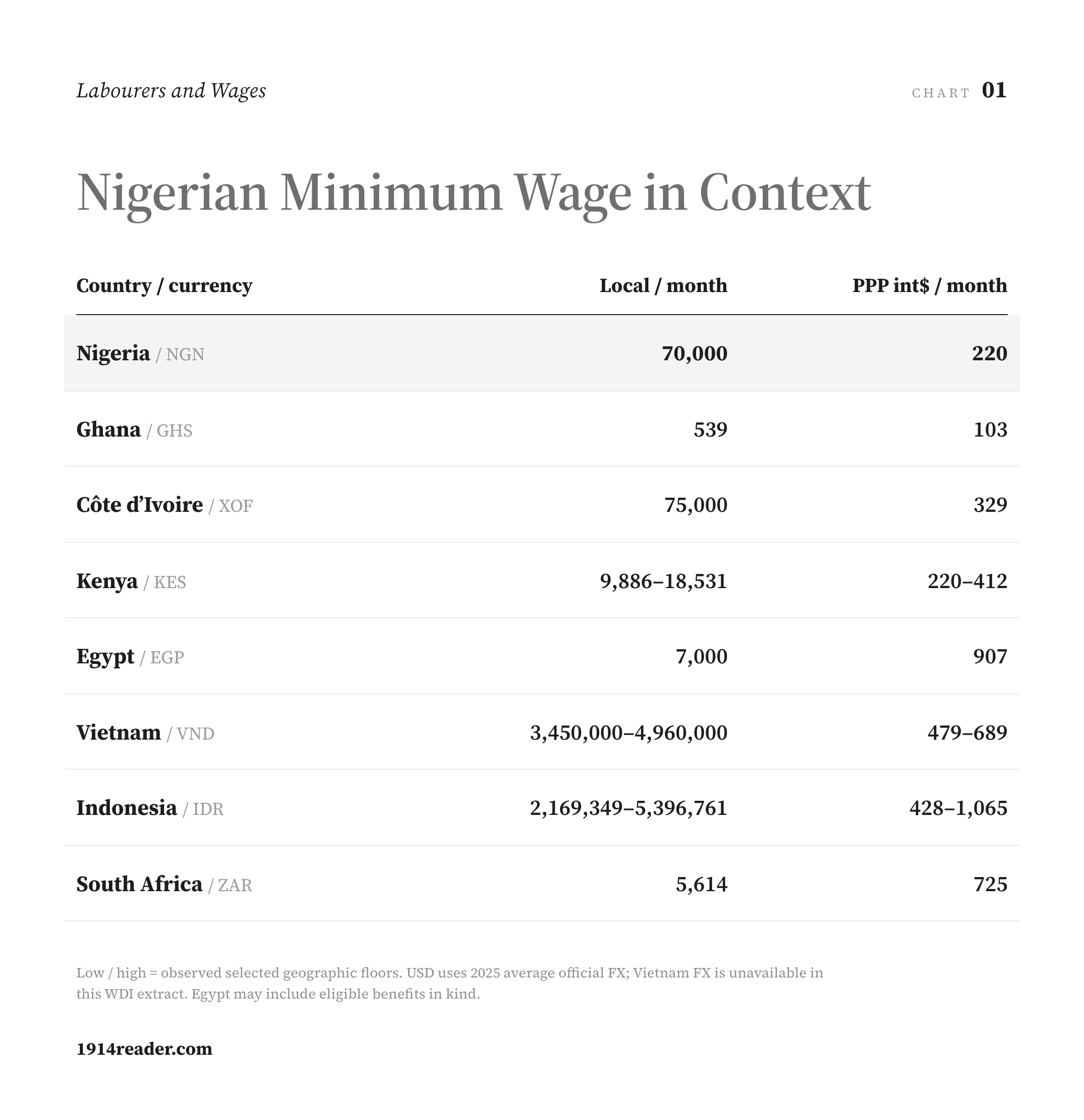
At 220 international dollars a month, Nigeria’s minimum wage sits near the bottom of this group: above Ghana’s and roughly level with Kenya’s lowest regional rate. Even Vietnam’s lowest regional minimum wage has more than twice its purchasing power. So whatever analysis we do with this benchmark needs to bear that in mind.
Below the threshold
The first thing we did was to set a threshold based on the minimum wage. We put this at ₦105,000 a month or ₦1,260,000 per year. This is simply 1.5x of the minimum wage. We use this as the low pay threshold i.e. anyone earning below this amount at any of the publicly listed companies in our cohort is classed as low pay. This is a line we chose but I hope you will agree that it is a fair one.
What we are saying here is that anyone earning below 330 international dollars a month is considered low paid. This will bring Nigeria in line with the minimum wage in the Ivory Coast and in the mid-range of Kenya.
Here’s what it looks like:
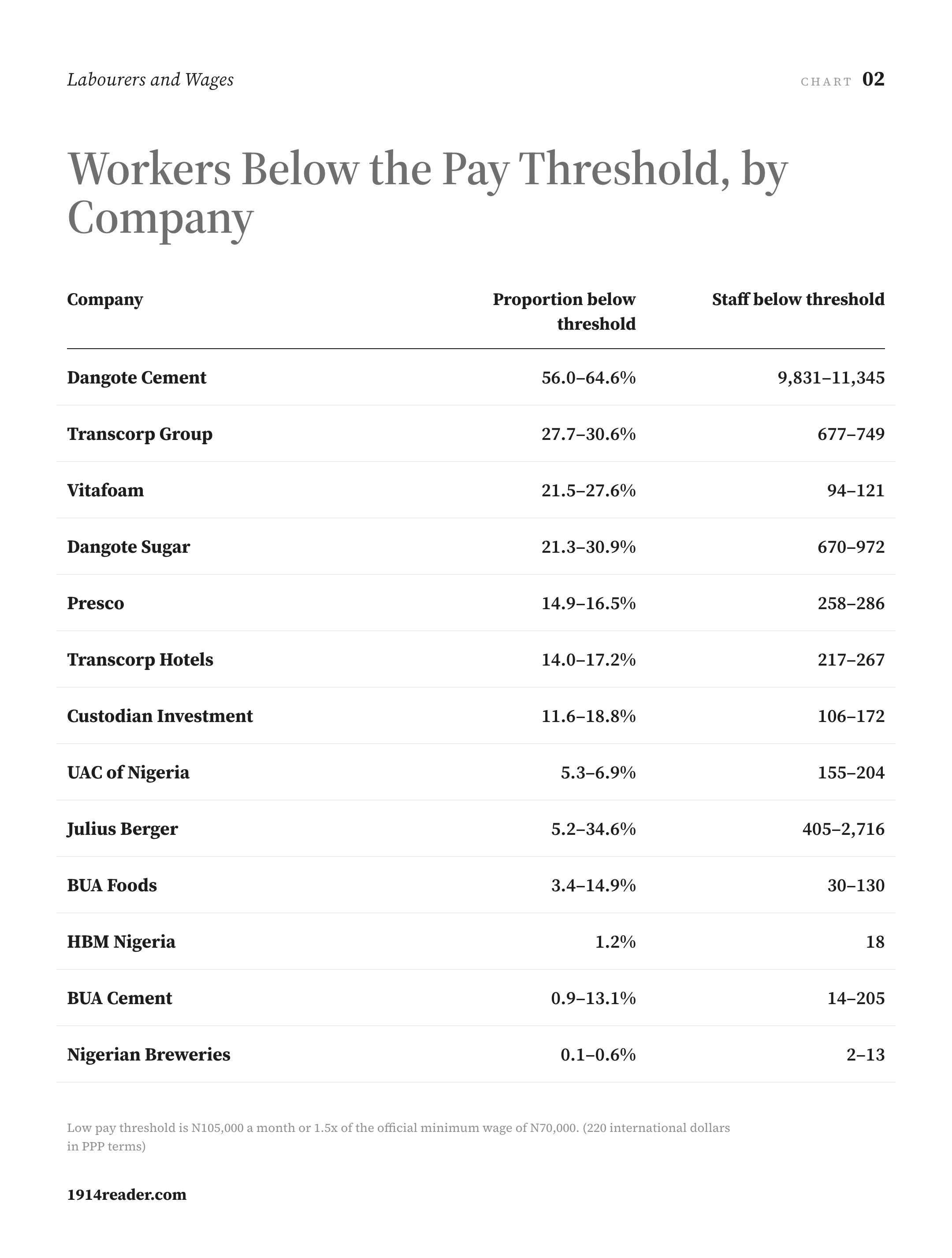
Some of the reason for the above is because of Dangote Cement’s size: it accounts for 23% of employment in our cohort (17,570 of 76,474 employees). But its share of low-paid staff is disproportionate: it accounts for at least 83% of employees whose disclosed pay bands fall entirely below our ₦105,000 a month threshold (9,831 of 11,800 employees). Up to 65% of the employees at Dangote Cement earn below this very modest threshold we set. And note that the second highest in terms of raw numbers of employees is Dangote Sugar.
Is it a manufacturing problem?
The next question we tried to ask was whether low pay is just a manufacturing problem relative to other sectors in Nigeria which might explain why Dangote Cement sits at the top of the low pay chart. Do other manufacturers pay low as well?
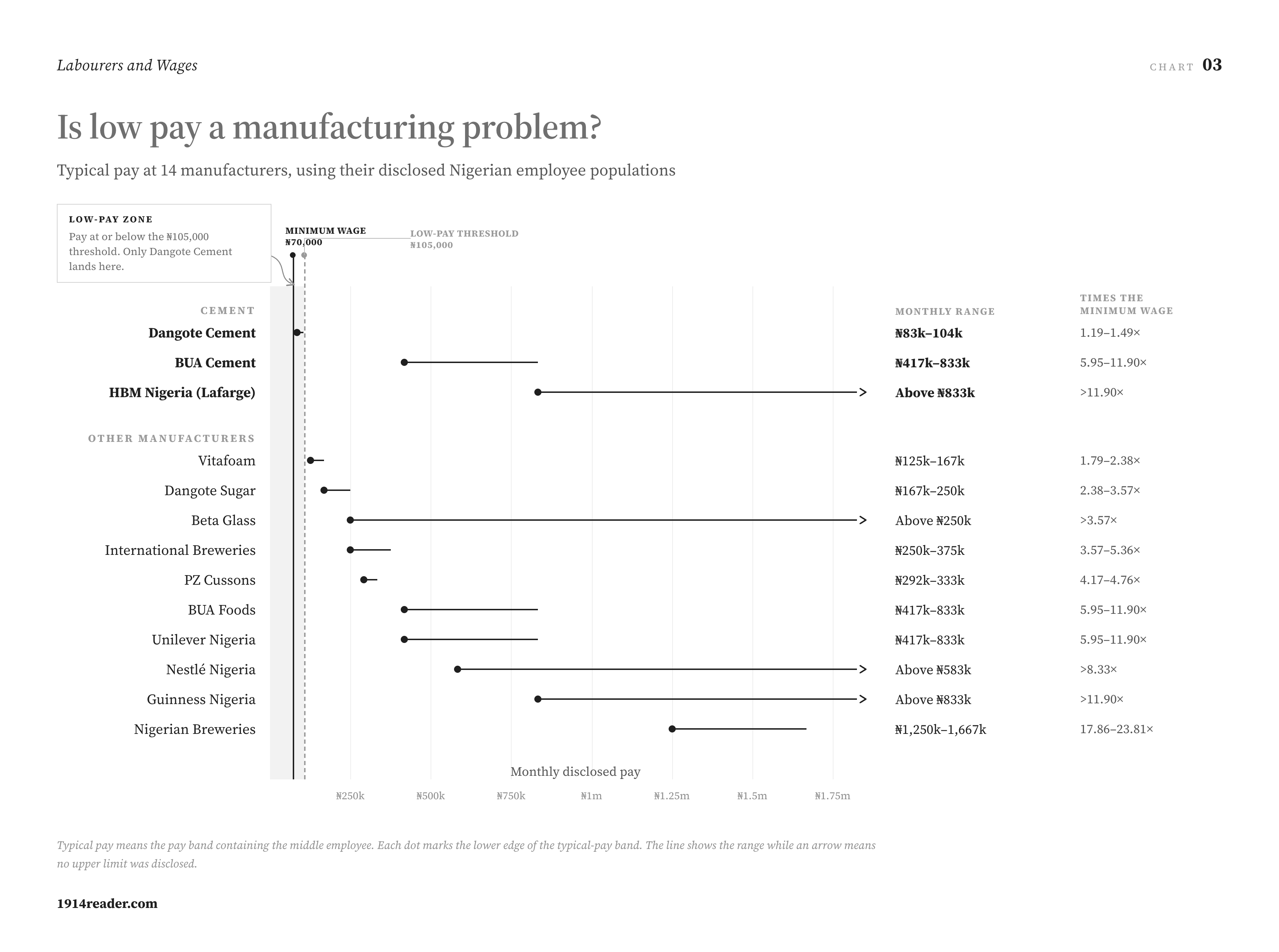
For this chart we have used the “typical employee”. This is the person right in the middle when a company’s staff are lined up from lowest to highest earner. We use the pay band containing that employee because, unlike using an average, it is not distorted upwards by a handful of very highly paid employees.
Dangote Cement is the only manufacturer in the cohort that falls into the low pay zone of ₦105,000 a month or below. It pays lower than other cement manufacturers and lower than other manufacturers. Only Vitafoam comes close to paying as low and it manages to (just about) pay the typical employee just above low pay threshold. This is where we will remind readers that Dangote Cement is by far the most profitable cement company in the world.
Can they pay?
Both of us still believe in a capitalist market economy so the next question we wanted to check was whether the low pay culprits we identified can actually pay more than they are paying. There is no point shouting that an employer is not paying well when their accounts show they have no cash or are running at a loss. So we decided to calculate what we call Pay Capacity.
The question here is simple: what will it cost for each company in our cohort to pay everyone in their employment at least ₦105,000 a month. We then calculated what percentage of their profit before tax it would cost to make this uplift. We chose this profit measure because it deducts borrowing costs (which are painfully high in Nigeria) which gives a much better picture on affordability than something like EBITDA.
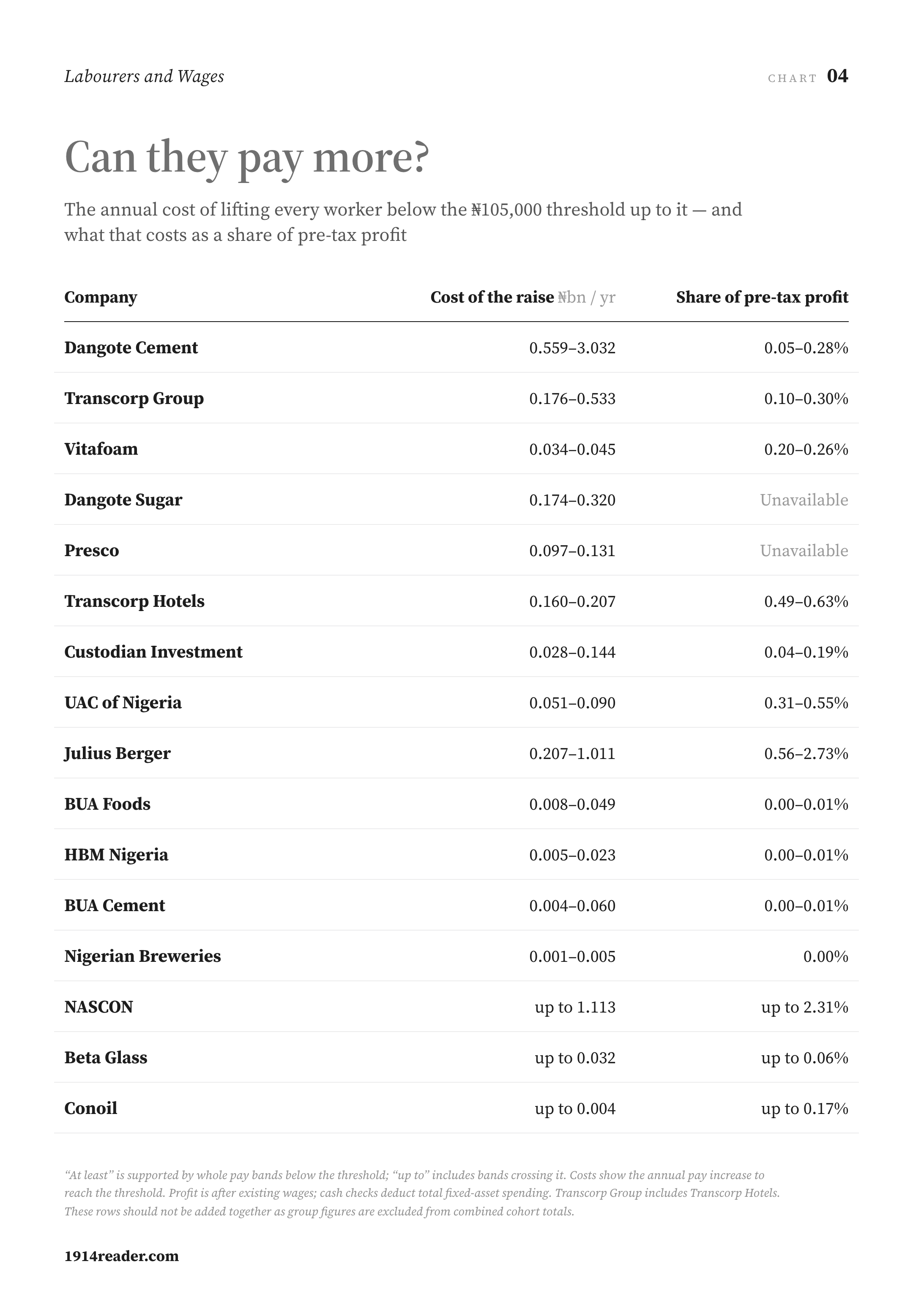
If Dangote Cement was to pull all its employees currently below the ₦105,000 a month to at least that level (so no one earned below that in the company), it would cost the company a maximum of ₦3 billion a year or 0.28% of its profit before tax of ₦1.53 trillion it made in 2025. We did a quick check on the amount of cash each company on this list has and the only ones that have a cash problem are UACN and Conoil. It needs to be said that Transcorp (in all its various manifestations) is the next worst payer on this list after Dangote Cement.
Now, there is a funny angle to this that we thought might be worth sharing. After someone casually mentioned to us that Dangote frequently appears in disputes with his staff at the National Industrial Court of Nigeria, we a ran quick search to test that claim.
There are 183 published documents of cases on the site. Here’s what we found:
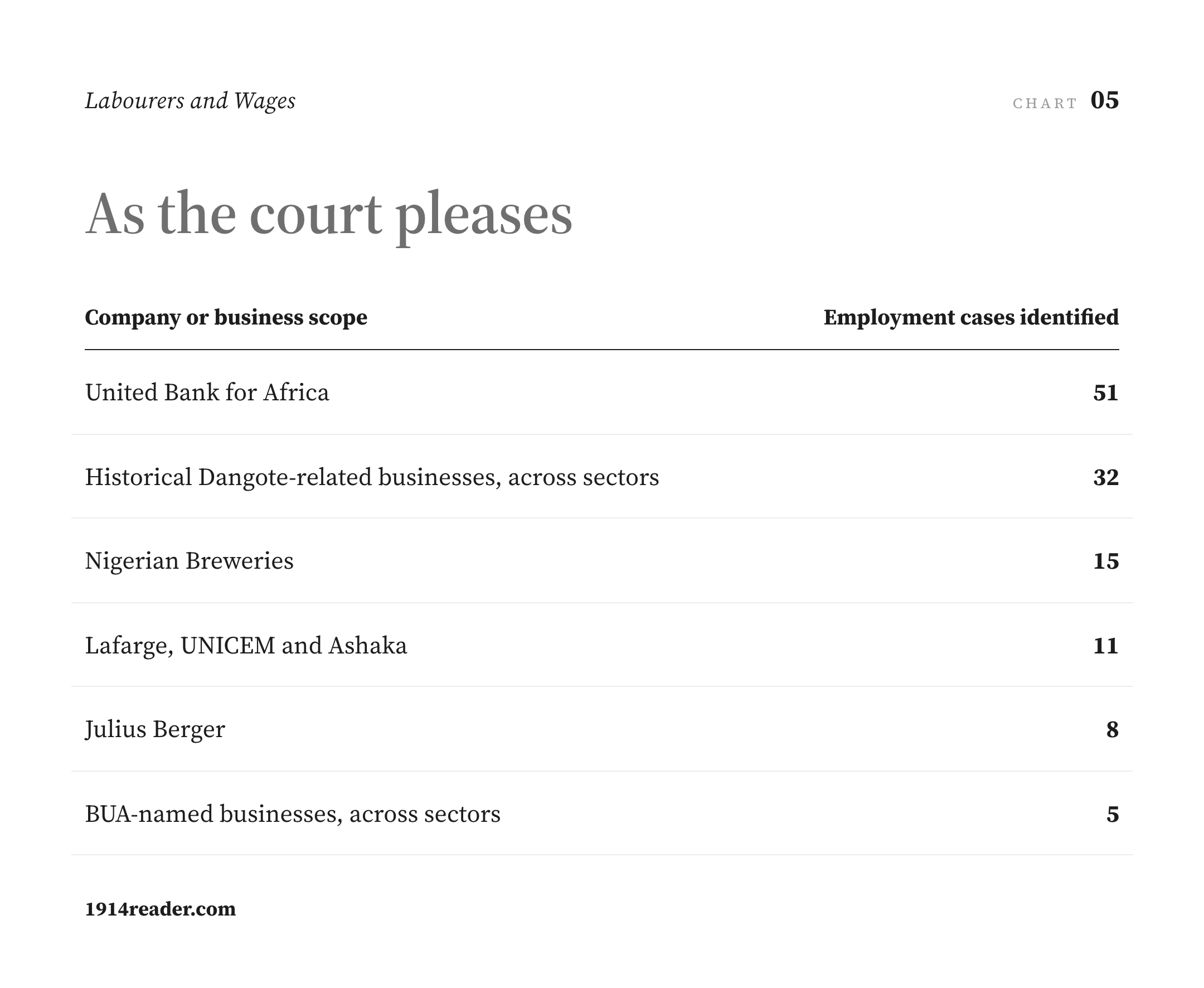
Please don’t take this too seriously as an analysis. It’s just a quick count covering different periods that may just be a function of the number of people employed. Some are brought by the companies (this one in particular is worth reading for the nastiness it showed) themselves, others are brought against the companies by their employees. And that number for Dangote includes all the various Dangote businesses from sugar to cement and refining (the refinery’s prospectus identifies employment-related claims and labour disruption among its business risks.) Still, it is quite funny that the two men behind the companies at the top of our low-pay table also have businesses with the highest case counts among those we checked at the industrial court. Maybe it is just a coincidence. Who knows.
Best in class
For what it’s worth, here are the best payers in our cohort, using the same typical employee measure
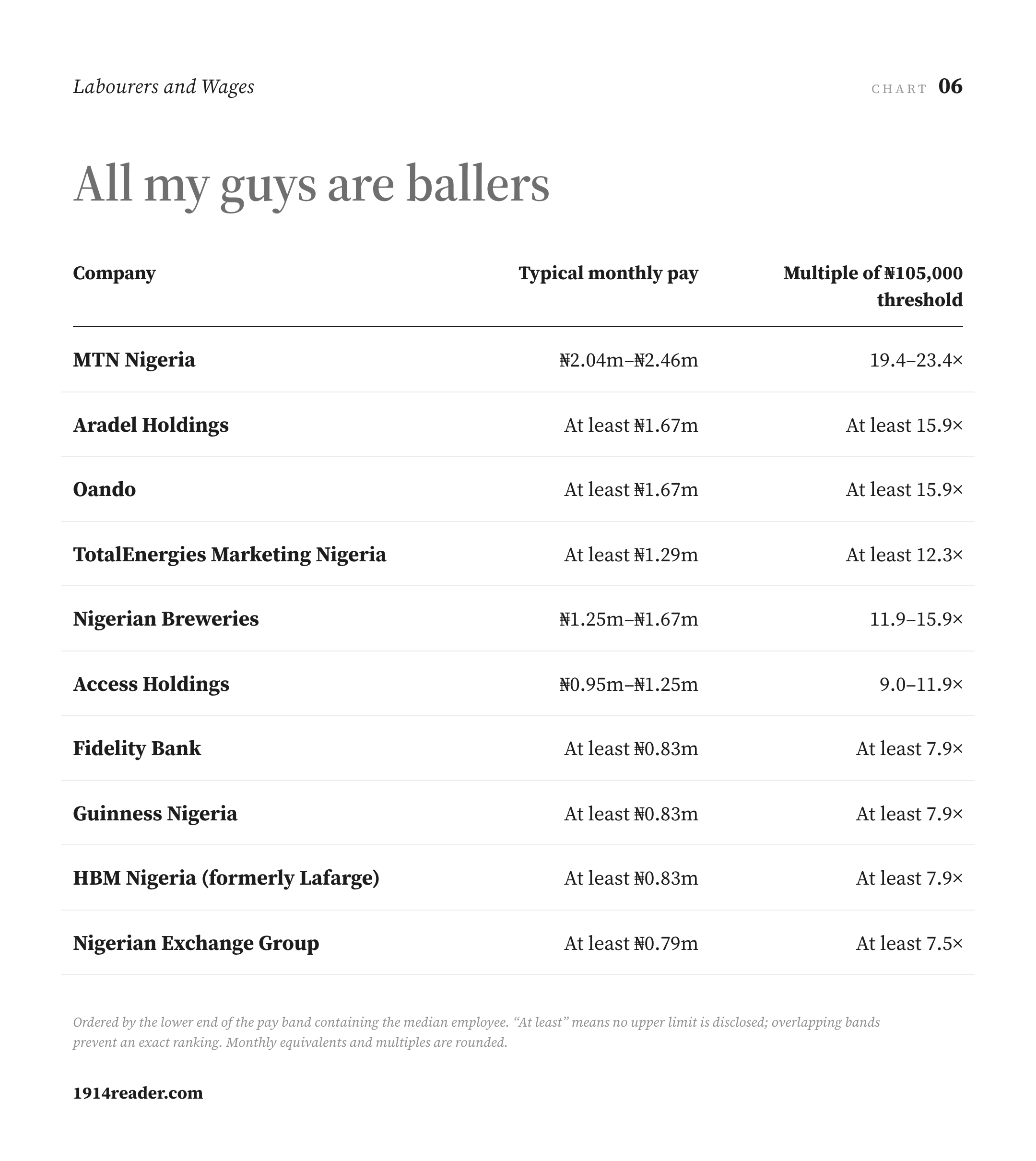
There is a good mix of companies and sectors here, which is encouraging in its own way. Decent pay is possible in different parts of Nigeria’s economy. The problem, of course, is that there are still too few employers competing for workers. That lack of choice strengthens the hand of those who are quite happy to pay very poorly.
Conclusion
As we said at the start, these companies account for only a small part of Nigeria’s employment story. But as public companies, their accounts give us a rare opportunity to examine what business success delivers for their employees. They should be setting a standard that other employers can aspire to. Paying people well ought to be part of what earns a company its reputation.
Which brings us back to Dangote. The discussion on Nigerian social media about whether he is a poor employer has substance when it comes to pay. It is difficult to reconcile this with the celebrations of him as the saviour of Nigeria and Africa, particularly when the cement group reported record profit after tax of over ₦1 trillion in 2025. All of this is worth keeping in mind as the refinery becomes a listed business and starts to regularly disclose what it pays its employees. The early signs are not good.
It seems that the rescue act he claims to be performing for Nigeria and Africa needs to begin with his own employees.
You can see our employer and pay data here and the NICN data here
Shout out to the one who will remain nameless 🙌🏾
Great read! Thanks for the analysis