

This week I published the latest chapter of The Whispering Class. It’s about interpreting as a kind of political inheritance.
Hope you have had a good week. Enjoy the usual selection below.
Nigerian Media
Egg selling is now a thing?
Weekend Trust gathered that fertility clinics have quietly become a destination for young women, especially students. Some who spoke to our correspondent claimed they sold their eggs to pay tuition fees, just as they are others who embarked on it to buy wigs, clothes among others. There are also among them single mothers who said they sell their eggs to feed their children.
What was once viewed primarily as an act of reproductive altruism is, for many, becoming an economic lifeline. Behind the promise of payments ranging from tens of thousands to hundreds of thousands of naira lies a little-discussed industry where financial desperation, medical intervention and ethical questions increasingly intersect.
The practice, popularly known as “egg selling,” involves stimulating a woman’s ovaries with fertility drugs before retrieving multiple eggs for use in assisted reproduction. Fertility specialists maintain that the procedure is generally safe when carried out under proper medical supervision. However, like any medical intervention, it carries recognised risks, including ovarian hyperstimulation syndrome (OHSS), bleeding and infection, making thorough counselling, informed consent and post-procedure monitoring essential.
Yet interviews conducted by Weekend Trust with egg sellers, women considering the procedure, fertility specialists, legal practitioners, psychologists and gender advocates suggest that many young women embark on the enterprise with little understanding of the potential complications. While some described the experience as a worthwhile means of earning income and helping families struggling with infertility, others recounted severe physical complications, emotional distress and unanswered questions about the information they received before agreeing to participate.
The issue first came to this newspaper’s attention during a conversation at a salon in Abuja, where discussions about egg selling and surrogacy had become surprisingly commonplace. Salon owner Hussaina Yusuf said economic hardship has made both options increasingly attractive to young women.
Meanwhile Nigerian fertiliser producers are making a killing right now. Why? Because Nigeria was dropped on its head as a child. (See more here):
Farmers in Taraba State are increasingly turning to melon (egusi) husks (chaff) as organic manure as the rising cost of fertiliser has become beyond the reach of many.
The sharp increase in fertiliser prices has forced many farmers to seek cheaper alternatives to improve crop yields.
Daily Trust gathered that the high cost of fertiliser has driven the growing adoption of melon husks as manure in communities where the crop is produced in commercial quantities.
In Sabon Gida, one of the state’s major melon-producing areas, farmers no longer burn melon husks after processing the seeds. Instead, they collect and apply the husks on their farms as organic manure.
Mukhtari Ajuji, a resident of Sabon Gida, told Daily Trust that farmers had found melon husks to be highly beneficial for crop production.
According to him, only a few farmers initially experimented with applying melon husks on their farms and recorded improved yields. Their success encouraged many others in the community to adopt the practice.
Another resident, Sani Haruna, said that a few years ago melon husks were regarded as waste, with many people burning them after processing the seeds.
“However, farmers later discovered that the husks serve as effective organic manure, which is why they are now collected and applied on farms,” he said.
Why did an Ifa priest set himself on fire? Because he was suffering from something a lot of Nigerians are in denial about:
Shock and confusion gripped residents of Adebiopon Village in the Obafemi Owode Local Government Area of Ogun State on Wednesday after a 50-year-old traditional priest, Muritala Shodiya, allegedly set himself ablaze.
PUNCH Metro gathered from multiple sources in the community on Thursday that the incident occurred on Wednesday evening when Shodiya reportedly doused himself with petrol inside an uncompleted building before setting himself ablaze.
The residents, PUNCH Metro gathered, quickly extinguished the fire and rushed him to the General Hospital, Ijaye, Abeokuta, where doctors pronounced him dead on Thursday morning.
Before the incident, Shodiya, popularly known as “Ifa,” was widely known for fortune-telling and Ifa worship.
He had reportedly practised in Ijaye for several years before relocating to Adebiopon village.
Speaking on condition of anonymity because of the sensitive nature of the incident, a community source alleged that Shodiya had set himself on fire after showing signs of depression.
“We learnt that he set himself on fire. He had not been himself since his wife left him for another man. He had been showing signs of depression,” the source said.
Not even judges are safe from this menace:
The Chairman of the Economic and Financial Crimes Commission (EFCC), Mr. Ola Olukayode, has decried the activities of internet scammers popularly known as Yahoo Boys, revealing how over N7.2 million was wiped from the account of a serving judge at midnight.
Speaking during the public presentation of two books authored by a retired high court judge, Justice Alaba Omolaye-Ajileye, the EFCC Chairman said he was woken from sleep around 1am by a distress call from a judge in one of the South-South states who had fallen victim to scammers.
“What was the problem? She had just been scammed of the money she had been putting together for six years to send her child to school.
“She said it was alerts that woke her up. She received debits at that time of the day. Was it that the bank was at work, or what could be going on?
“Before she knew it, she had been scammed of about N7.2 million. So she put a call through to me that I had to do something.
“Incidentally, it was the state where they got an order against the EFCC from investigating certain crimes. And she said, ‘My lord, I have an order, an injunction not to investigate financial crimes in that state.’
“She said, ‘No, no, no! This is an exception. You must do something immediately!’
In case you think being a kidnapper is easy work:
Some persons, who were kidnapped at their farms in Estako West Local Government Area of Edo State, said they escaped after their kidnappers slept off.
They narrated their ordeal at a briefing in Benin on Friday. According to the kidnap victims, their abductors were tired after making them to walk all night.
One of the victims, Destiny Braimah, who spoke on behalf of the victims, said he was returning from the farm when he ran into six men armed with guns and cutlasses.
Braimah said the kidnappers abducted 10 other persons and took them into the forest. He said they heard police shooting, while being marched into the forest.
According to him, “I was coming from the farm when I met six of them armed with guns and matchet. They also captured others, making us 11 victims.
“They took us from one bush to another. It was around 6 p.m. that we heard police shooting. They made us walked throughout the night.
“We got to a place, and they told us to hide. They were very tired. So they slept off.
“That was how we helped ourselves and ran away. We ran to the police station, and went to meet the police. The kidnappers beat us and maltreated us.”
I do not even know what to say to this. I am completely speechless:
The Ooni of Ife, Oba Adeyeye Ogunwusi, has conferred a chieftaincy title on Nollywood actor Olanrewaju Omiyinka, popularly known as Baba Ijesha, and also presented him with a brand new car.
Baba Ijesha disclosed the development in a Facebook post late Thursday, where he expressed appreciation to the monarch for the honour, warm reception and gifts extended to him and his wife, Afolashade Omiyinka, popularly known as Luminee.
He also revealed that he was bestowed with the chieftaincy title of Baba Awada Konge Oduwa.
The latest development comes weeks after the actor and his celebrity stylist partner, Luminee, welcomed a baby boy named King Kagar Omiyinka.
Baba Ijesha announced the birth of their son in an Instagram post where he thanked God for the child and described the newborn as a blessing to his family.
Tribune Online recalls that Baba Ijesha was sentenced to 16 years imprisonment in July 2022 after he was convicted for sexually assaulting a minor.
He was, however, released in November 2025 after spending more than three years in prison.
One of those only in Nigeria stories where if you try too hard to understand what is going on, you may land in hospital:
A man, identified as ‘Kano thug’ has issued a stern warning to bandit kingpin, Kachalla Maha, and sponsors of terrorism to steer clear of Kano State.
In a viral video on X sighted by DAILY POST, the visibly angry man cautioned that anyone nursing the idea of taking banditry to Kano state should have a rethink and stay away.
According to him, Kano is not like other places, noting that they do not tolerate bandits and terrorists in the state.
“Any fool planning to bring harm to Kano, starting with the notorious terrorist, Kachalla Maha, should think again and stay far away.
“Kano is not like Katsina, Zamfara, or Sokoto. We don’t tolerate bandits or terrorists here.
“Our people rose up, fought Boko Haram, Mai-Tatsine and crushed them completely in this state. Any terrorist who tries to enter Kano will find his final destination right here.
Non-Nigerian Media
The backlash to African governments borrowing with derivatives has begun:
A backlash against governments using derivatives to borrow against their debt is gathering strength, after the IMF cracked down on a multibillion-dollar loan to Nigeria as risky and opaque.
The $5bn credit line, arranged through a “total return swap” between Nigeria and First Abu Dhabi Bank, has raised concerns at the fund and among rating agencies and investors about developing countries using these opaque mechanisms to take on new forms of debt. They say the deals leave borrowers exposed to risks that are hidden from other lenders and conceal the true extent of their debt obligations.
The Nigerian deal has become a lightning rod for such warnings after years of effort to make emerging market sovereign borrowing more transparent. “The use of opaque borrowing has grown to a point where it presents a significant risk to that advancement, and the industry will respond,” said Samy Muaddi, debt portfolio manager at T Rowe Price. “To the extent these structures proliferate, there will be a Darwinian adaptation to respond to them.”
Impersonating a Dubai Prince is crazy work:
Maria believed she was romancing a prince from Dubai, captivated by his flirtatious smile and declarations of affection he showered on her during live video calls. But the suitor was an AI deepfake, making her yet another victim of an online romance scam.
The case illustrates how fraudsters posing as the real-life crown prince of Dubai ensnare victims by cultivating online relationships before swindling them out of money, with researchers tracing some of the scams to crime syndicates in Nigeria.
Maria met the scammer impersonating Prince Hamdan bin Mohammed, also known by his pen name Fazza, on a dating site before the conversation moved to a messaging app where he bombarded her with romantic messages.
“He kept on messaging me even when I was sleeping,” the Filipino domestic worker told AFP, requesting that her real name and age be withheld.
“It felt like there was a love spell that connected our minds.”
In one recording of a WhatsApp video call seen by AFP, the scammer, appearing lifelike as the prince, flickered on the screen. His words matched his lip movements, but not the prince’s voice.
“Hello beloved,” the voice told Maria. “I really appreciate your love and support.”
Maria, who was initially too lovelorn to suspect fraud, lost a year’s worth of savings.
The scammer manipulated her into paying 100,000 pesos ($1,625) for what he claimed were a marriage certificate and a “royal membership card,” which he said would help her secure a job in Dubai.
Her suspicion arose when he proposed meeting her at a hotel and demanded another 60,000 pesos ($974) for the booking. When she scrutinized his Facebook page, which has since been taken down, she noticed the account was based in Nigeria.
She cut off communication, sending one final message: “Go to hell, scammer.”
Meanwhile over in Florida:
A Florida woman had her driveway ripped up and taken away as part of an alleged scam carried out by someone in Nigeria, according to a report.
Luz Lenzi returned to her home in Sanford, about 30 miles north of Orlando, in February to find a mountain of rubble where her driveway once was.
“I didn’t hire them, I didn’t need to have my driveway redone,” Lenzi told News 6.
Police say someone claiming to be from a real estate company hired a contractor to update the driveway. However, the contractor abruptly stopped working on the driveway when a $15,000 check provided to pay for the job bounced.
The check was written by New Mexico-listed company “SOIL Realty LLC,” which investigators later tracked back to Nigeria.
Authorities said the contractor did not meet with the client and did not file a permit to do the work on the driveway.
However, police uncovered the true origin of the scam by tracing bank transactions and Google records tied to an email address used in the deal, leading them to internet addresses in Nigeria.
“I said, Nigeria, like in Africa? And he said, yes,” Lenzi recalled. “I said, how? I was shocked.”
Viewing centres as social spaces:
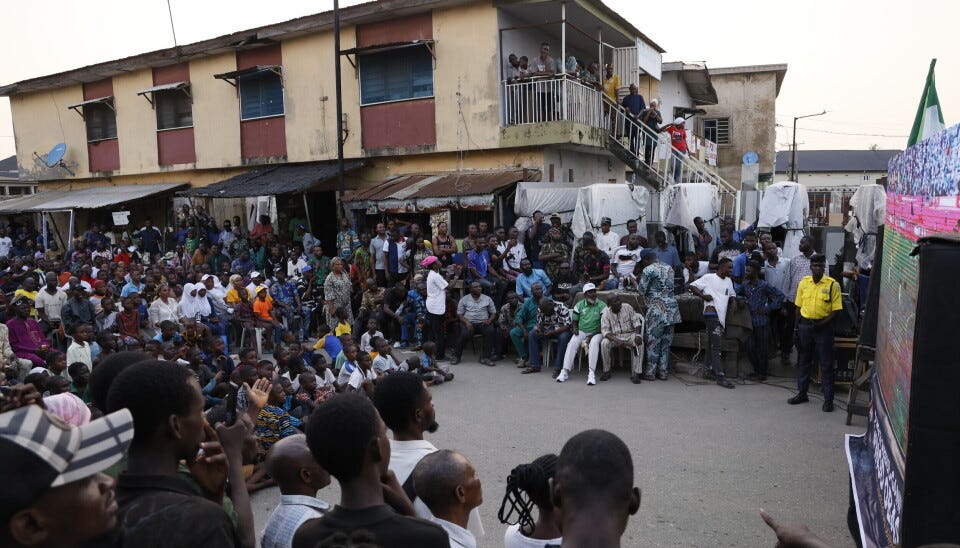
Benson Eze has owned the same viewing center at the White House Bus Stop in Lagos for 11 years. He can tell you, without checking a notebook, how many plastic chairs he has (94), what he charges on a regular match night (200 naira). What he cannot tell you is how many will walk through the door on any given day.
“With World Cup,” he says, glancing toward the entrance as the first spectators claim their chairs, “You stop predicting. You just prepare.”
Across Nigeria, preparation is well underway. The 2026 FIFA World Cup, hosted across the United States, Canada, and Mexico, is deep into its group stage, and viewing centers in Lagos, Kano, Port Harcourt, and Benin City are running at full capacity. These low-cost, communally organized spaces are where the vast majority of Nigerian football fans actually watch international football. During a World Cup, they become something harder to define: part sports venue, part open-air cinema, part informal town square.
The Lagos State Sports Commission estimates there are more than 3,000 registered viewing centers in Lagos State alone, with thousands more operating informally across the country.
Eze’s ₦200 ($0.15) entry fee is calibrated to exclude almost no one. Revenue comes from volume. On a full house during a popular group-stage fixture, he clears between 15,000 and ₦25,000 ($18) at the gate before generator fuel, cable subscriptions, and maintenance costs take their share.
News about AI from Australia:
Elii Emeghebo is suing a company he modeled for after an AI-generated image appeared to closely resemble him.
ABC News Breakfast reports that the Nigerian-Australian spotted an image while walking past the window of Peter Jackson’s Pitt Street shop in Sydney. He had modeled for the brand in the past, yet recognized himself not in the original campaign images but in an image he described as his “white twin.” He claims it was an AI-generated image of his likeness.
“My nose was reshaped, my skin tone and my eye colour was significantly lightened, and there’s some reshaping around my eyebrows and my eye shape to be more Eurocentric and a lot less black,” Emeghebo told ABC News Breakfast. “It’s not a good thing when you go from a shoot, something you’re really proud of … and you walk past the shop and see basically you, but without your identity there. It was really confronting and really unfair.”
Emeghebo has filed a lawsuit against Peter Jackson Australia at the Australian Human Rights Commission, alleging it whitewashed his image, which he said was proof of racial discrimination, per the outlet. Additionally he said that the company failed to compensate him for the use of the images. He claims that the images were intended only to promote the brand on its digital channels.
ICE arrested a Nigerian nun in Texas:
The arrest of a Catholic nun from Nigeria by federal immigration officers in southern Texas on Sunday made for an unlikely alliance on Capitol Hill as lawmakers from both parties demanded her release and asked the question: Why aren’t border officials focused on real threats to public safety?
Sister Leticia “Letty” Ugboaja, 56, was walking the block between her home and the Catholic Church where she attends Sunday Mass in McAllen, Texas, when she was stopped by Immigration and Customs Enforcement agents. The agents arrested her, taking her rosary, and brought her to a nearby detention facility.
As reports of Ugboaja’s arrest spread, demands for her release from members of southern Texas’ congressional delegation flooded social media.
“My team and I are working with DHS to gather details regarding the detainment of Sister Letty Ugboaja of Daughters of Mary Mother of Mercy,” Rep. Monica De La Cruz, a Republican who is running to defend the Texas border district she won in 2022, wrote in a post on X. “I have elevated this to the highest levels and will provide additional information as it becomes available.”
More Benin Bronzes returning to Nigeria. I wonder if anyone is keeping score and what the count is now:
Benin Bronzes from collections at the Museum of Ethnography Geneva, the University of Zurich Ethnographic Museum, and Museum Reitberg were returned to Nigeria this week. (Benin Bronzes are linked to a British raid on Benin City in 1897, and in the aftermath, the looted treasures made their way into museum collections around the world.) In addition, Switzerland also returned five other objects to Nigeria, including a bronze bracelet, that had been seized during criminal proceedings.
Per a joint release from museums, “The restitution follows several years of collaborative provenance research carried out under the Benin Initiative Switzerland, which showed that the objects were most likely looted from the Kingdom of Benin during the British attack in 1897. They would then have entered the art market and found their way into museums around the world. The ceremony also included the restitution of a bronze bracelet and four archaeological monoliths from Nigeria’s Niger Delta region seized in Switzerland as part of criminal proceedings and subsequently transferred to the state. Switzerland has now fulfilled its legal obligation to return them to their country of origin, the Federal Republic of Nigeria.”
The technology that was supposed to ‘leapfrog’ the need for wires in the ground is itself now being ‘leapfrogged’ by Elon Musk’s constellation of satellites in space. Unhappy is the land that finds itself constantly in need of ‘leapfrogging’:
Ekiti, a state in south-western Nigeria, is named after the Yoruba word for hill. In the 19th century, its rocky terrain was useful for self-defence. It is less ideal for 21st-century commerce, as Akin Oyebode has found. The state commissioner wants to boost the economy of Ekiti. But that goal is being hampered by terrible network connections. Connecting mobile towers or getting fibre cables up the hills from the landing point 250km away in Lagos, the commercial capital, is expensive, and he has struggled to persuade internet providers to bring more of their infrastructure closer. But recently the government’s connection, at least, has improved—thanks to Starlink, the satellite-internet service provided by Elon Musk’s SpaceX.
Mr Oyebode is not alone. Maddened by poor connections, more governments and rich Africans are turning to satellite terminals. For now, it is an expensive stop-gap. But in the coming years it could boost connectivity, both by providing internet to more Africans and by spurring broadband providers to improve.
Africa’s internet infrastructure is not fit for purpose. During a communications boom in the early 2000s, the continent eschewed fixed-line internet for cheaper mobile broadband; today more than 400m Africans, the bulk of the continent’s users, gain access to the internet this way.
But the technology has not kept pace with the rapid increase in data demand from streaming and AI-powered applications. Even in big cities like Lagos and Nairobi, Kenya’s capital, WhatsApp video calls can be glitchy. And things will get worse. Traffic is expected to at least triple by 2030. Cabled fibre internet, which has much higher capacity, is used by less than 1% of Africans and is being expanded too slowly. Nigeria alone “has a shortage of 90,000 kilometres of fibre-optic network”, says Bosun Tijani, the digital-economy minister. Africa as a whole is probably short by hundreds of thousands.
All this made the continent fertile ground for Starlink when SpaceX started the service there in 2023. Starlink relies on satellites, not cables or mobile-phone towers. It is useful for programmers trying to supplement the patchy network in a co-working space in a city and for aid workers in far-flung areas with no cables. Starlink is most active in Nigeria, where it first launched, and Zimbabwe. But it offers its services in 27 African countries and it is likely to have 1m customers on the continent by early next year, says TMF Associates, a satellite-industry analysis firm (today some 12m people subscribe globally, according to SpaceX).
This story about Christopher Harborne, Reform UK’s biggest donor, carries an interesting angle and graphic on Nigeria. Sadly the graphic is too long to share:
AML is a fuel broker, meaning that it buys fuel at airports to supply to flight operators at airports across the globe. It is a major supplier of fuel to the US military and has signed live contracts worth up to $108 million (£82 million) between 2023 and 2026, at more than 30 airports across Africa, Asia and the Pacific.
US transparency records show that AML has eight active contracts with the US Defence Logistics Agency, responsible for securing fuel supplies for military operations, covering refuelling services for US military and government aircraft.
According to 2024 US court documents, the company had received $39 million in contracts from the US Department of Defence since 2018.
One of these contracts was for the supply of fuel at Nnamdi Azikiwe international airport, which serves Abuja, Nigeria.
US transparency procedures mean that the contracts must identify the refuelling companies working with AML Global to provide the fuel, along with the refineries that supply it.
The contract for Nnamdi Azikiwe international airport shows that fuel provided by AML under its terms would be supplied by Reliance Industries’ Jamnagar refinery in Gujarat, India.
Over in India:
The Anti-Narcotic Wing (ANW) of CCB has arrested four people, including three Nigerian nationals, in two cases of drug peddling in the city. Sleuths of ANW seized 10.27 kg of MDMA crystals and 2.044 kg of hydroponic ganja, worth around Rs 23 crore from the accused. Acting on a tip-off, the sleuths raided a house in Madanayakanahalli police limits and arrested Ambemo Jela Victor, 37, Chime Ndubunsi Moses, 36, and Karikari Ames, 33, from Nigeria. The sleuths seized 10.27 kg of MDMA crystals valued at Rs 21 crore from their possession.
The accused had come to India on medical and tourist visas. Preliminary investigations revealed that the accused procured drugs from another Nigerian national based in Delhi. In another operation, the police arrested Mohammed Marel Fecoge (25), a native of Kerala and a private firm employee in the Banaswadi police station limits for allegedly possessing and selling hydroponic ganja.
They seized 2.044 kg of hydroponic ganja valued at Rs 2 crore from him. He came to the city four months ago and allegedly procured drugs from a person in Kerala, who in turn sourced the drugs from Thailand.