

This week I wrote about the recent tariff changes announced by the Nigerian government and what the general direction looks like. Tobi wrote a very well received piece on the limits of reform in the Nigerian context. And we had Carl-Henri Prophète on Frontier Matters to discuss the story and context of today’s Haiti and its troubles. I learnt a lot listening to him.

Enjoy the week’s selection below
Nigerian Media
What is going on with pepper farming in Nigeria?
Farmers who produced dry-season scotch bonnet and habanero peppers, as well as dealers who purchased the peppers in the North and moved them to markets in other parts of the country, lost a lot of money this year.
Due to the decline in the prices of agricultural produce, those who farmed during the previous wet season and grain merchants in the agricultural sector are still suffering significant losses.
Alhaji Muhammed Sani Sulaiman, a farmer from Saminaka in Kaduna State, told the Weekend Trust that many farmers who produced these pepper varieties this year did not profit from their efforts.
He said producers of scotch bonnet and habanero peppers spent a lot of money on seeds, fertilisers, irrigation fuel, chicken manure and pesticides but the prices of the spicy crop dropped below their expectations.
“Like me, I invested almost N7 million in growing spicy peppers. I bought seeds, fertiliser, chicken manure and other things with this money. The market was good when we initially started planting because we could sell a bag for up to N30,000, but eventually, it dropped to N3,000. We never received N200,000 for all the harvesting done on my farm.
“In fact, farmers in the dry season have lost a lot of money this year—something they have never done before. Additionally, majority of farmers took the commodities they grew during the wet season, sold them at a low price and invested in growing these peppers. It turned out that there were two failures: the first occurred during the wet season and the second occurred during the dry season,” he said.
Another farmer, Haruna Idris, said the cost of a hot pepper bag began at N30,000 but the price later collapsed to N4,000.
He said it became evident that farmers’ earnings from the production of spicy peppers would be extremely low despite spending lots of money on production.
“Pepper farmers are currently in a terrible predicament. I know people sold their lands and others sold their houses. I also know someone who sold his car to invest in pepper cultivation, but all of them are counting heavy losses.
I try not to cover stories like this in BTH (there are so many of them every week) but I will make an exception for this one buried at the end of a longer story about all sorts of criminals arrested:
He also confirmed the arrest of one Hamza Woru in Kaiama for unlawful possession of a human skull. Investigations revealed that the suspect allegedly exhumed the remains of a deceased relative for ritual purposes.
Describing the incident, the commissioner said, “The suspect attempted to sell the human skull before he was apprehended, while his accomplice is still at large.”
He added that the case has already been charged in court under the Kwara State law prohibiting dealings in human parts.
It is perhaps an easy mistake to make to confuse Mali with Malaysia:
Three Nigerian young girls trafficked under the guise of overseas employment have exposed a cross-border human trafficking syndicate that lured them with promises of jobs in Malaysia but ended up forcing them into prostitution in Mali.
The victims, Bella Boluwatife, Linda Zainab and Amoke Joy, who spoke to Vanguard reporter, said they were deceived, transported across multiple borders and held in debt bondage before their eventual rescue through coordinated intervention by authorities and anti-trafficking groups.
According to one of the victims, Bella: “Our journey began on February 17, 2026, when an agent identified as Peter Osas arranged what appeared to be legitimate travel plans to Malaysia with our parents. He assured us of employment in a bar or as a housekeeper to their parents. The process initially appeared credible, with a video call arranged with our supposed sponsor, identified as ‘Angel,’ during which they were coached to respond positively to all questions.”
“From Ogun State, we were taken to the Seme border and moved into Cotonou in Benin Republic. Our clothes were changed, new identities were issued, and passports were processed in less than an hour. We were told to lie about where we were from if questioned,” she said.
The journey, however, took a different turn as they were transported by road for six days through several checkpoints en route to Mali.
“At that point, we realised we were not travellers but cargo. There were armed officers at checkpoints, and money was exchanged to secure our passage,” Bella added.
“There were no houses, only makeshift shelters in a bush. We saw condoms everywhere and young girls, some as young as 13. That was when it hit us, this was not Malaysia. It was a brothel,” she said.
The victims said they were immediately forced into sex work and informed that each of them owed 1.5 million CFA francs, a debt they had to repay to regain freedom.
When the Lipman brothers invented the handheld PoS machine in 1995, I don’t think they ever envisaged this use case. But the nature of inventions is that they very often go on journeys that surprise the inventor:
The Delta State Police Command has commenced disciplinary proceedings against two officers captured in a viral video allegedly collecting money from a motorist through a Point of Sale (PoS) machine within the premises of the ‘C’ Division Police Station in Asaba.
The command’s spokesperson, Mr Bright Edafe, disclosed this in a statement, describing the incident as embarrassing, unprofessional, and conduct unbecoming of police officers.
He said the incident occurred on January 13, 2026, and drew public outrage after the footage surfaced online.
Edafe said the Commissioner of Police in Delta State, Mr Yemi Oyeniyi, aligned with the directive of the Inspector-General of Police, Mr Kayode Egbetokun, prohibiting extortion and the use of PoS machines or any electronic payment platforms within police formations.
Is poverty enough grounds for divorce? We go to Ilorin to find out:
An Area Court at Centre-Igboro, Ilorin, Kwara State, has dissolved the Islamic marriage between a couple, Toyin Ajibola and Bashirat Mohammed on grounds of lack of money.
The presiding judge, Hammad Ajumonbi, while delivering ruling said that even though Toyin did not want to divorce his wife, she still had the needed to move on not be left stranded.
According to the News Agency of Nigeria (NAN), he, therefore, dissolved their marriage and granted custody of the three children from their union to the wife.
The court also ordered the woman to observe the three months iddah (waiting) period before remarrying.
Ajumonbi ordered Toyin to be responsible for the feeding of their children.
“The defendant should have unrestricted access to their children, while the plaintiff should always make their children available any time the defendant requested to see them,” the judge said.
Earlier, Bashirat had applied for divorce saying that she was tired of her marriage to her husband due to paucity of fund and her husband’s irresponsibility.
“I want the court to grant me divorce so that I can have rest of mind,” she said.
The husband, however, told the court that he was still interested in his wife even though he was financially handicapped.
“I have been trying hard to get money to feed my family, but couldn’t.
“It is so painful that I can’t get money to visit her and the children when they left home,” he said.
Ok, that’s enough internet for today. We end the Nigerian section with this story as there is nothing more to add after a story like this:
A mortician named Amaobi, in charge of a mortuary in Agwabi, Buruku local government area of Benue State has been arrested by operatives of the Benue State Police Command.
DAILY POST learnt that the mortuary attendant was arrested after he was caught on Friday morning using the leg of a dead person in the morgue as a walking stick.
It was gathered that Amaobi took the dead person’s leg he was using as a walking stick to a retailer’s shop to buy some items when he was caught.
This unusual act, according to reports, drew the attention of the community, and it eventually led to his arrest by the youths.
Upon the arrival of police officers, Amaobi, in his confession, claimed that his action was a demonstration meant to draw people’s attention.
According to him, he was trying to get support so he could appeal to the government for help, especially to evacuate over 18 criminal dead bodies reportedly killed last year by security operatives and deposited in his mortuary.
Non-Nigerian Media
A husband and wife joint venture has ended in prison for both:
A husband and wife who stole the personal data of more than a hundred TfL workers and claimed false tax rebates worth £650k have been jailed. Luciana and Femi Akanbi's fraud was described by a judge as the 'worst ever' data breach in Transport for London's history.
A court heard Luciana Akanbi, 38, worked in HR for the capital's transport company and accessed her colleagues' private, personal information. Prosecutors said she and her husband, 51-year-old Femi Akanbi, used the passport number, national insurance numbers and bank details of 40 TfL employees to submit 139 false tax rebate claims to HMRC.
Woolwich Crown Court heard the fraud, carried out between September 2021 and January 2022, led to a loss of £433,000 from the public purse. The pair, who live in Dartford, have now been jailed for three years and nine months each for their part in the sophisticated fraud.
Meanwhile over in Atlanta but on a much bigger scale:
Indictments were unsealed today in the Northern District of Georgia and the Western District of Texas charging a Georgia man and a resident of the United Kingdom and Nigeria with conspiracy to commit mail and wire fraud, money laundering, aggravated identity theft and other crimes arising out of a scheme to defraud the IRS using stolen identities.
According to the indictment, Akinade Adedeji Raheem, 43, of Atlanta, Georgia, and Abayomi Quadri Eletu, 42, of the United Kingdom and Nigeria, conspired together and with others to claim fraudulent tax refunds using the stolen identities of accountants and taxpayers. Over the course of their scheme, the co-conspirators allegedly filed more than 300 false tax returns claiming over $100 million in refunds from the IRS.
Between 2018 and 2023, Eletu, Raheem and others allegedly obtained identifying information for tax professionals and taxpayers, including their names, addresses, and Social Security numbers, by creating online accounts with the IRS and requesting private taxpayer information. As part of the scheme, they changed the addresses of taxpayers to an address controlled by the co-conspirators, so the IRS would correspond with the co-conspirators instead of the taxpayers. They also submitted “change of address” requests to the U.S. Postal Service to cause the mail of some taxpayers to be forwarded to a co-conspirator’s address. Using the personal identifying information of others, Eletu, Raheem and their co-conspirators electronically filed tax returns claiming fraudulent refunds, then allegedly directed the IRS to split the refunds among several prepaid debit cards. Before issuing some of these tax refunds, the IRS sent verification letters to the addresses controlled by the co-conspirators, who, pretending to be the taxpayers, fraudulently verified the taxpayers’ identities and instructed the IRS to release the refunds.
Diezani Alison-Madueke says she’s a scapegoat:
The only woman to head the Opec oil group has told her corruption trial she “stepped on the toes” of powerful men and was warned she would be made a political “scapegoat”.
Diezani Alison-Madueke denies living a “life of luxury” in the UK including having the use of seven homes, spending £2 million at Harrods and taking private jet trips funded by bribes from the oil industry.
The former executive for the Shell oil company was appointed Nigeria’s minister for petroleum resources between 2010 and 2015 under the presidency of Goodluck Jonathan. She was president of Opec, the world’s largest grouping of oil producers, between 2014 and 2015.
“For the first time in history, a woman had been put in charge of the nation’s most powerful sector,” Alison-Madueke told Southwark crown court. “This was not something that went down very well.” She added: “Obviously I had stepped on the toes of all the people and the groups in the petroleum sector.”
Alison-Madueke, the daughter of the late King Ogbotom Edede of the Atissa clan, described Nigeria as a “very parochial society” and that a “woman sitting at the helm was a major no-no.”
Mama Brazil is a Nigerian in Johannesburg proselytising Nigerian food:
Some people are born into their passions, while others discover them over time. For Loretha, the love of cooking was inherited. Known to many Joburgers as Mama Brazil, she traces her culinary journey back to the 1980s, growing up in a bustling household where her mother worked tirelessly to feed and support their family.
From a young age, Loretha was drawn to the kitchen. Before heading to school, she would help her mother prepare meals, unknowingly laying the foundation for what would become her life’s calling. Out of eight siblings, she is the one who followed her mother’s footsteps most closely, continuing the family’s food business legacy alongside her brother, who now runs a restaurant in Brazil.
Loretha arrived in South Africa in 2005 with a completely different plan. Initially, she intended to start a shoe business, importing footwear from Brazil. But life had other plans. Her passion for cooking proved stronger, gradually pulling her back into the world she knew best. She opened the first female-owned Nigerian restaurant in one of South Africa’s busiest neighbourhoods, Kempton Park, just 10 minutes away from O.R Tambo International Airport.
[…]
Life wasn’t always easy. After helping her mother’s business, Loretha worked as a domestic worker, hoping it would lead to educational opportunities. When that promise didn’t materialise, she carved her own path, working across the globe in countries such as Iran, Dubai, and Brazil.
It was later when she left Brazil and came to Johannesburg that she was recognised by someone who had met up with her in Brazil and referred to her as ‘Mama Brazil’. That is where the name of her restaurant comes from.
Despite her international experiences, South Africa holds a special place in her heart.
“This country is blessed,” she says. “There is peace here, and there are opportunities. You don’t have to wait for someone to give you a job, you can create something for yourself.”
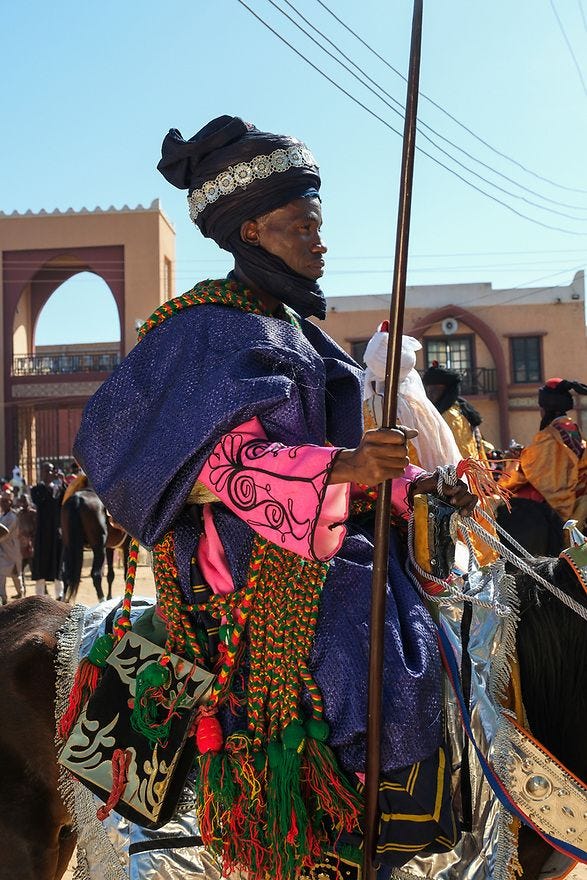
A feature on the Kano Durbar with some great photos too:
It was around 500 years ago that the Emirate of Kano’s reign was challenged by a neighbouring kingdom in northern Nigeria. At the time, explains Nasiru Wada Khalil, a Kano-based researcher on Oral and Intangible Cultural Heritages of Kano Palace, the Emir of Kano was king of one of the most important trading cities and kingdoms in Sub-Saharan Africa. And the neighbouring Emir of Katsina had decided to wage war at Eid al-Fitr, the celebration at the end of Ramadan.
In an exuberant show of support in Kano, thousands of local leaders dressed in their turbans and rode out on their gilded horses – decked in leather saddles made from the region’s skilled craftsmen and silver stirrups from local metalworkers – next to their emir. The display of strength and solidarity worked, and the Emir of Katsina backed down, says Khalil. From that time forward, each and every Sallah (Eid) day, the Durbar is staged. ‘The Durbar in Kano has been in existence for 500 years plus,’ Khalil continues, ‘and our local leaders pledge their allegiance to the emir by taking an oath that they are not going to retreat in case of warfare.’
Quite rare to see an extradition from Nigeria to the UK. Typically it’s America that demands it:
A man has been extradited from Nigeria and charged with the 2018 murder of a 23-year-old in London.
Matthew Adebiyi, 25, arrived in London on Wednesday and was charged with the murder of Joshua Boadu.
Boadu, known as SJ, was attacked in broad daylight on Linsey Street in Bermondsey, south London on June 11 2018.
He was taken to hospital in a critical condition with injuries to his chest, neck and arm, but suffered a heart attack on the way to hospital and his life support was turned off ten days later.
Adebiyi has been remanded in custody and will appear at Uxbridge Magistrates’ Court later on Wednesday.
Two others have previously been convicted of SJ’s murder, with Denilson Davis, 27, and a 16-year-old boy from the Southwark area sentenced at the Old Bailey in September 2019.
News from Oakland, California:
What began as a City Council hearing on a nearly $1 million fine for a man who city arborists said cut down protected trees on his Claremont Avenue property escalated into a heated debate about whether Oakland’s leaders would enforce their own laws.
It ended without a decision — and the council will take it up again next month.
The Tuesday hearing centered around Matthew Bernard and Lynn Warner, who city arborists say chopped down 38 mature trees without permits in 2021 and 2022 across their land, an adjacent city property and on neighbors’ lots. One arborist called it “the most egregious illegal tree removal case” in decades.
Bernard, who was born in Nigeria and immigrated to the United States in 2001, said he and Warner wanted to build a future home for their family on the Oakland hills lot, and did “everything in their willpower” to respect the city’s laws. He said that he had acted on advice of an arborist to remove trees at risk of falling, or igniting during a wildfire. Bernard’s neighbors have also sued him over the trees that he cut on their property.
The Oakland City Council was split — with some aligning with environmental advocates who felt the city needed to show it would not allow trees to be removed without consequences, and other council members expressing sympathy for a couple trying to navigate city permitting.
[…]
“I have to express my confusion about how a Black man should be the first to receive consequences for things that white people have been doing for centuries,” Fife said. “The hills were built up for white Oaklanders, that nobody else had access to — not Asians, not Mexicans, not Black people.”
The council weighed whether to impose a smaller fine of $411,000. The vote came down along the same lines — with those who had voted for the full fine refusing to approve the smaller amount.
With no consensus, the council agreed to continue the matter at its May 5 meeting, marking the second time the council has deferred the decision since the matter was first brought before it in December.
Long feature on ‘Pastor’ Tobi:
Stepping out of a black Lamborghini, dressed in a two-piece Under Armour tracksuit with dark sunglasses and a cap pulled down tightly over his face, Tobi Adegboyega looks more like a movie star than a church pastor.
In a video he shared on Instagram on March 25 this year, the Nigerian founder of the Peckham-based Salvation Proclaimers Anointed Church (SPAC Nation) is being mobbed by adoring young fans as he attends a charity running event in central London organised by his church.
However, despite the incongruity of a clergyman having this Hollywood appearance and celebrity status, what’s most surprising is that he is in this country at all.
For in December 2024, Adegboyega lost an appeal against deportation after it emerged he’d been living in Britain illegally for more than 20 years, having first arrived from Lagos in 2005 on a six-month tourist visa.
When questioned about this in an interview with the BBC, the pastor claimed he had simply ‘lost track of time’. Regardless, it appears that 16 months after the immigration tribunal, the 45-year-old continues to live in the UK.
[…]
One 18-year-old whistleblower known as Lovis had a £5,000 loan taken out in her name by a company associated with the church, without her permission, after she had shared her bank details with a minister while suffering from kidney cancer.
A second, Gracy, joined the church in 2017 aged 21. A minister soon offered to apply for Universal Credit on her behalf. Weeks later she received a benefits payment for £1,200, significantly more than she was entitled to. It emerged that her application had falsely disclosed she had two children, increasing her entitlement. The church told her to deposit £900 across two church accounts, allowing her to keep the remainder.
‘I am convinced that SPAC Nation is a cult,’ declared Labour MP Steve Reed in Parliament in January 2020 before criticising the leadership’s outrageous displays of wealth. The Streatham and Croydon North MP then alleged – using parliamentary privilege – that some male SPAC Nation pastors were engaging in sexual relations with young female followers.
Who is The General?
A notorious London gangster dubbed ‘The General’ has been jailed again - after repeated Home Office attempts to deport him failed.
Serial offender Joland Giwa, 36, was caught with around £17,000 worth of drugs when police raided his home in Risca, South Wales.
Giwa grew up terrorising the streets of Croydon as part of the ‘Don’t Say Nothing’ gang, or ‘DSN’ for short, after arriving in the UK aged ten.
He boasted on YouTube about his life of crime including ‘shanking’ his rivals - slang for stabbing.
Giwa was first jailed in 2009 for a string of offenses, and later moved to Newport in the hope it would sever his crime links with the capital - but failed to stay on the right side of the law.
The UK government has repeatedly tried to deport the criminal, believed to be from either Nigeria or Sierra Leone, but has been blocked for 17 years because neither country would take him.
Giwa and his twin brother landed at Heathrow in 1999, aged ten, without any parent, guardian or documentation.
He was granted indefinite leave to remain in 2005 - but that was withdrawn after his first conviction, and the deportation process began in 2009.
Somehow Nigerians have been entering Britain on visas created for Ukrainians:
Thousands of Asian, African and Middle Eastern migrants have come to Britain under the Government’s Ukrainian free visa scheme, The Telegraph can reveal.
Nearly 3,500 visas have been granted to migrants from 112 countries – including Afghanistan, Nigeria, Iraq, Iran, India and the Palestinian territories – under the two schemes offering sanctuary to Ukrainians fleeing Vladimir Putin’s invasion.
They were eligible as family members of Ukrainians in the schemes, which allowed applicants to come to the UK either because they had family in Britain or had been offered accommodation by Britons under the Homes for Ukraine sponsorship programme.
The schemes were set up by the previous government, but have continued under Labour as the war between Russia and Ukraine drags into its fifth year.
The 3,464 visas for non-Ukrainians represent one in every 80 of the 279,223 granted under the schemes, according to Home Office data analysed by The Telegraph.
Russians account for the biggest number of non-Ukrainian nationals to have come to the UK under the visa scheme, at 588. They are followed by Nigerians (408), Afghans (294), Iraqis (161), Moldovans (152), Turks (149), Indians (124), Belarusians (107), Iranians (107) and Egyptians (106).
Who the hell is that kid?
And the final stop of Max Iheanachor’s whirlwind pre-draft tour? San Francisco.
Since April 1, the former Arizona State tackle has crisscrossed the NFL universe in meeting with 12 teams for “Top 30” visits, which is some kind of clue underscoring his rising stock as the NFL draft looms.
“It’s a business, with teams bringing in all the guys they like or are interested in,” Iheanachor, 22, told USA TODAY Sports this week, on the eve of a visit with the 49ers that came on the final day when teams could conduct such sessions.
“You just kind of talk to them eye-to-eye. The O-line coach, teaching you in a room, seeing how you retain information. They want to learn about your character as a player. It’s definitely been an awesome experience.”
Maybe this winding journey leads to Iheanachor, ranked 27th on the big board for USA TODAY Sports, getting picked in the first round on Thursday. Regardless, that so many teams during the draft process have wanted a closer look at a prospect who has played football for all of four years – Iheanachor moved to the U.S. from Nigeria when he was 13 – seems to add value.
[…]
Listen to Saga Tuitele, Arizona State’s edgy offensive line coach, provide a snapshot. Tuitele, who was then at Fresno State, discovered Iheanachor when he went to check out another junior college player at East Los Angeles College (ELAC).
“Then, all of a sudden, I was like, ‘Who in the hell is that kid?’ Tuitele tells USA TODAY Sports.
David Ojabo has been mentioned here before (BTH - 45) but this is a fuller story of his journey. There is an Ojabo ko fo joke playing in my head. I’m very sorry:
David Ojabo likely has one of the most unique journeys in the entire NFL. He was born in Nigeria but primarily grew up in Scotland. He hooped for on the U-14 Scottish National team. And he didn’t touch a football until his late teens after moving to New Jersey. That, however, didn’t stop Ojabo from being selected in the second round of the 2022 NFL Draft.
Now, the Miami Dolphins edge rusher has a chance to prove that his choice of football wasn’t in vain after an injury-riddled start to his career. “You can’t even script this up, all those stops, man,” Ojabo said. “It’s been a wild journey, the ups and the downs, but it just made me into the man I am. I’ve met a lot of cultures, a whole lot of people, and I just feel almost like ready to take anything on, because I feel like there’s nothing I really haven’t seen with the international background and coming to America and being kind of all over the place leading up to now.”
Football, it would seem, found the 25-year-old by mistake. Ojabo moved to America at 17 where he began to flourish as a soccer and track star, even running a 10.8 second 100-meter dash. He set a Blair Academy school record, something that first put him on the map.
Obe ata is a foundational sauce. You heard it here first:
Obe ata is a foundational sauce in Nigerian cooking, made from tomatoes, peppers, onions, and chiles simmered until richly flavorful. The sauce forms the base of many dishes, from rice preparations like jollof to stews served with meat, fish, or vegetables. In this skillet dish, it becomes the base for gently poached eggs, creating a vibrant meal that works equally well for breakfast, brunch, lunch, or dinner.
Eggs are cracked into small wells in the sauce and covered so they can poach gently in the steam. This method allows the whites to set while the yolks remain soft and creamy, creating a rich element that blends into the sauce when broken. The technique is similar to dishes like shakshuka, but the flavor profile here is distinctly West African thanks to the bold, peppery depth of obe ata.
Fresh parsley and basil are scattered over the skillet just before serving to deliver brightness and aroma. A sprinkle of crumbled feta adds a salty contrast that complements the savory sauce and eggs.
Professor Ahmed Ahijo’s very simple solution to extreme heat in Nigeria’s north:
At less than a year old, the papayas are already fruiting outside the University of Maiduguri Teaching Hospital (UMTH) in the capital of Borno State, northeast Nigeria.
The fruit is joined by other crops – bananas and plantain – though they were still small and not yet ready to be eaten when The New Humanitarian visited in December 2025. Dotted among less edible plants like young baobab trees, the fruits fill up 26 plots, each 25 metres in length. Together, they form a 1.75 hectare orchard of roughly 826 trees – all selected for their ability to withstand extreme heat and arid conditions.
Inaugurated at the beginning of 2025, the hospital’s orchard was a direct response to one of the most pressing challenges doctors and staff are facing: rising temperatures caused by climate change.
Extreme heat is a global challenge with major implications for humanitarians. As the climate crisis intensifies, it won’t be uncommon to see emergency responders like doctors and nurses forced to take up adaptation measures like the orchard at UMTH.
Such projects can come with co-benefits, according to Ahmed Ahijo, chief medical director of UMTH. The hospital is a major healthcare institution, which caters to patients from across Borno, a region which has long grappled with a deeply entrenched conflict. A bombing in Maiduguri on 16 March killed 23 people and injured more than 100 others, a violent incident said to be indicative of a resurgent Boko Haram.
“Apart from helping to reduce and abate the temperature and mitigate climate change, we can also provide fruits for our patients and our staff at subsidised rates,” he told The New Humanitarian on a tour of the gardens.
The orchard is not yet complete, with many areas still empty, but fountains and benches have already been installed. The fountain water is intended not only for irrigation and for patients to enjoy, but also for animals like birds and bats. Some of the plots are named after real people, including Ahidjo, who has one dedicated to him.
A NYT feature on Kannywood, thriving in the face of censorship:
Hollywood and Bollywood may be the two biggest “-woods,” but in Northern Nigeria there is a scrappy, thriving filmmaking industry, nicknamed Kannywood. The name comes from Kano, both a city and a state, where moviemakers with modest means churn out an amazing number of productions, all while dealing with strict censors.
Nigeria’s film industry is perhaps better known globally for its bustling Nollywood industry, based in the economic capital of Lagos. But Kannywood, to the north, is a genre that focuses on different cultural aspects.
Mansura Isah, an actress, filmmaker and producer in Kano, is a leading figure who has worked in the business since 2001. Today, at 40 years old, she is particularly proud of “Jodha,” a film she finished making late last year. The film touches in part on social issues including H.I.V. awareness and early marriage.
But when Isah took the final cut to the Kano Censorship Board in January, a process every Kannywood filmmaker must go through before a movie can be released, she broke down in tears over the ruling. The officials ordered her to cut out most of a birthing scene.
“They just told me that the way I lifted my legs was not OK, that men can have a fantasy,” she said. She had spent a lot on the movie and especially on that scene, she said, because it’s “the core story.”
“Without that scene,” she added, “that movie can never be the movie that I want people to see.”
[…]
According to Adamu, Kannywood productions started addressing social issues when AREWA 24, a U.S.-funded, Hausa-language TV station, was created in Kano more than a decade ago.
He said creation of the station was one of two defining moments of modern Kannywood history.
“The first one was the introduction of censorship, which has altered the story lines and everything. And then the second one was American funding to initiate” AREWA 24, he said.
AREWA 24 was created in 2014 at a cost of about $6 million and initially financed by the U.S. State Department’s Bureau of Counterterrorism. At the time, American officials said the channel was crucial to countering the extremism of violent militant groups such as Boko Haram.
It took about four or five years for Kano filmmakers to incorporate social issues into their productions, Adamu said. What helped, he said, was seeing “the success of the TV shows that were inspired by American funding but not American story lines.”
The station was founded, he added, immediately after what he referred to as “the dark period” of censorship.