

This week I wrote about how to think about energy from first principles in Nigeria. The piece seemed to resonate with a lot of people.
Frontier Matters podcast should be back next week.
Enjoy the usual selection below
Nigerian Media
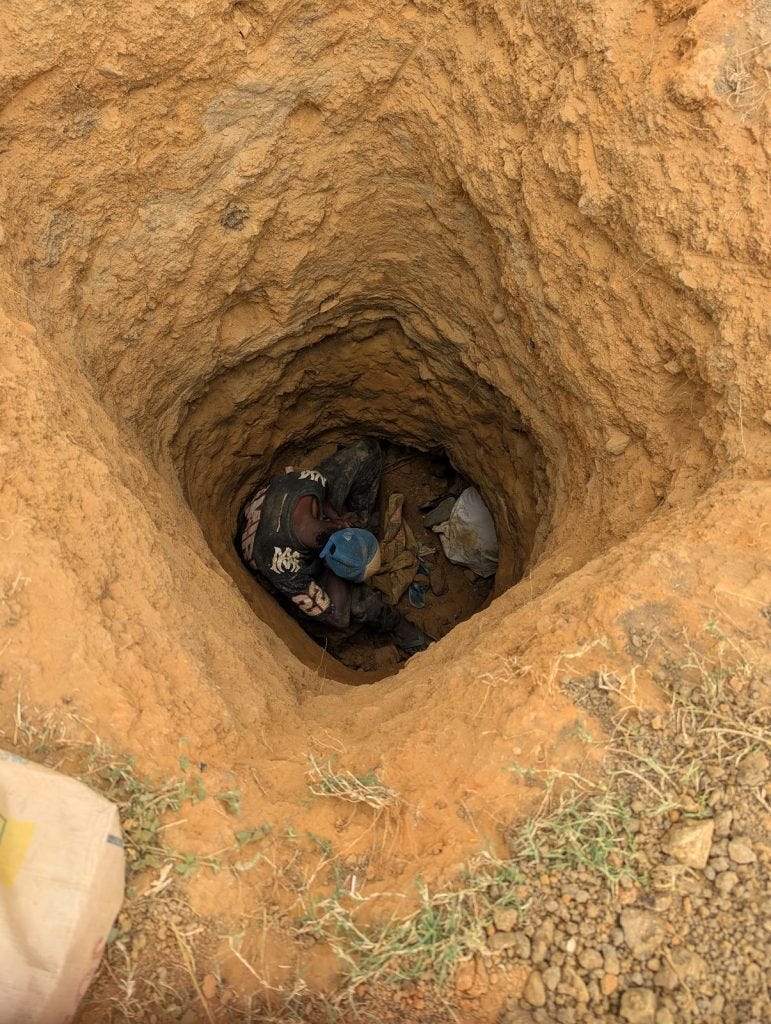
Very good article on wildcat gold mining in Niger state and the damage it is doing to communities and the environment. With lots of excellent photos too:
For about five years now, the silence of his neighbourhood has been broken not by the laughter of children or the bustle of new shops, but by the metallic clang of shovels and the chaos of hundreds of illegal miners, mostly youths.
Illegal miners had occupied lands within the community. Armed with weapons, cutlasses, and knives, and emboldened by impunity, they dig through residential lands in search of gold, carving scars into the earth and into the lives of those who lived there.
At first, Ike thought it was a case of young people constituting a nuisance, but when he confronted the miners who closed onto his property, his worst fears materialised. The same day he confronted them in late 2024, his home was attacked. During the attack, miners rained insults, calling him an enemy of progress and telling him to mind his own business while they focused on theirs.
[…]
An illegal miner who simply identifies as Rugged explained that the practice began as a response to constant power struggles among young people in the state capital.
“Miners who are stronger or have the numbers tend to attack the weak ones to collect their gold or money. So, we decided to also come with our weapons in order to protect ourselves and avoid intimidation,” the illicit miner told HumAngle.
Over time, the weapons were not only used against rival miners but also against residents and security personnel. Confirming what residents told HumAngle, Rugged admitted that when community members tried to stop them, they were chased away with threats.
If you don’t want us anymore, we don’t want you too either:
The Minister of Interior, Olubunmi Tunji-Ojo, has directed the Nigeria Immigration Service to immediately withdraw and deactivate passports held by persons who have formally renounced their Nigerian citizenship.
The directive, contained in a statement issued on Saturday by his Special Adviser on Media, Alao Babatunde, covers Nigerians whose renunciation requests have been formally approved by the President.
Tunji-Ojo said the ministry, saddled with the responsibility of citizenship integrity, derives its authority for the directive from Section 29(1) and (2) of the 1999 Constitution, as amended.
The statement quoted the constitutional provision as stating: “(1)Any citizen of Nigeria of full age who wishes to renounce his Nigerian citizenship shall make a declaration in the prescribed manner for the renunciation.
“(2)The President shall cause the declaration made under subsection (1) of this section to be registered and upon such registration, the person who made the declaration shall cease to be a citizen of Nigeria.”
According to the statement, the minister said once a person ceases to be a citizen, they can no longer hold any sovereign document of Nigeria, including a passport.
Abuja’s trees are disappearing. The inability to build around nature remains one of the saddest things about Nigerian construction:
Across the Federal Capital Territory, chainsaws hum where trees once stood, and bulldozers carve through forests that once cooled the city and absorbed its floods.
But beyond the rising skylines and luxury estates lies a more troubling reality: as green cover disappears, temperatures climb, floodwaters surge faster, and climate risks intensify. What was once a gift from nature, has not been sapped by man in his quest to build more structures for pecuniary gains. Thus, with more houses springing up here and there, fetching millions for their owners, Abuja is gradually being turned into a scorched earth and rendered bare by builders. The effect comes back to hurt every city dweller.
When Abuja was chosen as Nigeria’s capital in 1976, it wasn’t just a political decision — it was a bold vision. Planners imagined a city that would rise in harmony with nature: rolling hills, lush forests, and wide green belts that would shield residents from the harsh African sun and unpredictable rains. Every street, park, and estate was mapped with an eye toward balance — a capital that would breathe, not just function.
Architects and urban planners dubbed it a “green city,” a symbol of modernity intertwined with ecology. Protected forests and buffer zones were deliberately integrated into the master plan, meant to absorb floodwaters, moderate temperature, and sustain biodiversity. Abuja was meant to be more than concrete and steel; it was meant to be a living city, where nature and development coexisted.
Today, that vision is under siege as rapid population growth, sprawling estates, and unrelenting construction are erasing the very green spaces that were meant to define the capital. The dream of a climate-resilient Abuja is fading, replaced by heat, dust, and the creeping threat of floods — a stark warning that Africa’s showpiece city may be paying the price for unchecked urban ambition.
From the air, the changes are undeniable. Satellite images show forested hills around Gwarimpa, Kubwa, and Jabi shrinking year by year, replaced by sprawling housing estates, highways, and commercial complexes. Where once thick greenery cushioned the city against heat and floods, now bare patches of land and dusty roads dominate the landscape.
That thing Fela sang about….
Three people were killed when an ambulance conveying the corpse of an old woman home for burial ran into a tricycle.
The accident which happened in the Big Gutter area of Aba road in Umuahia on Thursday, claimed the lives of two Keke passengers on the spot while the third victim died in the hospital.
The ambulance which was driven by a woman, was alleged to be speeding when it hit the tricycle that was coming from the Ubakala-Old Umuahia axis.
A crowd of sympathisers who gathered at the scene after the incident, alerted some police officers who arrived the scene and helped in evacuating the injured victims to the Federal Medical Centre Umuahia for immediate attention.
No official statement has been issued by relevant agencies in the state about the accident but some residents who witnessed the incident claimed that it could have been caused by over speeding on the part of the ambulance driver.
An eyewitness who pleaded anonymity, said that the ambulance was conveying the corpse of a 77-old-woman to the Isi Court area of Umuahia for burial when the accident occurred.
Daniel Bwala wants you to know what happened to him after his car crash of an interview with Mehdi Hasan:
The Special Adviser to President Bola Ahmed Tinubu on Policy Communication, Daniel Bwala, has said he underwent throat surgery days after his widely debated interview with Al Jazeera journalist Mehdi Hasan.
Bwala disclosed this on Friday during an appearance on News Central’s programme, 60 Minutes with Mr Kay, while reacting to the interview and the backlash that followed online.
“Eight days after the interview with Mehdi Hasan, I underwent surgery on my throat. I don’t know whether it is the ‘Obidient’ people that threw that African thing, but in any case, I’m back and strong,” he said.
He criticised a group of social media users he identified as “Obidients,” accusing them of placing political loyalty above national interest.
“I know the environment I come from; it’s an environment where there exists a species of ‘Trojans’ of social media called the ‘Obidient,’ who do not care about the national interest or the security of Nigeria and will do everything possible to achieve the aim of their hero, no matter the cost,” Bwala stated.
Nigeria’s disorder and coordination problems in miniature:
Zuba, a major commercial hub in the Federal Capital Territory (FCT), is grappling with the absence of a functional central motor park despite hosting about six strategic markets.
Located along key highways linking northwestern states and the southern part of the country, the town falls under Gwagwalada Area Council. Its strategic position earned it a pioneer motor park, reportedly built in 1986 by then FCT Minister, Hamza Abdullahi.
Findings by Abuja Metro show that the once-bustling motor park, constructed alongside shops that added commercial vibrancy to the facility, has gradually lost its relevance due to the emergence of parallel roadside terminals within the community.
As a result, most drivers have abandoned the park, leaving it largely occupied by mechanic workshops, makeshift stalls and a few struggling businesses.
Stakeholders who spoke to Abuja Metro attributed the decline to the park’s location, which they said is far from major roads where passengers typically alight.
An official of the National Union of Road Transport Workers (NURTW), Abubakar Bello, explained that passengers arriving in Zuba often prefer boarding onward vehicles directly from the roadside rather than hiring motorcycles to access the motor park.
“Passengers come into Zuba from different parts of Abuja, but once they drop, they are reluctant to take motorcycles to the motor park. Instead, they join vehicles heading to places like Kaduna or Lokoja along the roadside, often at cheaper rates,” he said.
According to him, this trend has forced many drivers to relocate their operations to the roadside in search of passengers.
Revenge theft is officially added to the lexicon:
The Airport Police Command has arrested a 28-year-old man, George Ikpe, over the alleged theft of equipment valued at about N15 million from his former workplace, Vovida Communications Limited, an IT solutions company.
According to the statement issued by the Command, the suspect was apprehended on April 3, 2026, by operatives of the Murtala Muhammed International Airport Police Division after what authorities described as careful intelligence gathering and investigation.
Police said preliminary findings showed that Ikpe allegedly gained unauthorised access to the company’s premises located along the Murtala Muhammed International Airport axis and carted away key equipment.
A review of the company’s CCTV footage was said to have captured the suspect’s movements, helping investigators confirm his identity.
Items reportedly stolen include two custom-made Vovida Central Processing Units (CPUs) valued at ₦10,357,000 and a high-end printer valued at ₦4,715,000, bringing the total value to approximately ₦15,072,000.
Further investigation led to the recovery of the stolen CPUs after the suspect provided useful information. However, the high-end printer had already been sold before his arrest.
The suspect reportedly told investigators that he carried out the act as revenge after his employment with the company was terminated.
Non-Nigerian Media
The intrepid Ruth McClean goes undercover in a erotica WhatsApp group. Journalism ensues:
On a recent morning in northern Nigeria, some thousand women’s phones pinged. The latest chapter from “Nymphomaniac King” had just dropped on a women-only WhatsApp group.
I had been silently observing in the group, Oum Hairan World, for months, after the author let me in. The prose was explicit, using Hausa words for body parts that would never survive the region’s Islamic censors. The group of Muslim women responded in kind, in a hilarious, emoji-laden discussion of who could handle the king’s appetites.
“His Majesty’s great staff is what impresses you all,” posted Oum Hairan, the author, teasing her raucous readers.
Then, just as “Nymphomaniac King” reached a tantalizing climax, she slammed the paywall down.
“You will pay 300 naira (about 20 cents) for the regular group,” she wrote to the women begging for more pages. She added that “V-VIP” access cost 1,500 naira, dropped her account number and waited for the payments to roll in.
[…]
But then, in 2021, the Hisbah called her into their office in Kano, Nigeria’s second-largest city. When she presented herself before three women from the Hisbah, she said they told her to make her writing less erotic.
“They told me I was committing a very big sin,” she said, laughing. She said she shot back, how could they know that — unless they were reading her books?
When they admitted that they had read a few, she explained her philosophy. Her books were targeted at married women, she said, and the point was to convey messages about society. She was a mother, trying to raise upright children, she added, so she wouldn’t do anything to corrupt young people. Indeed, in a kind of foreword to each book, Mrs. Umar forbids young, unmarried women from reading them.
The Hisbah seemed to accept her explanation.
“I told them I couldn’t promise to stop, and they let me go,” Mrs. Umar said.
I hope Moby does not plan to visit Nigeria anytime soon. Lest he becomes the thing he sniffed out:
A Canada Border Services Agency (CBSA) detector dog sniffed out 40 kilograms of undeclared beef and chicken that was stashed in a travellers’s luggage at Toronto Pearson Airport late last month.
CBSA tells CityNews their dog, Moby, caught scent of the meat in a traveller’s luggage arriving from Nigeria on March 27.
“The food products were seized and the traveller was fined,” CBSA said while reminding travellers that they are required by law to declare all food, plant and animal products coming into Canada.
If you are on a provisional licence in the UK, you need to take extra care:
A coroner has called for the government to look into a loophole in UK driving laws after a Nigerian man who had twice failed his test caused the death of a pensioner.
Timothy Kusemi, 41, killed Susan Whittles, 70, in a collision in the East Riding of Yorkshire while driving unsupervised on an provisional licence.
Kusemi failed to give way at a crossroads and hit the side of Whittles’ vehicle, which had right of way in Bridlington, on November 24, 2023. Whittles died at the scene and her husband, a front seat passenger, was seriously injured.
A coroner has now called for the government to close a loophole that allows foreign motorists to drive unsupervised for a year without L-plates. This rule does not apply to British learner drivers.
Kusemi held a Nigerian driving licence which was valid in Great Britain for 12 months from the date he became resident. He was issued with a provisional British licence and was required to pass a driving test before September 14, 2023.
Kusemi, who had moved to the UK 14 months before the crash, had passed his theory test but failed his practical driving test twice before the collision. He failed his practical test four further times before passing on March 21 last year. The coroner noted that Kusemi continued to drive beyond the 12-month limit despite failing his test.
After pleading guilty on June 10 last year to causing death while unlicensed and uninsured, Kusemi was given an interim disqualification. He went on to plead guilty on February 23 to causing death by dangerous driving and while unlicensed, and causing serious injury by dangerous driving. He was jailed for six years and banned from driving for 11 years, after which an extended retest will be required.
New documentary about Nigeria’s female film directors out in the UK today:
7.30pm, Channel 4
There’s a reason why this Friday evening buzzkill of a documentary strand is approaching its 50th season: it does a brilliant job of finding essential, often bleak stories from around the world and offering a potted guide. This new run begins in Nigeria and the conservative city of Kano, which is home to a prolific film industry. Anja Popp meets Mansurah Isah, one of its few female directors, and explores her battle to elevate women’s perspectives.
Helen Ogbu is running for office in Ireland:
At the top of the staircase in Helen Ogbu’s home in Galway is a large picture of her late husband Sunny Ogbu, a man who she always described as the “light of my life”.
In 2010, Sunny Ogbu was poised to make a big announcement about plans to run for the People’s Democratic Party in Nigeria in the country’s national assembly. The day before his announcement, he spotted what he thought were stranded locals on the roadside. They were waving for help, and despite his driver’s reservations, they pulled over. In fact, it was a team of suspected hired assassins.
“His driver slowed down and the next thing, they put the gun to his head and shot him,” Ogbu, 53, said this week, speaking from her home in Galway. Ogbu, who was the first person of colour to be elected to Galway city council in 2024, has now been selected to run for Labour in the Galway West by-election, following Catherine Connolly’s election as the president of Ireland.
For the first time, she is telling the full story of how she came to Ireland from Nigeria, where she was born and grew up as part of a family of nine children; how she lost her husband in a killing that she had feared would happen for years; and how she is facing down racist and anti-immigrant sentiment in a bid to win a seat in the Dail in this May’s election.
Incredible things are happening in Ireland:
A Nigerian national who insists gardaí mixed him up with one of his nine identical brothers is the first person in the State to be prosecuted for obstructing deportation.
Alleged “decuplet” Sam Okwuoha (28) was originally brought before Dublin District Court on Tuesday, following a Garda National Immigration Bureau (GNIB) investigation.
He claims a case of mistaken identity has led to him being charged with a single offence contrary to the Immigration Act 1999.
According to court documents, he is accused of obstructing Det Gda Graham Dillon at Dublin Airport on March 6th during an effort to deport him from the State.
The accused, who had previously lived in Dublin, replied, “I am not the person” when the charge was put to him.
Bail was denied on Tuesday, and his case continued before Judge Alan Mitchell at Cloverhill District Court on Friday.
The accused, who appeared via video-link, spoke several times during the procedural hearing, at first repeating his contention that “I am not the person named on the charge”.
The judge noted the allegation was a “summary only” offence, dealt with at the District Court level, and punishable by a maximum 12-month sentence and a fine of up to €2,500.
“It is the first time we have ever used it,” Dillon told the court.
Your flight from Lagos to Barbados that you have been waiting for will depart next month:
Nigeria’s Air Peace will restart once-monthly flights from Lagos, Nigeria to Antigua and Barbados starting May 24 using a Boeing 777.
Sean Mendis says Air Peace has threatened to sue him for questioning the wisdom of this service. I’ve known Sean for more than 20 years, when we co-moderated the Delta Air Lines forum together on FlyerTalk. He’s former COO of Ghana’s Africa World Airlines and he wrote on LinkedIn,
The airline argues this service makes sense based on “previous ad-hoc charter flights to Antigua and Barbuda in 2023 and a landmark Lagos-Montego Bay charter flight to Jamaica operated in 2020.” A single ‘landmark’ charter flight six years ago. There were some services beyond this. And it’s just… weird.
There’s not a lot of traffic West Africa and the Caribbean. So daily or even Saturday-only service would bleed horribly. So the one thing that monthly service has going for it is fewer flights means losing less money.
My Father’s Shadow still getting love and if you’re in Houston you can still see it:
The Nigerian/British co-production “My Father’s Shadow” arrives in Houston on a wave of acclaim that has made it one of the most celebrated movies from the African continent over the last year. It won outstanding debut honors at this year’s BAFTA Awards for filmmaker Akinola Davies Jr., nabbed the British Independent Film Awards’ best director nod, was given the Golden Camera Special Mention title at Cannes and was the UK’s official entry in the international category for this year’s Oscars, though it didn’t make it to the final five. Throw in a multitude of nominations and wins at various global film festivals and “My Father’s Shadow” is a low-key, indie juggernaut.
Not bad for a movie made for around $3 million by a guy directing his first narrative feature with a 16mm camera and a hope and a prayer. Co-written by Davies with his brother, Wale, “My Father’s Shadow” is a moving, semi-autobiographical remembrance of family and fatherhood, set against the chaotic backdrop of Nigeria’s disputed 1993 election in which the ruling military junta annulled the results, sparking violence and protests.
Yet the film, playing twice on Saturday at the Museum of Fine Arts, Houston and streaming on mubi.com beginning Friday, opens quietly, with 11-year-old Remi (Chibuike Marvellous Egbo) and his eight-year-old brother Akin (Chibuike's real-life brother, Godwin Egbo), playing in their village, waiting for their mother to come home from work. Their father, Folarin (Sope Dirisu, "Gangs of London"), is working far away, and they don't know when they might see him again.
Aso-oke is God-ordained and there is nothing anybody can do about it:
Artisans work for hours setting threads on looms to create narrow, tightly patterned strips, which are later sewn together into wider cloths for garments and accessories.
“This is what Iseyin is known for,” Kareem Adeola, 35, said from behind his loom. “We inherited it from our forefathers.”
While many weavers in Iseyin are middle-aged men, younger people like Waliu are entering the trade, bringing new ideas and skills.
Some engage graphic artists to develop new designs.
- ‘Meant to be handwoven’ -
Despite rising demand, the craft has largely stuck to its rudimentary roots.
Attempts to mechanise production have been limited or largely failed.
“If you use a machine to weave aso-oke, it won’t come out as nice as if it was handwoven,” said Adeola, weaving a yellow-and-olive piece.
“People have tried it before and it did not work. It is meant by God to be handwoven.”
Which one of you brought bushmeat into Peckham?
A Russian crypto firm has opened an office in Lagos:
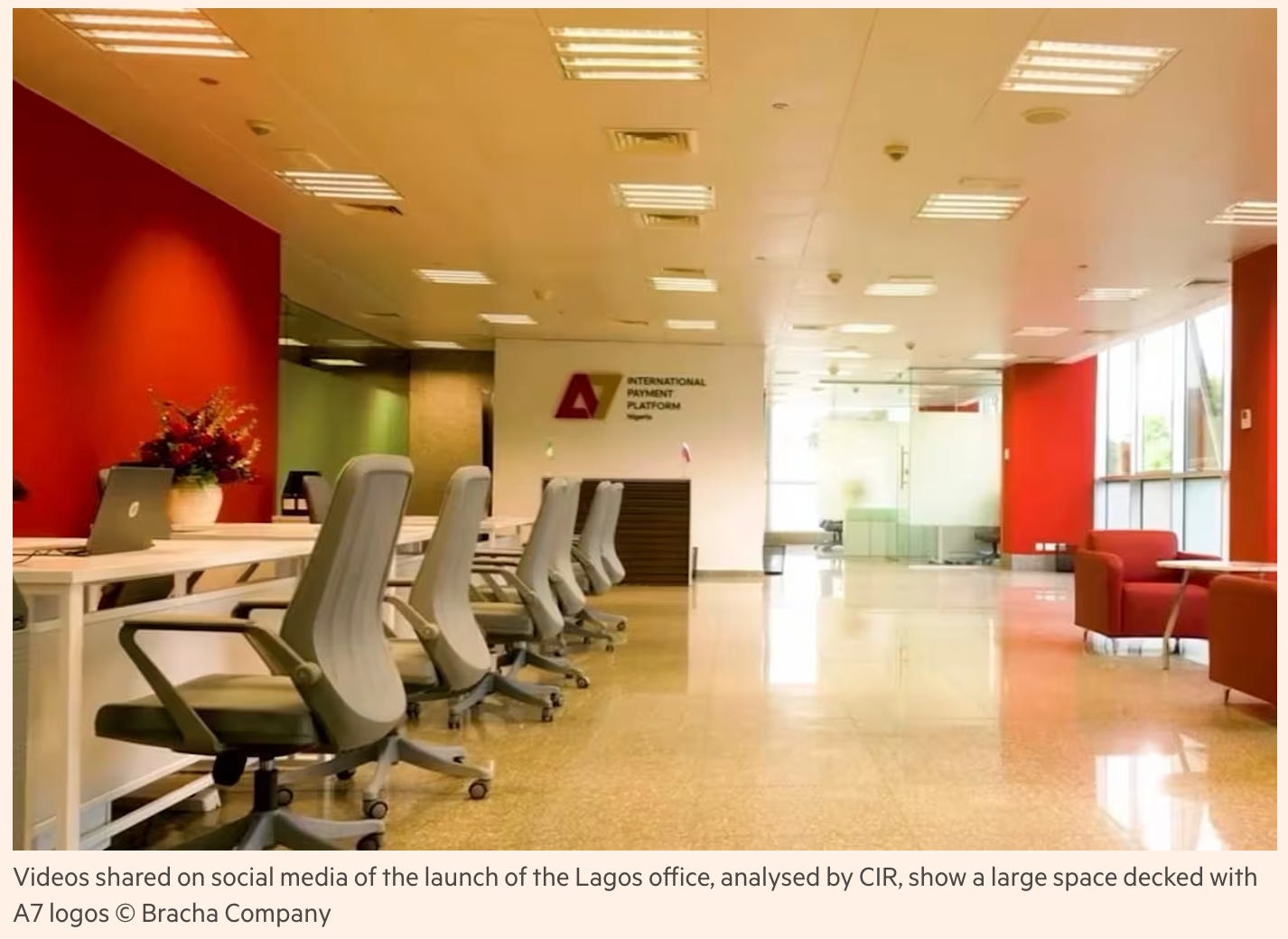
A recent vacancy posted on a Russian recruitment site sought a project manager to build a business “from scratch” in Togo, west Africa. The employer would be A7, a Russian cryptocurrency network under western sanctions, run by a fugitive oligarch and a state defence sector bank.The advert is the latest sign that Moscow is seeking to build an alternative payments system after its banks were cut off by the west in response to the full-scale invasion of Ukraine. The company’s eye on Africa tracks with Moscow’s expanding influence across the continent. Russia has strengthened its presence in several African countries in recent years, making new political inroads following a string of coups in the Sahel region and in Madagascar, and signing a series of trade and military deals.
A7 and its backers may be seeking to “integrate their operation into the Kremlin’s larger strategic machine in Africa,” according to Elise Thomas, senior investigator at the Centre for Information Resilience, a London-based non-profit research group. The payments network opened an office in Nigeria last autumn, videos showed, and also announced a new branch in Zimbabwe.
[…]
“The project is being implemented with the comprehensive support of government financial agencies of all parties,” Mikhail Dorofeev, deputy chair of PSB, said about the Nigeria and Zimbabwe openings, according to state news agency Interfax. He spoke of “a shared interest in . . . scaling a stable and sanctions-resilient cross-border settlements system”.
Update on the Australian lithium play in Nigeria. Note that the company is putting a lot of sponsored reports (including this one) into Australian media:
Chariot Resources has confirmed the presence of valuable spodumene in all six of its previously announced high-grade lithium samples taken from its green Fonlo and Iganna projects in Nigeria.
Independent quantitative mineralogical analysis, completed by the University of British Columbia, identified easily processable spodumene, accounting for between 28.4 per cent and a whopping 75.3 per cent of the overall weight in crystalline phases.
The confirmation is a serious boost for the company’s Nigerian ambitions, with the presence of the simple, recoverable spodumene being a major contributing factor for any hard-rock lithium hopeful.
Spodumene is far more amenable to conventional processing methods than other lithium-bearing minerals, such as the common lepidolite, which is complex and full of impurities. Notably, lepidolite was not identified in any of Chariot’s test results.
The six samples also returned impressive lithium oxide grades between 2.66 per cent and 5.96 per cent, with management insisting that the new mineralogical data now provide the necessary technical input for its development plans to eventually produce a direct-shipping lithium ore.
Test work also identified the caesium-rich mineral pollucite, with one sample from Iganna notching up 9.5 per cent of the mineral. The company says this explains the elevated caesium values previously reported and strengthens its interpretation that Fonlo and Iganna are the most favourable lithium-caesium-tantalum (LCT) pegmatite systems.
Notably, the confirmation of mineralogy has substantially cleared the metallurgical pathway for Chariot’s Nigerian assets, allowing high-confidence planning to accelerate technical studies and field programs.
The Fonlo and Iganna projects form part of a four-project portfolio in southwest Nigeria in which Chariot is currently acquiring a 66.67 per cent interest. The portfolio covers 254 square kilometres and has a documented history of artisanal lithium mining.
Getting hot in here:
Azeez Akanni hopped on a yellow bus heading for the central business district on Lagos Island, beads of sweat rolling down his neck and arms.
The 32-year-old clothier regularly navigates chaotic traffic to deliver luxury clothes and footwear to customers across the megacity of Lagos, Nigeria’s commercial capital.
But his and millions of others’ commutes have been snarled by brutal temperatures as Africa’s most populous country fights a heatwave.
Adding to the pain, a spike in fuel prices from the Iran war has sent costs for air conditioning and back-up generators shooting up alongside the mercury.
“The sun is too hot,” Akanni told AFP, wedged between two equally sweaty passengers.
High temperatures are nothing new in the west African nation, perched just above the equator
But according to the Nigerian Meteorological Agency (NiMet), things are getting worse: it warned in a 2025 report that in the decade from 2016-2025, nine out of the 10 years were “among the 12 warmest on record”.
Last week, UK-based Korean DJ JinseoulMusic, who is currently touring Nigeria, shared her struggles in a post on Instagram to her more than 430,000 followers.
“Surviving Nigerian heat with no light,” she wrote, using the colloquial term for electricity. “Heat woke me up in the middle of the night.”