

Living in a country with more than a thousand years of documented history means I am always seeing things for the first time in places I have passed for years. On Sunday I went for a haircut at the same place I have used since moving to the UK more than twenty years ago, and for the first time noticed the faded inscription on the brick wall outside: The North Metropolitan Electric Power Supply Co.
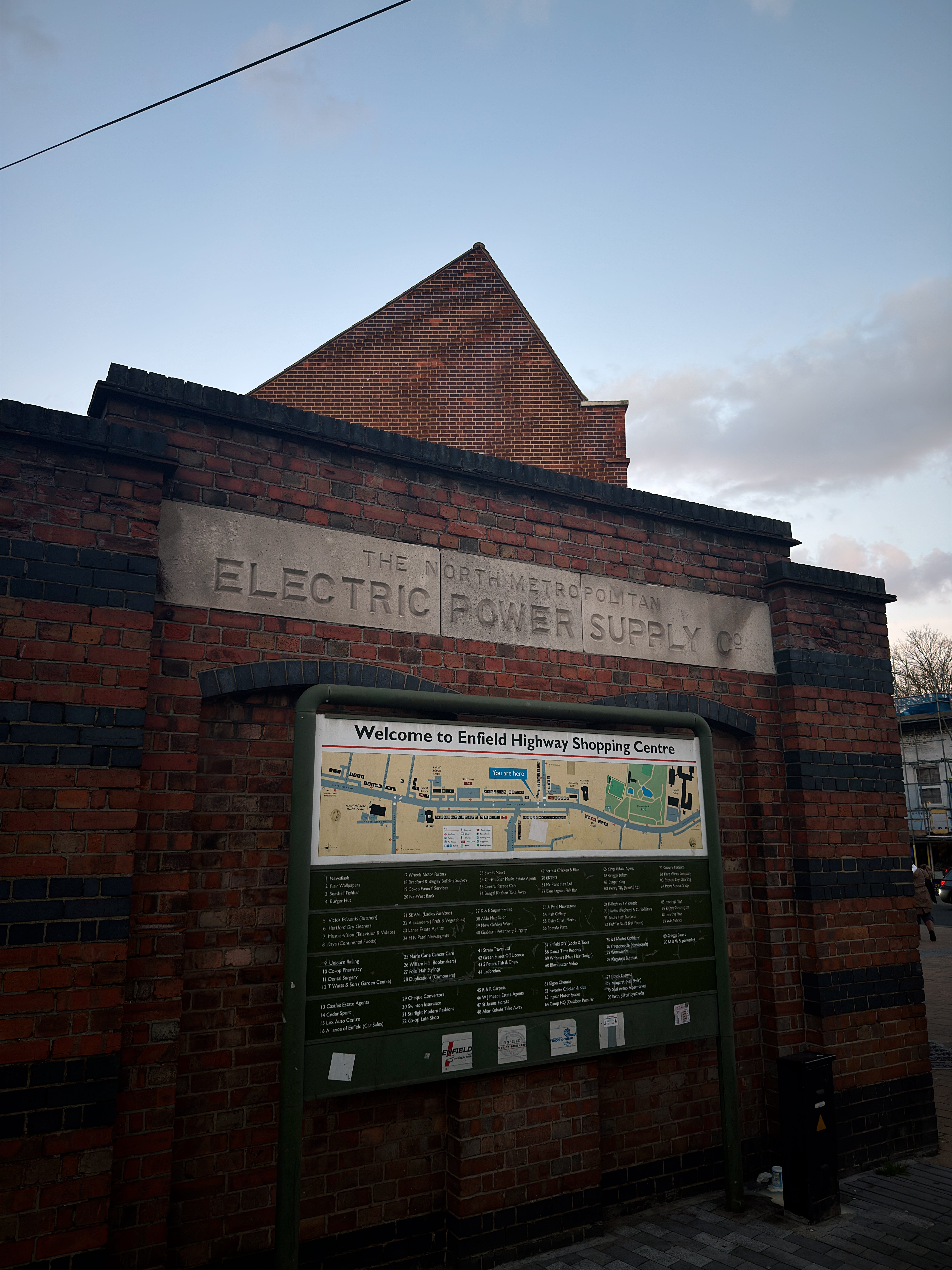
What caught my eye was "Power Supply." Before the First World War, the company was helping to power trams, underground railways and entire towns. I live something like twelve miles from this sign, but when I looked up the Wikipedia page I was surprised to find that the power station once supplied the town where I live. The phrase struck me because the plant was clearly not imagined as a public utility summoned to overcome darkness with illumination - it was a force that moved, pumped and powered things, and earned a healthy living while doing so.
The history of regional electricity in Britain broadly shows that companies quickly ran into a commercial problem because lighting alone created an awkward evening peak, and real viability came only when they found daytime loads - tramways, electric motors. A brief history of power generation published by Enfield Council emphasises the point: companies that needed power to function congregated around the plant, and their demand is what made it viable. Street lighting came after, in 1913.
I thought about Nigeria when reading that old inscription in the photo above that preserves a meaning of electricity that the country never inherited: not the banishing of darkness, but energy harnessed to make things move, pump and produce.
Defensive vs Productive
When you survey the history of energy generation in today’s advanced nations, the story runs something like: resource, task, paying user. At the Dutch windmills of Kinderdijk, wind was used to pump water and keep low-lying land dry. Later, steam and then electricity scaled the same job. In Britain, the first practical steam engines were built to pump water out of mines - steam did not begin as abstract “progress” but as a solution to a bottleneck. Norway turned falling water into cheap electricity for industrial production; Norsk Hydro used that power to begin manufacturing nitrogen fertiliser in 1907. First-principles energy policy: match the resource to a paying industry. In all of these examples, illumination hardly ever featured as a primary driver.
One way to think about all this in relation to Nigeria is in terms of defensive and productive electricity. Defensive electricity is what people buy to survive dysfunction: light, fans, phone charging, refrigeration, generator fuel, and various other coping mechanisms. Productive electricity is what multiplies output: pumping, milling, welding, cold chains, rail, machine tools, fertiliser, industrial processing, water treatment.
A power sector dominated by defensive demand will always have brutal tariff politics, because households and tiny businesses are being asked to bear costs the wider economy is not productive enough to support. A power sector anchored by productive demand has a much better chance of paying for itself. This does not mean households do not deserve affordable electricity - of course they do. But it means household affordability should be treated as a kind of explicit social policy, not hidden inside general market debt that later shows up as a bailout.
Ratchet Effect
Yesterday the Nigerian government announced a further bailout - N3.3 trillion (roughly $2 billion) - for the settlement of legacy debts accumulated in the power sector over the past decade:
“Following verification, ₦3.3 trillion has been agreed as a full and final settlement, ensuring a fair and transparent resolution,” the statement partly read.
The government noted that implementation of the repayment plan has already commenced, with 15 power generation companies signing settlement agreements valued at ₦2.3 trillion.
It added that the Federal Government had so far raised ₦501 billion to fund the initiative, out of which ₦223 billion had already been disbursed, while further payments are ongoing.
"Full and final settlement" is doing a lot of load-bearing work in that statement. As anyone familiar with the Nigerian power sector knows, the problems are deeply structural, so the moment one debt is cleared, another begins to accumulate. Without getting too far into the weeds, in Q1 2025 the federal government absorbed about 59% of total generation costs because end-user tariffs were frozen at July 2024 rates. By Q3, tariffs for July, August and September 2025 were still frozen at those levels. DisCos could show a 95.21% remittance rate on their adjusted invoices in Q3 - but those invoices had already been shrunk by subsidy. The cost of generating power is far higher than what consumers can reasonably be asked to pay.
Original Sin
There are several original sins one can point to as the culprit for this. One I like to talk about is that the auction of telecoms licences at the turn of the millennium - and the privatisation of the entire sector - was too successful, and created problems no one has properly acknowledged since. Nobody imagined that the licence round would turn MTN Nigeria into one of the largest and most profitable companies in Nigerian history, with a whole economy of suppliers built around it. Those who missed out on that round of wealth creation - the politically connected class - determined never to make the same mistake again. Every privatisation or licensing round since has been plagued by underqualified people with not much capital to invest, using every connection they have to descend on the process and make sure “they leave with something.”
The power sector privatisation has been the biggest victim of this. Assets that needed patient capital were handed to buyers armed mostly with political access and expensive foreign-currency debt, virtually guaranteeing either unaffordable tariffs or recurring public bailouts. Transcorp’s purchase of Ughelli Power illustrates the problem. This was a 594 MW plant built in 1964, coming to the end of its useful life. Anyone who bought it would need to invest serious money to repair and upgrade it.
But here was how Transcorp funded the purchase [2023 annual report, PDF page 96]:

Around 2013, LIBOR was something like 0.51% per annum. The addition of an eye-watering 8.5% margin suggests the lender treated the loan as a speculative, high-risk venture. The fact that Transcorp ultimately had to restructure the tenor and then defaulted on a relatively paltry $1.6 million final instalment a decade later proves that any initial scepticism was entirely warranted. That the government pocketed the $300 million sale proceeds merely added insult to injury - this was capital no longer available to invest in upgrading a plant the same government had neglected for decades (within six weeks of taking over, Transcorp “ramped up” available capacity from 160 MW to 324 MW - that is, they simply got staff to turn up to work).
Generation is not the only problem of course. There are real losses, problems with collections and metering, gas constraints, transmission bottlenecks, FX exposure, and governance failures. NERC, the electricity regulator, reported that in Q1 2025 DisCos collected ₦553.63 billion out of ₦744.27 billion billed to customers, so there are leaks all along the chain.
Countries build the power systems they can imagine, and Nigeria has long imagined electricity as household relief than as an engine of production.
A journey into history
I can never resist wandering into history, and two questions have nagged at me for a while. Why do Nigerians use “light” as shorthand for electricity? All my life this has been the case - power generation’s most visible impact, in life and in vocabulary, has been illumination. And what, historically, was the way the people who occupied the area we now call Nigeria harnessed and deployed energy?
The social imagination of electricity in Nigeria was formed far more by illumination, prestige and urban modernity than by productive power. Electricity arrived as a symbol of urban modernity and illumination, not as the backbone of any kind of productive revolution. A 2024 paper by Adewumi Damilola Adebayo explored the history of electricity in Lagos from 1860 to 1914:
I argue that the political and economic circumstances, especially the politics of financing electricity, that led to the installation of the first power plant in 1898 were influenced by African agency. Agency, in this context, is the knowledge that came from learning about and experiencing electricity, coupled with an unusual socio-political influence that enabled Africans to sway the policies of the colonial government.4 The African residents desired electricity. However, they expected and insisted that the colonial government should finance electrification from its surplus revenues. The construction of the first plant became the subject of a political process spanning three years from 1893 to 1895. This process revealed the motivations for the introduction of electricity, the parties involved, its original purpose (for lighting streets, public buildings and private residences) and the government’s preference to fund it through a house tax.
The financing debates around the Electric Lighting Ordinance were framed entirely around street lighting and house lighting. From the 1860s to the 1890s, Lagos residents had encountered electricity as light and spectacle. Public lectures at the Literary Society demonstrated electrical experiments. The Lagos Observer and the Anglo-African reprinted foreign articles on the wonders of the new technology. And warships in the harbour - HMS Raleigh in 1886, HMS Royalist the following year - literally played electric light across the town as demonstrations of imperial technological prowess. For the fiftieth anniversary of Queen Victoria’s accession, the colonial secretary proclaimed a public holiday and had the Royalist‘s searchlight sweep the capital between nine and ten in the evening. Electricity entered the Lagosian imagination as illumination, and it never left.
When the colonial government and the Lagos Chamber of Commerce began serious discussions about electrification in the early 1890s, every argument ran along the same track. The Chamber wanted better-lit back streets to protect its “many small stores and branch factories” from burglars. The press argued that electric light would render “burglary impossible except at an enormous risk.” Churches competed to install electric lights as a mark of distinction - at least four had done so by 1910, and one congregation accused the Public Works Department of sabotage when a power cut interrupted an organ dedication. Domestic consumers applied in such numbers that the PWD had to shelve requests for months. Electric light was a status good, a marker of conspicuous consumption and urban modernity - never a tool of production.
Energy from First Principles
Rhetoric is a grossly underused tool in Nigerian politics, and this is yet another case that cries out for it. The country's elite and leadership have a responsibility to reframe electricity - away from illumination, towards energy as a force multiplier for productivity. (They would do this, but they are too busy installing their solar panels at the correct angle and loading up on inverters and batteries, making sure they have "light" round the clock.)
Thinking about electricity from first principles means asking a set of rude questions Nigerian policy has spent decades evading. Power for what? Generated from which local resource? Sold first to which users whose output rises enough to pay for it? Subsidised for whom, and how transparently?
A serious strategy would begin with productive load: water systems, irrigation, cold chains, rail, industrial estates, machine shops, fertiliser, processing because a system that cannot earn revenue from work will never sustainably finance comfort.
The old sign in North London says “Power Supply” because that is what electricity was understood to be: motion, traction, industry. In Nigeria it is still mostly called “light.” That is more than a linguistic quirk. It is a clue to how thinly the thing itself has been imagined. A country that thinks of electricity mainly as relief from darkness will keep piling subsidies onto losses and calling the result reform. A country that thinks of electricity as energy can begin with a harder, better question: what work should this energy do? Until Nigeria answers that honestly, ₦3.3 trillion will not be a full and final settlement.
Words matter and so does - as a first step - naming things correctly.
I continue to make the argument to anyone that will listen that the separation of petroleum (something that is exported for government revenue) and power (something that the government tries and fails to provide the population) in Nigerian policy making is one of the biggest failures of conceptualisation. It’s all energy and policy should be focused on making it available first then affordable (market forces allowing).
You've up-Nepa-ed my understanding of this subject. Thank sir.
But doesn't that raise the question why MAN isn't leading opinions on this subject? We only hear of them when they're complaining about diesel prices😅