

A quiet week here on 1914 Reader. We wanted to give you some time to catch up on content before we start bombarding you again. Next week Wednesday, the latest chapter of The Whispering Class will drop. This one will be free for a few days before going behind a paywall.
Enjoy the usual selection below
Nigerian Media
A story about unoccupied government houses in Bauchi:
Findings by Weekend Trust revealed that at least four sets of about 6,000 housing units in Bauchi State are either completed but unoccupied or abandoned halfway through construction. Several of them have now been overgrown with weeds and taken over by reptiles.
The housing schemes include the 1,000 Unity Estate located along Jos Road, the 1,000 Isa Yuguda housing units at Hakan-Yafi village, the Federal Government 1,000 housing units along Ningi-Kano Road and the 2,500 Governor Bala Mohammed housing units across the six Bauchi emirates: Katagum, Jama’are, Dass, Bauchi, Misau and Ningi.
Weekend Trust gathered that the construction work for the Unity Estate started sometime in 2007, but the project was abandoned halfway. While a significant portion of the first phase was 100 percent completed over 15 years ago, other units were abandoned at various levels of completion.
Further investigation also indicated that some residents of Bauchi, suspected to have applied for the houses but got tired of waiting for formal allocation, sometimes in 2014, moved into some completed portions of the houses. The uncompleted structures in the estate have been left at the mercy of vandals, reptiles and criminals using them as hideouts.
It was also observed that while several walls of the abandoned structures have collapsed, others are replete with cracks.
The second 1,000 housing units project, located about 3 kilometers away from the Unity Estate, was initiated and completed by the former Governor Isa Yuguda-led administration. Although it was fully completed, not a single house has been officially allocated, years after completion. The structures have been taken over by hoodlums who converted them to criminal sanctuaries.
Multiple sources at the Bauchi State Ministry of Housing, who craved anonymity, confided in this paper that the houses have not been allocated to occupants due to the change of governments.
One of the sources said former Governor Yuguda completed the estate towards the end of his second tenure in May 2015, but had left the office by the time they were ready for allocation.
“His successor, the present administration, hasn’t paid much attention to the project. I later learnt that the terms for occupying the houses were also reviewed and the applicants found it difficult to own them. I don’t know if the present administration will review the terms again to simplify the processes to enable the applicants to own the houses,” the source said.
The most annoying thing about mining stories in Nigerian media is they never tell you what they were mining. That is the most important part of the story!
Troops of 176 Guards Battalion under Operation MESA have arrested 98 suspected illegal miners during a raid on an illegal mining site in Gwagwalada Area Council of the Federal Capital Territory, FCT.
This was made known in a post on X by Zagazola Makama, a counter-insurgency and security expert in the Lake Chad region.
Makama stated that the operation was conducted at about 5:55 p.m. on March 23, following intelligence on illegal mining activities in the area, noting the troops stormed the site and apprehended the suspects without resistance.
The source further revealed that items recovered during the operation include one vehicle, eight motorcycles, five pumping machines, 27 shovels, seven sledgehammers, 22 diggers, three head pans, five mining mats, and a sack of charcoal.
“The arrested suspects have been handed over to the Guards Brigade Provost Group for further investigation and necessary action,” he said.
Even by Nigerian standards this whole attempt at rehabilitating a convicted paedo has been shocking:
Controversial Nollywood actor Yomi Fabiyi has once again ignited public outcry after doubling down on his defence of convicted actor Olanrewaju Omiyinka, popularly known as Baba Ijesha, claiming the 2021 incident was a matter of “play” rather than a criminal attempt at sexual violence.
During a recent live session that has since gone viral, Fabiyi sought to downplay the gravity of the assault that led to Baba Ijesha’s imprisonment. Fabiyi claimed in the Yoruba language that “there was no intention to rape. Baba Ijesha just wanted to play with the girl and kiss her quickly because he knew the homeowner would be back soon.” He further added, “He just wanted to kiss the girl and play with her breasts.”
The case, which first shook the Nigerian entertainment industry in 2021, involved the sexual assault of the 14-year-old foster daughter of comedienne Damilola Adekoya, professionally known as Princess. The incident was captured on CCTV, providing key evidence that led to a high-profile trial.
In July 2022, a Lagos State High Court sitting in Ikeja convicted Baba Ijesha of sexual assault and indecent treatment of a child. He was sentenced to five years and three years’ imprisonment, respectively, to run concurrently.
And another story that just leaves you speechless:
Chaos erupted in Southern Ijaw on Wednesday after a 47-year-old man, identified simply as Emi, collapsed and died while undergoing a traditional punishment for the alleged rape of a 10-year-old girl in Ekeowe.
According to community sources, the victim was returning from a farm with her aunt when Emi allegedly ambushed and assaulted her in a nearby bush. Under a longstanding local custom, the punishment for such an act involves receiving 10 strokes of the cane from each of the community’s 12 families, totaling 120 lashes.
Tensions mounted as some residents offered alternatives to the brutal flogging, with one proposing N50, 000 and another N15, 000 to spare the suspect. However, the wider community rejected the offers, insisting that the full traditional penalty be enforced as a deterrent.
During the marathon flogging session, Emi collapsed and lost consciousness after receiving just 40 strokes—a third of the prescribed punishment. He was later confirmed dead upon arrival at the community hospital.
The death sparked immediate pandemonium, with angry youths flooding the streets.
Armed soldiers from the Ogboinbiri base were deployed to restore order, following fears that the situation could escalate further.
This shouldn’t be funny but I couldn’t help myself especially at the highlighted section:
Panic gripped residents on Tuesday after a truck loaded with sand rammed into the main gate of the Gombe State Government House, damaging the structure.
The incident, which occurred around 12:55 p.m., involved a gate reportedly constructed as part of ongoing renovation projects at the Government House under Governor Muhammadu Yahaya. The gate has yet to be officially inaugurated.
Eyewitnesses said the truck lost control before crashing into the multi-million-naira facility.
“I was standing across the road when I saw the truck approaching at speed. Suddenly, the driver seemed to lose control, and the vehicle veered off and hit the gate,” said a trader, Musa Abdullahi.
Another witness, a commercial motorcyclist, Ibrahim Sadiq, said the incident could have been more tragic if pedestrians had been nearby. “It happened very fast. People started running when they saw the truck coming. Thankfully, no one was injured,” he said.
A security aide in the area, who spoke on condition of anonymity, said the impact caused significant damage to the newly installed gate. “The gate is part of the ongoing renovation. The force of the crash bent parts of the structure,” he added.
Non-Nigerian Media
Interesting or weird story:
A serial criminal jailed for drug dealing has won a reprieve against deportation because immigration courts cannot decide whether he is a British citizen.
Isaac Bramwell was set for deportation to Nigeria after being sentenced for possessing class A drugs, an asylum hearing was told.
The 28-year-old had previously lodged an appeal but committed another offence while waiting for the decision and was jailed for more than five years – a sentence he is currently serving.
However, his deportation case will now be reconsidered because it is unclear whether he is a British citizen.
Although Bramwell was born in Britain, his mother is Nigerian and was adopted by parents in Nigeria who had UK settled status.
The dispute over Bramwell’s citizenship centres on whether his mother acquired UK settled status when she was adopted.
Bramwell was born in south London in 1997 and has never left the UK, but he qualifies as a foreign criminal and was thought to be eligible for deportation because of his mother’s Nigerian heritage.
The Home Office has insisted that, despite living here from birth, Bramwell is not a British citizen because his Nigerian mother did not have settled status in the UK when he was born.
His mother was adopted in Nigeria in 1987 by parents who did have UK settled status, but the Home Office contends that this did not mean she had settled status when the family returned to the UK.
And a similar sort of story:
A Nigerian with a 30-year criminal history can be deported after the overturning of an earlier ruling that it would be “unduly harsh” to separate him from his children.
Sydney Igbanoi racked up 22 convictions over three decades for drug offences, assault, harassment and cruelty to animals.
However, the 48-year-old was allowed to stay in the UK because an immigration judge had ruled that it would be unfair on his children if he were deported.
Home Office officials appealed against that ruling after Igbanoi was recently handed a 42-month jail sentence for possession with intent to supply cocaine and MDMA, supplying cocaine and MDMA and the supply of a class B drug.
The appeal tribunal was told that before his latest sentence, Igbanoi had a long history of offending, comprising 22 convictions for 33 offences primarily in relation to using and dealing drugs, that stretched back to 1997.
Igbanoi came to the UK as a 14-year-old in 1991, having travelled on a settlement visa to join his father, and has held indefinite leave to remain status since.
The tribunal was told that Igbanoi had four British children aged from ten to 26. A 17-year-old daughter lives in Finland with her mother, but she was said to have a “strong relationship” with Igbanoi.
A 16-year-old daughter was said to have been estranged from her father, while a ten-year-old son was said to be living in Italy, although the tribunal was told that the boy had been in touch with Igbanoi.
A letter from Igbanoi’s probation officer said that his expulsion from the UK “would harm his relationship with his children, who depend on his presence and support … with continued support and the stability provided by remaining in this country [he] will continue to make positive contributions to society and uphold the law”.
Igbanoi said he “had been “socially and culturally integrated” into the country. A first-tier tribunal agreed, but a deputy judge at the appeal level has overturned that ruling. Paving the way for Igbanoi to be deported, Judge Mark Symes, said he would not face significant obstacles to integration in Nigeria because he still had family there, including a mother and siblings.
The state visit is still generating content:
Nigerian President Bola Ahmed Tinubu’s daughter-in-law had royal watchers doing a double take at the Nigerian state banquet by rocking a gown that looked much like one in Kate Middleton‘s closet.
On March 19, Layal Jade Tinubu shared a glamorous video on Instagram that showed off her style from the state banquet at Windsor Castle the day prior.
Tinubu, who is married to the president’s son, Seyi Tinubu, attended the diplomatic dinner at Windsor Castle on March 18.
President Tinubu’s daughter-in-law sported a dark green velvet gown for the special occasion, and the frock’s fitted style with a folded neckline was reminiscent of the deep green Talbot Runhof gown that Princess Kate wore in November 2025.
Why do people in Ejigbo speak French?
Ejigbo is located north of Nigeria’s economic capital, Lagos and more than 350 kilometres from its French-speaking neighbour, Benin.
In the streets here, where the official language is English, one can hear what is called “petit français”: a mix of words in Yoruba and Baoulé, interspersed with French.
Although surrounded by French-speaking countries such as Benin, Niger, Cameroon and Chad, Nigeria has very few French speakers, even though teaching the language is in theory compulsory up to secondary school, although there is a severe shortage of teachers.
Since the early 20th century, the inhabitants of Ejigbo have been migrating to French-speaking countries such as Benin and Togo, but above all to Côte d’Ivoire.
Many residents hold dual nationality and divide their time between the two countries. Three times a week, buses cover the 1,200 kilometres between Ejigbo and Abidjan.
It is common for shopkeepers and restaurant owners to accept CFA francs to pay for a bowl of attiéké – fermented cassava semolina – a typical Ivorian dish frequently found in Ejigbo.
Akanbi Mudasiru Ilupeju is a professor of French and a sociolinguist at the faculty of arts at the University of Lagos, and hails from Ejigbo.
“In Ejigbo, people don’t just speak one type of French. It is, let’s say, a slangy French or a more relaxed French. There is standard French, the kind that everyone can understand well, which is reserved for the elite – those who have been to school, students, or nationals from French-speaking countries living in Ejigbo.”
But, he added: “There is also street French: a mix of the national languages of the country the speaker has lived in. Especially in Abidjan, where local languages such as Baoulé are mixed in.”
Excerpt from a new (critical) book about Meghan and Harry:
In 2024, Harry and Meghan travelled to Nigeria to promote the Invictus Games, a trip that caused criticism after it was styled as a quasi-royal tour despite the fact the Sussexes were no longer working royals.
Bower claimed that the pair believed Nigeria was “the perfect battleground on which to weaponise a portrayal of the royal family as racist”.
The director of Invictus was reported to have told Harry that the majority of Nigerians were convinced Meghan was a victim of the royal family’s racism, according to the book.
Who is Neff Giwa?
Neff Giwa has never played in a football game and has only watched highlights of the sport, but over the past two weeks, the 6-foot-7, 295-pound rugby player from Ireland has become one of the hottest commodities in college recruiting.
Miami was the first to offer Giwa, who projects as an offensive lineman, a scholarship after coach Mario Cristobal saw a video posted on X just last week. Several other Power 4 conference schools quickly followed with offers.
In that post, Brandon Collier, who runs Germany-based Premier Prospects International (PPI), predicted Giwa “will be a 1st round pick one day! Remember this tweet!!!”
Over the past decade, Collier, a former defensive tackle at UMass, has helped place approximately 100 international athletes at major college football programs. Many have been former track and field athletes, soccer players, basketball players and some were even alpine skiers and tennis players. PPI produced eight players who started in the SEC last season. Valdin Sone, a 6-3, 315-pound elite shot putter-turned-defensive tackle born in Sweden, became the organization’s first five-star recruit and signed with Georgia in December.
In early January, Collier received a tip from a former rugby player in England. “I got a kid you’re gonna love.”
[…]
Neff Giwa was born in Ireland. His father, a physiotherapist, and his mother, a nurse, emigrated from Nigeria. He grew up in Cashel, about two hours from Dublin, and started playing soccer when he was 4. He played for his local team, Cashel FC, in the U12 and U13 divisions, but as he started getting a lot bigger, his friends introduced him to rugby.
More Benin Bronzes on their way, this time from Zurich:
Zurich’s Museum Rietberg has transferred ownership of eleven objects from the Kingdom of Benin held by Museum Rietberg to the Federal Republic of Nigeria. Museum Rietberg won’t be sending them all back to Nigeria; two will be repatriated, while nine will remain on loan in the musuem’s collections. The items are just a few of the thousands linked to a British raid on Benin City in 1897, and the looted treasures made their way into museum collections around the world.
Among the objects are those pictured above: a bracelet with horseman and animal figures (called a Ikoo akon’eni), a mask (Uhunmwu-Ẹkuẹ), and a carved ivory tusk from an ancestral shrine (Akon’eni Elao). All originate from the Kingdom of Benin.
Per a City of Zurich press release, the city is “acting in response to a restitution claim filed by Nigeria as the body responsible for colonial-era collections. The National Commission for Museums and Monuments (NCMM) filed an official restitution claim in July 2024 on behalf of the Nigerian government and the Kingdom of Benin for the eleven Benin objects held by Museum Rietberg.”
“This decision made by the City of Zurich will indeed go a long way in healing certain aspects of our fragmented colonial past and I have no doubt that the Benin Royal Palace, the Benin people, and all Nigerians will truly appreciate the symbolism of this significant return,” NCMM Director General Olugbile Holloway said.
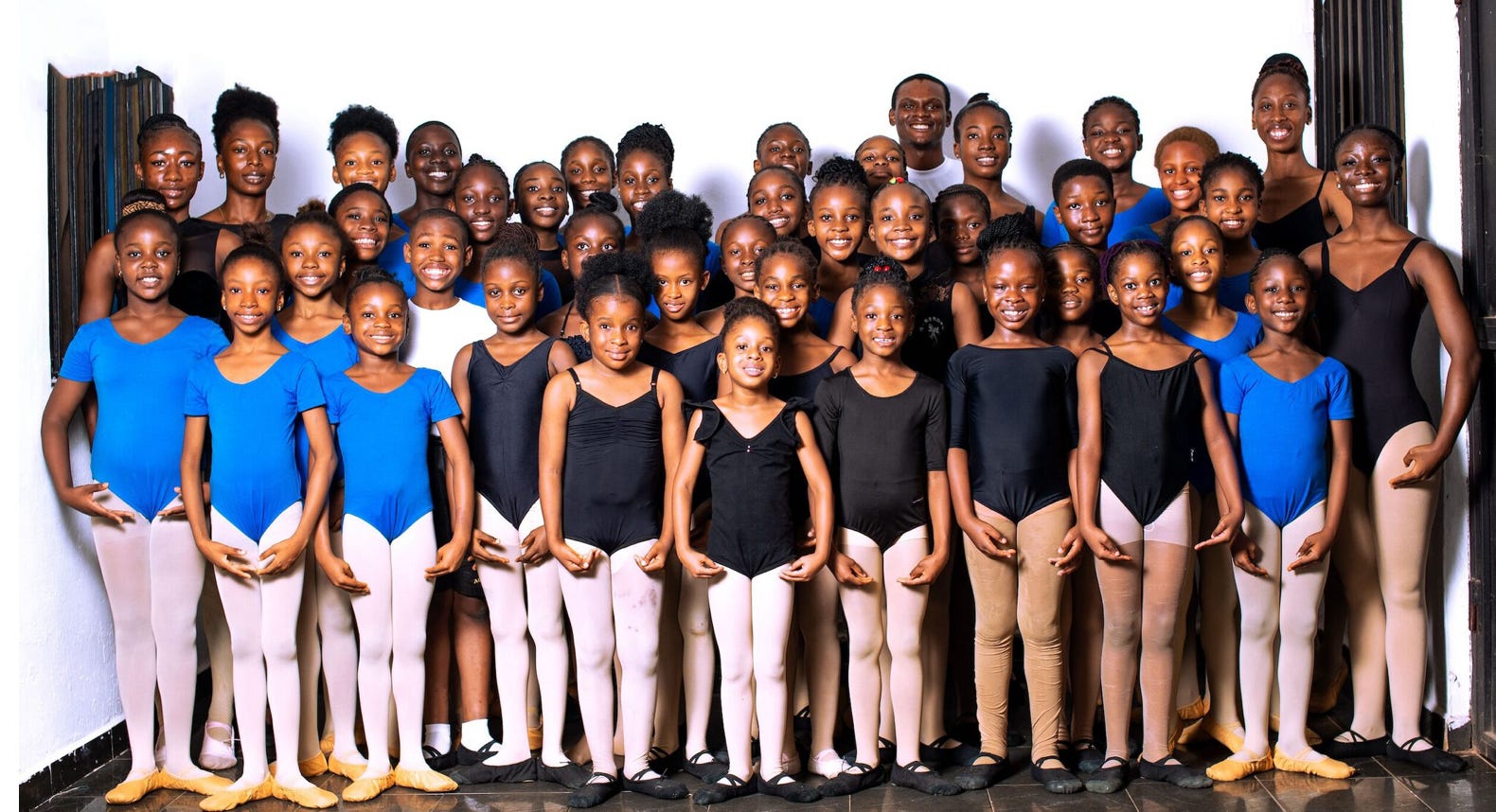
Feature on a Nigerian ballet school:
Ayomi Tsalu’s love for dance all began with the 2001 film Save the Last Dance. The movie was Tsalu’s first introduction to classical ballet at age 12, and he was hooked—dreaming of one day studying dance but having no opportunities in his hometown in Nigeria.
Tsalu first stepped into a studio in 2010, when he attended university and discovered the local studio where he would begin his journey as a teacher. The studio’s instructors had little to no formal ballet training, which Tsalu says is common for teachers in Nigeria, and this ignited in him a passion for offering quality ballet instruction to Nigerian students.
Tsalu began Above Ballet Company in 2015, teaching classes around the country and creating cohorts of dancers for performance opportunities, while simultaneously seeking out more extensive training for himself. In 2019, as the founding director and CEO of Nigeria’s Above Ballet Company, Tsalu attained Level 3 certification in the Cuban Methodology of Ballet with Alicia Alonso’s Dance Foundation. In 2022, he began training with the Imperial Society of Teachers of Dancing (ISTD) and attained his diploma in dance and ballet education the following year. In June 2024, Tsalu opened the Above Ballet Company Academy in Lagos, where he trains students through nine grade levels and presents them for ISTD graded examinations. In 2025, he completed American Ballet Theatre’s National Training Curriculum, which qualified him to teach pre-primary to grade 3.
The name “Above Ballet Company” comes from Tsalu’s desire to “be above the standard” and raise the bar of the ballet training that currently exists in Nigeria. “I know that there are a lot of ballet students who are in search of quality ballet training,” he says. “My vision is to bring [professional] ballet training to Nigerian students, trained entirely in the country by a Nigerian.”
We come back to this story first picked up in June last year in BTH 100:
A 26-year-old man who was in the United States on a Green Card has been sentenced for laundering fraud proceeds through an unlicensed money transmitting business, announced Acting U.S. Attorney John G.E. Marck.
Ayobami Omoniyi pleaded guilty Aug. 19, 2024.
U.S. District Judge Andrew S. Hanen has now ordered Omoniyi to serve 32 months in federal prison and pay $202,273.80 in restitution. Not a U.S. citizen, he is expected to be removed from the country following his imprisonment. At the hearing, the court heard additional information that Omoniyi had been committing crimes since arriving in the United States and that he had been a recruiter for the scheme.
In 2021, Omoniyi and others operated an unlicensed money transmitting business that received and transferred funds from business email compromise victims, including a fishing company in Australia. Victims received spoofed emails that appeared to come from legitimate businesses and were tricked into sending payments to accounts conspirators controlled.
As part of his plea, Omoniyi admitted he moved money through multiple bank accounts. The funds originated from fraudsters involved in a business email compromise wire fraud scheme.
Omoniyi also acknowledged receiving victims’ funds and, for a fee, transmitting the fraud proceeds to others.
United States Attorney’s Office
News from Ireland:
Two directors of a criminal gang have been jailed for what was described in court as “a worldwide, highly sophisticated money laundering scheme on a breathtaking scale”.
Elike Francis Ogbuefi, aged 42, from Clonard Road in Crumlin, Dublin was jailed for nine years while his co-accused 32-year-old Steven Silvester from The Paddocks, Morristown in Newbridge, Co Kildare was jailed for seven-and-a-half years.
The men were arrested and charged following a long running investigation by the Garda National Economic Crime Bureau.
Both men had denied the charges but were convicted by a jury following a trial last month.
Over €6 million was stolen and laundered in a variety of scams including romance frauds and smishing schemes and moved through a variety of accounts.
The two men were in charge of supplying and monitoring accounts where the stolen money was deposited. They received repeated requests worldwide for accounts to be used for all types of fraud.
The requests came largely from Nigerian phone numbers and details on Ogbuefi’s phone, which gardaí managed to access, included the type of jobs required, the amounts going through the accounts and specifications as to the type of accounts required.
Ogbuefi gave instructions that the type of account sought had to be in an Irish name, not an African name, to avoid suspicion.
He was the contact for those outside the country and a nine minute instruction video on how to engage in this activity was also found on his phone.