

This week we published the final entry in our read-along of Joe Studwell’s How Africa Works. Hope it has been worth your time if you followed along. I also wrote about a seemingly quiet reversal of a centuries old population pattern going on across Nigeria.
Fingers crossed, the podcast should return next week. In the mean time, enjoy this week’s selection.
Nigerian Media
And they say manufacturing is not thriving in Nigeria:
In a quiet community in Jos, north-central Nigeria, a middle-aged blacksmith uses an axe to scrape a tree branch into the shape of a rifle buttstock. Behind him, two young apprentices pump manual bellows and hammer glowing metal into form. Around the workshop lie iron scraps, unfinished gun parts and crafted stocks, evidence of a traditional craft quietly evolving into an illicit activity.
Bitrus Pam, known locally as Oga, has long forged his craft as a blacksmith. But apart from farm tools, he now often designs and fabricates firearms, a more lucrative but illegal venture that has become an increasing concern in conflict-plagued Nigeria.
In Nigeria, the Defence Industries Corporation of Nigeria (DICON) is statutorily responsible for weapons production, but the law also allows licensed private firms, such as Proforce. Yet, alongside this official and lawful system, a shadow industry has taken root. Illegal networks, drawing on traditional blacksmithing skills and modern electric welding, are producing arms beyond regulatory control.
[…]
“In Kwan Pan LGA of Plateau State, we uncovered a blacksmith who once specialised in crafting farming tools but later turned to producing firearms without a license,” said a military source who asked to remain anonymous because he had no clearance to speak on the issue.
He said recent arrests in Plateau State suggest a broader trend: “Electric welders are increasingly shifting into clandestine weapons fabrication, selling their work to criminal networks. Also, among the suspects we have arrested are graduates of technical schools where they learn electric welding and are now applying it illegally.”
Investigators say materials are sourced from everyday markets.
“They use metals, iron water pipes, gas cylinders and welding equipment, most of it purchased where building materials are sold,” another military officer said, adding that in some cases, gunsmiths repurpose motorcycle exhaust springs to assemble pistols. “Some construct weapons from scratch, while others adapt original components, such as the skeletal frame of a foreign-made AK-47, modifying it into a new firearm.”
A very confusing story. It’s not clear why the “youths” carried out the abduction other than that it was an opportunity too easy to pass up to make some money?
A mortuary attendant at NKST Hospital located at Jato Aka, headquarters of Kwande Local Government of Benue State, MT Tiga, was on Thursday abducted by thugs who wanted to prevent a planned mass burial for the victims of bandit attack on Tyungu Jam and Mbaav communities.
Saturday PUNCH gathered that the abduction prevented families of the victims from access to the corpses which had been deposited at the mortuary as there was no official to attend to them.
Bandits had invaded Tyungu Jam and Mbaav in Yaav and Mbadura Council wards of Kwande LG on March 5, killing several people and injuring many others.
The State Governor, Hyacinth Alia, described the killings as “senseless and barbaric” in a statement issued by his media aide, Solomon Iorpev, and called on security operatives to apprehend the attackers.
Saturday PUNCH gathered that 11 victims were scheduled for mass burial on Thursday, an event that had drawn people and priests from within and outside the state.
However, the process was disrupted when some thugs allegedly invaded the hospital, abducted the mortuary attendant, and sealed the mortuary, denying families access to the bodies.
[…]
When contacted, Chairman of Kwande LG, Neji Terhile, said those mobilising for the mass burial did not consider the volatility of the area.
He added that some victims had already been buried.
“You are aware that these people slept in their houses and were attacked by Fulanis. Mobilizing a mass burial in such a community is a death trap,” the chairman said.
A rant of an article about the menace of Yahoo boys and what they are doing to young girls:
Every money these boys make is almost wasted on girls, booze, hair plaiting and maintenance, and looking dope like yankees; nothing meaningful. However, the police will not allow them to enjoy the stolen money. It’s like by their appearance yee shall know them – once you are a boy with ear and nose rings, plaited hair, no belt and bogus attire, the police come unto you. Most often, we see them being pushed into police vehicles after their phones and bodies were searched. They are released after they settle. How do we move forward like this?
Now, they are not only taking over our girls but communities. Once they blow, they rent rooms in virgin areas in the cities. The place becomes their ‘hideouts’. Greedy landlords now use the opportunity to jack up house rents, making rents very exorbitant for the common man. And, of course, the young girls flock around them like vultures. They actually serve as live-in lovers. They are not ashamed of street fights. So disrespectful. So spoiled. We are losing these girls, honestly. With them in any community, there’s always a party. Whatever they’re celebrating is unknown to other community members. But you can’t be unaffected by the heavy sounds from the speakers. It gets worse if you despise the lyrics of the music. It’s possible for you to absent-mindedly spend more than two minutes listening to ‘Omblee, Omblee, Omblee’. Whatever that means. After partying, the area is left littered with disposable cups, pure water satchets, and bottle water containers. Indeed, these boys are becoming a nuisance to society.
It will shock you to know that boys in secondary schools are now also into Yahoo business. It’s no longer for jobless people. At a CBT Centre recently, after filling out his JAMB form, a boy ran back to the coordinator and begged him to allow him to make changes in his form. Guess what? The boy said he mistakenly put his Yahoo Yahoo email instead of the one he uses for school purposes. This is the level of moral decadence amongst the youth.
New police campaign just dropped:
As part of effort to wage war against cybercrime, the Ogun State Police Command, has launched the Nigeria Police Force-National Cybercrime Centre (NPF-NCCC), tagged “Real Odogwu No Dey Hide Face”.
The move is to safeguard the digital cyber space, an initiative of the Inspector General of Police, IGP Olatunji Disu.
The IGP, in a statement signed by the Police Public Relations Officer, DSP Oluseyi Babaseyi, was represented at the introduction by the Director NPF-NCCC, CP Ifeanyi Uche Henry.
He said that the Real Odogwu No Dey Hide Face campaign is being introduced across the Commands, to address the borderless nature of cyber threats, including Identity Theft, Romance Scams, Phishing, Business Email Compromise(BEC), among others.
A truly funny story from Anambra:
Nnewi-based native doctor, Ikechukwu John Paul, popularly known as Aka Mmuo has pleaded with the Anambra State Governor, Charles Soludo for pardon.
DAILY POST reports that following his arrest, the native doctor was on Friday taken by operatives of Agunechemba to the river where he allegedly performs rituals.
He was accused of performing rituals, including bathing internet fraudsters, Yahoo Boys to scam their victims.
Speaking after he was paraded by the local security operatives, Aka Mmuo begged the governor for forgiveness, stating that he will not indulge in such activities again.
He said, “I want to plead with our able governor, Professor Charles Soludo and all citizens of Anambra State. I didn’t know how the law works.
“I will never go to the River to make sacrifices again. I’m pleading with the governor and the Anambra government that there is a means of forgiveness, they should forgive me. I will never do it again”.
The decade old menace of tuta absoluta may finally be over?
Tomato farmers in parts of northern Nigeria are reporting improved pest control and higher yields following the introduction of a new pest management initiative designed to tackle the destructive Tuta absoluta pest that has devastated tomato production in recent years.
The initiative is being implemented by the National Horticultural Research Institute (NIHORT) under the coordination of the Agricultural Research Council of Nigeria and the Federal Ministry of Agriculture and Food Security.
The programme is being carried out in collaboration with international partners, including Razbio UK and the Federal University of Lavras in Brazil.
According to the lead researcher on the project, Dr Oke Abiola, the programme is funded by Innovate UK Business Connect and is aimed at strengthening Nigeria’s food security by protecting tomato production across the value chain.
Abiola explained that the invasive pest, Tuta absoluta—locally known as “Sharon”—has remained a major threat to tomato farms since it first appeared in Nigeria in 2015, causing severe losses for farmers across the country.
To address the problem, NIHORT developed an indigenous Integrated Pest Management (IPM) package designed to control the pest while reducing farmers’ reliance on chemical pesticides.
The package includes two patented bio-pesticides—NIHORT-Lyptol and NIHORT-Raktin—solar-powered Tuta trap trays and an improved tomato seed variety known as HORTITOM 1.
Non-Nigerian Media
Ije Nwokorie is the only black boss of a FTSE 250 company:
Nwokorie joined the board as a non-executive around the time of the IPO, became chief brand officer and then chief executive. He is the only black chief executive on the FTSE 250.
Before there is time to ask whether Dr Martens might have been better off listed in New York, he answers the question pre-emptively. “People ask if we want to list in America. We’re in Britain. Why would we not big-up our own markets?”
He continues: “I don’t find any limitations on growing this business because we’re listed on the British stock exchange. When I look at the reality of where we are and where we need to go, there’s nothing broken here.”
Nwokorie finds the broader national pessimism towards business baffling. “Why are we in Britain not more excited about the companies that we have?” he asks. “The default position is cynicism as opposed to optimism.”
The waitress interrupts with the first dishes: green plantain chips (his wife’s favourite), aubergine sauce, crispy onions, rice cakes with black-eyed bean hummus, and both prawn and short-rib akara fritters.
Nwokorie, 55, was born in the United States and grew up in Nigeria. He studied architecture at Columbia University in New York before moving to London to follow his then-girlfriend, who had relocated for work. He expected it to be a short stint, but it turned into a permanent move — and a marriage.
“The mythology of Britain in my family wasn’t positive,” he says. His father had spent time in London after getting stuck there during the Nigerian civil war. “He [was in a] bedsit in Cricklewood putting a 5p coin in the heater every two hours. He was freezing himself to death. Growing up my dad never said anything positive about London.”
Big report on the children who have been taught to fight in Nigeria’s north east:
Yusuf is 15 years old. He is small for his age. His shoulders are narrow and his voice has yet to fully break. But all across his body there are scars. A deep gouge on his shin where he was struck by a piece of burning shrapnel. Another above his right hip where a bullet entered and remains lodged to the day. Marks that will forever remind him of the years he spent serving in Isis’s army of child soldiers.
One night a decade ago, a group of men arrived on motorcycles at his village in Nigeria and abducted him. They carried him off to their stronghold in the bush where they spent the next few years filling his mind with extremist doctrine and training him how to kill. By the time he was ten years old, he was regularly involved in raids against the Nigerian army and skirmishes with rival jihadi groups.
Now, after five years of relentless fighting, he considers himself an experienced soldier. “I should be the one training them,” he said with a smirk when asked what it was like for him to fight against trained military professionals. He may well be right.
The men who kidnapped and groomed Yusuf, whose name has changed to protect him from reprisals, belonged to Islamic State West Africa Province (ISWAP), which since Isis’s defeat in Syria in 2019 has emerged as the pre-eminent branch within the group’s global network and the torchbearer for its ambitions of re-establishing an Islamic caliphate.
Headquartered on the shifting islands of Lake Chad in Nigeria’s northeastern borderlands, ISWAP is estimated to comprise more than 10,000 fighters, making it by far the largest of any of the group’s provinces.
That the group could have expanded to such a size is more remarkable for the fact that unlike other Isis provinces, such as those in the Middle East and East Africa, almost none of its members are foreign nationals, due to the remoteness of its location. Instead, ISWAP recruitment relies heavily on a programme of mass abductions and forcible conscription. And like Yusuf, many of those who are abducted are children.
Tech Bros in Lagos be doing too much:
Tunde, determined to impress, once planned a “tech-forward” romantic gesture. He hired a drone to deliver grilled skewers of suya to my balcony because “flowers are too analog.” The drone misread the GPS, crashed into the neighbor’s laundry line and scattered spicy beef across their freshly washed bedsheets. The ensuing shouting match involved three households and one irate landlord waving a broom like a machete.
I laughed until my ribs hurt. Tunde called it “an unexpected product pivot.”
Later, over drinks, he asked if I thought we were “scalable.” I told him love isn’t a start-up. He countered that neither is Lagos, which has an established tech industry. Yet here we are.
A month later Tunde came with me to a cousin’s wedding in Ibadan — a high-stakes mission, as weddings are where aunties sharpen their matchmaking claws. He survived the onslaught of “When is your own wedding?” questions with a polite smile and several small bottles of stout.
During the after-party, as Fuji music vibrated the ground, he whispered, “Your family is like a lively app — no off button.”
I almost kissed him then, swept up by the absurd tenderness of the moment. But my mother appeared, armed with more questions about our future plans, and the spell broke.
The race to save Pangolins and other wildlife in Nigeria and Africa:
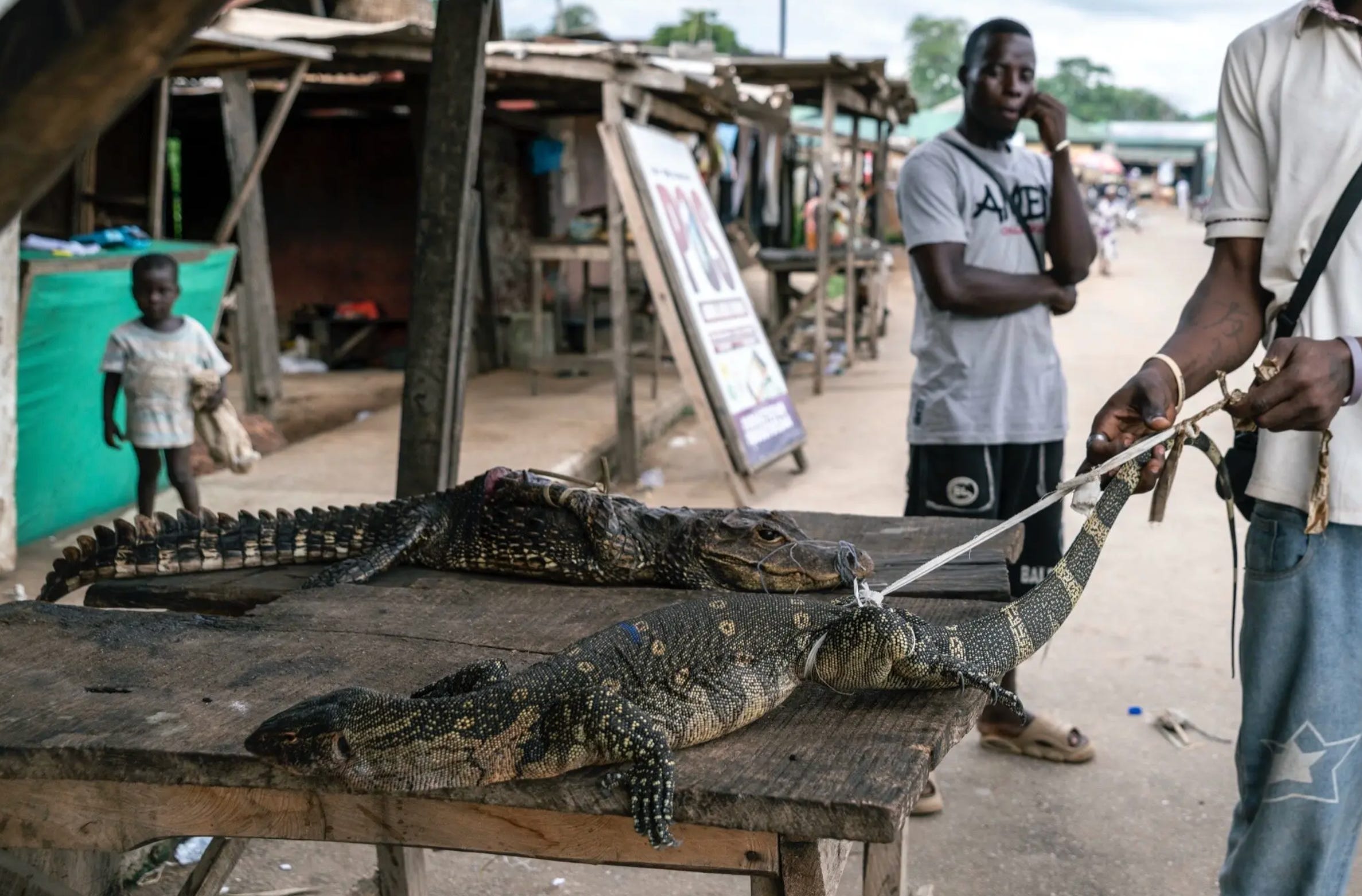
Last year, I traveled to Nigeria to report on the trafficking of apes out of Africa — a growing problem, driven in recent years by social media videos of chimpanzees and gorillas being kept as pets. While there, I learned about Bili, a baby gorilla who narrowly avoided such a fate. But the selling of chimps, gorillas and bonobos makes up only a small portion of the illegal wildlife business. These images, captured by the Congolese photojournalist Arlette Bashizi, show the breadth of the trade in Nigeria, as well as the efforts to police it.
Above, staff members at the Nigeria Customs Service’s storage facility in Lagos, Nigeria, weigh bags of pangolin scales seized by officers from the agency’s Special Wildlife Office. In one of the largest such seizures, officials intercepted 196 bags filled with scales, possibly representing as many as 38,000 pangolins, which are also known as scaly anteaters. A major factor behind the demand for wildlife products is an array of beliefs about their medicinal powers: The perceived health benefits of rhino horn, for instance, made it more valuable than gold a decade ago, fetching around $30,000 per pound at its peak. Pangolin scales, in traditional Asian medicine, are believed to have the power to treat a variety of ills, from abscesses to cancer.
Some 350 miles to the east, in Calabar, officers from the Nigeria Customs Service lay out animal parts seized from traffickers near the border with Cameroon. The crossing there is part of a route often used by animal traffickers to bring illicit wildlife products and live animals from Cameroon and other African countries into Nigeria, where they are then smuggled to other parts of the world. Last March, customs officers arrested a person entering Nigeria from Cameroon with parrot heads, packs of parrot feathers, heads of African hornbills and chimpanzee parts including hands, feet and heads.
Princess of Wales will play a major role in next week’s state visit:
The Princess of Wales is set to play a major role in the upcoming Nigerian state visit, Buckingham Palace has revealed. Between 18 and 19 March, the President of Nigeria, Mr Bola Ahmed Tinubu and his wife, First Lady Oluremi Tinubu, will make their way to Britain at the invitation of King Charles and Queen Camilla.
In a sign of their ever-growing influence within the royal family, however, it is Prince William and Catherine who will be the first Windsors to welcome the couple ahead of a dazzling state banquet.
The President and First Lady are scheduled to arrive at London Stansted Airport on the afternoon of 17 March. There, the couple will be greeted by Mark Bevan, Deputy Lieutenant of Essex, on behalf of the King, as well as Ambassador Mohammed Maidugu, the Acting High Commissioner of the Nigerian High Commission.
The following morning, the Prince and Princess of Wales will officially welcome the President and First Lady at the Fairmont Hotel Windsor. Their Royal Highnesses will accompany the couple to Datchet Road in Windsor, where they will receive a Ceremonial Welcome before a formal welcome from the King and Queen at the Royal Dias. A Royal Salute will be fired at Windsor Home Park and the Tower of London, ahead of a Salute from The Sovereign’s Escort and the playing of the Nigerian national anthem.
News from Kano:
As the son of Ayatollah Ali Khamenei takes over as Iran’s supreme leader after the assassination of his father in a United States-Israeli attack, hundreds of mourners gathered in a mosque far away from the war in the Middle East to grieve the late leader.
The adherents in northern Nigeria’s Kano State solemnly chanted prayers. At one point during the recitations, the voice of the religious leader that carried over the microphone to all corners of the hall, cracked with grief. Among the crowd, one young man wiped his eyes.
On Sunday, Iran named Mojtaba Khamenei as his father’s replacement. In Kano, the community sees it as a move ensuring the “continuation of his father’s resistance”. The assassination of the elder Khamenei last week in an air strike has stirred deep emotions among Nigeria’s minority Muslim Shia, a group that sees its faith and identity intertwined with that of the larger Shia community in Iran.
For 60-year-old academic Dauda Nalado, the elder Khamenei’s killing was not merely another event in foreign politics; it was the silencing of a revered spiritual teacher.
“Ayatollah Ali Khamenei is not only a leader of the Shiite community or even Muslims alone. He is regarded as a leader of oppressed people across the world,” the university professor told Al Jazeera. “If you look at Iran’s involvement in issues concerning Gaza and Palestine, you will understand why many people admire his leadership.”
We’ve covered this company on BTH in the past:
Shares in Chariot Resources soared as much as 55 per cent to a high of 15 cents in early trade after the government approved the transfer of six licences into a joint venture with local partners, clearing a significant regulatory hurdle for its Nigerian lithium portfolio.
The approvals cover four exploration licences and two small-scale mining leases previously held by Continental Lithium, which will now be incorporated into a new company called C&C Minerals.
The company says that only routine administrative steps now remain to finalise the transfers, which will allow Chariot and its partner to move straight into active field programs at the projects.
Chariot will hold 66.66 per cent of C&C Minerals, with local partners Continental Lithium retaining a 33.33 per cent stake.
Chariot says it will now move swiftly to systematically validate drill targets in the field so it can get the rods turning across the largely undrilled ground as soon as possible.
The company says the ground already carries a documented history of artisanal production and represents the first time an ASX-listed pure-play lithium company will ever drill for lithium in Nigeria.
The joint venture’s 254-square-kilometre portfolio spans four project clusters dubbed Fonlo, Gbugbu, Iganna and Saki in the Nigerian states of Oyo and Kwara.
One of those stories forever seared in my memory. It happened a few years before I moved to the UK but the investigation was still a big topic when I got here. I recall the Met Police spent something like £6m on the investigation at the time:
The longest unsolved child murder case in modern UK history could still be answered because ‘someone out there knows what happened’, a retired detective has said.
‘Adam’ was a name given by Scotland Yard to a young boy whose dismembered body was discovered floating in the River Thames in London on September 21, 2001.
The child’s identity remains unknown 25 years later with no one ever charged despite an investigation that took police to South Africa, Holland, Germany and Nigeria.
Adam, who is thought to have been a Nigerian boy aged five or six, is believed to have been trafficked to the UK via Germany then murdered in a ritualistic killing.
His body, which had the head and limbs severed, was discovered near the Globe Theatre and numerous high-profile appeals followed, including by then President of South Africa Nelson Mandela.
Now, a new Channel 5 documentary called ‘The Body in The River’ which aired last night has re-examined the heartbreaking and disturbing story of Adam.
Despite a series of people being arrested, there has never been a charge over his murder - but police still believe the evidence they need is somewhere in London.
Andy Baker, a former Metropolitan Police commander who worked on the investigation, has told the programme that the case could still be solved.
Oxtail and jollof are now available in Oakland:
At 9jaGrills, a newish Nigerian spot near Oakland’s Jack London waterfront, the main dining room follows the standard blueprint for today’s shiny, Instagram-optimized restaurants: the lush faux greenery wall, the neon-lit catchphrase (“Food 🔥, Drinks & Vibes”) in glowing pink cursive. The space is tidy, bright and perfectly pleasant — but, at 10 o’clock on a recent Friday night, it was also totally empty.
Instead, a couple dozen people had crowded out on the small tented patio in back, which was a distinct ecosystem unto itself: a haze of hookah smoke, disco lights, cheap furniture and mystery drinks in red plastic cups. On the big-screen TV, two identical twin DJs from Nigeria spun Afrobeats on stage in Lagos. Everyone else on the patio appeared to be West African, and apart from one table of middle-aged gentlemen dipping fufu into a big bowl of stew, no one else seemed to have come for the food at this hour.
It was more of a backyard party vibe. A kick back with a couple of cold Trophy Lagers vibe.
Not that we were going to let that deter us from our mission. We had made the trip because we had a wicked craving for oxtails, and we’d heard on good authority that this food-truck-turned-brick-and-mortar-lounge was the spot in Oakland for Nigerian-style oxtails and jollof rice — and maybe the only spot where you can reliably score those dishes until midnight on the weekend.