

There is no need to reach for a map if the name Akoko means nothing to you. It is enough to know that it is a cluster of more than forty towns and villages in what is now Ondo State, in south-west Nigeria. It rarely features in the Nigerian press, let alone beyond the country's borders - and when it does, it is almost always for a specific set of reasons.
At the end of February this year, Vanguard carried a story about communities in the area being cut off by infrastructure neglect - poor rural roads, the report claimed, leave many settlements isolated from major markets and economic opportunities. That same month, several papers covered the commissioning of the Aiyegunle–Iwaro Oka Road in Oka-Akoko. BusinessDay noted that the governor acknowledged persistent demands for intervention in the Akoko axis; THISDAY reported him describing the road as critical for moving agricultural produce, while the Olubaka of Oka observed that successive administrations had started and abandoned it before this one saw it through.
In June 2025, the Ondo governor flagged off the dualisation of the Akungba–Ikare Road. Tribune quoted him describing the corridor as a lifeline for Ondo North, framing the existing road as narrow, congested, and prone to fatal accidents. Two months later, residents of Ogbagi-Akoko protested over the Ikare–Ogbagi–Irun Akoko–Ado-Ekiti Road. BusinessDay reported that protesters described the 40.2-kilometre stretch as abandoned, in total disrepair, and unmotorable; TVC News said residents called it a daily nightmare, and quoted the Federal Controller of Works acknowledging that only eight kilometres had been completed so far. In August 2024, Leadership reported that the governor had ordered the rehabilitation of an alternative road into AAUA after the main entrance became unsafe following repeated fatal crashes - the story tied the danger explicitly to the road’s topography and the need to divert heavy vehicles. Then, after another deadly crash in October 2025, Arise reported that the governor ordered the restoration of damaged barricades and access ramps along the Ikare–Akungba highway. Finally, in April 2024, Nigerian Tribune reported that residents of Arigidi Akoko and Iye-Akoko said the major road to Iye-Akoko had deteriorated so badly that their only link to neighbouring communities was effectively severed. Most were farmers, the report noted, and the road’s condition was preventing them from moving produce to Ikare-Akoko and other urban markets; after rain, even motorcycles struggled to pass.
Run for the hills
In a 2018 paper titled Nupe Hegemony in Akokoland in the Nineteenth Century: A Study in Local Imperialism in Pre-Colonial Nigeria, 1845-1897, the authors - Johnson Aremu and Sola Oniye - describe how people in Ikare reacted to constant raids by the Nupe. Here is a section:
A common axiom says that if there is war in any area, there must be unrest and all social activities must be grounded to a halt. Akoko was not an exception in the 19th century. The 19th century invasions, most especially the Nupe imperialism, had demographic impact on the Akoko people. During the period, a significant number of Akoko people shifted from one place to another. While the unconquered Oka Akoko possibly fluctuated in population according to the degree of security which prevailed in the surrounding countryside, other Akoko towns and villages such as Afa-Etioro almost went into extinction due to incessant raids. Due to the Nupe invasions in Akoko, an appreciable number of people went into exile. For instance, some of the Ikare people went into hiding in places like Owa-Ale’s hill. The hill served as a safe abode for the people during the period. […] The abandonment of traditional village sites and the dispersion of the villagers were reactions of people unable to defend themselves more effectively. Many villages probably remained dispersed until the Royal Niger Company troops had restrained their Nupe imperialist.
It is an argument I have often made that the dispersal of people across Nigeria is one of the more visible legacies of slavery still hiding in plain sight. Slave raiding and nineteenth-century warfare made defensibility, not convenience, the organising principle of settlement across large parts of what is now the country. Travel through Nigeria and the pattern becomes unmistakable.
Much is made of colonialism and its legacy in Nigeria, yet it is slavery's imprint that stares you in the face as the force behind some of the country's hardest challenges today. As I have written before, this is a problem to be solved - not merely a fact of life to be accepted.

This ought to make intuitive sense: the whole of colonialism lasted well under a century, whereas slavery was a fact of life for at least four hundred years. There are many examples beyond Akoko. Joint Nupe-Ilorin slave raids and tribute exactions drove Yagba people out of their towns and into inaccessible hills, and pushed others into Ilorin itself. Kabba's local memory adds vivid detail that people fled to Obangogo hill, smeared shea butter on the rock face so attackers could not climb, and rolled boulders down on those who tried. A detailed history of pre-colonial Eggonland records that Fulani slave raiding in the nineteenth century was so intense that most Eggon people abandoned the plains for the safety of the hills. Those who remained on lower ground hid in forests, placed settlements behind thorn bushes and trenches, posted sentries on rocks and tall trees, and used buffalo horns to warn of approaching raiders.
A 2015 archaeological investigation of abandoned Zangang hilltop settlements in southern Kaduna found caves and rock shelters, house and granary foundations, shrines, and potsherds. The study notes that oral tradition consistently explains the retreat to the hills as a security response to slave-raiding expeditions, followed only later by movement back down onto the plains. Scholarship on the Mandara region tells a similar story - the mountains served as refuge from slave raids, with raiding states on the plains driving people steadily upward. UNESCO documentation records that Sukur itself was raided and devastated between 1912 and 1922, and later research notes that significant movement down from Upper Sukur to the plains began only after slave raiding ended in the 1920s.
The point should by now be clear. If people once had reason to scatter themselves across difficult terrain as a defence against slave raiding, it will be far more difficult - and costly - to deliver infrastructure to them today if they remain in those places. Akoko's modern infrastructural challenges can be read in this light. My argument has always been that Nigeria needs to physically build its way out of slavery's legacy: constructing new towns and cities on easier terrain, consolidating them into larger urban areas, and then persuading people to move there - on the straightforward grounds that slavery is over, it is not coming back, and there is no longer any reason to hide in the hills.
Be careful what you wish for
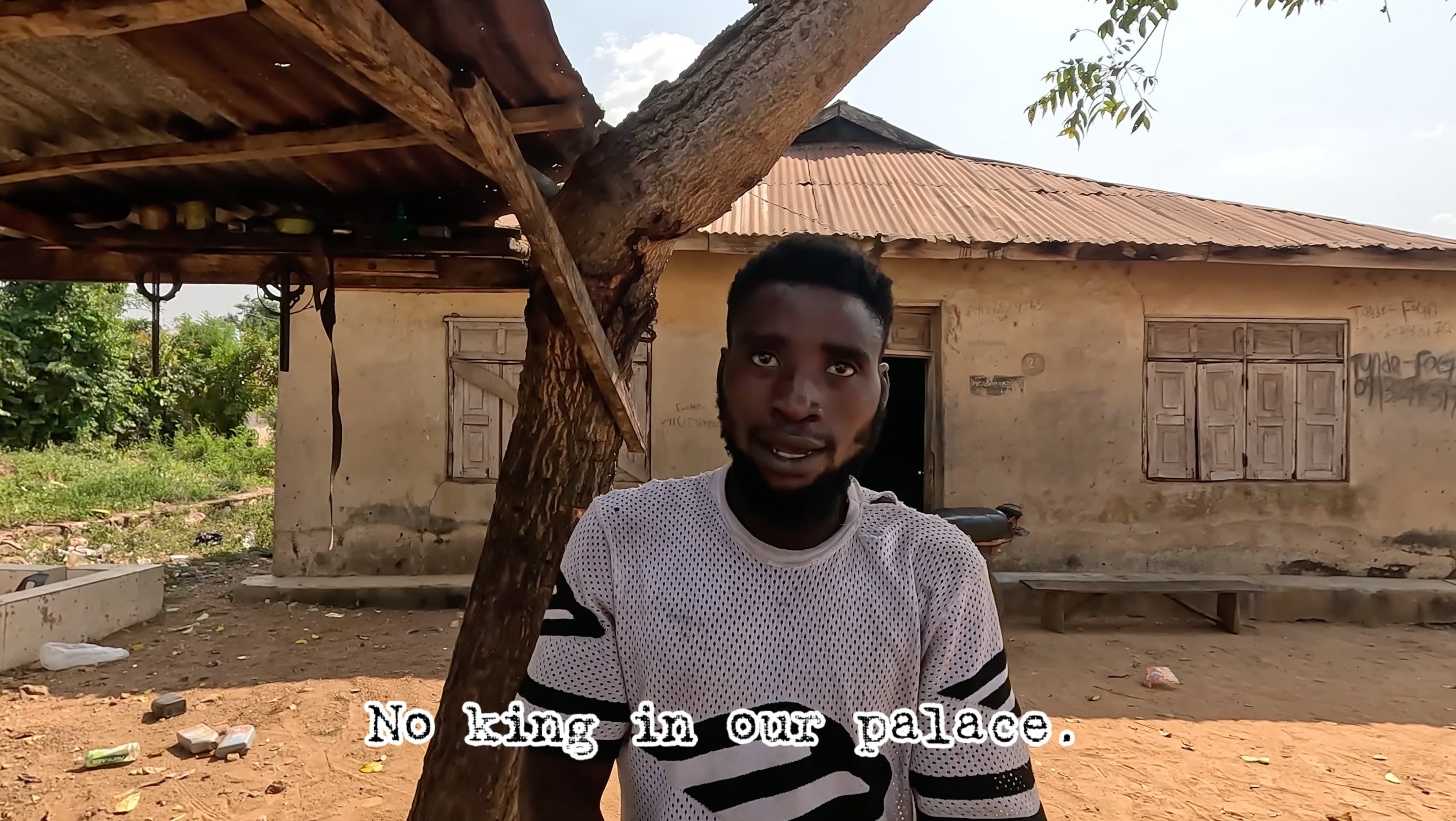
What prompted this post was coming across the YouTube channel of a young man called Olaoluwa Ojeleye. He visits towns, mainly in south-western Nigeria, and documents what he finds, largely unfiltered. In one video, he visits a town called Faji in Osun State, and it has the unmistakable feel of a ghost town - abandoned schools, empty houses, even the “palace” seemingly deserted. There are dilapidated buildings everywhere. The town’s mobile network is poor and the only place where he seems to run into a number of people is because that is the spot where the network is good and so people congregated there.
The situation is not much different in another town called Okua, save that the “king” has apparently migrated abroad to work. One man tells him that farmers have been discouraged by the downturn in cocoa prices, though he concedes that lower food prices are good for consumers. He asks for government help with mechanised farming - the manual kind is simply too hard, he says, and people end up in hospital doing it. Another man tells him they have no electricity or roads, and that the last time they felt any government presence was when Olagunsoye Oyinlola - who happened to be from the area - was governor. You may recall that Oyinlola served as Osun governor from 2003 to 2011. Once elections are over, the man says, politicians dump them like a bad habit. Much as I sympathise with their plight, I can’t shake off the nagging question in my head - what is the point in delivering infrastructure to places that have been depopulated?
There are several other videos on his channel, and after watching a number of them, the same story emerges: towns across the south-west are being steadily depopulated. What goes unspoken is that anyone with any sort of agency has left for a bigger town or Lagos, Nigeria's economic capital.
But the spectre that truly haunts these places is insecurity. Slave raiding was its own form of insecurity, and isolation once made sense - the better to be hard to reach than to be carted off as a slave. Today's insecurity is of a different kind: bandits who rob, kidnap, or kill, and in some places religiously fuelled violence. In this latest iteration of Nigeria's longest-running story, isolation no longer offers protection. There is strength in numbers, and so the logic now runs the other way - flee to a bigger town.
Plenty of news reports corroborate what Mr Ojeleye is seeing on his travels. A broader regional piece in The Guardian in May 2025 offered a good overview, describing a silent reign of terror across the interiors of Ondo, Ekiti, Osun, Ogun, and Oyo - farmers and investors shutting down farms, activity in parts of the region falling sharply under the weight of killings and fear. For Osun specifically, Punch reported in January 2024 that many residents of Ifon and Ilobu fled their homes after renewed clashes. When violence escalated again in March 2025, the Osun government imposed a twenty-four-hour curfew and extended it to Erin-Osun; Punch then reported that displaced residents fled to Okinni, Osogbo, and Ido Osun, while Vanguard described the three towns as appearing deserted, with only a few people peeping through windows. AIT used similar language - streets deserted, residents displaced.
This phenomenon is of course not confined to the south west. Reuters has described villagers fleeing attacks in Niger State, farmers abandoning land after repeated raids, and the depopulation of rural areas in Borno after prolonged conflict.
Full circle
I seem to be getting my wish - though this is, of course, not how I wanted it to happen. I have no desire to make excuses for Nigerian leaders and officials, who can do far more than they currently even attempt. But as we have seen with Akoko in particular, even with the best will in the world, delivering public services to remote and forbidding terrain that was chosen precisely because it was hard to reach is a very difficult task. And it is not clear that it makes any sense to do it anyway.
But as with everything else, there are no shortcuts. While denser urban areas may be far more efficient for public service delivery, they bring their own formidable challenges. As Lagos and other large Nigerian cities have shown, without serious thought and sustained effort, rapid urbanisation outruns service delivery and whole cities slide into slums.
Yet there is, without doubt, an opportunity buried in the harrowing insecurity that is forcing people across the country to unpick, at great cost, the long-run legacy of slavery. Four centuries of dispersal are being reversed - painfully, chaotically, and with no guiding hand. Whether that opportunity can be contemplated, let alone grasped, is of course another matter entirely. But the movement is already under way, and it will not wait for Nigeria’s leaders to catch up.
I admire your mind a lot. Looking beyond the obvious and unearthing historical drivers of today’s challenges - slavery, insecurity and infrastructural deficits nicely tied together in this piece.
This is a very thoughtful perspective, especially the historical context of how people fled to inaccessible areas due to conflicts, and how that is now a disadvantage in the current geopolitical context. Thanks for taking the time to put this piece together!