

I published the introductory chapter of the new book project I’m attempting to write in public. I hope you will come along for the ride. At least one chapter a month (chapter 1 should be out first week in February). Subscription required.

And earlier this morning, my quick take on the SEC’s new regulatory “sakula” went out.
This week’s edition is slightly abridged (no Nigerian media section) due to travel commitments.
Enjoy this week’s selection and see you next week
Non-Nigerian Media
I’m still speechless at this fire and its aftermath:
A Scottish priest has lost three brothers in a tower block fire in Nigeria that is believed to have killed a dozen people.
Father William Omatu, assistant priest at Our Lady of Lourdes in Cardonald, lost siblings Stephen, Casmir and Collins in the fire on Christmas Eve.
The fire at the 25-storey Great Nigeria Insurance House building on Lagos Island killed 12 people, according to local media.
The National Emergency Management Agency (NEMA) was deployed by the federal government in Nigeria to clear the debris following the fire.
Four bodies were recovered from beneath the rubble and have been handed over to health authorities for formal identification.
A funeral for the three brothers was held in Ihiala in the Anambra State, on Wednesday.
Our Lady of Lourdes said on Facebook: “Thoughts and prayers with Fr William and his family this morning at this very difficult and sorrowful time.
“The funeral Mass for Fr William’s brothers, Stephen, Casmir and Collins will take place in their home parish in Lagos at 10am Nigerian time (9am in the UK).
Houston Rockets celebrated Nigerian Heritage night at a recent game:
The Houston Rockets celebrated Nigerian Heritage Night against the Oklahoma City Thunder on Thursday night at Toyota Center. Playing against the defending NBA champions always means a lot, but it coming on Nigerian Heritage Night made it extra special for Rockets coach Ime Udoka, who played for the Nigerian national team.
Udoka was born in Portland, but his father Vitalis came to Oregon from Nigeria to attend Portland State.
“For me, obviously growing up with a Nigerian father and playing with the national team and kind of growing up in a household with some culture, it’s who I am, my background and everything I’m about and proud of,” Udoka said before the game. “Great to be in Houston, they call it ‘Little Lagos’ here, and the (Nigerian) population, obviously, is very high here, and a lot of places I go I’m welcomed with that. So, we’d like to go out and try to put on a good show tonight for the crowd, and for the Nigerians in particular.”
Aside from Udoka — who played for Nigeria in the 2005 FIBA African Championships, the 2006 FIBA World Championships and in AfroBasket 2011 — the Rockets also start Josh Okogie, who was born in Lagos, Nigeria.
Hakeem Olajuwon, the Rockets’ Pro Basketball Hall of Famer who was raised in Lagos, also was sitting courtside.
Lots of reporting still coming through on the December US airstrikes in Nigeria:
Three weeks after the U.S. carried out airstrikes in northwestern Nigeria, an unexploded munition from the attack destroyed buildings and injured three civilians 600 miles away, leading locals to question the Trump administration’s narrative about the strikes and whether they even hit militant targets.
On Christmas Day last year, President Donald Trump ordered the launch of at least 16 GPS-guided munitions against alleged terrorist enclaves in Sokoto state, specifically the Bauni forest axis of Tangaza Local Government Area. The Nigerian government, which coordinated with the U.S., told media outlets that the airstrikes involved the deployment of MQ-9 Reaper drones and the U.S. Navy warship USS Paul Ignatius, stationed in the Gulf of Guinea.
According to eyewitnesses in the village of Jabo, Sokoto, debris from unexpended munitions fell on an open field, but no civilian casualties were recorded. However, an unexploded munition also made landfall in Offa, Kwara state, nearly 600 miles away from the target area in Sokoto, where it destroyed several buildings, including a hotel.
“Suddenly we heard a loud noise, and when we looked up, we saw something bright and burning in the sky just like a rocket,” Bello Adewale, the director of Solid Worth Hotel, told Prism. By the time the dust cleared, three members of staff were lying injured amid a rubble of cement bricks and torn ceilings.
“A staff was hit on the head and another was seriously injured. A third staff developed a panic attack and had to be rushed to the hospital,” Adewale added.
Another dispatch from Lagos by Alexis Okeowo:
I’ve heard Lagos described as a tropical-climate version of a city like Moscow, an environment perceived to be so culturally hostile that its inhabitants have to summon great resilience in order to survive. But that’s not quite right: the city may be unwelcoming, but its residents are so hopeful, so trusting that they will realize their Lagosian Dream. In what they trust, I’m not sure—it’s not the federal or local governments, which tax but don’t provide. Nor is it their leaders, who do well personally even as their constituents struggle. Many Lagosians place faith in a higher power, but it may also be a trust in one another, despite the warnings everyone is given from childhood to be suspicious both of strangers and of people you know. When the essential fabric of society has been stretched to its near breaking point, because of the various failures of extractive authorities, it’s impossible to rely only on yourself. Instead, you need family, friends, neighbors, colleagues, and sometimes even strangers to help when you can’t get transportation or child care or medical attention, to pitch in when your area has no water or light.
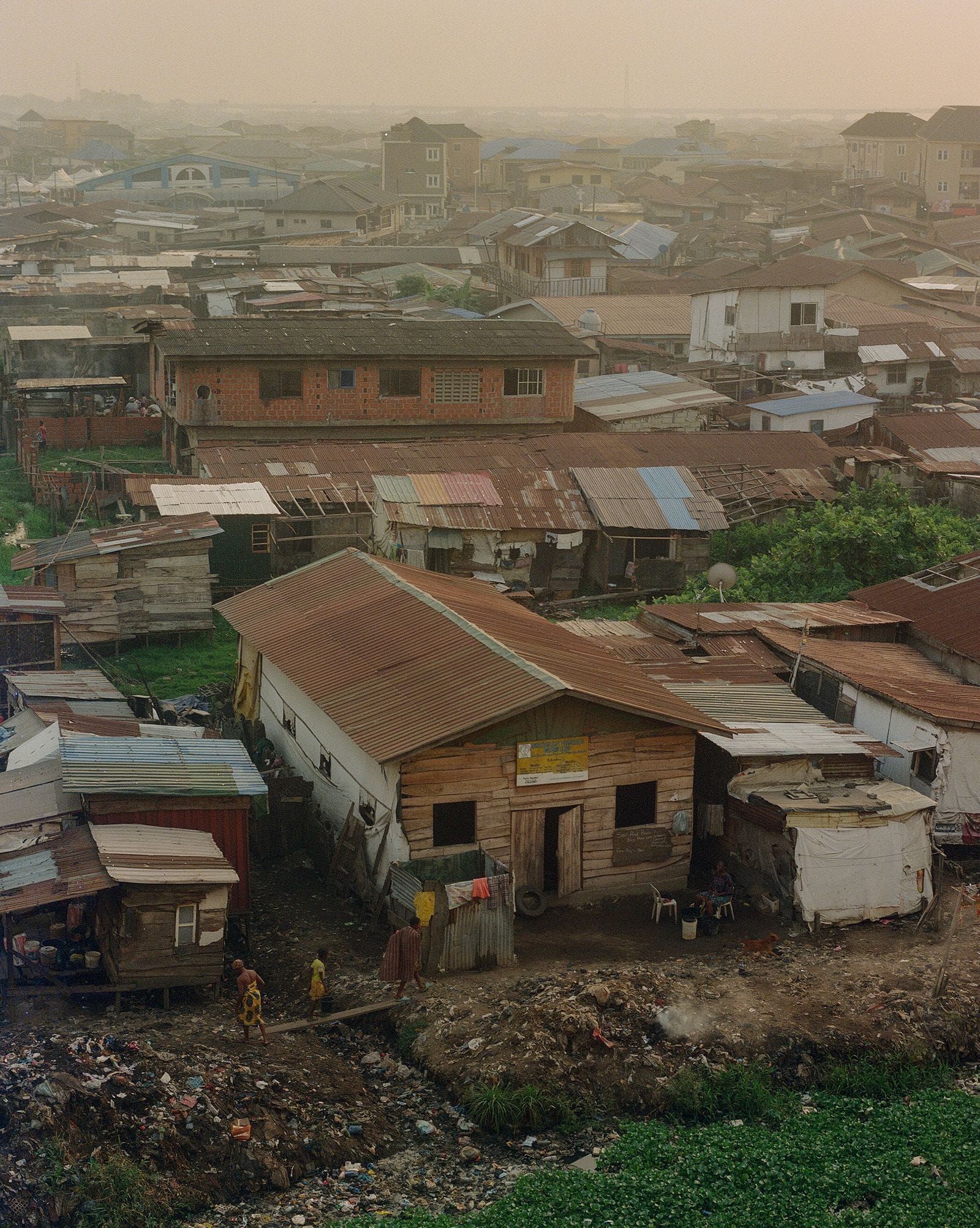
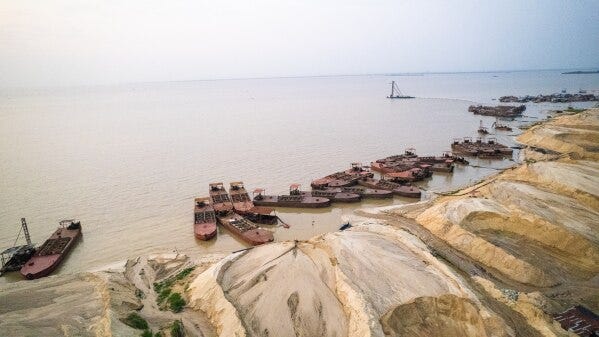
Photo essay on sand dredgers in Lagos. I often tell people this is another reminder of the failure of cement policy in Nigeria but they tell me I’m going too far:
Men in Nigeria lower buckets into the murky water of the Lagos Lagoon and bring up loads of sand, one by one. Going underwater for about 15 seconds at a time, dredgers haul up bucketloads bound for construction sites, reshaping the coastline of Africa’s largest city.
Filling a boat takes about three hours, which is worth about 12,000 naira ($8) to a middleman who supplies larger buyers. Dredgers and local traders say the price of sand, crucial for making concrete, has risen steadily.
The changes to the lagoon are unmistakable. What was once an open stretch of water is increasingly broken up by sandy patches, narrowing channels, and reshaping currents that support thousands of fishermen.
Same story about sand dredging but in a different paper and more prose than photos:
Not far from the bridge, wooden boats are loaded with sand. One of thousands of local dredgers, Akeem Sossu, 34, has been diving for sand for at least three years. He slips beneath the surface for about 15 seconds at a time, hauling up bucketloads bound for construction sites.
Akeem said he and his partner earn about 12,000 naira ($8) each per boatload, selling to a middleman who supplies larger buyers. Filling a boat takes about three hours. Formerly a tailor, he said dredging now supports his household.
“I come out early, sometimes 5 a.m. or 6 a.m., depending on the tide,” he said.
Dredgers and local traders say the price of sand, crucial for making concrete, has risen steadily as development in Lagos has accelerated. A standard 30-ton truckload of what’s known as sharp sand — coarse and gritty — now sells for about 290,000 naira, or roughly $202, reflecting strong demand.
[…]
For some fishermen, dredging has forced an uneasy shift away from the sea. Joshua Monday said he has largely parked his two fishing boats and now works as a mechanic.
He learned how to fix boat engines years ago as a backup.
“If not for this mechanic work, I don’t know how I would survive,” he said.
He said rising costs and shrinking catches have made fishing untenable. Fuel can cost more than 150,000 naira ($104) for a single trip, he said, with no guarantee of a return.
“Sometimes you go to the sea and come back with nothing,” he said. “All the fuel is gone.”
I had never heard of her before reading this article:
Social media influencer Esther Thomas – known as Sunshine – has died, her family has confirmed.
The Nigerian content creator, who had nearly half a million followers across Instagram and Facebook, died suddenly on January 9 after undergoing surgery.
Confirming her passing in a statement shared online, Thomas’s family said: ‘We the family of Esther Thomas (A.K.A. Sunshine) with pain in our heart we regret to announce the sudden demise of our beloved sister and daughter.
‘We are trying to put things in place so we could put her to rest.’
Fellow social media star Chidera Madu shared details of Thomas’s passing.
He explained that she started experiencing stomach pain on December 28, which led to a hospital trip on New Year’s Day.
After a series of scans, Madu claimed that doctors determined Thomas had a fibroid that had ‘grown so big.’
Doctors reportedly recommended surgery to remove the fibroid and while they said that the procedure had been a success, Madu believes Sunshine experienced complications.
Nigeria keeps popping up in stories about oil tankers around Venezuela:
One tanker that had been headed toward Venezuela to load up on crude oil diverted away from the country following the U.S. strikes and is now headed to Nigeria, while another four that were sailing to the Latin American country are now stationary, according to vessel tracking data and Singapore-based marine brokers.
The tanker that is now headed to Nigeria is the Chinese-owned Thousand Sunny, a supertanker that has been moving Venezuelan oil to China over the past five years. It had been on course to Venezuela since mid-December despite President Trump’s declaration of a “complete blockade” on Dec. 16. The other four tankers are run by companies that have been sanctioned by the U.S.
And this one:
Vessels attempt to “mask their identity, conceal their activity … and evade tracking,” according to Ian Massey, head of corporate intelligence at S-RM. “Such techniques range from the use of obfuscated ownership structures, through to regular changes in a ship’s flag of affiliation and the switching off of automatic identification system (AIS) transponders.”
Some vessels also broadcast false signals. One of those seized by the US this week, the M Sophia, was broadcasting a location off Nigeria while it was in the Caribbean.
Economist talks up local players in Nigeria’s oil industry. Not sure I buy it as the problems facing the industry (like the lack of exploration) are beyond them:
Since taking office in 2023 President Bola Tinubu, a former oilman, has tried to improve things in the Delta by beefing up security, streamlining contracting and dangling tax incentives, along with a raft of other reforms designed to lower costs and raise competitiveness. That seems to be paying off. In 2025 Nigeria produced 1.47m barrels of crude oil per day on average, the highest level in five years, according to Rystad, a consultancy. The government hopes to double that to 3m barrels per day by 2030. That would put it in the top ten of global producers, behind Brazil.
The rebound is locally driven. Renaissance Energy, a consortium of mostly local firms, took over Shell’s onshore subsidiary in March. Seplat, another home-grown firm, acquired all onshore and shallow-water licences of ExxonMobil, the largest Western oil major, for $1.3bn in 2024. (In December Heirs Energies, a locally owned firm, became Seplat’s largest shareholder in a deal worth nearly $500m.) Oando, which acquired four onshore blocks from Italy’s ENI last year for $783m, plans to invest $2bn by the end of the decade.
Nigerian oil executives argue that local firms are better placed to take risks. Ahonsi Unuigbe of Petralon Energy, which acquired its first oilfield in 2021, says that smaller firms like his “can be nimble and fast”. Tonye Cole, the co-founder of Sahara Group, a Nigerian conglomerate, reckons locals are better equipped to deal with the communities in the Delta whose consent is crucial for operating there. Decades of oil spills and gas leaks have left it one of the most polluted places on earth. Resentment of foreign firms is widespread.
Security in the Delta has improved. Seplat reports that pipeline losses, largely from theft, rose to between 10-15% of output between 2020 and 2021; since 2022 they have not exceeded 5%. Osa Igiehon, the boss of Heirs Energies, says the oilfield it purchased from Shell, ENI and Total in 2021 was once “the poster-child for the challenges which bedevilled onshore production”. Since then, he says, output has doubled and “third-party action”—such as pipeline sabotage—has ceased.