

Not long ago I had dinner with a bright young man, who had clearly read a lot and had a love of reading. Over the course of the evening he mentioned, almost in passing, that he had come to love books and reading years earlier, as a boy, when a ship docked in Port Harcourt, Nigeria, where he lived, and began handing out free books. His mother did not let the chance go by: she went down and gathered as many as she could carry. That was how he met the Famous Five, Nancy Drew and a good many others he came to love.
The story struck me as incredible. But I made a mental note of it and said nothing further, because I wanted to check it for myself.
Medina
In 1914, with the loss of the Titanic still fresh and the first Safety of Life at Sea (SOLAS) convention only just drawn up in answer to it, a new American freighter, the Medina, was completed at the Newport News Shipbuilding and Dry Dock Company in Virginia. She was a workhorse, a Mallory Line carrier for the New York - Galveston run, built to transport fruit, vegetables and other perishables along the Atlantic coast. International Marine Engineering put her and her sister, the Neches, at 421 feet and counted them among the largest and most modern freight steamers then working the coast.
She had side cargo ports and wide hatches, mechanical ventilation, and electric fans for the onions. She measured 130 metres and weighed 5,426 gross tonnes at launch; the larger figure of 6,818 came later, after she was rebuilt to carry passengers.
The Newport News yard also had a motto, one that has since passed into something like legend. When the Allies occupied Japan after the war, General Douglas MacArthur discovered that the country’s communications were in such disarray that he could not issue commands across it. To fix this he hired a thirty-three-year-old engineer named Homer Sarasohn, who soon concluded that everything would have to be built from scratch. He wrote a textbook, designed an eight-week course in industrial management, and made it compulsory for every Japanese manager. And to impress upon them that quality mattered in all they did, he handed them, as a guide for writing their mission statements, the motto of Newport News Shipbuilding:

Back to the Medina. In 1948 she was bought by a Panamanian company, renamed Roma, and converted to carry passengers - cabins for 287, with dormitories for another 694. During the Roman Catholic Holy Year of 1950 she carried pilgrims to Rome, and afterwards emigrants to Australia. In 1952 she passed to the Costa Line, was renamed Franca C, and worked the route between Italy and Argentina. In 1959 she was remade as a first-class luxury liner, cruising the Mediterranean and the Black Sea before pioneering cruise operations out of Miami.
In 1977 the Franca C was put up for sale.
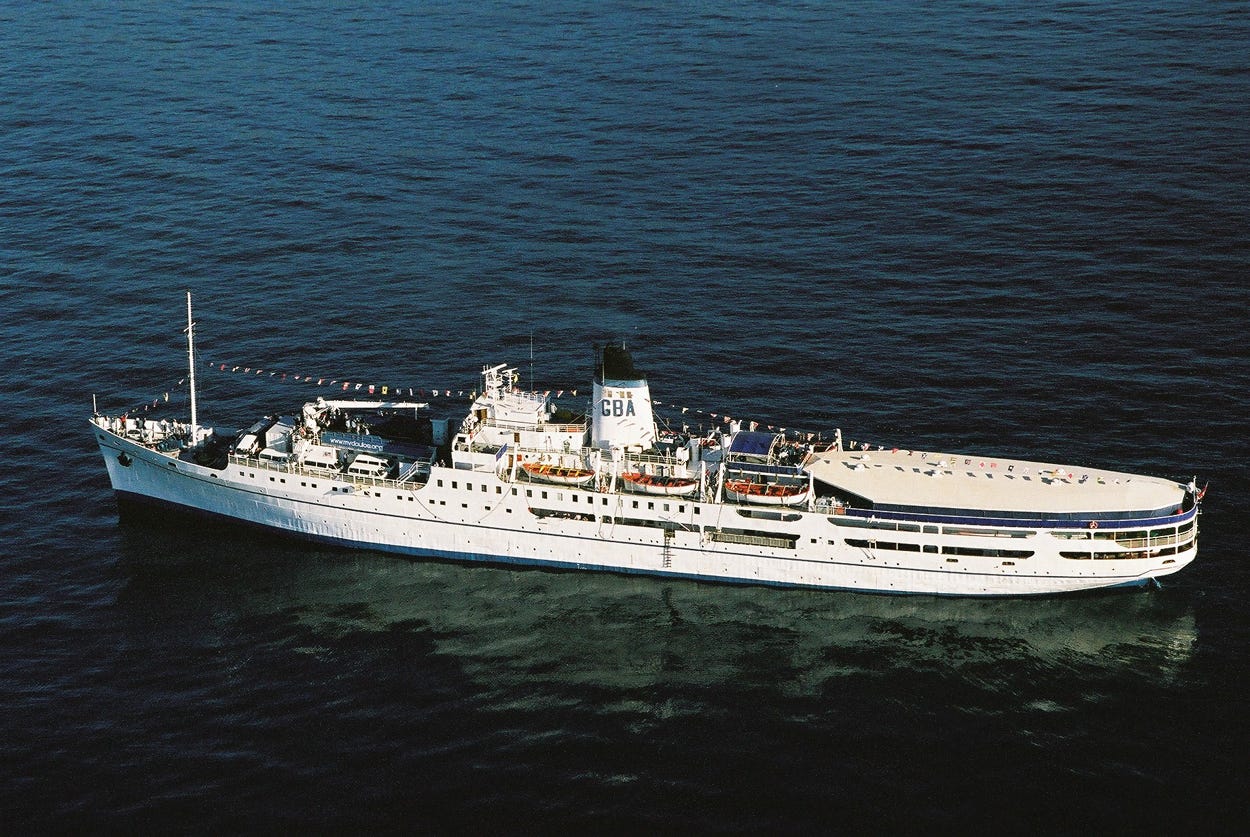
Gute Bücher für Alle
It was at this point that it became the property of Gute Bücher für Alle or Good Books for All (GBA), which was itself the brainchild of George Verwer, the founder of a Christian NGO called Operation Mobilisation (OM). GBA signed the purchase on 4 November that year, renamed her Doulos, took out the swimming pool, built a covered book exhibition on deck, fitted her out in Bremen, and sent her into service on 3 June 1978.
George Verwer was one of the great evangelical mobilisers of the late twentieth century, a restless American missionary organiser who turned book distribution, short-term missions, volunteers, ships, spectacle and religious urgency into a global machine. His origins were ordinary enough. Born on 3 July 1938 to Eleanor Caddell Verwer and George Verwer Sr, a Dutch immigrant electrician, he grew up in Wyckoff, New Jersey, just outside New York City. The family attended a Reformed Church in America congregation, though Verwer would later recall church as something closer to a social club than a living faith. As a boy he was an athlete, a Boy Scout and a troublemaker, awkward with girls, and once in trouble with the police for breaking into a house.
The origin myth of his life turns on a woman named Dorothea Clapp. When Verwer was fourteen, Clapp gave him a copy of the Gospel of John and prayed, for years, for the students at his school. Three years later he attended a Billy Graham meeting in New York and made a personal Christian commitment. Clapp, he liked to say, had put him on her “Holy Ghost hit list.” After his conversion he became evangelical in the most literal sense, handing out texts, organising meetings, converting classmates; within a year some two hundred of them had come to faith. As student council president, he distributed a thousand copies of the Gospel of John at school and began giving away Christian books, a habit that lasted nearly seventy years.
In 1957 Verwer and two friends, Dale Rhoton and Walter Borchard, sold their possessions, loaded a van with tens of thousands of pieces of Spanish-language Christian literature, and drove to Mexico. When he married Drena Knecht in 1960, the couple skipped the honeymoon and went straight back to Mexico for mission work. On the way he tried to barter their wedding cake for petrol. The first attendant filled the tank and let them keep the cake; the second simply took the cake.
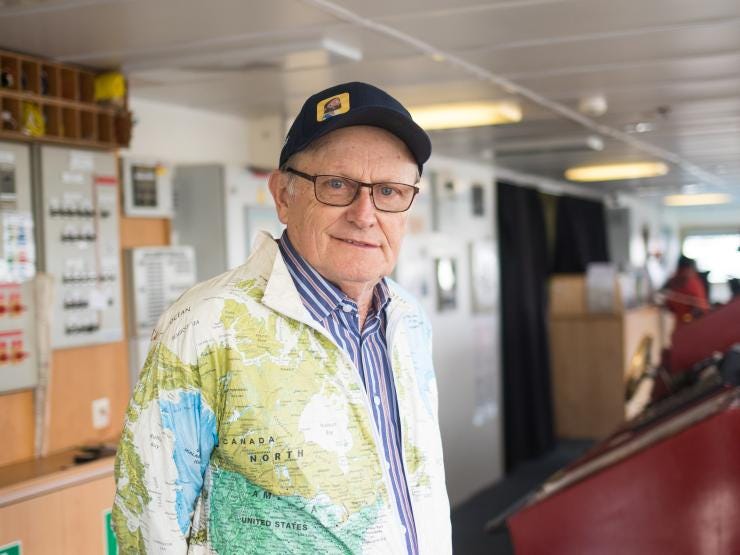
The name Operation Mobilisation came out of failure. Smuggling Bibles into the Communist countries of Europe, Verwer was arrested and deported, and in the reflection that followed - at private prayer in Vienna - he watched young people boarding a bus. The name arrived with the idea: to mobilise “busloads” of them into mission. In a 2017 interview he traced the word to post-war Europe, where the French, Germans and British had lately been killing one another, and where he wanted a “Revolution of Love” that turned a word once reserved for war to the work of the church. In Franco’s Spain, open Protestant evangelism was restricted, so his team improvised. They ran a stamp shop, scattered Bible verses around Madrid, drew those verses from the Catholic Bible so that priests and nuns might join in, handed out “commercial” leaflets rather than overtly religious ones, and kept a secret evangelical bookshop for trusted contacts.
The work expanded through Europe, the Middle East and Southern Asia, with emphasis on local leadership and collaboration with churches and other missions. In 1962, the first formal “Operation Mobilisation” campaign involved 300 young people distributing about 25 million tracts across European cities; by 1963, 2,000 participants from 30 countries were involved in literature distribution across 80,000 towns and villages.
Messiology
The ship idea came later, and it was essentially a logistics hack. Verwer first floated it at a prayer meeting in Bolton, England, in 1964, because OM’s work in India and the surrounding regions depended on dangerous, months-long road journeys in battered vans loaded with literature. A ship could house people, carry books and vehicles, host events and serve as a base for community work. The first, Logos, was bought in 1970, and the funding story is revealing: no one in the organisation had ever owned or run a ship. When the contract was signed they had only half the money and needed the rest of the £70,000 fast. It came, in the end, through “many small gifts from many nations” - among them OM’s own workers and alumni.
Verwer’s gift was not theology but mobilisation. Christianity Today calls OM one of the largest mission organisations of the twentieth century and reckons that some three hundred other agencies were founded by people it had influenced or by former OM workers. He also helped make short-term missions ordinary. His model lowered the barrier to entry: you did not have to commit your whole life first; you could go for a summer, a year, two years. Such agencies, he argued, took young people with little experience and trained them through mentoring in the field - and he claimed the short-term movement had launched more long-term missionaries than any other in the previous forty years.
His own favourite theological idea seems to have been “messiology” - not “missiology” in the polished academic sense, but the notion that Christian work is messy because people are messy. Spirit-filled people, he said, remain human, with their beautiful and their messy sides, and he counted himself among those who had erred in life and ministry. He framed it as a theology of grace: God working through flawed people and flawed institutions. The “rough and ready” approach brought real trouble. Logos was wrecked in 1988 along with $125,000 worth of Christian books; OM workers were injured or killed in accidents (a grenade was thrown on to Doulos in Philippines in 1991); teams ran foul of the authorities; and Verwer himself admitted that some of his ideas had been bad. He spoke of anger, fear and doubt, of being too hard on his wife, of the need to repent quickly. And he spoke openly about his struggles with sexual temptation.
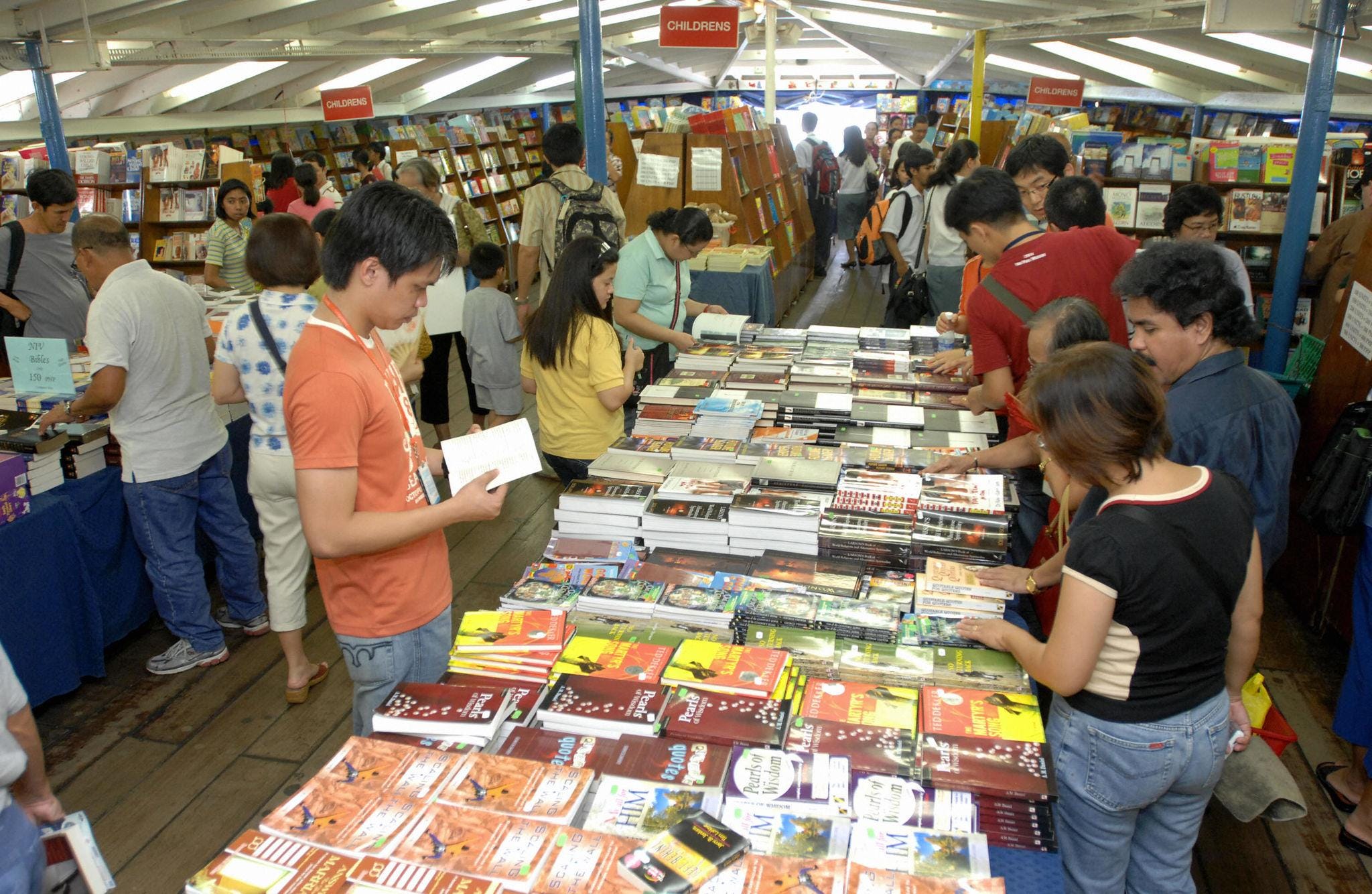
Verwer stepped down from the leadership of OM in 2003 and twenty years later, he died near London at the age of 84.
Doulos
The Doulos spent thirty-two years in GBA’s service, and in that time she welcomed more than 22 million people across 601 port calls in 108 countries, sailing over 360,000 nautical miles. For all that she gave books away, the official figures record 16.9 million books bought on board - selling them was central to the model. Many more were donated in port to establish or enrich libraries for the public, for schools, colleges and universities, with a large selection set aside especially for children.
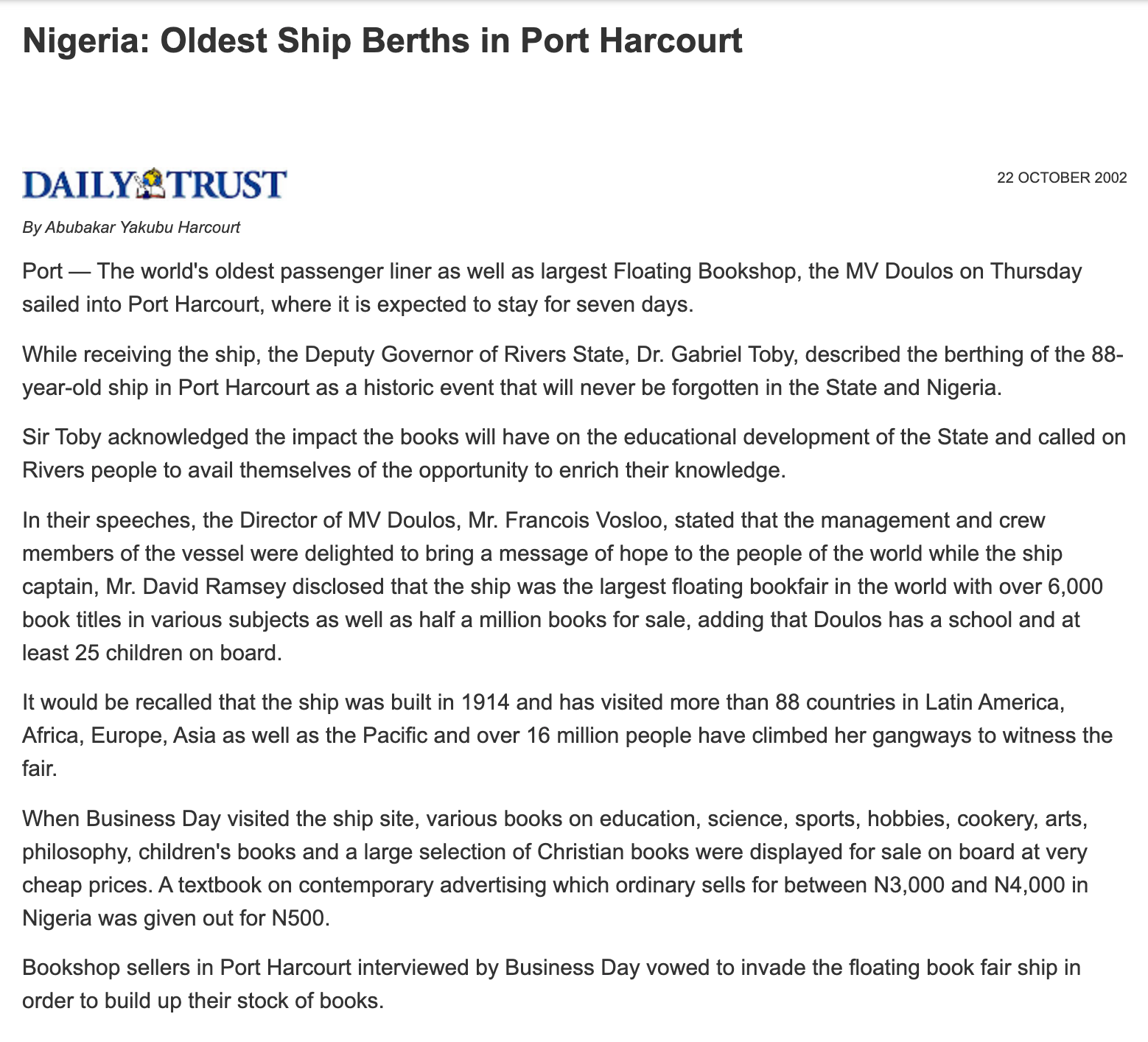
From 17 to 29 October 2002, the Doulos lay docked in Port Harcourt. Here is how the Daily Trust reported it on 22 October:
(Another GBA ship, Logos II, also visited Port Harcourt three years later in January 2005).
Afterlife
By 2009 the Doulos was ninety-five years old. The Titanic’s long shadow finally caught up with her when the safety regime it had forced into existence meant the cost of bringing it up to modern SOLAS standards was judged too high. A safety survey found that keeping her in service would cost more than €10 million in repairs, and OM’s leadership decided that, given her age and her limited future, the money could not be justified. The ministry closed on 31 December 2009; her last public book fair had been held five days earlier, in Singapore.
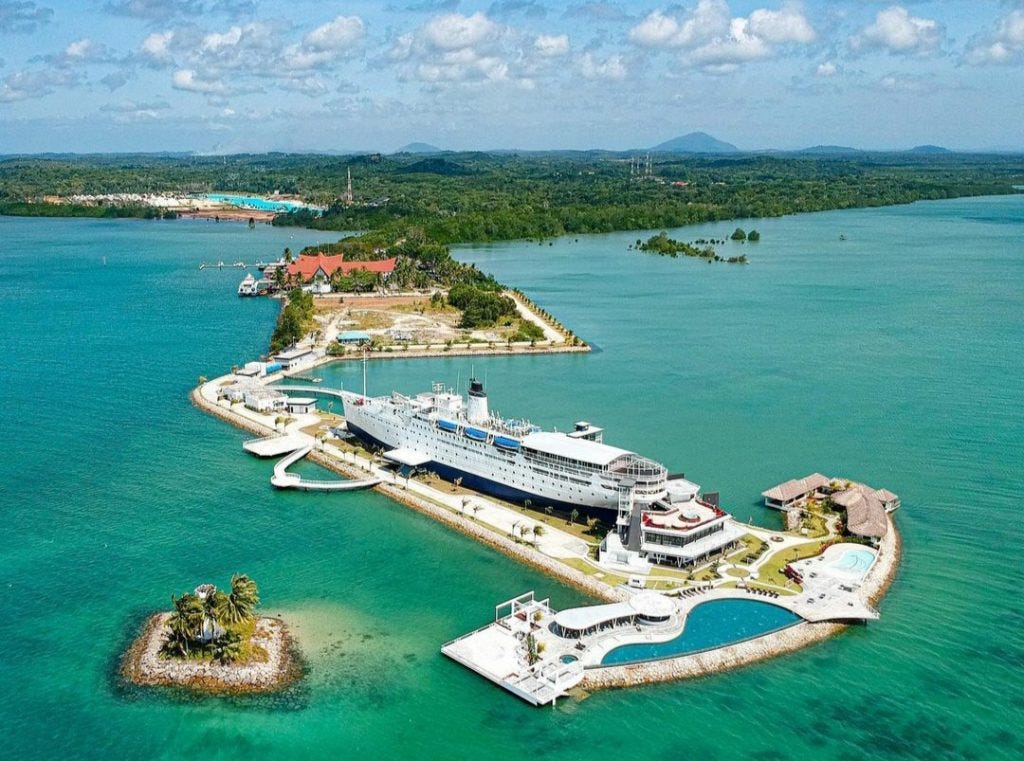
In 2010 a Singaporean, Eric Saw, bought her for S$2 million, renamed her Doulos Phos, and in time converted her into a ship hotel on Bintan Island, Indonesia. After nearly a decade of planning and heavy repairs, she soft-launched as a hotel at Easter 2019.
Saw was a Singaporean businessman whose background lay in human resources and training, not shipping. He spent his first two working decades in corporate HR, with a leaning towards training, and liked to joke that for a man who had studied Business Administration he was “neither interested in business nor administration.” The turn came around 1998, when he acquired the Stewords Riverboat, a floating restaurant on which he also ran training programmes.
The Stewords Riverboat was a Mississippi-style replica built in Singapore in 1991, left vacant and decaying after the American chain A&W moved on, before Saw bought it. Having no experience in food and drink, he first set up the Santa Fe Tex-Mex Grill to learn the restaurant trade before taking the Riverboat on.
He knew the Doulos before he owned her. He had visited her book fair several times with his family when she docked at HarbourFront, taking his children aboard with no notion that he might one day own the ship. As it turned out, he bought her before he had anywhere to put her. For three years after the purchase the Doulos Phos sat in a Jurong shipyard while Saw was turned away by one government agency and private developer after another; he later confessed he had been “naïve” to expect a smooth approval. Idleness alone cost him around $25,000 a month in basic upkeep, berthing fees and a skeleton crew.
The Bintan solution arrived after Singapore had failed him. Someone in his prayer group suggested he speak to Frans Gunara of Bintan Resorts, and in 2013 Bintan Resorts International agreed to convert the Doulos Phos into a land-berthed hotel. In October 2015 the ship was towed to a 1.4-hectare spit of land near the Bandar Bentan Telani ferry terminal. Some 90,000 metric tonnes of sand were reclaimed to create Anchor Isle, and a small army of civil engineers, structural engineers, naval architects and land architects went to work. Ninety-nine piles were driven forty metres into the seabed and capped with a half-metre layer of concrete; then, riding fifteen giant airbags and hauled by winch cables “as thick as a human arm,” the ship was dragged 170 metres into her final position on land. By the end Saw had spent some S$23 million (US$18 million) of his own money across fifteen years to see it through. The 2019 opening proved a false start: Indonesian and Singaporean Covid restrictions soon brought operations to a halt, and Singapore did not fully lift its border measures until 2023. Having survived two world wars, a parade of owners, decades of missionary service and the threat of the scrapyard, the ship began her new life and was met at once by a pandemic.
But he does not present it as an ordinary return-on-capital venture. His vision, he says, was to channel the profits to charities and ministries. He answered to a board that included Canon James Wong and a former Doulos captain, PJ Thomas; he drew a nominal salary of $1 a year; and the operating profits, he insists, go to Christian charitable causes whether or not he ever recovers his investment. What he hoped the hotel might pay for was wells in India - he spoke of the daily journeys women make for water, and of what contaminated water does to those who drink it, as the things that drove him. The first profits, he planned, would go towards clean-water wells in a single Indian village.
Saw renamed her Doulos Phos, usually rendered “Servant of Light” - a name drawn from Isaiah 49:6, inspired, he says, by Jesus as both servant and light. In 2024 he published a 180-page account of the whole endeavour, The Ship And I: In Pursuance Of The Grand Old Lady Of The Seas.
The world turns on such small things - though rarely on them alone. A ship, docking at Port Harcourt almost by chance, and a boy left with a lifelong love of books. But chance was only half the story. The ship provided the occasion; his mother, an educator who needed no convincing of a book’s worth, provided the rest.
That, in miniature, is the life of the Doulos. She began as a cargo ship, then a passenger liner, then a floating evangelical bookshop, and finally a Christian entrepreneur’s hotel and act of philanthropy. The thread running through is not books but the patient repurposing of a single steel hull for one moral economy after another: commerce, migration, leisure, evangelism, charity, and now heritage tourism. The same ship that once carried cheap paperbacks into Port Harcourt now sells sea-view cabins at Bintan. She is a destination now, not a vessel. Yet she also remains loose in the world, lodged in people - including the young man I met at dinner.
Eric Saw would say the mission continues through profit and memory.
Wow.
Luther famously noted that a Christian shoemaker does his duty not by putting little crosses on the shoes, but by making high-quality, durable shoes. God is pleased with good craftsmanship.
Always good ships.
This is so beautiful. What a beautiful life the ship has had. I cried. I think about the patient repurposing of my own life. Feyi, for lack of a better word, you are incredible! Thank you for writing and sharing.