

The always excellent Adia Sowho writes
There’s a version of history that goes like this: colonialism ended, and then the work of nation building began.
We tend to remember who left. We pay less attention to what they left behind.
When political power transferred, the institutions through which power moved often transferred with it — intact, operational, and optimized for the purposes they had always served. The checkpoint that required papers to move goods across a region did not disappear because the flag above it changed. The licensing system that created dependency on official approval did not dismantle itself because the officials were now local. The bureaucratic structure that generated revenue through control did not lose its appetite for control when a new administration arrived.
What changed, in many cases, was personnel. What remained, however, was the logic.
Systems do not transform automatically when leadership changes. They transform when their underlying incentives change, when their design is deliberately altered, when the people who benefit from their current form lose the power to preserve it. Those conditions require more than a transfer of formal authority. They require a reckoning with what the authority is actually built on.
The colonial checkpoint was not just a physical location. It was an arrangement — who had to stop, who didn’t, what it cost to pass, who collected that cost. Replacing the people at the checkpoint without redesigning the arrangement preserved the arrangement. In some places, it still runs today. Renamed. Reformatted. Recognizable.
What has been renamed, but not redesigned, in your operating environment?
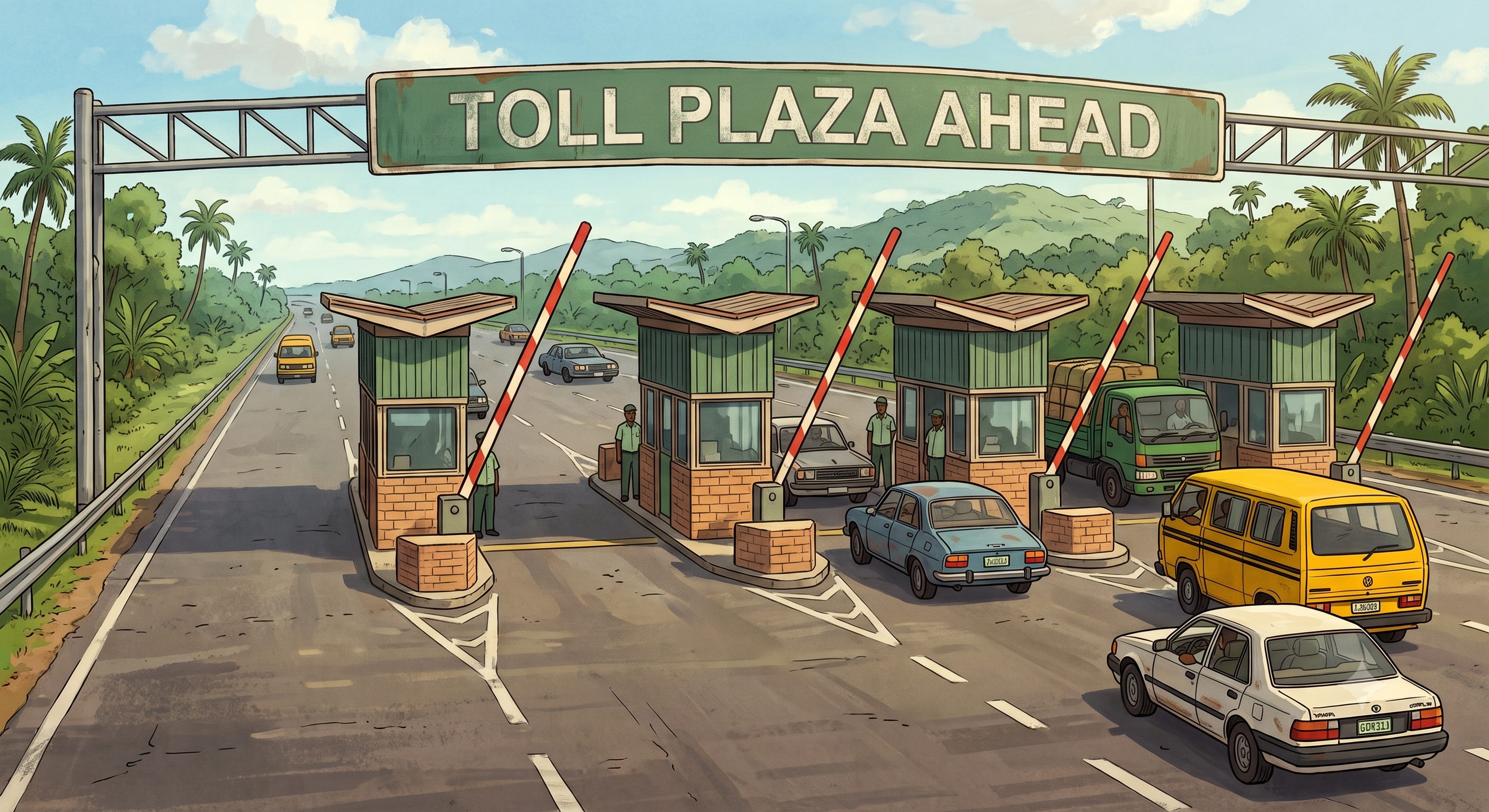
Adia describes something I have been thinking about for years: Nigeria’s regulatory environment defaults to extraction. Since I am terribly bad at naming things, and the ever-prolific Feyi (who gave us many gems) has refused to help me, I will call it Toll Gate Niger. A useful comparison is India's infamous License Raj. Toll Gate Niger works this way: government regulators find wherever new value or a new market is being created, and attach a legal right to extract rent from it, usually through a permit or a ban.
It is worth asking why extraction became Nigeria’s default regulatory instinct. There are two common and plausible explanations. The first is inherited history: the British built Nigeria’s institutions to extract, and after independence, the state that took over kept running the same machine, just under new management. The second is the political economy of oil: Nigeria’s oil sector grew into an enclave, largely separate from the rest of the domestic economy, and successive governments found this arrangement comfortable so long as the rent kept flowing to the centre. Over decades, governments got used to that arrangement, and they carried the same instinct into how the whole economy is administered.
There is a third speculative reason I have been thinking about: a theory of what government is for. Governance in Nigeria runs on what might be called an “overseer” theory of government. Under this view, government is not an active participant in the economy, and it is not expected to produce anything on its own. Its role is only to oversee, mediate disputes between producers and citizens, and punish those who break the rules. This view has real roots in market failure theory. But developing economies are full of market failures that block coordination and prevent private investors from forming credible expectations about the future. In that setting, a government that acts only as a detached overseer is not enough. Sometimes solving a market failure requires the government to become an active participant while seeding a market that would not otherwise exist. A government committed to the overseer theory cannot do this. It is only prepared to deploy brute and blunt instruments of governance like legal coercion and Pigouvian taxation. When those tools fail to fix the underlying problem, which they often do, they morph into extortion.
Lagos State’s recent attempt to manage plastic pollution illustrates this point. The state banned single-use plastic bags, and for a few weeks, stores stopped giving them out and told shoppers to bring their own. Formal grocery stores complied, since government sanctions carry real weight for a business with a fixed address and a license to lose. The informal market, which is enormous in Lagos, ignored the ban, and there was never a real way to enforce it there. The policy is a predictable and ongoing failure, as the streets of Lagos are no cleaner than before. But the state never lifted its sanctions on the stores that had complied; rather, the ban evolved into a form of penalty on plastic bags. Grocery stores responded by selling the bags to shoppers outright. The city is still as polluted as ever, and shoppers now pay a tax on plastic bags that funds nothing but another channel for extraction.
The deeper implication of the overseer theory is that nobody expects the government to deliver anything. A government that sees its job as boundary policing does not measure itself by clean air or working infrastructure. It measures itself, whether officials say so or not, by how much it can block. Lagos could have taken a different approach to plastic pollution: seed a functioning recycling market first, and reach for a ban only at the edges, once that market existed to absorb the waste. But the government does not see itself as a participant with an output focus in the quest for a clean city. It merely exists to oversee whatever solutions people can come up with, and it gets some free revenue along with that.
I don't know if the name is right but it perfectly explains the IGR extortion fixation at all levels of government in Nigeria. It has become that government exists to extort citizens. Which in a way is cultural for many parts of Nigeria where there are no concept of citizenship but just that of rulership, slavery and subjectship. A subject will pay to be allowed to exist by the sovereign. Sovereignty doesn't rest with the people.