

In 1978, in his Independence Day address to the country, Nigeria’s then military ruler and future civilian president, General Olusegun Obasanjo, explained what he wanted national honours to achieve. Sixty-four Nigerians had been decorated “to continue to reward service and merit other than by means of material consideration”. He also announced a Register of National Heroes, intended to make selfless service something “worthy of every Nigerian’s pursuit”. He was outlining a theory of human behaviour that Nigerians would notice whom their country chose to honour and adjust their ambitions accordingly. This would create a sort of virtuous cycle where the government would get more of the type of Nigerian it considered worthy of honour for their role in advancing the country.
Obasanjo was following a long line of rulers who have tried to direct their citizens’ ambitions through public recognition. In 1802, Napoleon Bonaparte, at the time France’s First Consul, established the Legion of Honour to reward individual merit in a country where a revolution had been waged against the privileges of birth. Military courage and civilian accomplishment would receive recognition within the same institution. Among those honoured was Alessandro Volta, the Italian physicist who invented the electric battery, whom Napoleon made a knight of the Legion in 1805. He also decorated Benjamin Delessert for his factory’s success in producing sugar from beet, offering France a domestic alternative to imported cane sugar at a time when war had severely disrupted supplies. In doing so, scientists and industrialists could stand alongside generals, with identifiable achievements explaining their presence in such company. Napoleon also wanted to bind a country exhausted by revolution and war around a common idea of national honour.
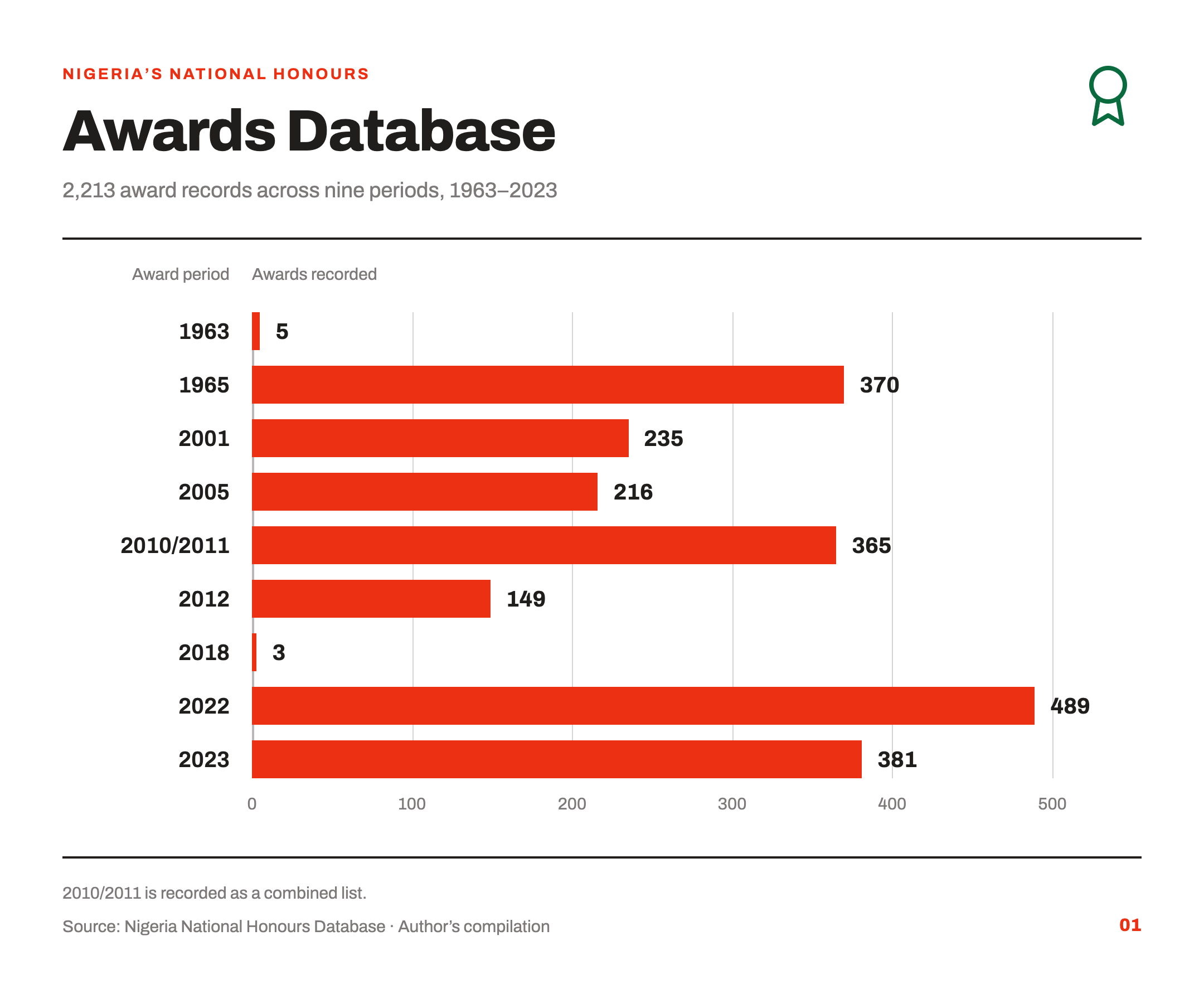
So what has Nigeria decided is “worthy of every Nigerian’s pursuit”? To investigate, I assembled a database of 2,213 national honours awards1, covering nine award periods between 1963 and 2023. I drew on government gazettes and official citation booklets, supplemented by contemporary newspaper reports and some material supplied by the ministry responsible for national honours. Alongside the recipient’s name and the rank of the honour, I brought together evidence about their career and the contribution they were being recognised for. I also followed people who were honoured on two separate occasions to follow their progress through the hierarchy.
Counting the number of businessmen or academics on a list tells us something about who Nigeria recognises but examining the specific honours they receive tells us how highly their contributions are ranked. I therefore distinguished (or tried to) recipients’ broader career backgrounds from the jobs they held when honoured. For example, a retired general does not lose his military history because the citation at the time of his award describes him as a businessman. The largest cohort turned out to be 2022 (the late former President Buhari seemed to hand them out like party packs on his way out), with 489 awards - 436 supported by individual official citations which provide accounts of the recipients’ work and the government’s reasons for recognising them. This allows us to examine what the government has wanted Nigerians to admire over the years.
Limitations
The national honours have not operated as an annual exercise so any gaps in the data have more than one explanation. The promised combined ceremony for 2015 and 2016, for example, never took place. To deepen the confusion, the absence of a ceremony does not mean that nobody received an honour: former Vice President Yemi Osinbajo received his GCON in 2015, and Walter Onnoghen (former Chief Justice of Nigeria) received the same rank in 2017. So awards were certainly handed out in some years for which the database contains no recipient list. The ministry’s historical summary records 348 awards in 1964 and 142 in 1982, for example. I was not able to obtain some relevant documents while others have been identified as present in some archives but produced a dead-end when I tried to track them down.
All told, the best official benchmark I could find is the ministry’s 2022 retrospective, which reported 5,341 awards. But the database I managed to put together contains 2,213 records: 1,832 from post independence up to 2022, followed by another 381 in 2023. The earlier records amount to roughly a third of that official benchmark from 2022. This is not a precise completeness rate because the official sources themselves sometimes disagree (quelle surprise.) As an example, the retrospective records 241 awards for 2001 but the complete gazette I was able to obtain for that year contains only 235 entries.
Surprisingly (to me, at least), there are also differences between being selected for an honour and actually completing the process of receiving it. Of the 2,213 records, 514 remain provisional: 365 entries in the combined 2010/2011 list and the 149 names on the 2012 shortlist. They are evidence of selection but every individual’s completed appointment and acceptance has not been independently established. A separate 752-entry gazette from 1998 is preserved outside the main analysis because the exercise was subsequently reported to have lapsed, whatever that means. These distinctions are important particularly when counting completed awards or following somebody’s promotions through the system.
Does the missing material invalidate the exercise? Not really because what I really wanted to do was look for patterns. But that does not mean that the missing data is of no effect. The available cohorts were determined by the records I was able to recover rather than selected at random, and the main dataset currently only covers awards under civilian governments. The stronger reassurance comes from testing the patterns within the available years.
Knowing who somebody is presents another difficulty. I was able to assign a category to 1,858 records, while 355, or 16%, remain unresolved. A judge identified by judicial office is generally easier to classify than someone whose entry consists of initials and a surname, say. I have tried to keep the unknowns visible and to distinguish a person’s broader career from the position they held when the award was given. But even then, categories still require judgment. A person’s occupation alone cannot establish whether they got their award based on merit or favouritism.
The evidence about why people were honoured is much thinner than the evidence about their names and ranks. Many earlier records supply a job title without any individual citation. The 2022 booklet is much richer, but even there the short closing citation can omit achievements that are described elsewhere in the recipient’s profile. Furthermore, an official profile is often just the government presenting its case for the award, rather than an independent audit of everything claimed in it (I give an example of this below.)
The treatment of rank also needs some care. The ‘prestige points’ I have used in the database are just a convenient way of summarising an ordered hierarchy not that one decoration is worth twice another. The actual distribution of ranks remains the stronger evidence.
Finally, it is worth stating the obvious that the database contains recipients, rather than the wider population of nominees or deserving Nigerians who received nothing. Therefore, while it can show which groups account for larger shares of honours, it cannot calculate a scientist’s chances, say, of recognition relative to a politician’s. It also cannot establish whether the honours motivated anyone to invent something or choose a different career. The records simply let us examine the examples the government put before Nigerians.
Prestige Points
The raw count of the awards above treats a MON and a GCFR as one apiece even though they occupy very different positions in the hierarchy. To capture that difference, I assigned each award rank “prestige points”: ten for GCFR, and then falling one point at each successive rank down to one point for FRM II. This deliberately simple scale preserves the ranking and lets us compare a group’s share of awards with its share of prestige points. These are research weights, not government scores: ten points do not mean someone contributed ten times as much to Nigeria, of course.
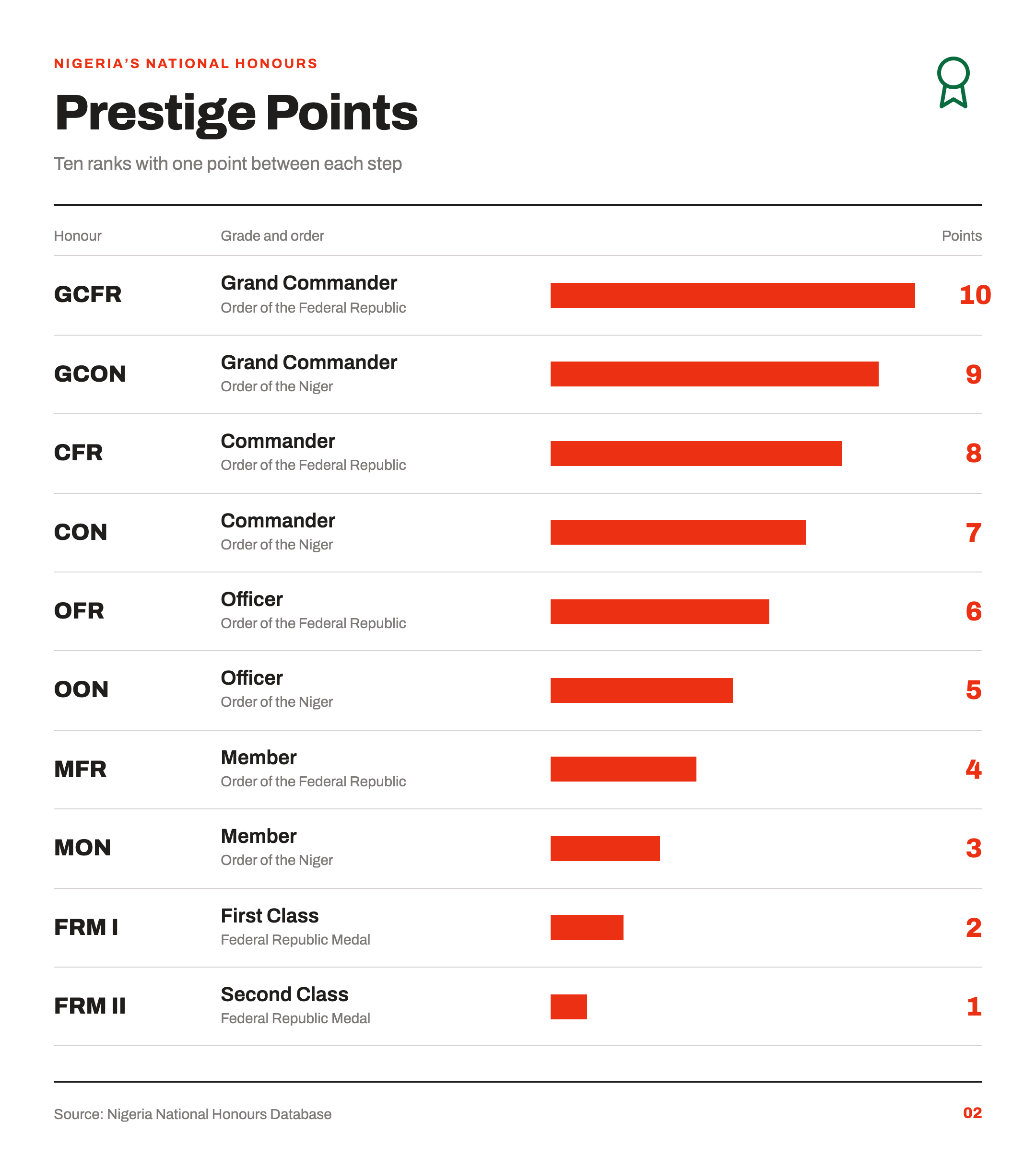
The GCFR is normally given to presidents and heads of state although there have been a couple of exceptions such as MKO Abiola and Obafemi Awolowo, neither of whom ever held the highest office in the country. The 2022 retrospective counted 14 GCFR awards in the wild although I have only been able to find entries for nine people. It carries the maximum ten prestige points, but honouring someone for becoming president tells us very little about which achievements everyone else is being encouraged to emulate. I therefore calculate the results with and without awards identified as coming with the job, such as Bola Tinubu’s GCFR. Abiola’s award stays in both calculations, with its full ten points, because he was not being honoured for taking office.
Headline Findings
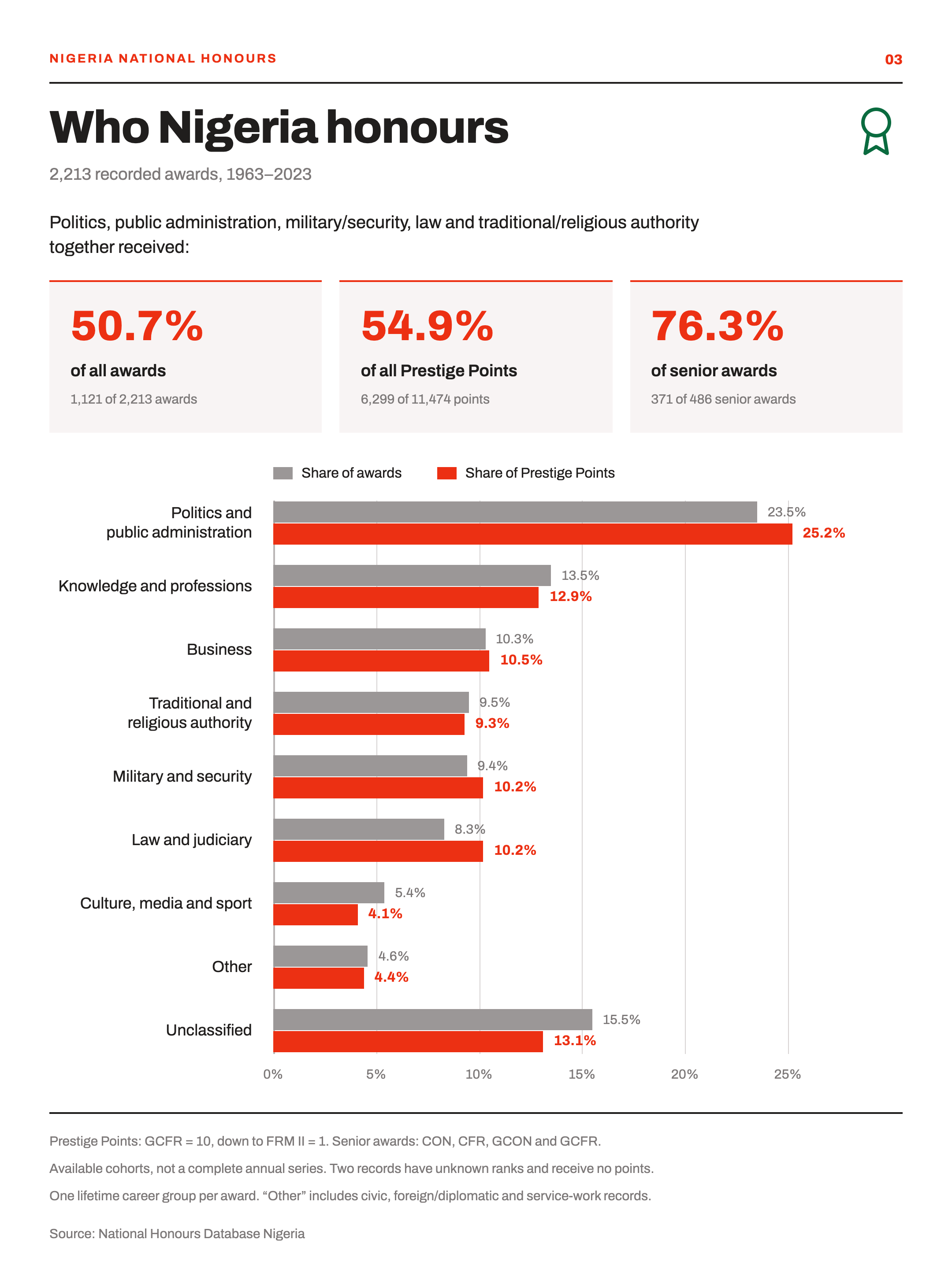
Across the 2,213 awards in the database, people whose careers lay in politics and public administration, military/security, law, or traditional and religious authority collected fully half, 50.7%, of the awards. When weighted by rank, their share rises to 54.9% of all Prestige Points. This preference becomes much more pronounced at Commander level and above: these groups received 371 of the 486 senior awards, or 76.3%.
Using names might better illustrate this point. In 1965, Ado Bayero, at a time he was already the Emir of Kano, received the CFR honour (eight Prestige Points) along with a whole host of other such Nigerians including the Minister of State for External Affairs (Senator Nuhu Bamali), the Etsu Nupe, the Tor Tiv and the Emir of Gwandu. More than half a century later, the 2022 awards included GCONs (nine points each) for Senate President Ahmad Lawan and Chief Justice Olukayode Ariwoola while General Lucky Irabor, the then Chief of Defence Staff, received the CFR honour. These men all arrived at their respective honours with considerable authority already attached to their names. Their institutions had already placed them in positions from which they could command attention and influence other people’s lives. The medals only supplied an additional distinction showing that the authority they exercised within those institutions now came with the country’s formal endorsement of them as exemplary Nigerians.
This suggests that institutional standing (people who are already inside the system) carries a particular premium in the upper reaches of the honours system. Nigeria does recognise contributions from across different parts of society, but the most prestigious honours tend to confirm people who already have a place within the established order. In other words, there is a potentially self-reinforcing process here: people acquire authority within important institutions, receive national recognition, and become the examples everyone else is encouraged to emulate. In this way, the state is adding prestige to people who already possess it.
Gani Fawehinmi’s GCON (the GOAT, by the way) is an obvious counterexample. It shows why a legal career does not automatically mean insider status. It is possible to acquire institutional standing by building something valuable outside of authority. An honour can reward that achievement and reinforce the existing hierarchy simultaneously.
Three Points for a Submarine Cable
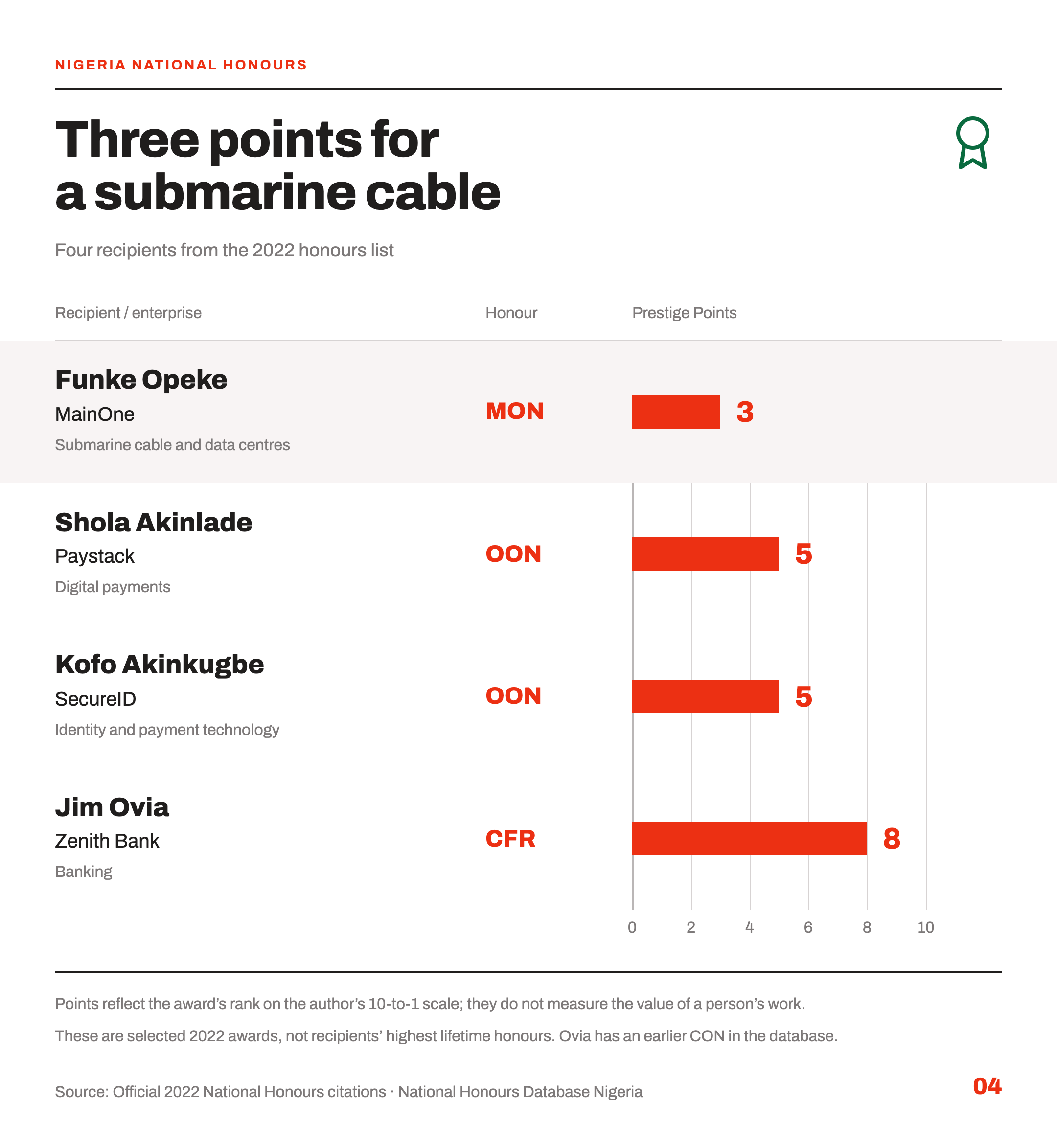
Funke Opeke helped build the infrastructure that made it possible for other Nigerians to become entrepreneurs. During the global financial crisis, her company, Main One, raised $240 million to lay a submarine cable connecting West Africa to Europe which was operational by July 2010. MainOne helped bring down the cost of international connectivity, making better internet access available to businesses that badly needed it. A contemporary investor case study described both the difficulty of financing the project and its wider economic effects. The company subsequently helped bring fibre to Yaba’s emerging technology cluster. By the time the government honoured her in 2022, Main One’s cable had been delivering internet traffic to Nigeria for twelve years. The government’s own citation (PDF, page 252) credited her with delivering the project on time and within budget, alongside subsequent investment in data centres. It awarded her the Member of the Order of the Niger (MON), worth three Prestige Points. On a development test, a MON is a very weak signal to send about building the infrastructure of a digital economy.
She may yet climb the ranks: Jim Ovia progressed from the his earlier CON award to CFR in 2022, so the MON need not be the final word on her contribution. In the same list (page 182), Paystack’s Shola Akinlade and SecureID’s Kofo Akinkugbe received the OON, worth five points each.
But Opeke’s citation gives us a concrete example of the economic capability Nigeria says it values, and the prestige it attaches to someone who helped to create that capability. Is getting an infrastructure project finished on time and within budget something to be taken for granted? Apparently.
Opeke is just one example of a wider pattern. To look beyond individuals, I grouped together the awards associated with what you might call productive activity and knowledge: business and infrastructure, alongside science, education and health. This is a deliberately generous definition, taking in established bankers and working professionals as well as people creating something new. Across the database, this group account for 489 awards, or 22.1% of the total, and 21.5% of all Prestige Points. But if you narrow the view to Commander level and above (CON, CFR, GCON) their share falls to 15.1% of the Prestige Points available at those ranks. Productive and knowledge-based work does get recognised but it given considerably less room at the top.
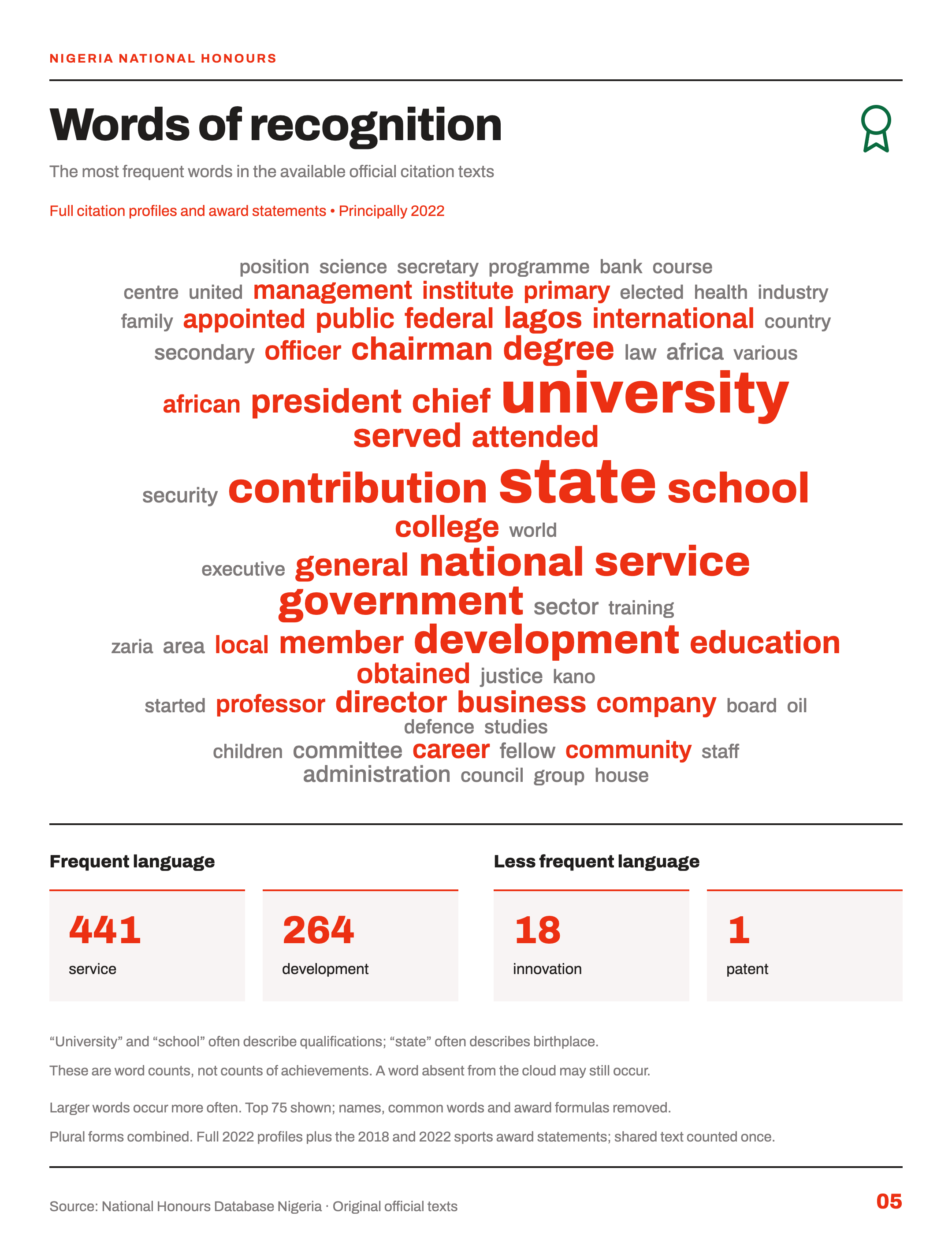
The wording used in the official citations offers another clue. Across the original official texts available to me - overwhelmingly from the 2022 booklet - the most frequent words include “state”, “university”, “service”, “contribution” and “school”. “University” often tells us where someone studied, rather than what they discovered; “state” frequently tells us where they were born. Once plural forms are combined, “service” appears 441 times and “development” 264 times, against 18 mentions of “innovation” and just one of “patent”(“innovative” appears separately.) This contrast suggests that the language is much more suited to simply describing a career and praising service rather than spelling out a new capability that Nigerians might be encouraged to emulate.
Hierarchy in Tragedy
That Nigeria is a deeply hierarchical society is hardly news. But even knowing that, I found something in the database that amazed me. On 21 May 2021, a military aircraft crash killed the Chief of Army Staff Ibrahim Attahiru and ten others. Nine of those men went on to appear in the 2022 honours records. But even in this shared act of commemoration, the honours reproduced the hierarchy within the military exactly. In other words, even though the men all died on the same flight, the chain of command survived them in the awards.
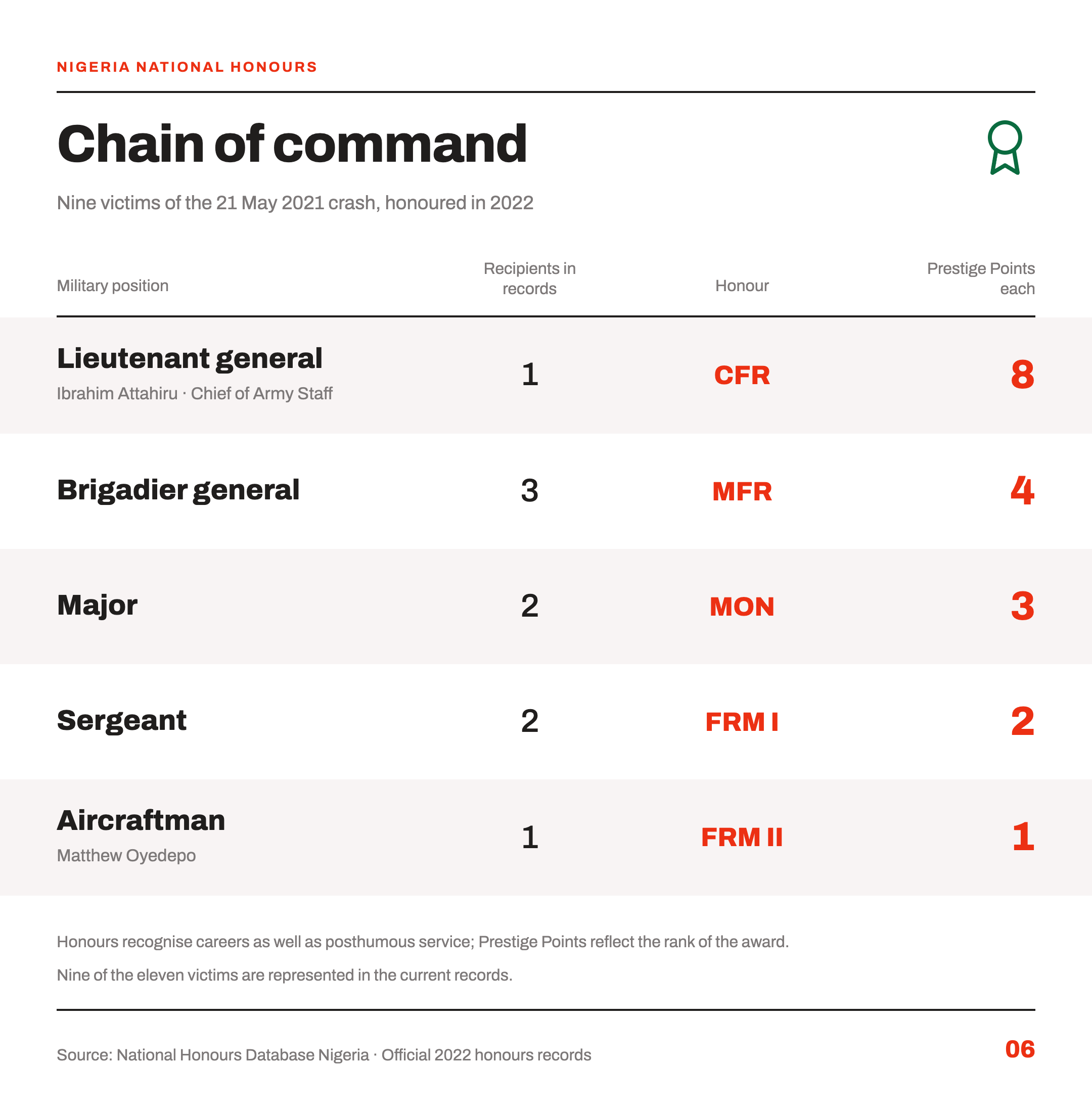
I found this astonishing. You can die in the service of your country and still be honoured according to your rank?
Rapid Promotions
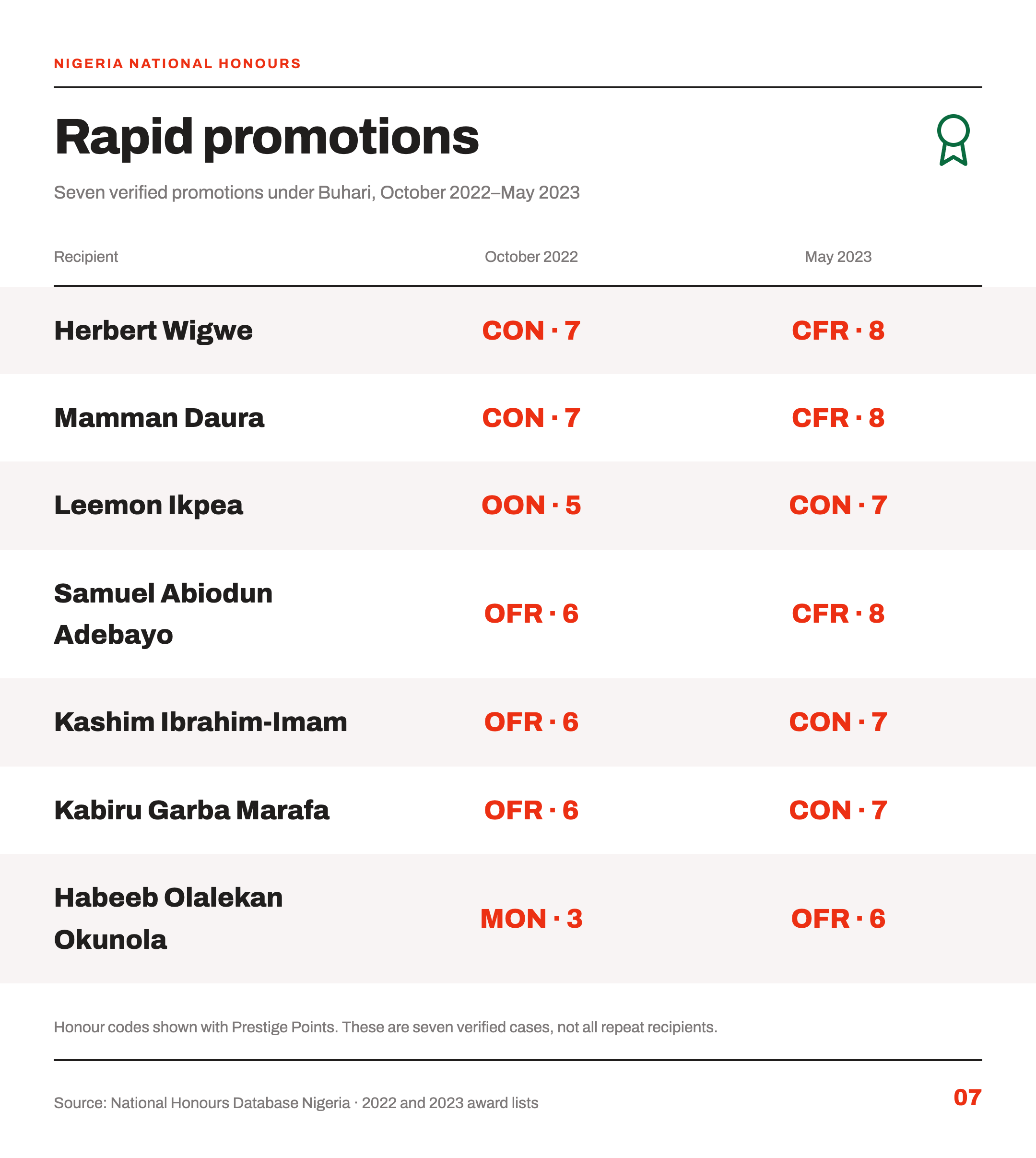
As mentioned earlier, the late President Buhari seemed to hand out national awards like party packs on his way out of office. Something even more interesting, however, is that at least seven people who were decorated in October 2022 appeared at higher ranks in May 2023. The interval was approximately seven and a half months with Habeeb Okunola making the biggest jump: three steps, from MON to OFR. The available 2023 sources do not supply individual explanations for these upgrades but the same presidency seems to have reassessed several recipients within months.
Honour Before Achievement
One final point on the standard of evidence used to hand out these honours. On 11 October 2022, Julius Dediare Rone, the head of UTM Offshore, received an OFR, worth six Prestige Points. His official citation (PDF, page 112) described his company as building a floating liquefied natural gas facility and claimed that his initiative would lift 600 million people out of energy poverty and provide clean cooking for 900 million across Africa. Having begun with these promised benefits, it then concluded by praising his “innovation which has led to the expansion of the gas market”.
On 18 November 2022, thirty-eight days after the ceremony, the Japanese engineering company JGC announced that its consortium had been awarded the contract for front-end engineering and design, the work needed to define the plant before construction. Earlier conceptual design work had begun in 2021, but this next stage was not scheduled for completion until December 2023. Construction would follow only if the project went ahead. There was a real business and a project under development in this case, but the citation had allowed its promised benefits to mingle freely with claims of achievement. In other words, the honour and medal were ready before the engineers had even finished designing the plant.
Conclusion
Nigeria is wasting an opportunity to encourage the capabilities it keeps saying it needs and that is a shame. An honours system gives the government a useful tool to identify people whose work deserves public admiration and explain why others should follow their example. But the pattern in this database suggests that the more prestigious the honour, the more its recipients already belong to the established institutions of Nigerian life.
There is a lovely example from Japan of how recognition can echo in unexpected ways beyond the person being recognised. In 1949, Hideki Yukawa became the country’s first Nobel laureate “for his prediction of the existence of mesons on the basis of theoretical work on nuclear forces.” At that time, Ryoji Noyori was eleven years old. He later recalled that Yukawa’s prize had helped awaken his interest in science (PDF, page 81): “At age eleven, I was inspired by Professor Hideki Yukawa’s Nobel Prize - Japan’s first – and awakened to science.” In 2001, Noyori then won the chemistry Nobel himself, for developing the catalysts used in the industrial manufacture of medicines. Public recognition of one person’s work helped another person imagine their own life in science.
The Nigerian government already hands out honours and decides how much prestige to attach to different achievements. It could use those same tools to make building useful things a more visible route to national recognition. The disappointment here is that an instrument with that possibility has become so heavily occupied with recognising people whose importance was already well advertised.
Obasanjo’s phrase, “worthy of every Nigerian’s pursuit”, was an invitation to people who had not yet to made a contribution to Nigeria to have a go at doing so. Nigeria could use its honours system to give accomplished builders a prominence that makes their work familiar far beyond their own industries. It would also be useful if the explanation of how they earned it gave other Nigerians watching something to emulate. If you want more of something, you should go out of your way to reward and incentivise that thing.
That, too, is part of how countries develop themselves.
Great work here. I like how you essentially exposed that our honours system lacks a distinct and clear methodology. I may be reading too much into it but that can hardly make a source for inspiration if we’re not clear why people receive them. One conclusion I drew from your detailed research is that government officials are more likely to get these honours than anyone else. I don’t think that is ideal in any way.
In any case, I like how the piece was surprising without being cynical.
This is so so good! It seems like something that can pass as a dissertation in school😄
I particularly liked how you spoke at length about the data collection hiccups. Out of curiosity how long and how much effort did this take? And did AI make it any easier😅?