

Cheung Yan1 became a dollar billionaire simply by noticing. In 1990, after five years in the wastepaper trade in Hong Kong, she moved to Los Angeles with her husband and built a business around a very simple opportunity. Container ships were arriving on America’s west coast packed with Chinese goods but sailing back practically empty, making the return journey unusually cheap. China’s factories, meanwhile, needed vast quantities of strong paper to make the boxes for the next shipment. Cheung bought discarded American cardboard, filled those empty containers with it, turned them to pulp in China and then into new boxes that returned to America carrying yet more Chinese goods. By 2001, America Chung Nam, the company she founded with her husband, had overtaken DuPont and Procter & Gamble to become the largest exporter from the United States by freight volume.
Nine Dragons (the China-based manufacturer she founded in 1995 to turn America Chung Nam’s recovered paper into packaging board) began production in Dongguan in 1998 with a single paper machine capable of making 200,000 tonnes a year. By May 2002, its annual capacity had reached one million tonnes. Then the numbers became ridiculous: 3.3 million tonnes by 2005 and 5.35 million two years later. Its Dongguan complex, with thirteen giant paper machines running twenty hours a day, became the largest paper mill in the world, while Cheung employed more than 10,000 people across the company. Her fortune, estimated at $3.4 billion in 2006, rose above $10 billion a year later, briefly making her the richest self-made woman in the world. Cheung had entered the wastepaper trade long before Zhu Rongji became premier, so she cannot be called his creation. Her great fortune was to have built the right business just as Zhu’s reforms were consolidating the economy in which it would become an empire. China entered the World Trade Organisation (WTO) in December 2001, a culminating achievement of his premiership, and between 2004 and 2007 its exports grew by more than 30 per cent a year. All those goods had to be put in boxes.
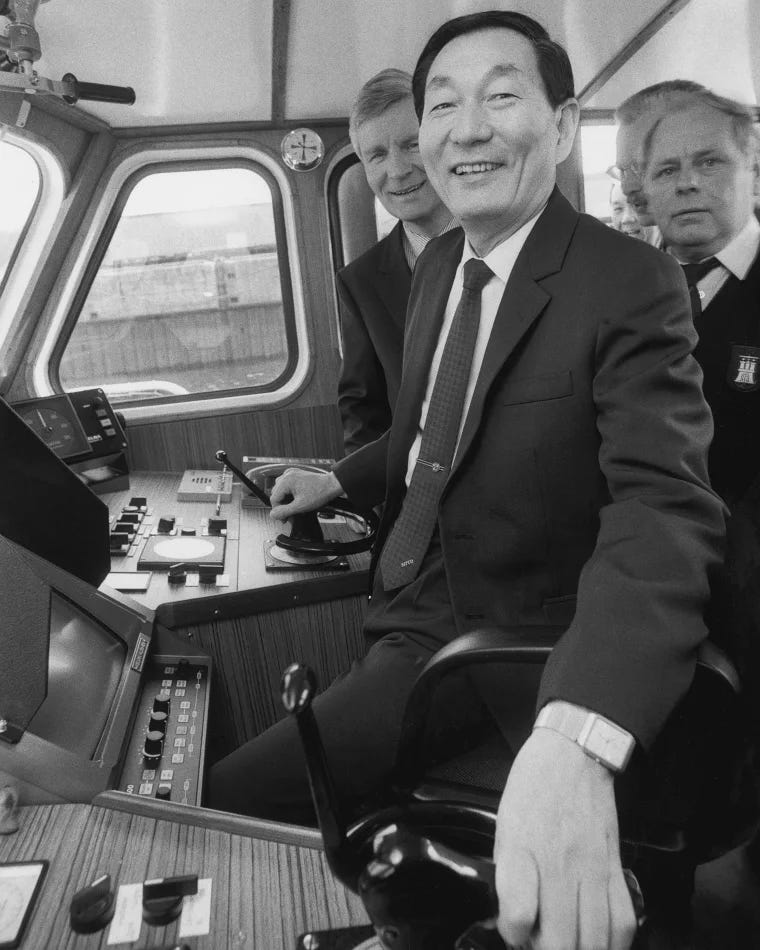
He came to bury Caesar
Trained as an electrical engineer at Tsinghua University, Zhu Rongji spent much of his early career inside the State Planning Commission. During the Hundred Flowers campaign in 1957, colleagues asked him to speak at an internal meeting. In a three-minute speech, he criticised planning officials for drawing up plans and budgets without serious investigation, relying instead on reports and figures detached from reality - what he called “subjectivism”. When the political wind reversed, those same remarks were reclassified as “rightist”. In January 1958, Zhu was demoted and expelled from the Communist Party and he was not allowed back in until 1978. During the Cultural Revolution, in a separate punishment, he spent five years doing farm labour at a cadre school.
This broken relationship between plans and reality stayed with him until he took charge of China’s economic portfolio as vice-premier in 1993. The problem, as he saw it, was no longer that the old state-led economy was inefficient. To him, it had largely ceased to reveal anything useful about itself symbolised by what he called the “tumour” of fake accounts which could be found at the root of every problem in the economic order. His famous inscription of “make no false accounts”, delivered to the Shanghai National Accounting Institute, was of a piece with his disdain for irrational growth plans and subjectivism.
In the pre-reform days, a state-owned enterprise (SOE) might also be its workers’ landlord, hospital, and childcare service. This was the danwei, or work-unit, system, built around the “iron rice bowl” of guaranteed employment and a package of housing, medical care, education and pensions. The SOE was, in essence, a miniature welfare state. Banks lent to them because officials required them to, losses were rolled forward and workers remained on payrolls whether there was useful work for them to do or not. By 1997, the net profit of all China’s industrial SOEs (after the losses of failing firms were net against the earnings of profitable ones) had fallen to zero.
The policy under which he began to tackle this problem was known as “grasp the large, let go of the small”. During the brutal restructuring from the mid-1990s to the early 2000s, roughly 35 million workers disappeared from SOE payrolls (employment fell from 77 million in 1995 to 42 million in 20032.) Some SOEs were sold, some leased to their managers, some folded into stronger companies and others were simply bankrupted. One of the most prominent examples was the Shenyang Smelter, founded in 1936 and once one of China’s 500 largest SOEs. It employed more than 10,000 people and had led the country in the production of several non-ferrous metals. But it also produced 42 per cent of Shenyang’s sulphur dioxide emissions, all while losing money. Its three great chimneys stopped smoking in the summer of 2000; on 8 August, a court formally declared it bankrupt.
Here Zhu becomes an awkward fit into the story that is now commonly told about China. These days “Chinese economic policy” brings to mind subsidies, national champions, technology funds and officials selecting industries in which the country intends to dominate. Yet Barry Naughton argues that3, on a narrow definition, targeted industrial policy reached its lowest point under Zhu. Industrial policy, in this sense, means a government identifying particular sectors and directing resources towards them in order to change the structure of production. It presupposes that a market already exists but while a command economy can be good at issuing commands, it is rarely able to will markets into being.
In that sense, Zhu spent much of his premiership dismantling the institutions that issued those commands. Most industrial ministries were abolished and formal responsibility for industrial policy was transferred out of the State Planning Commission. For a period of time, there was practically no government agency taking charge of industrial policy. He also decided against launching large state projects in semiconductor fabrication, nuclear power and large civilian aircraft, three industries that would later become central to China’s ambitions. Zhu saw his work (as The Undertaker of China’s old industrial order ) as making decisions about what industries and sectors should be allowed to die. Or to put it another way, it was the preparation of the soil into which industrial policy could later be planted: removing dead firms, allowing prices to do their work, forcing enterprises to keep accounts and building the institutions within which a market could function.
None of this made Zhu a “free-market liberal”. Naughton describes his economic view as resting on two beliefs namely, the need for markets and the need for a strong government. Markets were useful because they subjected bureaucrats to a discipline they could never be relied on to impose on themselves. Government, on the other hand, was necessary because Zhu was suspicious of entrepreneurs as well. He believed that left to their own devices, they would dodge taxes and help themselves to public property as cheaply as they could get away with. He was irritated by the corruption that accompanied local privatisations and never became a strong advocate of private-property rights for their own sake. His ideal was a state powerful enough to set rules that its own officials and enterprises dare not ignore. You might say that he shrank the perimeter of the state economy while hardening its centre.
The names of most enterprises that were let go are long forgotten, but those that took their place are impossible to miss today. In steel, Baoshan Iron and Steel absorbed Shanghai Metallurgical Holding and Meishan in 1998 to form Baosteel, the corporate ancestor of today’s China Baowu (now the world’s largest steelmaker, producing almost 125 million tonnes of crude steel in 2025, more than ArcelorMittal and Nippon Steel combined). In oil, a big exchange of assets in the same year turned CNPC and Sinopec into two vertically integrated national groups. PetroChina was then carved out of CNPC in 1999 and dual-listed in New York and Hong Kong the following April, raising $2.9 billion at a valuation of roughly $30 billion (its state-owned parent retained around 90 per cent). All these were attempts to place enormous state assets inside recognisable corporate forms thus exposing part of their capital to outside investors and making their managers answer for commercial results.
The old China Telecom monopoly was divided by business line, with its mobile operations spun out into China Mobile (now the world’s largest mobile operator by customer base, with over one billion mobile customers), while the fixed-line network initially remained with China Telecom. Near the end of Zhu’s premiership, the State Power Corporation was dismantled into two grid companies - including State Grid (now the world’s largest utility and, with annual revenues of $555.4 billion, the third-largest company in the 2026 Fortune Global 500) - and five competing electricity generators. Administrative monopolies were broken up, competition was introduced between state-controlled firms and public ownership was concentrated in a smaller number of much larger companies. Seen from outside China, it was easy to mistake Zhu for a free-market liberal.
There was an even more consequential reform that made a lot of what he achieved possible. By the early 1990s, Beijing had slowly lost control of the country’s revenues under an arrangement where local governments collected taxes via a patchwork of negotiated fiscal contracts. They were allowed to retain much of what they raised and could use some of the money to grant their favoured enterprises tax exemptions. The central government remained responsible for national policy but lacked the financial firepower to actually implement them. Zhu’s 1994 tax-sharing reform replaced much of this bargaining with rules. Taxes were divided into central, local and shared categories; the new value-added tax was split 75 per cent to Beijing and 25 per cent to local governments; and a national tax administration was built alongside local tax offices. Per one IMF measure, the centre’s share of total revenue rose from 34 per cent in 1993 to 56 per cent in 19944. More broadly, budgetary revenue recovered from 10.4 per cent of GDP at its low point in 1995 to about 16 per cent in 2001. Zhu was so proud of the reform that he said in 1996 he deserved a Nobel Prize in economics for it.
The tax reforms gave Beijing the funding to finance infrastructure and absorb some of the costs of SOE restructuring. But it also created a lasting imbalance (till today) by shifting revenues upwards while leaving local governments responsible for a significant chunk of spending. The pressure this placed on local authorities encouraged the proliferation of land sales and various other forms of off-budget finance. In the immediate term, though, it restored Beijing’s capacity to govern a large and complex economy.
Zhu applied the same logic to the financial system. In 1998, the government issued RMB270 billion5 (around $32.5 billion at the time) in special bonds to recapitalise the four large state banks. Bad loans were then moved into four state-owned asset-management companies, with nearly RMB1.4 trillion transferred by the end of 2000. The provincial branches of the People’s Bank of China were replaced by nine regional offices, a way to deliberately block the channels through which governors and local Party officials pressured banks to lend to their favoured enterprises. Sometimes he would deliberately make the same point in dramatic fashion. In October 1998, Beijing refused to rescue the Guangdong International Trust and Investment Corporation (GITIC), the principal foreign-fundraising arm of China’s richest province, and ordered it closed. GITIC was formally declared bankrupt the following January, owing about $4.3 billion. Foreign banks were taught a hard lesson that lending to a politically connected Chinese state company did not always come with a sovereign guarantee6.
What grew in the space Zhu cleared were private businesses and foreign-backed manufacturers who became large enough to challenge the old SOEs and absorb some of the workers they released. The surviving SOEs were reorganised as joint-stock corporations and mostly returned to profitability. Government money shifted away from dictating particular industrial outcomes towards broader investments in capacity like research grants, the Chinese Academy of Sciences and Project 985 (the elite-university programme named after its announcement in May 1998) which concentrated resources on a small group of higher institutions to make them reach world-class research standards. Alongside this, higher education itself was expanded more broadly, raising the number of university graduates from around one million in 2001 to five million in 20077.
Next came the most consequential transfer of all. To allow SOEs die without taking their workers’ homes down with them, Zhu agreed to sell work-unit apartments to their occupants at heavily subsidised prices. In 1998 and 1999 alone, something like half of China’s urban housing stock changed hands, often for a fraction of its market value. Arthur Kroeber8 has described the privatisation of China’s urban housing as “one of the greatest wealth transfers in history”, worth an estimated $540 billion, or about one-third of China’s GDP in 2003. It was Right to Buy with Chinese characteristics, on a scale that would have made Margaret Thatcher blush. Millions of urban families acquired an appreciating asset almost overnight, transforming housing from a welfare benefit provided by an employer into the most valuable form of private property most of them would ever own. But it also helped turn property into the principal store of Chinese household wealth and laid the foundations for the extraordinary housing boom - and the dependence on ever-rising land and house prices - that followed. It ended up drawing a sharp dividing line between those who received subsidised apartments from the state and migrants and young people who later had to buy into the market at rapidly rising prices. As Evan Osnos put it, “the world’s largest accumulation of real estate wealth was under way.”9
Around the same time, rural workers were migrating to cities on an unprecedented scale. WTO membership opened Chinese producers to ferocious competition but it also gave them reliable access to the largest consumer markets in the world. Chinese suppliers upgraded their manufacturing methods and the country embedded itself in global production networks. The fear had been that WTO accession would destroy Chinese industry. Instead, growth remained above 10 per cent for five years from 2003. In that sense, Cheung Yan did not need a government policy to designate wastepaper as a strategic industry, neither did Zhu need to select her as a winner. In his consolidation of the Chinese economy, her observation about those empty return ships was tested until it became an industrial empire.
The Human Cost
All of these upheavals came with an immense human cost. In the cold light of history, the restructuring looks to have justified itself. The SOEs that were closed tended to be smaller and less productive, while the labour productivity of those that survived closed the gap with that of private firms. But restructuring happens to people individually, not economies in the aggregate. Many of the people the liquidated SOEs previously employed remained unemployed for years. Others eventually returned to work at lower wages (and lower status) or accepted early retirement and left the formal labour force altogether. Some recent research that followed workers that were displaced during the reforms found that the damage was persistent: earnings remained lower long after the initial job loss, with many workers re-employed in less-skilled occupations, under informal contracts and by employers the authors inferred were less profitable10. The subsidised transfer of work-unit apartments left many of those workers with a valuable asset, but owning the roof over your head was not the same as replacing the institution that had previously held almost your entire life together.
Zhu had the good fortune of arriving late to the reform scene which allowed him to get round some of these challenges. Between 1979 and 1983, long before he became premier and took control of economic policy, Chinese farmers had been given much greater freedom over what they produced. Food output rose rapidly and rural households found that they could spare labour for other types of economic activities. Township and village enterprises spread through the countryside, followed by an explosion of privately owned shops, restaurants and small manufacturers in the cities. Come the late 1990s, these parallel businesses had acquired enough scale to absorb some of those workers released by collapsing state enterprises. This was not Zhu’s achievement so much as his inheritance: he smashed the iron rice bowl when China was no longer short of rice.
To be clear, the countryside was not quite the soft landing this makes it sound. As noted earlier, the same 1994 tax-sharing reform that restored Beijing’s ability to collect revenue had darker consequences further down the system, increasing the pressure on local authorities to find alternative sources of funding. In predominantly agricultural provinces, officials tried to close the gap with taxes and so-called village reserves imposed on rural households. In March 2000, Li Changping, a 37-year-old township Party secretary in Hubei, wrote directly to Zhu telling him that peasants were suffering and agriculture was in danger. He described elderly villagers who wished for an early death, children unable to go to school and a local bureaucracy in which refusing to invent figures made an honest official’s job almost impossible. Zhu, to his credit, did not ignore the warning and ordered an investigation.11
For many rural households, the only answer was to leave. But the hukou system placed rural migrants outside of the housing and schooling available to urban residents. Cities trying to find jobs for laid-off SOE employees sometimes dismissed migrants or restricted the occupations open to them. Cheung Yan’s factories offered work to thousands of people but Nine Dragons Paper also illustrated the new discipline that replaced the old security. In 2008, a labour-rights organisation accused the company of a long pattern of industrial accidents, inadequate safety equipment and discrimination against workers (link in Mandarin, requires browser translator). It published extracts from an employee handbook under which workers could be fined 300 yuan just for jumping the queue in the cafeteria, 500 yuan for napping or bringing in an outsider to see the factory, and 1,000 yuan and dismissal for organising a strike or spreading rumours detrimental to the company’s image. Asking a colleague how much they earned could be grounds for dismissal.
Cheung rejected the claim that Nine Dragons had become wealthy by treating its workers harshly. She argued that the company paid out more in bonuses than it collected in penalties and had ended the practice of fining employees for spurious reasons. A more careful executive might have stopped there but Cheung instead explained that she still considered fines legitimate in the right circumstances because without them, workers might carelessly injure themselves and then return to demand compensation.
Where the old system had protected urbanites while wasting capital, the new system used capital more efficiently while shifting more of the risk to workers who were no longer permanently tied to a work unit. That mobility made it possible for labour and investment to move towards more productive businesses and at the same time introduced dismissal, demotion and insecurity as ordinary features of economic life.
Suffering for Something
In countries where government often appears incapable of acting at all, it is often very tempting to conclude that China’s advantage was simply a leader willing to bang the table. Zhu himself encouraged that image when at his final annual press conference in 2002, a reporter asked him about a Hong Kong newspaper’s description of him as a short-tempered man who banged on tables and benches and stared down opponents. “It’s true I’ve banged on tables; it’s true I’ve stared at people,” Zhu replied. He denied banging benches because that would have hurt, and asked what use a leader was if he could not stare - he might as well be a vegetable. He insisted that he had never tried to intimidate ordinary people, only greedy and corrupt officials. The exchange is quintessential Zhu but it can lead down the wrong road. A leader can bang a table in any country in the world but whether that banging can get the levers of government to move is another thing entirely.
China’s reforms are often cast as one long march away from Maoism, but their sequencing was important. To recap: agriculture was reformed and made more productive first. Township and village enterprises then expanded through the countryside. Small private businesses created a market for urban services and retail. Only after this alternative economy had acquired substantial mass did the leadership take on the hard core of large state industry and, of course, the WTO accession which came later. Zhu’s attack on the old industrial order was just about survivable because this other economy was already growing beside it.
The sequence was far from painless or perfectly designed, but the destructive steps were connected to opportunities that could make use of what they had let go. Copying China is difficult enough but the most dangerous way to learn from China is to copy it in the present tense because what is visible today are giant state firms, technology funds, infrastructure networks and grand national plans.
Taken together, China’s emergence as an economic and technological power was the result of the policy package pursued between 1978 and the middle of the 2000s: marketisation, openness and investment in physical and human capital. The enormous programme of targeted industrial policy now associated with China came later and surely cannot retrospectively explain the growth that preceded it. The China that developing countries now encounter is therefore not quite the China that got rich.
The country’s massive internal market, its reservoir of underemployed but literate rural labour, its state-owned financial system and the political dominance of the Communist Party have not been incidental details in its incredible story. They shaped which reforms were possible and how quickly decisions could be carried through. Naughton’s conclusion is that the distinctiveness of China’s institutions (particularly the CCP) makes the successful parts unusually difficult to transfer anywhere else. The useful lessons are thus more literal than functional. A developing country should should ask what economic function a particular institution performed in Chinese economic development. What market will buy any additional production? What stops temporary protection for a new industry from becoming permanent support for a politically connected failure? And what institution will be independent (and brave) enough to tell the government that its chosen policy is not working?
In Nigerian public debate - and in versions of the same argument elsewhere across Africa - economic suffering is often presented as a down payment on eventual prosperity. The elite version says that macroeconomic adjustment takes time and that citizens must be patient. The popular version says that every developed country passed through hardship on its way to wealth. Both contain elements of truth: structural change creates losers, and correcting years of accumulated distortions is never painless. But pain is not some sort of promissory note that the future is obliged to honour. Suffering earns no economic return just because it has been endured. The distinction ought to be between necessary reform and productive reform. A government can remove a subsidy, devalue a currency or raise taxes, with each action correcting a genuine distortion. But the correction does not by itself create a new source of production.
Nigeria’s experience over the past three years offers a useful illustration. Since 2023, the government has removed petrol subsidies, liberalised the exchange rate and tightened monetary policy. The IMF’s conclusion is that these measures have strengthened macroeconomic stability and rebuilt resilience. It also says that economic conditions remain extremely difficult as poverty has risen, food insecurity remains severe and electricity, security and cumbersome trade procedures continue to constrain productive growth.
Against that background, one Nigerian exporter recently lamented being unable to quote competitively for an overseas order. That is to say, a cheaper currency has not automatically turned into an export strategy. One recent assessment calculated that Nigeria’s manufactured exports fell by 5 per cent, from $1.8 billion in 2022 to $1.7 billion in 2025, despite a roughly 70 per cent devaluation of the naira. Manufacturers still relied on inputs priced in dollars (or tracking dollar costs) while contending with expensive logistics and an onerous trade regime. If a reform only makes imports more expensive without making exports more competitive then it has completed only the destructive half of the job.
This does not mean that governments should avoid reforms until every complementary institution is ready. China itself did not reform according to some perfectly designed master plan. Its leaders often proceeded experimentally (“crossing the river by feeling the stones” as Deng famously put it), solving one problem while creating another. But there must be some intelligible mechanism connecting present losses to future production. If citizens are asked to suffer, the government should be able to explain what the suffering is laying the ground for and how success will be measured. Otherwise, people are merely suffering during reforms and will have nothing to show for it at the end.
Qingguan
Zhu’s own record also demonstrates that state capacity by itself is not enough. An authoritative government can execute the wrong policy with the same efficiency as the right one. One of the best examples of this is illustrated by the story of Huang Tongwen12, a county Party secretary in Anhui during a terrible drought. Local officials typically protected their careers by minimising bad news or inventing a triumphant recovery. Huang did the opposite by refusing to enforce an impossible grain quota. He divided the affected villages according to the severity of the drought and ordered that the worst-hit peasants should not be squeezed for grain they needed to survive (Naughton describes Zhu’s grain procurement policy as the single worst policy of his government). He then reported the true extent of the disaster to his superiors. Provincial officials investigated and then sent relief after confirming his account to be true. But the episode caused Huang’s county to be officially classified as an area of extreme poverty, an embarrassment for leaders who preferred attractive figures and his (Huang’s) career stalled as a result. A darkly comic and popular saying at the time among bureaucrats was “no lies, nothing accomplished”, an ironic contrast with Zhu’s famous instruction to China’s accountants.
That contradiction comes close to summarising Zhu as a public official. Naughton thought the best key to understanding him was the traditional Chinese ideal of the qingguan, the upright official who was intolerant of corruption and convinced that public office carried a moral obligation to intervene13. The same certainty that allowed him to confront insolvent banks, failing enterprises and resistant provincial officials also made him arrogant, rough on subordinates and unwilling to entertain criticism when he believed he was right. His successes and his failures often came from the same place.
In the final analysis, his biggest economic legacy was changing what the Chinese state did. He reduced its role in the micromanagement of thousands of enterprises while making it more capable of enforcing rules across the country. Markets would discipline bureaucrats while a stronger government would discipline markets, le pouvoir arrête le pouvoir. In place of the special deals, exemptions and negotiated arrangements of the early reform period, he sought general rules backed by a more powerful centre.
Still, for a man who dominated economic policy so completely, Zhu’s final act was restrained. He promoted a generation of younger technocrats, gave Wen Jiabao increasing responsibility and left office when his term ended. For all the complaints about him having an overbearing manner, Zhu was not threatened by rising talent. After spending a decade deciding which parts of China’s old order had reached their end, he also accepted the end of his own authority.
Asked in 2000 how he hoped to be remembered after leaving office, Zhu said “I only hope that after I step down, the people of the whole country can say that I was an honest official, not a corrupt one.” If they were generous enough to say that he “did do some practical things”, he added, he would thank God14.
I first came across Cheung Yan’s story in Evan Osnos’ Age of Ambition (starts around page 67). I always say this is the book that got me really interested in China. I remember reading it and thinking, this is such an interesting country! Osnos wrote a more in-depth piece about her in a 2009 New Yorker piece.
Different sources give different numbers for the actual number of people who lost jobs in the restructuring but I have gone with this number from Andrew Batson’s 2020 blog post Zhu Rongji nostalgia and Li Peng’s legacy
I have leaned heavily on Barry Naughton’s The Rise of China’s Industrial Policy: 1978 to 2020 for this section and much of the piece.
See IMF 1996 report - Section 2c on fiscal reforms
See Reform Strategy section in this IMF 2003 paper.
Mark Landler’s 1999 New York Times report is good on the GITIC bankruptcy. Opens with foreign bankers travelling from Hong Kong to Guangzhou expecting reassurance and returning in stunned silence.
Naughton, page 43
Arthur R. Kroeber’s China’s Economy: What Everyone Needs to Know - page 75, under the section titled “What Was The Impact of Urban Housing Privatization?”
Osnos, page 57
Xinping Tian, Jinquan Gong and Zhe Zhai, “The Effect of Job Displacement on Labor Market Outcomes: Evidence from the Chinese State-Owned Enterprise Reform,” China Economic Review 72 (April 2022)
The WaPo article I linked to does not say that Li wrote to Zhu, however the same story is told in Will The Boat Sink The Water?: The Life of China’s Peasants (Chen Guidi and Wu Chuntao) and says in Chapter 6: “Li Changping, currently editor-in-chief of the magazine China’s Reform, attracted national attention in 2000 by writing directly to Premier Zhu Rongji regarding the plight of the peasants when he was a county Party secretary.”
Huang’s story is also told in Chapter 6 of Will The Boat Sink The Water?: The Life of China’s Peasants
Zhu Rongji: The Twilight of a Brilliant Career (Barry Naughton) - short piece (10 pages), written just as he was leaving office.
People’s Daily account of his 15 March 2000 press conference titled Being an honest official and doing practical work. Scroll down to the middle of the page. May open in Mandarin.
Masterful writing!
Thank you for being a source of important economic commentary.
I always feel my IQ getting a booster shot after reading one of your articles.
At its core, this is a political problem with economic consequences, as indeed it also was in China. Well done!