

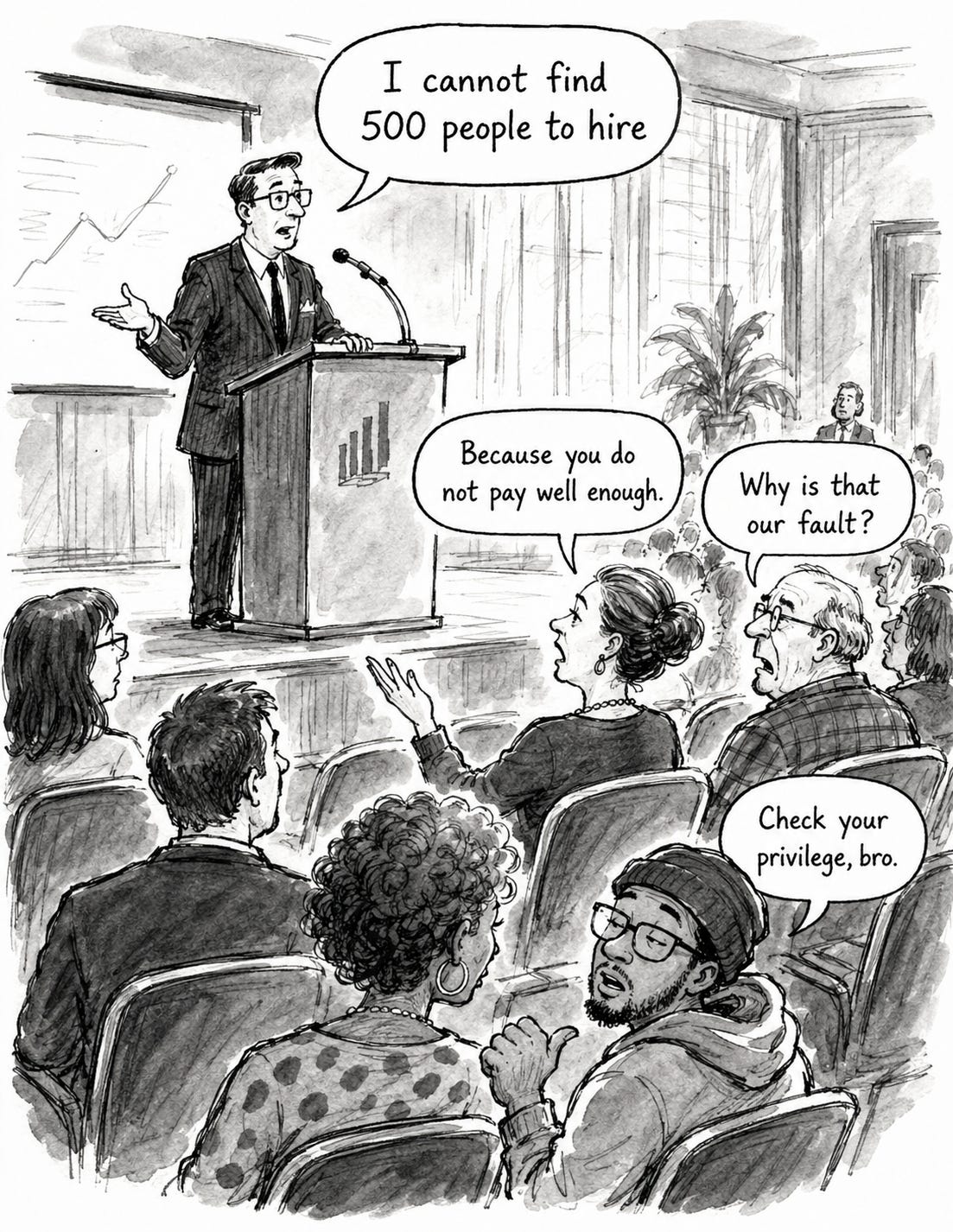
There is a funny thing that happens whenever a famous or high-status Nigerian says something true but inelegantly. Everyone immediately starts debating tone. In this case, it was the CEO of Moniepoint, one of Nigeria's fast-growing unicorn fintech companies, complaining about the dearth of talent in Nigeria, so much so that he could not fill 500 open senior positions in the company. Was he rude? Was he being elitist? Was he looking down on Nigerians? Could he have said it better? Is this another example of Nigerian tech people speaking as if they are the only smart people in the room?
All fair questions, perhaps. But tone is often where serious conversations go to die. I think the comments have generated strong reactions because they touched a nerve. Nobody likes to hear that their country cannot produce enough highly skilled people for its own best companies. It sounds insulting. It sounds like the sort of thing people say after raising foreign capital and attending too many conferences where they are asked to explain "Africa".
But the uncomfortable question is not whether Nigeria has smart people. Of course it does. That question is boring. The better question is what kind of economy produces senior talent at scale? Not brilliant individuals. Nigeria has always had those. Not people who can pass exams. We have those too. Not people who can hustle, improvise, survive, learn three skills at once, and make something out of almost nothing. If anything, Nigeria produces too many of those because it gives people no choice.
The question is narrower and more important: what kind of economy produces large numbers of people who have learned how to solve complex problems inside complex organisations? That is the question behind the outrage. And once you ask it properly, the issue stops being about one CEO’s phrasing and becomes a much larger indictment of Nigeria's development model - if it can even be said that it has one. Talent is not born. It is not summoned by LinkedIn posts. It is not produced by vibes, youthfulness, intelligence, or "tech ecosystem" branding. Talent is a product of institutions, and we know that is one area in which Nigeria has consistently fallen short.
Human Capital is not a Certificate
We talk about human capital as if it were a thing people carry around with them. Like a CV. Or a university degree. Or an online course certificate from Coursera. This is one reason the debate becomes confused very quickly. Someone says Nigerian graduates are not ready for work. Someone else responds that Nigerian youths are brilliant and hardworking. Someone else blames ASUU. Someone blames bad parents, culture, "yahoo", and "hookup". Someone blames colonialism. Someone posts a thread about how they learned Python in six months and now earn in dollars. All of these things can be true and still miss the point.
Human capital is not simply schooling. It is not even simply skill. It is the accumulated capacity of a person to function productively in the world: health, language, numeracy, judgment, discipline, confidence, social competence, technical knowledge, emotional regulation, practical experience, and the ability to learn further. The last bit is very important. A good education is not just what you know. It is whether you have been formed into the kind of person who can keep learning.
A recent World Bank report1 on human capital shed more light on this point. Human capital is built in a collection of settings: homes, neighbourhoods, and workplaces. It is not restricted to schools and classrooms. This sounds obvious until you apply it to Nigeria. By the time a company is hiring a senior engineer, product manager, operations lead, compliance specialist, data scientist, or finance controller, it is not merely evaluating "the education system". It is evaluating the entire social history of the candidate. Was the person well-nourished as a child? Did they grow up in a household where language, curiosity, books, and adult attention were present? Did they attend a school where teachers showed up and knew what they were teaching? Did they live in a neighbourhood where safety, electricity, transport, sanitation, and peer effects supported learning rather than constantly interrupting it? Did their first job teach them anything? Did their second job have competent managers? Did anyone ever show them what excellence looks like? The talent conversation gets trivialised because people enter the debate at the point of hiring, when much of the story has already been written.
As the World Bank report makes painfully clear, skill gaps appear very early. In some countries, children whose mothers have less education already show large vocabulary and mathematics deficits by age five, before school has had enough time to do much. These gaps then persist through childhood and adolescence. It means that by the time a child enters primary school, society has already made large investments in some children and large non-investments in others. The school then receives both groups and pretends it is starting from zero. Policymakers and other stakeholders in Nigeria always speak as if human capital can be repaired at the end of the pipeline.
We wait until university, then complain about graduates. We wait until NYSC, then complain that young people lack discipline. We wait until recruitment, then complain that candidates cannot write properly. We wait until a startup needs managers, then complain that there are no senior people. But that person being interviewed by Moniepoint at the age of 28 already began that journey when they were two years old. This is not to downplay personal responsibility. It is a pushback against magical thinking. Human capital is accumulated. The deficits compound, just like advantages.
Firms Don't Just Buy Talent
A firm that says it cannot find enough senior talent may be telling the truth. But if many firms say the same thing, the question is no longer simply: "What is wrong with schools?" It is also: "Where are people supposed to become senior?" Senior talent is produced by junior talent being placed inside organisations that know how to teach, challenge, discipline, reward, promote, and retain people over time. A school can teach you accounting. A firm teaches you how accounting works when invoices are late, when regulators have questions, when customers are angry, when software breaks, when the CFO wants numbers by 7 a.m., and someone somewhere is trying to steal from the company. A school can teach you software engineering. A firm teaches you how to maintain systems that cannot go down, work with legacy code, review other people’s work, communicate trade-offs, respond to incidents, and build products under constraints. A school can teach you management theory. A firm teaches you that human beings are complicated, incentives matter, information is always incomplete, and the organogram is usually lying.
This kind of knowledge is not appreciated enough. It is not "soft skills". It is not secondary. It is the core of productive competence. The great economist Kenneth Arrow made this fundamental observation in his famous idea (and paper) on "learning by doing"2. Production itself is a learning process. People and organisations become more productive by repeatedly making, coordinating, correcting, and improving. Knowledge is not only invented in laboratories or taught in classrooms. It is acquired in the act of doing.
Learning by doing happens inside firms through routines and process improvement; across firms through labour mobility, imitation, suppliers, and clusters; and at the national level when institutions learn from experience and embed those lessons into policy and production3. This is why the firm is such an important site of human capital formation. A good firm does not merely consume talent. It upgrades it. It takes a person with potential and gives them harder problems. It surrounds them with people better than them. It creates routines. It documents processes. It punishes sloppy work. It rewards competence. It lets people see how decisions are made. It exposes them to customers, regulators, technologies, logistics, capital, risk, and failure. After five years in such a place, the person is no longer the same way they joined. They become better.
In Nigeria, too many people spend their working lives in organisations that do not teach very much. They work in microfirms that are permanently close to death. They work for bosses who are themselves improvising. They work in businesses where there is no training budget, no management system, no documentation, no internal labour market, no serious mentorship, no process discipline, and no patient capital. They work in survival mode. You can learn many things in survival mode. But it rarely produces deep organisational capability.
The World Bank report says this directly. Workplaces are not only places where skills are used; they are places where human capital is built. But many workers in low- and middle-income countries are concentrated in jobs with little opportunity for learning: small-scale agriculture, low-quality self-employment, and microfirms. The report notes that returns to experience are lower among the self-employed than among wage workers, and lower in small firms than in medium and large firms. One person spends five years in a structured organisation with competent managers, demanding customers, audited systems, performance reviews, and exposure to increasingly complex tasks. Another person spends five years doing repetitive work in a small business where nothing scales and every month is a cash-flow emergency. Both have "five years experience." But they have not accumulated the same human capital.
This is one reason the Nigerian labour market is so strange. Employers ask for young people with ten years of experience because they want maturity without having paid for formation. Young workers want senior salaries because they know firms will discard them if they do not bargain aggressively. Firms underinvest in training because workers may leave. Workers leave because firms do not train, promote, or pay them enough. Everyone’s behaviour is individually understandable. The collective result is a low-capability equilibrium.
The Economy is the Curriculum
There is an even deeper layer to the problem. Human capital is not produced only by homes, schools, and firms. It is produced by the structure of the economy itself. A country’s real knowledge is not measured by how many people have degrees. It is revealed by what the country can do. Can it manufacture medical devices? Can it build reliable logistics systems? Can it run large hospitals? Can it design and maintain industrial machinery? Can it produce pharmaceuticals to standard? Can it manage ports efficiently? Can it regulate complex financial markets? Can it build software at scale? Can it export services competitively? Can it coordinate thousands of suppliers to deliver a high-quality product on time?
The economic complexity literature, associated with César Hidalgo and Ricardo Hausmann, argues that development is fundamentally about accumulating productive capabilities. These capabilities include skills, infrastructure, institutions, supplier networks, technical standards, managerial routines, and know-how. They are complementary. They work in combinations. Having one without the others is often useless. This is why development is so hard. It is not enough to say: "train more engineers.". Engineers for what? To work in which industries? With which suppliers? Under which standards? Using which machines? Serving which customers? Financed by which capital? Protected by which contracts? Regulated by which institutions? Learning from which senior people?
Capabilities are not isolated Lego blocks lying around waiting to be assembled. They are more like ecosystems. One capability makes another more useful. A country that already has many capabilities finds it easier to acquire new ones. A country with few capabilities struggles because each missing capability reduces the value of the others. Poor countries do not automatically catch up just because they are poor. They converge only when they accumulate the right combinations of capabilities that allow them to enter more complex activities. Otherwise, they remain stuck in low-productivity traps4.
I believe this should change how we talk about talent. A low-complexity economy can produce educated people. It can produce brilliant people. It can even produce globally successful individuals. But it will struggle to produce deep pools of experienced people in complex fields because the economy does not generate enough complex tasks. If the economy is dominated by trading, importing, arbitrage, political access, informal services, subsistence production, rent extraction, and small firms that never scale, then that is what most people will learn. They will learn how to survive, bargain, improvise, evade, endure, and move quickly. These are real skills. In Nigeria, they are often necessary skills.
But they are not the same as the skills produced by an economy full of export manufacturers, research labs, engineering firms, large hospitals, advanced logistics companies, competitive banks, deep suppliers, well-regulated utilities, and technology companies operating at the frontier. Moniepoint itself became a unicorn by making it easier to collect cash, not by fundamentally reshaping how Nigerians pay for things.
A Nigerian developer who has never worked inside a serious engineering culture is not stupid. A Nigerian nurse who has never worked in a properly run hospital is not lazy. A Nigerian technician who has never had access to modern tools is not inferior. A Nigerian manager who has only managed chaos is not genetically incapable of order. But talent develops through the kind of problems it solves. When the economy offers mostly low-complexity problems, it produces mostly low-complexity experience. The few people who acquire high-complexity experience often do so by leaving the country, working remotely for foreign firms, or joining the tiny number of local organisations that operate near global standards. So when executives complain about a shallow talent pool in Nigeria, perhaps it is because the pool is being filled from a very narrow river.
Economic Implications of Learning By Doing - Kenneth Arrow
Learning by Doing in Markets, Firms, and Countries - Naomi R. Lamoreaux
The Theory of Economic Complexity - César Hidalgo, and Viktor Stojkoski
Ngl, we all feel Nigeria is cooked, but do not know to what degree. What particular hit me was thus particular paragraph:
"This is one reason the Nigerian labour market is so strange. Employers ask for young people with ten years of experience because they want maturity without having paid for formation. Young workers want senior salaries because they know firms will discard them if they do not bargain aggressively. Firms underinvest in training because workers may leave. Workers leave because firms do not train, promote, or pay them enough. Everyone’s behaviour is individually understandable. The collective result is a low-capability equilibrium."
Thank you for the indepth analysis 🙏🏽
The Arrow observation about learning by doing is the structural insight that elevates this from a Nigerian talent debate to something with genuinely global implications and I dont think you've fully explored the scariest version of where your argument leads.
If firms are where senior talent gets built, and the mechanism is junior people being placed inside complex organisations where they encounter harder problems than school ever gave them, then the AI automation wave is about to create the exact same talent pipeline failure you describe in Nigeria but through a completley different cause.
Companies across every developed economy are automating the junior roles. The document review that taught junior lawyers how contracts actually work. The financial modelling that taught junior analysts what drives a business. The code review that taught junior engineers how production systems behave under load. Each of those tasks is being handed to AI because the cost saving is immediate and obvious. What isn't immediate or obvious is that those tasks were the training pipeline for the senior talent the company will need in five years.
Your phrase "we wait until recruitment then complain that candidates cannot write properly" applies with terrifying precision to what is about to happen globally. Companies will automate the junior work in 2026, save 30% on headcount, report it as efficiency gains, and then in 2031 discover they have no pipeline for the senior roles they desperately need. They'll blame universities. They'll blame "this generation." They'll blame everyone except the decision they made five years earlier to remove the developmental layer from their own organisation.
Nigeria's talent gap exists because the economy didn't produce enough firms that develop people. The global AI talent gap will exist because firms voluntarily dismantled thier own development infrastructure for a quarterly cost saving. Different cause, identical mechanism, same result.
The World Bank data on early childhood deficits compounding through adolescence maps onto the professional development curve perfectly by the way. A junior who misses their first two years of learning-by-doing in a firm is permanently behind, just like a child who misses early vocabulary development. The window exists and then it closes. Automating junior roles closes that window for an entire generation of professionals and the cost wont show up for half a decade.
Brilliant piece. This deserves a much larger audience than it currently has.