


Rwanda
Rwanda is the kind of country the world would scarcely mention were it not for the catastrophe of 1994 - and for what has been built in its wake under Paul Kagame. It is a country of modest scale (some 13 million people) and unusual population density at the heart of the continent. But this chapter cannot escape, nor does it try to escape, the brutal fact that dominates Rwanda's global reputation: the genocide, in which around 800,000 people were slaughtered, many hacked to death with machetes. It is difficult to read anything about Rwanda - growth statistics, clean streets, investor roadshows - without sensing that it is all written in the shadow of that abyss.
Studwell refuses to treat "Hutu" and "Tutsi" as different ethnic groups in any real sense. There is no clear evidence, he notes, that the groups have distinct ancestry; all Rwandans speak Kinyarwanda. Belgian administrators, captivated by the pseudoscientific "Hamitic thesis," designated the Tutsi minority as racially superior and the Hutu majority as inferior - then froze the distinction into identity cards from 1933, backed by skull measurements and other anthropometric nonsense. That history helps explain why 1994 keeps yielding fresh horrors no matter how many times one returns to it. Every reading seems to surface something new to me. This time it was Robert Kajuga: the leader of the genocidal Interahamwe militia was himself born to a Tutsi father and a Hutu mother, a fact he concealed while directing the slaughter against Tutsis.
Three decades on from that atrocity, there remains a central moral problem about Rwanda: Kagame himself. Rwanda's post-genocide recovery is popularly understood as a miracle of discipline and will, and Studwell concedes that "much of the developmental progress" is real. Yet he also calls Rwanda "an unsettling place." Citizens are surveilled constantly through phones and computers; the security services have penetrated not only Rwanda but, in Studwell's words, "many places outside"; and a trail of kidnapped and murdered exiles attests to the regime's long reach. Kagame emerges from these pages as extraordinarily vindictive - so ruthless that during the Ugandan war his comrades nicknamed him "Pilato," a nod to his readiness to order executions (much of the chapter relies on Michaela Wrong’s 2021 book, Do Not Disturb).
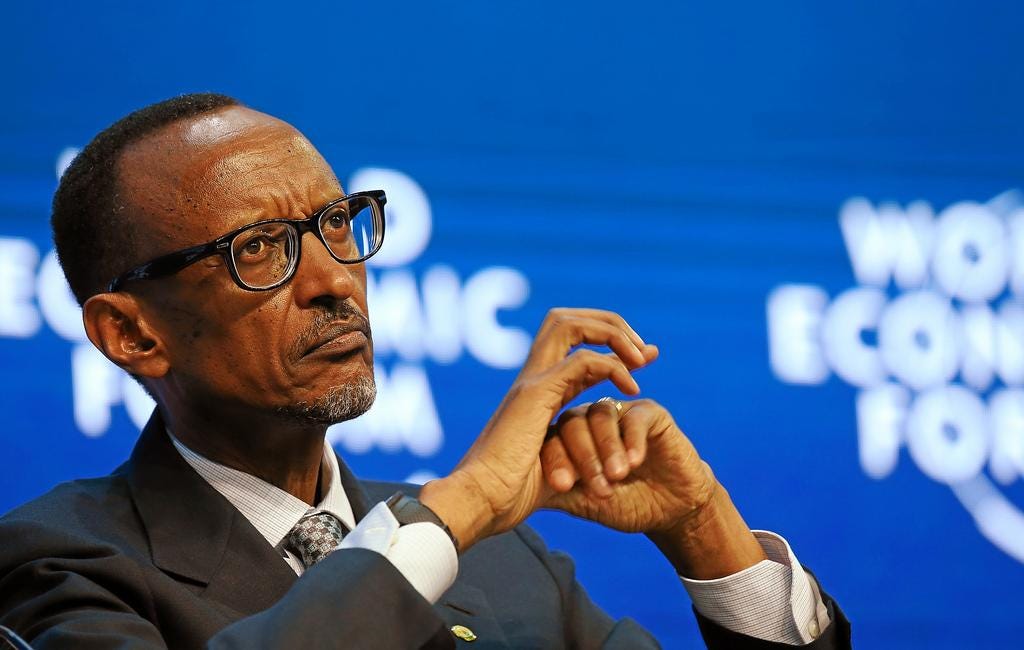
This ambiguity about Rwandan is further sharpened by Studwell's framing of the country as "Singapore in Central Africa". Kagame has long admired Singapore's one-party dominance and what he calls "no nonsense" governance - the willingness to crush opponents while co-opting talent into the state. Rwanda adopted both the aesthetic and the methods: immaculate streets, a ruling party that tolerates no rivals, a civil service capable of actually delivering. The economic analogy seems counterintuitive at first - Rwanda is landlocked, far from any port - but Studwell argues that Kagame sought to turn that very remoteness into leverage. High transport costs into Central Africa shield local producers from import competition while the same geography allows Rwanda sell logistics and financial services into a vast, underserved hinterland. Isolation, in that sense, has become its moat.
The problem is what that hinterland contains. Studwell is unsparing about Rwanda's treatment of eastern Congo as a resource-rich backyard. The post-1994 interventions make for grim reading: attacks on refugee camps in the DRC in 1996 that killed thousands of civilians; a subsequent UN report cataloguing hundreds of incidents and raising the spectre of genocide; and the second Congo war, which metastasised into one of the deadliest conflicts since 1945 - one estimate puts deaths from disease and hunger alone at 4.7 million. Whatever the exact details of these foreign adventures, their pattern is not contested. Rwanda's internal stability has been purchased, at least in part, through external violence and extraction from eastern Congo in particular. Kagame’s developmental state casts a long shadow.
Western donors, desperate for an African state that could actually deliver, have backed Rwanda heavily: since the early 2000s, aid has averaged around 40 per cent of the annual budget. Kagame built the Strategy and Policy Unit to absorb all that aid and monitor delivery, and a Rwanda Development Board modelled on Singapore's Economic Development Board. The results, under Vision 2020, were impressive: GDP growth averaged 7.8 per cent annually from 2000 to 2019, and GNI per capita climbed from roughly $270 to around $1,040 by 2024. But Studwell is sceptical of Vision 2050, the successor plan, that sets targets he dismisses as a "pipedream" - achievable only through sustained double-digit growth of a kind no country has managed for long.
Sector by sector, the picture is mixed. Agriculture has received genuine attention in the form of centralised fertiliser purchasing, improved distribution and extension services. But Kagame also dictates to farmers what to grow and where. Output has risen, though the gains remain modest. Industry tells a similar story of ambition meeting constraint. "Made in Rwanda" established industrial zones and courted foreign manufacturers; government-linked firms like NPD and Horizon moved into construction materials and road building. Yet manufacturing keeps colliding with fundamentals: electricity is ruinously expensive at $0.11/KwH (almost five times what it costs in Ethiopia), and in goods trade Rwanda imports vastly more than it exports. The export growth that has materialised comes largely from services rather than factories. Rwanda's Singapore wager, it turns out, works everywhere but on the factory floor.
The biggest warning sign, according to Studwell, is in politics not economics. Rwanda's "developmental coalition," he argues, is a "chimera." After a brief period in which Hutu politicians served as figureheads, Kagame took direct control. In a country that is overwhelmingly Hutu, genuinely free elections would not keep a Tutsi-led regime in power indefinitely; democracy, therefore, is something of a sham. The chapter's descriptions of staged "National Dialogue" spectacles and ritualised performance contracts ("imihigo"), conducted under the watch of an intimidating security apparatus, reinforce the point. What is called reconciliation looks less like organic healing than coexistence enforced at gunpoint.
So how should we judge Rwanda? I come away convinced that the usual postures - hagiography ("the Singapore of Africa!") or dismissal ("too small to matter") - are both unsatisfactory. Rwanda demonstrates what disciplined state capacity can achieve: execution, infrastructure, a stability compelling enough to attract donors and investors alike. But it also reveals how swiftly "development" can become an alibi for permanent coercion at home and predation abroad.
And if this is a "model," it is one built around an exceptional leader, an exceptional trauma, exceptional donor largesse, and a regional security environment that Rwanda has shaped in deeply troubling ways. In that sense, Rwanda does not solve Africa's development riddle. There isn’t much to copy here.
- Feyi
Agriculture
In the eighth chapter, Joe Studwell turns towards what has become his singular, uncompromising obsession: the transformative power of the smallholder farmer. Having explained Africa’s structural inheritance and examined four early movers, he turns to the continent as a whole and asks where development must now begin in practice. He argues that agriculture is not just a sector of the economy; it is the bedrock and critical early driver of all successful development. He presents a vision where the humble family farm is the only engine capable of kickstarting a national economy, reducing mass poverty, and creating the domestic demand necessary for industrialisation. It is a compelling narrative, but as I have noted throughout this review, there is some distance between Studwell's prescriptive policy logic and reality. I have written quite a bit on agriculture (too much to link individually, so curious readers can go to the archives page), so I will not repeat some of my previous arguments. Also, since there is only one more entry for this read-along, I will restrict myself to just two parts of the chapter that I consider most important, which are labour and farm size.
The Yield "Paradox"
Studwell's views on agriculture rest firmly on what he believes was the East Asian playbook. He argues that in a labour-abundant, capital-poor environment, smallholder family farms are objectively more efficient than large-scale, mechanised commercial operations. The assumption here is about the incentives of ownership and hired labour. On a small plot, a family will work every square inch with a degree of care and "self-exploitation" that a wage labourer on a plantation never will. By maximising yield per hectare rather than output per worker, a country solves the immediate problem of food security while creating a massive multiplier effect. Studwell notes that in Ethiopia, every 1% growth in agricultural value-added correlated to a 0.9% drop in extreme poverty.
This is the foundation of what he calls the "Birth of Demand." When millions of farmers move from subsistence to surplus, they buy tools, clothes, and processed goods, providing the initial spark for local manufacturing. For Studwell, this is a universal law of development, a sequence that cannot be bypassed. He insists that East Asia's success started with a rural transformation process - and the backbone of that process was labour-intensive agriculture, small plots, state support, and relentless pressure to increase productivity.
An Important Distinction
One of my favourite scholars on this subject is the economist John Mellor. Much of Studwell's policy blueprint can be found in Mellor's work, though Studwell rarely cites him. Ethiopia's agricultural transformation found approval from both men, to which I am in complete agreement. Under Zenawi's leadership, the state put agriculture before and above all else. It created a science-based modernisation checklist: state-provided fertiliser, high-yield seeds, and a massive army of extension workers. This meant doubling grain production in two decades and effectively ending famine as a mass phenomenon. However, Mellor departs from Studwell in one simple but important way. The true engine of agricultural transformation is not just any farmer, but the "small commercial farmer" and not the subsistence farmer.1 These farmers are the ones with enough land to produce a marketable surplus, adopt new technologies and, crucially, spend their increased income on local, non-tradable goods and services. This is what creates an employment multiplier that absorbs the rural poor who do not own enough land to be farmers themselves. While Studwell emphasises smallholder farmers as the key factor, Mellor argues that the type of smallholder also matters.
Does Size Matter?
This is an important question in many development seminars and conferences, as it is in the bedrooms of many romantic partners. Central to Studwell’s thesis is the Inverse Farm-Size Productivity (IFSP) relationship - the idea that small is always better. He uses this to justify land redistribution as a necessary policy. However, careful surveys of the evidence suggest a more nuanced position. Analysis by economist Dietrich Vollrath has shown that IFSP has a "U-shaped twist". 2 While yields fall as farms move from small to medium, they start rising again once farms exceed 10 hectares and can leverage capital such as tractors and modern irrigation.
This U-shape suggests two different peaks of efficiency: high yields driven by cheap family labour on the one hand, and high yields driven by machinery and capital on the other. One implication of this is that Studwell’s insistence on the smallholder-only path risks trapping African agriculture in a "valley of death", with medium-sized farms that are too big for family labour but too small for modern capital. If this dynamic holds, then a country that breaks up large, mechanised farms into medium plots will not get the Asian Miracle - they get a productivity collapse. This logic can be extended to argue that the efficient policy in such contexts might be to foster agricultural consolidation. Encouraging large farms that can leverage modern capital may be a better way to raise aggregate output, provided the landless small farmers have manufacturing jobs to move into. This is a transition that has eluded Ethiopia.
Africa is not Asia
I have said that one consistent theme in this book, perhaps inadvertently, is that Africa is not Asia. What makes Studwell interesting is his insistence that Africa must be Asia. I believe this to be wrong, but it is to a writer's credit that they are wrong in interesting ways. His model of agriculture and how it links to manufacturing is built on land-scarce Asia, where an abundance of low-cost labour and a scarcity of land made labour-intensive manufacturing the logical path. Economist David Ndii has criticised this model of Africa as a "Factor Endowment" category error3. He argued that in Africa, land is abundant and labour is scarce in relative terms. This makes Africa’s endowment more similar to Latin America. Because African agricultural productivity is so low, food is expensive. Because food is expensive, the reservation wage for factory workers is high, making African manufacturing globally uncompetitive.
The relevant argument here is that Ndii suggests that focusing on agriculture should not be a stepping stone to building garment factories, but a way to leverage Africa’s unique land abundance into a sustainable middle class. Trying to force an Asian labour-intensive model onto a land-rich continent is a faltering experiment that has led to a new wave of debt distress without stimulating private industry. There might also be something wrong with the specifics of this argument, but I agree with the general spirit that importing the Asian model of development to Africa has met with some hard constraints. Perhaps the greater wrong here would be to keep increasing the dosage of that formula.
Missing the Big Lesson
Before the birth of this publication, Feyi and I both watched Asia in our own ways and agreed that there are useful things to learn. But one important belief we both share, and which might be the most important lesson from Asia's success, is that creating markets works. Studwell's vision often glides over the granular frictions that development researchers have documented about agriculture in Africa4. They identify a "Yield Gap" that isn't just a result of poor policy, but of deep market failures. The most significant is risk. A smallholder farmer is not just a keen optimiser; they are also an extremely risk-averse survivalist. Research shows that without index-based weather insurance, a farmer is rationally justified in rejecting high-yield seeds.
Farmers are often cash-rich at harvest when prices are low and cash-poor at planting when inputs are needed. The cash-poor cycle of African farming means that even if a farmer wants fertiliser, they rarely have the liquidity at the right time to buy it. While Studwell calls for state credit, recent observations in Ethiopia and elsewhere show that it only succeeds when it creates an efficient credit market - otherwise state-led credit often becomes a monopoly for the elite, starving the very smallholders and SMEs it was meant to empower.
Research has also shown that the agricultural input market has a "market formation” problem and not a household optimisation problem. Agrodealers are often the final link between global input producers and farmers. They are often the only firms in rural areas. They are also often small, credit-constrained, and exposed to bankruptcy risks. Hence, if agrodealers do not have the finance to stock and do not trust the market, then farmers do not get inputs. Ultimately, this implies African agricultural stagnation is not primarily a farmer problem, nor a land reform problem, but a market formation problem on the supply side of inputs. While policy sequencing matters, policies must address the relevant constraint to work.
What becomes clear is that Studwell is too rigidly attached to his thesis and policy sequence, so much so that the three parts of the book read like three different books. He is right to stress the importance of agriculture, but beyond that, he had nothing relevant to say about agriculture in Africa.
Next week, which is the end of this read-along, I will outline my reasons why Studwell is wrong about everything.
-Tobi
The Inverse Relationship of Farm Size and Productivity. - D. Vollrath
Agricultural Technology in Africa. VoxDevLit, Vol 5, Issues 1 & 2. - Suri, T., Udry, C., et al. (2022/2024)
![How Africa Works [Chapters 9 -10]](https://substackcdn.com/image/fetch/$s_!M_sO!,w_140,h_140,c_fill,f_webp,q_auto:good,fl_progressive:steep,g_auto/https%3A%2F%2Fsubstack-post-media.s3.amazonaws.com%2Fpublic%2Fimages%2F6c15c8d9-e1bd-4ba5-8888-6a189b9f6d3a_2880x2159.jpeg)
Apart from the issues raised, Rwanda has an extremely problematic 'Development State' in which a) The main 'state' holding company is directly owned by the ruling political party; and b) the other one is fully owned by the Rwandan army!
Thanks so much for this. I've got Studwell's book queued up to read, and it's really helpful to have a critical commentary to accompany it.