

My co-author on Formation, Fola Fagbule, recently took a drive down the Lagos-Calabar Coastal Road and was struck by a few things. If you’re a certain age, you might remember that at a point in time, Lekki was the fastest growing urban area in the world. Lekki was also built from scratch and so it presented an opportunity for Nigeria and Nigerians to stamp their authority on the environment. What you see there today is the final outcome and it is left for you to determine how well it has gone.
As Fola says, the Lagos-Calabar Road offers another opportunity to avoid mistakes of the past.
The dazzling streetlights lend a glossy sheen to the boring grey tarmac. The welcome monotony of smooth asphalt is broken only by occasional glimpses of the stunning coastline at undulating contours. It continues for what seems like an eternity in the context of Nigeria, this most fundamental of civilisational implements: a functional road. Still under construction for an indeterminate cost, by a controversial contractor selected without the courtesy of a sham tender, commenced without so much as a cursory impact assessment – the multi-trillion Naira Lagos to Calabar coastal road has been forced from the drawing board into real life.
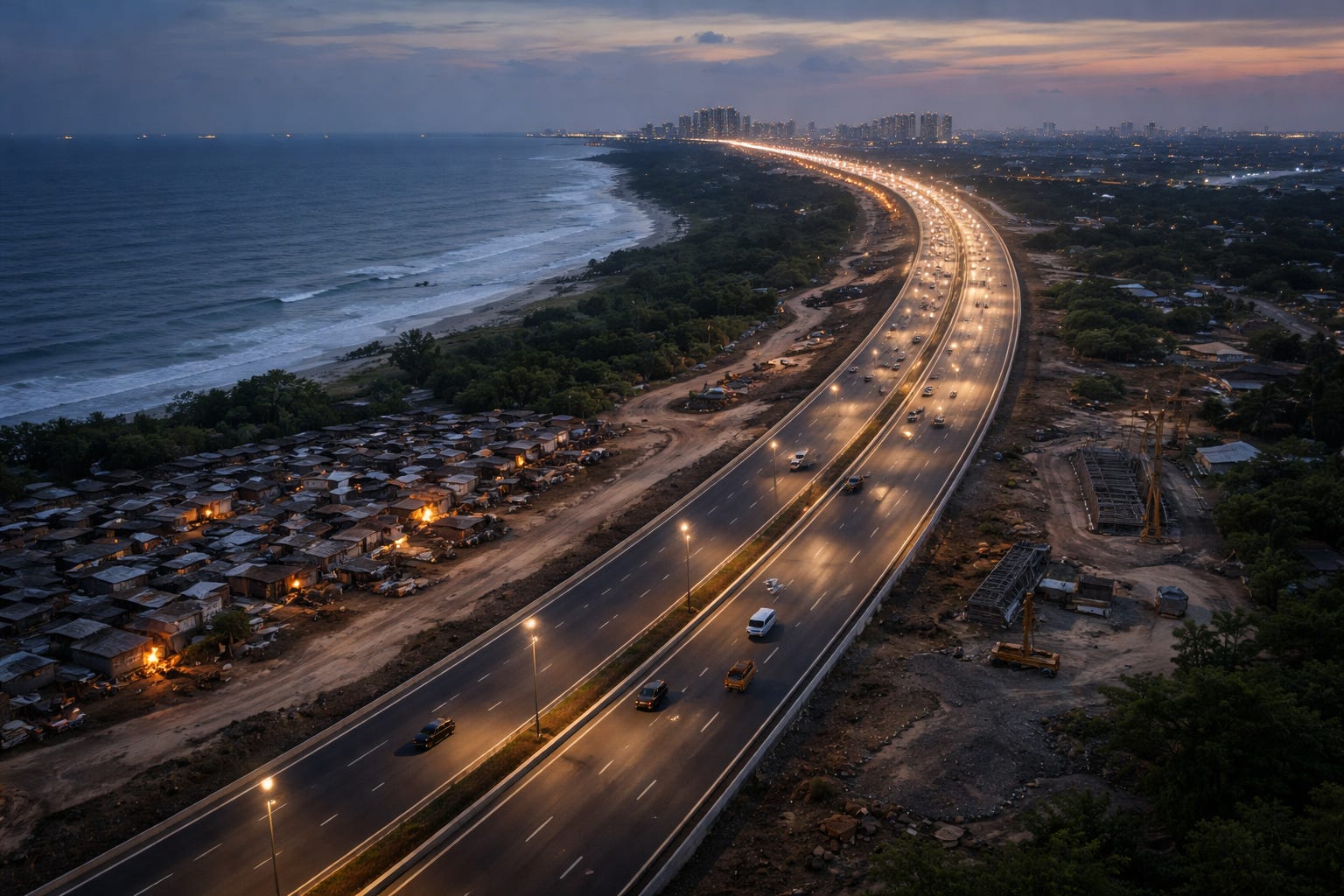
As always, real life is messier than any drawing board. The road to Calabar is at once an immediate boon for business, and a reliable vector and ardent amplifier of the systemic disorderliness endemic to Nigeria. Right from its first few kilometers, the transformational impact of the road is immediately evident. Notoriously easy to reduce into gridlock with little more than a single intersection being shut off to traffic, Victoria Island is the beneficiary of a new means of egress into Oniru and Lekki. Further up the road, dozens of neighbourhoods and communities hitherto considered barely livable on account of poor road connectivity are instantly transmuted into members of a new greater Victoria Island.
Running nearly parallel to the entirety of the existing Lekki-Epe road (itself already the catalyst for the fastest growing real estate development corridor in Africa), this new road will inject potent fuel into that fire. Even the most innocent of economics will easily recognise boom-town signals everywhere along this corridor that is already home to the recently built Dangote refinery and Lekki seaport. There is money to be made, property values are soaring, and new fortunes are being accumulated.
The situation could not be more different among those most unfortunate humans for whom the arrival of the road is an immediate existential matter - itinerant settlers living in shanties and sheds along its alignment. An amalgam of communities displaced by the relentless advance of new construction works, and new communities formed to serve the various needs of construction workers. A shapeshifting ghetto, an ever-expanding slum. The already weak capacity of the state to enforce the rule of any laws in Nigeria attenuates into non-existence under these conditions. A reliable incubator of criminality.
Among the more settled communities living along the evolving highway, the more distant risk of severe future environmental consequences along the coast due to structural design decisions being taken today is not an insignificant matter of concern. What will rising sea levels and shifting mangroves do to sedimentary basins, and what will be the impact of these material realities on coastal erosion, flooding and drainage in the long run? The only correct answer is that nobody knows. This ignorance is hardly unique to the communities along the new road. If the same question were asked about Banana Island or Eko Atlantic, two of the wealthiest neighbourhoods in Lagos, the answer would be much the same. Out of ignorance stems a lack of capacity to plan, a mere stop along the highway to failure. We are already intimate with what failure looks like: a megacity with grossly inadequate infrastructure of every kind leading to poor quality of life for everyone involved.
But what does good look like? The ability to plan effectively for the long-term and execute on that plan diligently is not a strength that Nigeria is famous for. What institutional framework exists that would survive the test of time - effectively coordinating the actions of the Federal, States and Local governments traversing the nascent economic corridor from Lagos to Calabar? What are the design principles of the corridor? How will spatial planning and land allocation work? Will there be a coherent zoning framework? What will be the role of independent technical experts? How can financing be optimized for all the infrastructure that must be procured? For good or for ill, what is being built is not merely a road to Calabar. It is the foundation for an inter-state economic corridor of immense potential. Sustainable economic corridors do not emerge merely because places become easier or faster to reach.
Planning, coordination, design thinking and the institutional and governance capacity to execute are the key ingredients. It is not often that a genuine case emerges for the creation of a new institution in Nigeria. A Lagos-Calabar Corridor Development Authority formed by and between the federal and relevant states and local governments may be ideal. This Authority would be well-funded and entrusted by its founders to develop the vision for the corridor, collect the necessary research information, create the masterplan, and ensure its implementation over a very long-term horizon. Significant wealth will be created, and material harm can be avoided if this work is properly done.
As we say in Nigeria, this work will not do itself. And the deadline to commence was already yesterday.
Fola Fagbule is a Nigerian banker, investment professional, and writer, best known for his work on infrastructure finance in Africa and for co‑authoring the history book Formation: The Making of Nigeria from Jihad to Amalgamation
Although Development Authorities have not been very successful in Nigeria (think River basin authorities), the great need for coordination required on this opportunity justifies using one. Its effectiveness will however depend entirely on whether we actually do things differently.
Without the article explicitly stating it- the primary objective of the road project was
to extract economic rents from a vast value chain: