

Unfortunately, it is not possible to dismiss any figure that relates to Nigeria’s NNPC, no matter how ludicrous it sounds. Nigerian newspapers have lately run stories about NNPC spending N11 trillion on “security”. Punch’s opening paragraph had it like this:
The Nigerian National Petroleum Company Limited recorded claims totalling N11.2tn from the Federation in 2025 for costs and advances incurred on its behalf, including expenses related to securing the country’s oil and gas assets, an analysis of its 2025 audited financial statements has shown.
For some context, the 2025 budget for the country had something like N6.11 trillion for the very broad category of national security. So even by the very low standards of the ghastly NNPC, this merits a second look.
The offending item is on page 106 of the accounts under note 24.2:
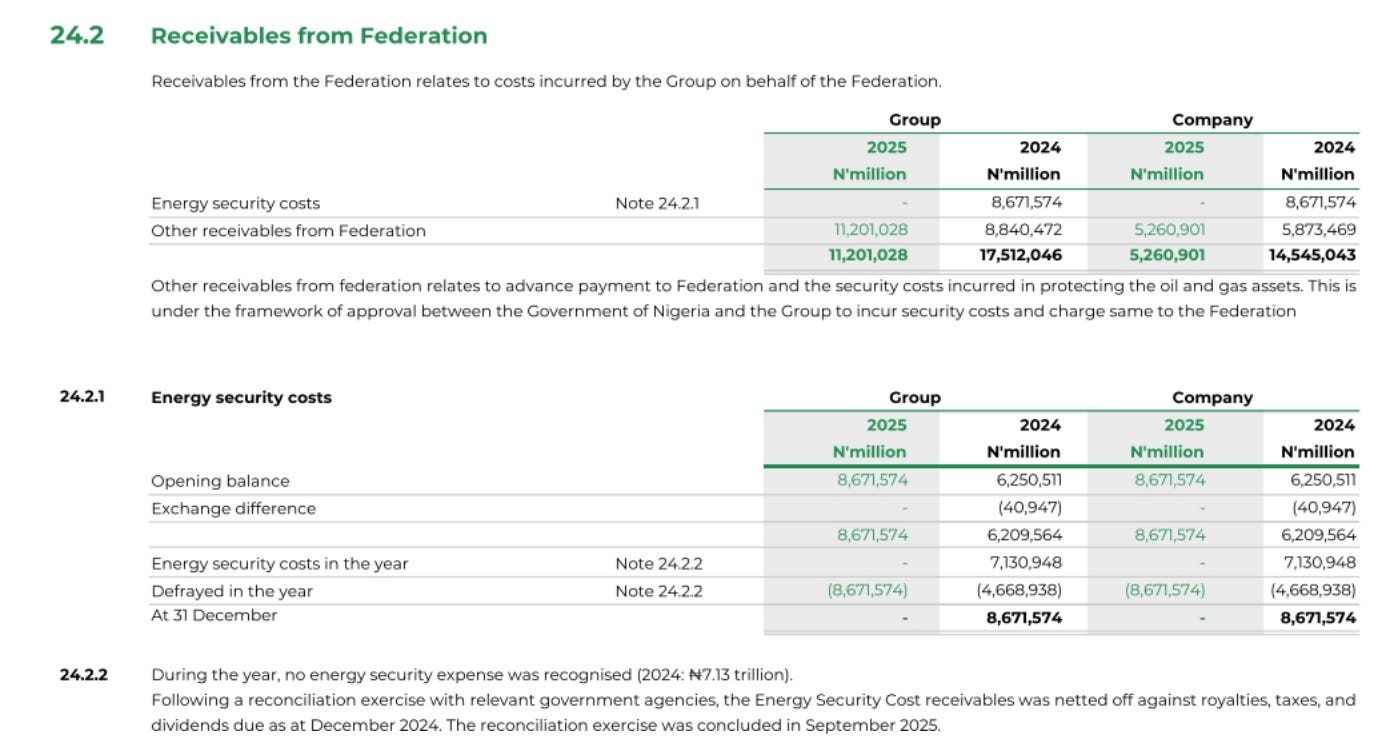
The first thing that’s obvious is that these are gross balance sheet assets. They are not an account of money that was spent during the year. The definition NNPC uses to describe the “Other receivables from Federation” creates additional problems because it does not split out how much of that N11.2 trillion represents security costs and how much represents advances.
The balance increased by N2.361 trillion, or 26.7%, during 2025. But even that increase cannot safely be called annual security spending since it is the net movement after additions less settlements, together with other adjustments. The note does not provide any reconciliation.
The separate “energy security costs” line needs explaining too. It is not the same balance as the N11.2 trillion of other receivables. But what does “Energy security” mean anyway? To find that I had to go back into the previous year’s (2024) accounts under note 25.2.3 (page 78):
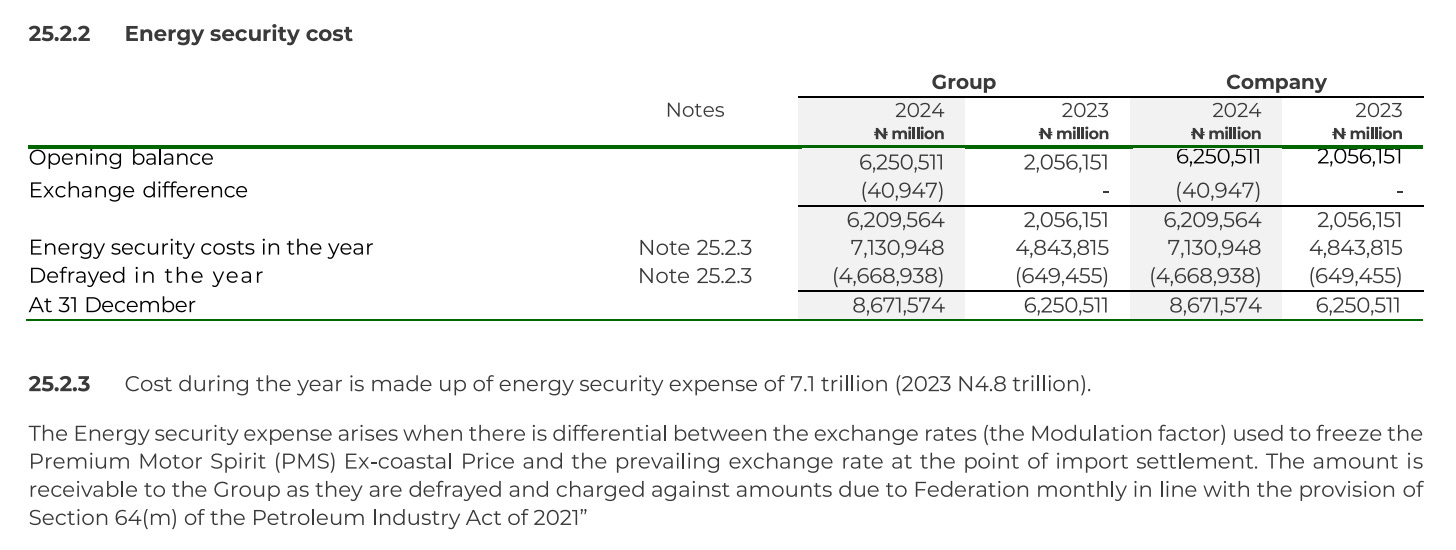
In other words, petrol subsidy. Now that the ongoing low-energy presidential election campaign has been somewhat enlivened by the topic of returning petrol subsidies, this is a useful reminder of how much the previous subsidy regime cost.
NNPC recognised N7.13 trillion of new energy-security costs in 2024. After settlements, the outstanding claim stood at N8.67 trillion at year-end ($5.56 billion). No new costs were recognised under this heading in 2025, when the entire balance was cleared against royalties, taxes and dividends owed by NNPC to the Federation. Anyone who is promising to return this thing really needs to be pressed on how they are going to pay for it.
Pipeline security means something quite specific and politically charged in Nigeria so giving this N11.2 trillion a “security” tag is bound to raise eyebrows and cause a lot of cynical whispers. There are actual security expenses in the accounts. If you go into note 10, you see this N129 billion in there:
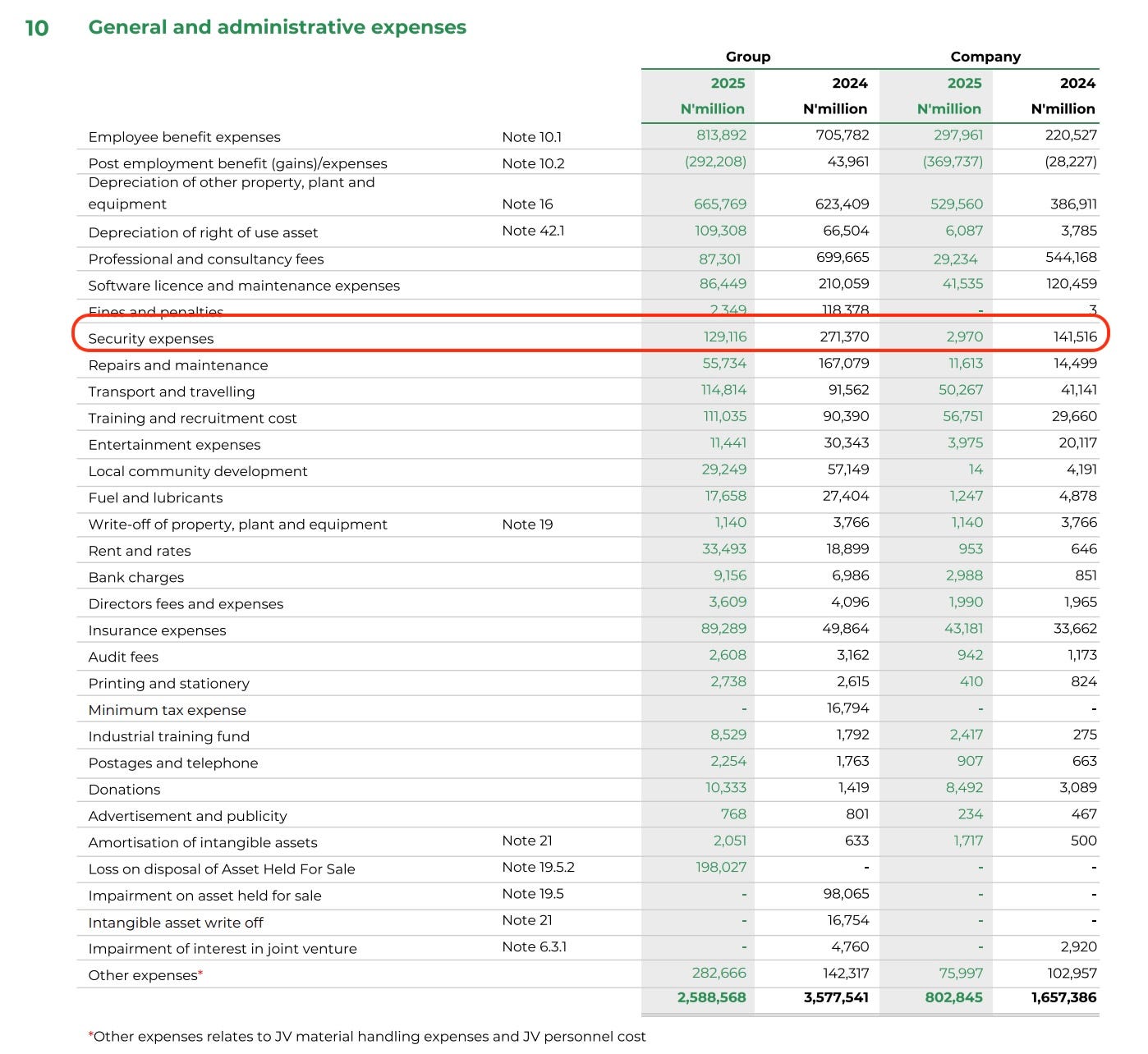
And if you go to note 8, you see another security expense embedded inside a line of N213 billion:
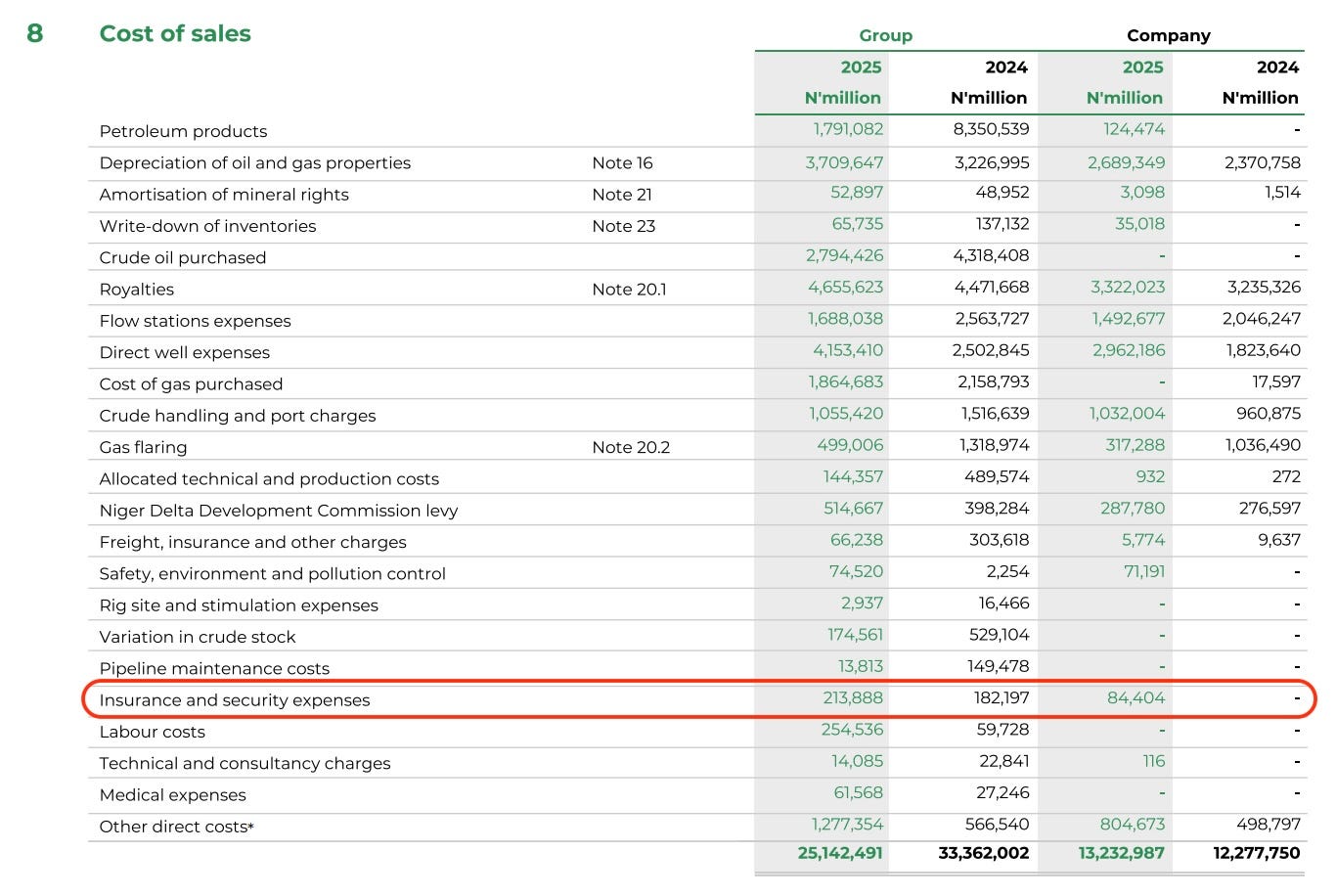
Even counting the insurance component as security, these two expense lines total N343 billion. That is unlikely to be a complete security bill as the accounts do not identify the asset-protection costs buried in the N11.2 trillion receivable.
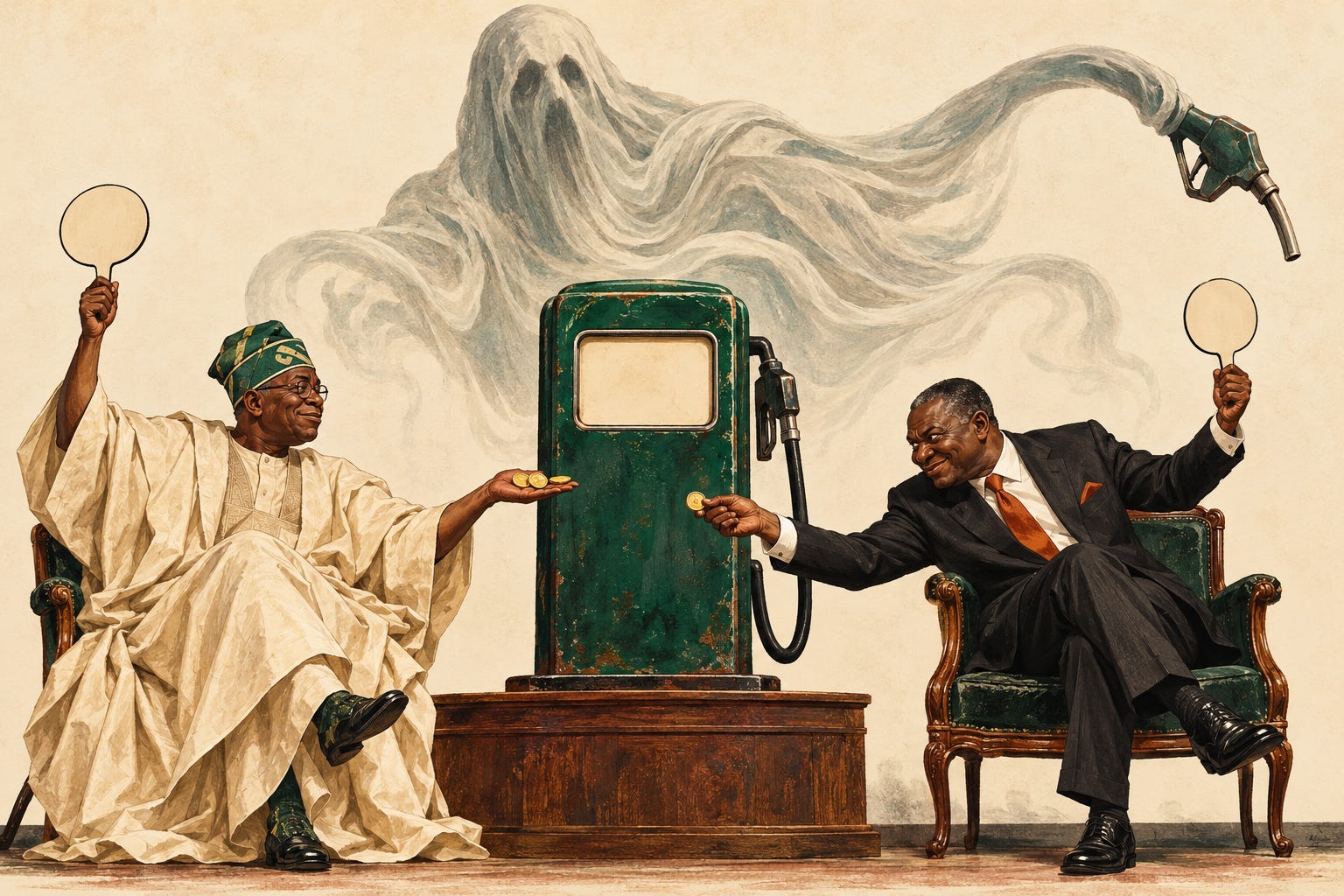
But as I alluded to at the start, the purpose of this small controversy is actually to remind Nigerians of what the fuel subsidy regime (or more accurately, naked hedge) cost. It was like a parasite that systematically destroyed the Nigerian government’s finances from the inside out. It swallowed revenues that could have financed public services (at least in theory) and left the government exposed to a bill that rose with oil prices and a weakening naira. The damage it did will continue into the foreseeable future.
Given all of this, it is of course not surprising that Nigerian politicians are now competing to show who can bring it back in the most damaging way possible. Donald Duke, a presidential candidate who ought to know better (but who am I kidding), has promised to bring back petrol at N300 per litre ($0.23). Earlier, some guy who says he’s running for president under the SDP, bid this down to N200 per litre. Peter Obi says he will “remove the corruption and retain the subsidy”, whatever that means. And then, today, the finance minister announced plans for a “price modulation” as the government’s response. He said it is “neither a subsidy nor a price control: it is designed to smooth prices over time rather than suppressing them”. If you believe that, then you’ll believe anything.
This is not to say that the announcement of the subsidy removal in May 2023 did not inflict a damaging wound on Nigerians that was made worse by the government’s lack of imagination or effort in cushioning the blow. All of those things are true. But Nigerians should soberly consider that what these desperate politicians are proposing are not solutions. You can have a country (barely) or you can have a subsidy with a country attached to it, which is what the old regime turned Nigeria into.
These political promises are unserious.
Did Nigeria ever actually have a petrol subsidy? Is there an accounting of the details of the subsidy like actual vetted consumption, actual recipients of these subsidies and so forth? Or are we just looking at bulk figures with no underlying detail? Was subsidy removed or was the price of fuel increased?