

There is a specific pain that has really hit Nigerians since the removal of fuel subsidies in 2023. While some of the shocks like inflation were expected but no less painful or avoidable, the thing that has been a body blow to a lot of Nigerians is the cost of moving from one place to another. In other words, transportation costs.
For a while now, I have been discussing this issue with a friend who really opened my eyes to the damage transportation costs have been doing to Nigerians (we hope to have him on the podcast to discuss this soon). The problem is hiding in plain sight but if you were to listen to the cast of characters currently running for office in the upcoming elections, you’d barely hear them mention it. I have lately been collecting seemingly random stories in Nigerian (and foreign) media that illustrate this problem in isolation. Here are seven such stories in no particular order.
Some parents are cutting their kids attendance in school to three days a week to save on transport costs:
Solomon Enemona, a parent in Dutse Alhaji, said he previously spent N800 daily on transportation for his two children to get to their school in Kubwa but now spends N2,000 to the same location.
Mr Enemona noted that consequently, he reduced the number of days his children attended school from five to three weekly, to enable him to meet other essential household demands.
Peoples Gazette - October 2026
Some bank staff have been secretly sleeping in their offices:
While most residents of Lagos Island were just beginning to stir from sleep at about 5:30 a.m., 28-year-old bank worker, Samson Adeyemi was already in the restroom of his office building, hurriedly brushing his teeth before colleagues arrived.
For nearly eight months, the customer service officer had turned a small corner of his office into a makeshift bedroom.
Unable to cope with the rising cost of transportation and accommodation in Nigeria’s commercial capital, he spends most weeknights in the office.
“I leave the office around 6 p.m. and resume by 7 a.m. the next day. If I go home to Ikorodu every day, I could spend over four hours in traffic and spend around N5,000 on transport daily. My salary cannot comfortably cover it anymore,” he told PUNCH Healthwise.
Punch - June 2026
Below The Headlines readers would have seen this when I included it in the newsletter last year. Residents in a rural area have become so isolated that they have revived their old market so they don’t have to travel to another market:
This village in the Niger Delta has started to feel more like an island.
People here say they used to regularly leave Ngwoma, along its dusty roads lined with papaya and banana trees — to go to the doctor or visit the market in bigger towns nearby. But these days, the price of fuel is keeping many of the village’s 2,500 residents at home.
[…]
When the fuel subsidies were still in place, the local market had shrunk to a fraction of its original size because it was cheaper for residents to travel to larger towns, where goods are less expensive. With many now largely confined to the village, residents are trying to revive the traditional market.
Washington Post - July 2025
One teacher lived away from his children so he could afford to go to work:
For Mr Olawale Lawal, a teacher and father of three, the reality became unavoidable about three years ago. Until then, Lawal travelled five times a week between his home in Ota, Ogun State, and his workplace in Ogba, Lagos. At the time, he spent about N2,500 daily on transportation. But following the sharp increase in transport fares after the removal of fuel subsidy in 2023, the arrangement became increasingly difficult to sustain.
“At a point, going to work from home every day became unsustainable because I realised that more than 50 per cent of my monthly take-home was going into transportation. And that began to affect my ability to meet up with my financial responsibility for the family,” he said.
Faced with the reality of spending a significant portion of his salary merely getting to work, Lawal began looking for an alternative. “As a result, I decided to make arrangements such that I would not have to go home on a daily basis. The first decision was to stay with a family friend in Agege, but after a while, a colleague and I decided to get a manageable apartment at a location close to our place of work where we reside between Mondays and Fridays,” he explained. The arrangement solved one problem, but created another: Lawal could no longer enjoy the everyday presence of his wife and children.
The Sun - September 2026
Rains and time of the day have a big impact on transport costs:
For Chichi Okafor, a sales attendant at ASPANDA Market in Lagos, the impact has been deeply personal. Okafor said her monthly earning was N45,000 in 2023; although she now earns N60,000 she is not better off as the increase is not commensurate with the hike in prices of other daily consumables between 2023 and now. As a result, she is now more troubled navigating through life and lives on a support system to survive monthly.
According to her, immediately President Bola Tinubu announced removal of subsidy, the pump price of fuel increased and transport fare between Mile 2 where she stays and Trade Fair where her workplace is located got increased by almost 100 per cent. She stated that the U.S.-Iran war has further compounded the situation, disclosing that transport fare between Mile 2 and Trade Fair, which was N200 before subsidy removal, has gone up to between N400 and N500 and occasionally N700 especially during peak period. According to her, the fare increases to N1000 when it rains during peak hours. She added that a plate of rice in the market before subsidy removal was N500 but it is now N1000 with even a smaller meat.
Guardian - July 2026
Transport costs have been going up faster than school fees and parents are getting sticker shock from the increase:
For instance, at Little Oaks School, Maryland, a parent, Akin Olaofe, said tuition increased from N220,000 to N286,000, while the school bus fare rose from N60,000 to N100,000 per term.
At Immaculate Schools, Ogba, Lagos, a parent said fees for day students increased from N180,000 to N234,000 per term, while the school bus fare rose from N50,000 to N90,000. The proprietor of Brilliant Minds School, Akute, Ogun State, Mr Femi Anjorin, said the rising cost of running the school has necessitated fee increases to reflect current realities.
Similarly, Tower Gate Schools, Ojodu, Lagos, increased school bus fees from N40,000 to N85,000 per student, while tuition rose from N165,000 to N214,500. At Blooms Private School, Omole, Lagos, a teacher said students now pay N90,000 for the school bus, up from N50,000.
Guardian - May 2026
And finally, in Abuja, workers have been turning to pickup trucks:
Rising transport costs and declining purchasing power are forcing workers in the Federal Capital Territory (FCT), Abuja, to adopt desperate measures to survive, including riding in the open backs of pick-up vans and turning private cars into commercial taxis to supplement their incomes.
For workers earning around the N70,000 national minimum wage, the rising cost of transportation, food, accommodation and education has made it increasingly difficult to meet basic needs.
Some commuters now risk their safety by travelling in pick-up vans because they are cheaper than commercial buses, while employees who own vehicles charge colleagues for rides to offset the cost of fuel.
Patience, 28, who lives in Masaka, a satellite community on the outskirts of Abuja, earns N77,000 monthly but spends about N2,000 daily on transportation.
Daily Trust - October 2026
We can’t not check in on Instagram as well to get the pulse of the nation. I was struck by this random video where the popular actress and filmmaker Toyin Abraham was launching her annual praise concert.
In the video she announces food for everyone and the cheers go up from the crowd. But when she announces she would refund transport fares? Even louder cheers than for food.
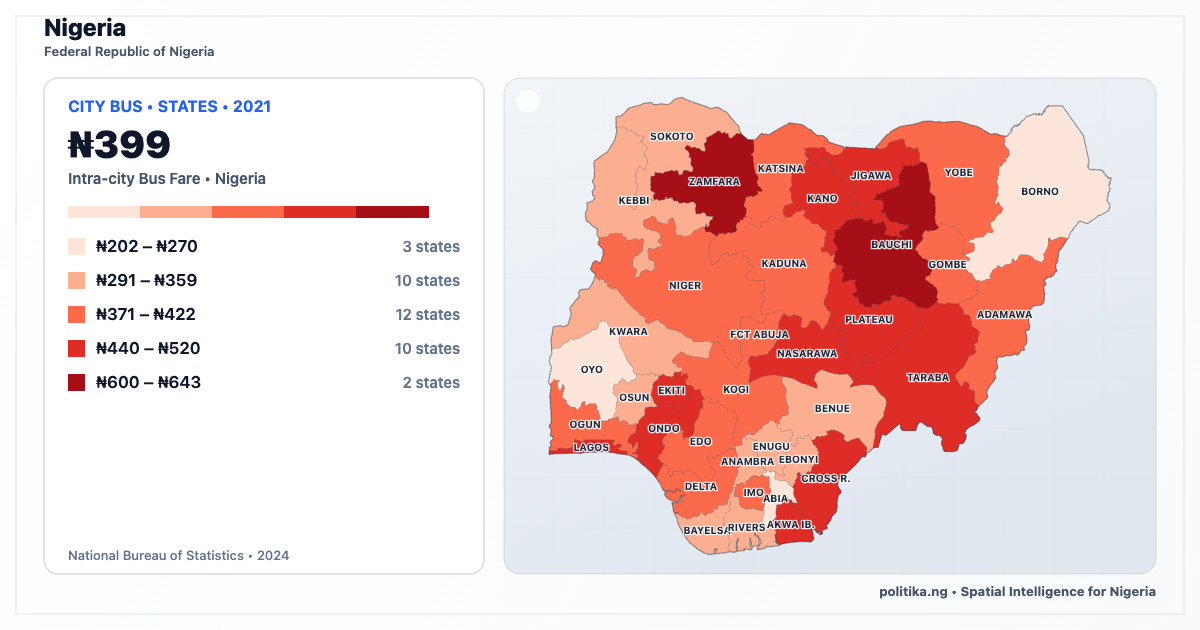
The single most impactful thing the Nigerian government (who removed the petrol subsidies) could have done to positively impact the lives of Nigerians and cushion the blow of the economic shock would have been to come up with a well thought through transport plan. The data bears out what needs doing. Courtesy of Politika.ng, a new website that aggregates NBS and other data sources, I can check what average intra-city transport prices were in 2021 (no available data for 2022):
And when I check for the latest figures available for 2024:
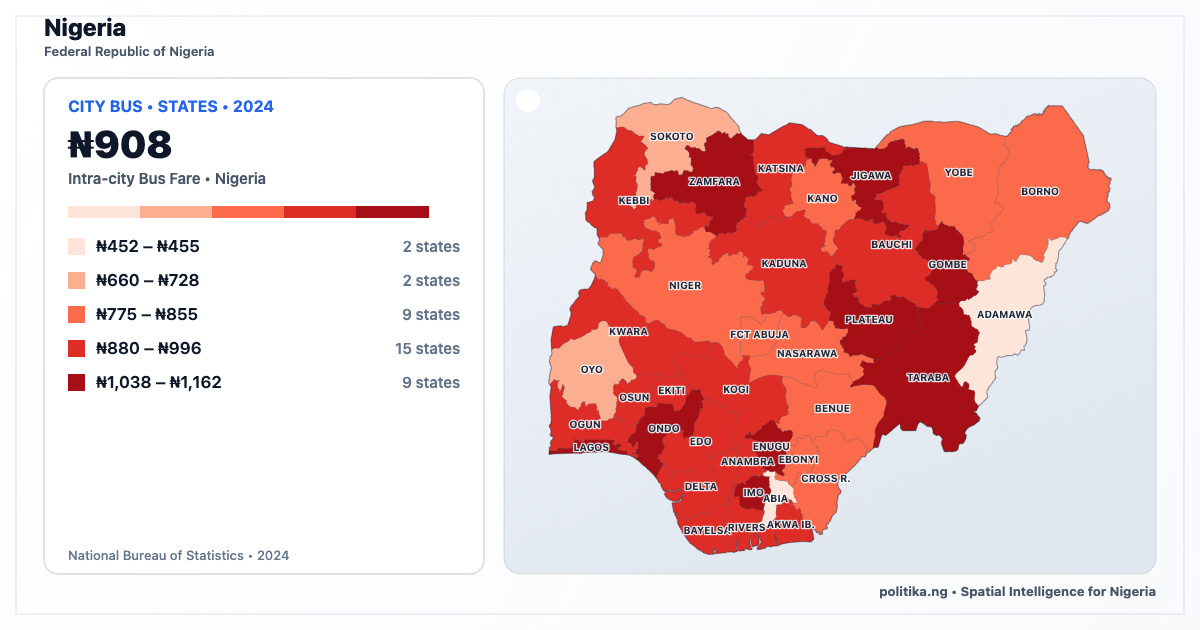
Things are certainly much worse now even with a doubling in prices in a couple of years.
CNG is the way and the truth
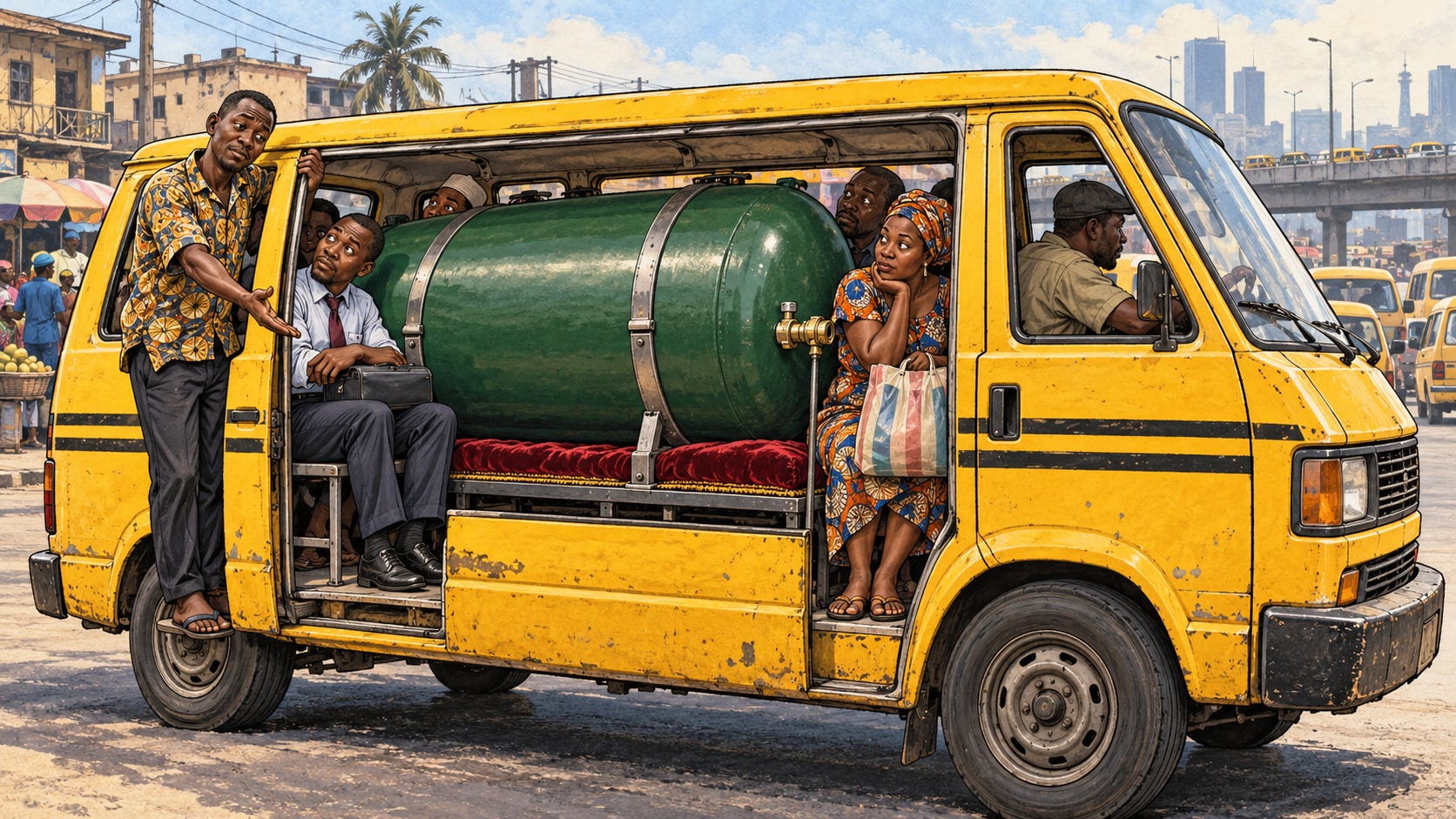
And yet, what has been the government’s response to all of this? It has presented a switch to Compressed Natural Gas (CNG) as its flagship national response to the transport-cost shock following subsidy removal. President Tinubu has repeatedly presented it as the means by which Nigerians would obtain cheaper transport fares, attached substantial promises to it, and built a dedicated presidential programme around it.
In his Independence Day speech on 1 October 2023, four months after he was sworn in as president, he said:
16. Making the economy more robust by lowering transport costs will be key. In this regard, we have opened a new chapter in public transportation through the deployment of cheaper, safer Compressed Natural Gas (CNG) buses across the nation. These buses will operate at a fraction of current fuel prices, positively affecting transport fares.
17. New CNG conversions kits will start coming in very soon as all hands are on deck to fast track the usually lengthy procurement process. We are also setting up training facilities and workshops across the nation to train and provide new opportunities for transport operators and entrepreneurs. This is a groundbreaking moment where, as a nation, we embrace more efficient means to power our economy. In making this change, we also make history.
10 months later in August 2024, in another national broadcast, he promised a transport cost reduction of 60% through the CNG initiative:
18. We have started the distribution of conversion kits and setting up of conversion centres across the country in conjunction with the private sector. We believe that this CNG initiative will reduce transportation costs by approximately 60 per cent and help to curb inflation.
A few days later, at an event to ‘inaugurate’ 30 CNG buses donated by DAPPMAN and NNPC, he once again linked the switch to CNG with lower transport costs and reduced spending on imported fuel:
”Countries like India have mandated CNG for all commercial vehicles since 2004. In Nigeria, commercial vehicles make up about 80 percent of our petroleum demand, costing us trillions of naira every month.
”The solution is here. We have it. We will work on it. We promise you, definitely, things will get better. Prosperity will be achieved,” the President said.
That claim about India is false by the way. India imposed CNG requirements on particular fleets in particular cities, most famously Delhi. It did not require all commercial vehicles across the country to use CNG from 2004. On 11 December 2003, India’s Petroleum Ministry published the main provisions of the National Auto Fuel Policy, which had been presented to Parliament. The policy recommended encouraging CNG and LPG in cities suffering high pollution, while allowing vehicle owners to choose their fuel and technology. It also set future emissions requirements for interstate buses and trucks.
In fact in October 2023, when Tinubu was promoting CNG, the Commission for Air Quality Management set requirements for interstate and intercity buses serving Delhi and the surrounding National Capital Region. The rules expressly applied to both state-owned and private operators, with deadlines extending into July 2024. The announcement also described state governments’ plans to buy thousands of new diesel buses during 2023–24.
But let’s not let facts get in the way of a good story, eh? Back to President Tinubu and CNG. Most recently in September, he issued a dedicated statement on the National Affordable CNG Transit Programme in which he described an agreement with all 36 state governors to pursue measurable reductions in transport costs from 1 October, and an implementation committee under the Nigeria Governors’ Forum. He explicitly rejected restoring petrol subsidies and said “at a time like this, our answer cannot be to return to the ruinous petrol subsidy regime that consumed trillions of naira and left our economy exposed to every movement in international oil prices, as some have suggested. We must accelerate the cheaper alternatives we have been building at home.”
There have been actual policy decisions formulated around CNG as well. On 31 July 2023, Tinubu announced provision for ₦100 billion to acquire 3,000 twenty-seat CNG buses by March 2024. Participating transport companies would receive financing at 9%, repayable over five years. On 18 August 2023, he formally established the Presidential Compressed Natural Gas Initiative, explicitly to ease the effects of subsidy removal. Its initial targets included more than 11,500 new CNG vehicles and 55,000 conversion kits, with an early focus on mass transit and student hubs. On 13 May 2024, he directed ministries, departments and agencies to procure CNG-powered vehicles, and ordered that procurement proposals for conventional petrol vehicles be rejected and revised. Finally, on 1 October 2024, in another Independence Day address, he said the federal government would assist all 36 states and the FCT in acquiring CNG buses for cheaper public transport.
I have taken time to lay this out to make it clear that CNG has been the government’s undisputed top priority in terms of a response to the transport problem. Earlier this year, there was some belated attempt to consider EV buses and Tinubu then expanded the presidential initiative to cover EVs and charging infrastructure. The presidential initiative was then renamed Pi-CNG & EV. But this was no more than an afterthought.
The question to ask is how did the Nigerian government decide on CNG as the solution and then double down on it as it did? What experiences from other countries led it down this path? Why did a programme requiring substantial investment in fuel distribution and vehicle conversion become the headline answer to an immediate nationwide affordability crisis and where is the evidence that it offered the greatest passenger benefit among the available options?
What the literature says
The most useful starting point is Sonia Yeh’s eight-country study in Energy Policy [PDF], published in 2007. She found that wide adoption needs CNG pump prices 40–50% below petrol and a conversion payback of three to four years or less. Without these, markets fail even when there are enough stations. In every country she studied, the price gap was created by government incentives, and she judged that none of the markets would survive if that support were removed. A driver must recover the conversion cost through savings accumulated over actual distance driven. That favours vehicles which travel frequently, provided refuelling does not disrupt their work. In other words, CNG for cars has rarely been a market in its own right. It is a price gap that needs to be created by policy.
A 2015 World Bank report recorded the expansion of Pakistan’s CNG fleet from about 120,000 vehicles in 2000 to 2.74 million in 2010, followed by gas shortages, rationing and restrictions on further expansion. In February 2026, Bangladesh ordered CNG stations to close for six hours a day during part of Ramadan to preserve gas supplies for electricity generation. A 2021 study comparing diesel, CNG and electric buses in Bangkok found that CNG buses had the lowest modelled lifetime cost, while electric buses performed better on environmental and health impacts. Its cost comparison assumed that diesel and CNG refuelling infrastructure already existed (a significant limitation in Nigeria, where the CNG refuelling network was still very limited), while including infrastructure costs for electric buses.
A June 2022 Centre for Science and Environment report, produced in collaboration with Nigerian ministries, recommended prioritising suitable, high-mileage public transport vehicles and reliable refuelling infrastructure, while coordinating CNG investment with electrification. A government-hosted Energy Transition Plan presentation recommended prioritising preparations for electric vehicles over CNG conversions. It referenced World Bank reviews suggesting higher-than-expected conversion scale-up costs and warned that CNG infrastructure could become stranded as vehicles shifted to electricity.
CNG around the world
I wanted to do a quick tour around the world to get a sense of different countries’ experiences in trying to push CNG adoption for transport. Perhaps it might tell us something as to how Nigeria arrived at this solution.
New Zealand supported CNG adoption in the early 1980s with loans covering the full cost of converting a vehicle. Favourable loan conditions were withdrawn in 1985, and the government removed CNG subsidies in 1987. Vehicle use and the refuelling infrastructure subsequently collapsed. The earlier referenced Yeh study also identified various problems with fuel and conversion quality during the rapid expansion between 1980 and 1985, which damaged consumers’ perceptions of the vehicles. By the time of her 2007 study, she described the New Zealand CNG market as effectively dead.
Argentina’s 1984 programme initially tried to replace imported diesel in public transport. A 2011 study found that urban buses remained predominantly diesel-powered anyway during the period studied. Operators faced the cost of changing their fleets and maintaining two technologies, while government pricing policies gave diesel a competitive advantage. CNG adoption was concentrated in vehicles converted from petrol (retaining the ability to use either fuel). Interviewees also identified shorter driving range and the loss of boot space to gas cylinders as disadvantages for car owners. An industry assessment estimated that CNG-converted vehicles accounted for 11.2% of Argentina’s circulating fleet at the end of 2024.
In India, Delhi’s early adoption programme encountered problems with refuelling and vehicle maintenance. In March 2002, 55 of the city’s 94 CNG stations depended on gas delivered by road. An account of the programme said that inadequate gas pressure increased filling times and produced long queues. Delhi subsequently expanded its pipeline network and by April 2020, it had 419 CNG stations. The same report describes inadequate maintenance support from companies converting existing buses. Authorities eventually discontinued the conversion of existing public transport buses in favour of buying new CNG buses from manufacturers.
Pakistan initially encouraged adoption through tax exemptions for refuelling and conversion equipment, alongside priority gas connections for CNG stations. By 2010, it had 3,331 stations. The World Bank’s 2015 review linked subsequent shortages to declining domestic gas production and reserves, with power generation and industry also affected. A government programme started in 2010 tried to reduce public’s transport’s gas consumption. Its included “gas holidays” during which supplies to CNG stations were cut for several days each week and a ban on imports of conversion kits and cylinders. The report also mentioned later restrictions on manufacturers’ conversion activities.
In Bangladesh, CNG refuelling has been affected by interruptions further upstream in the gas system. A fire at a floating LNG import terminal on 21 July 2026 was followed by roughly two weeks of shortages in Chattogram. In its report on the terminal’s partial restart on 6 August, the national news agency, BSS, described low pressure and long queues at CNG stations. An autorickshaw driver said he had struggled to obtain gas during the preceding fortnight. Station operators reported that pressure improved and queues shortened as supplies resumed. The disruption affected CNG vehicles through the gas distribution network, although the damaged facility handled imported LNG.
In Malaysia, the Malaysian Gas Association’s 2016 review reported that the regulated CNG price left Petronas, the country’s sole CNG supplier, making losses and discouraged other suppliers from entering the market. In November 2024, Transport Minister Anthony Loke announced that gas-powered vehicles would no longer be registered or licensed for road use from 1 July 2025. He reported 44,383 active registrations under the natural gas for vehicles (NGV) programme, representing 0.2% of registered vehicles (excluding motorcycles). Among other issues, the government cited ageing fuel cylinders and difficulties obtaining genuine replacement parts leading to unsafe modifications. Loke said cylinders had a service life of approximately 15 years and replacing components with genuine parts could cost more than RM7,000 (US$1,715) per vehicle. Petronas Dagangan’s 2025 integrated report later confirmed that the NGV operation had closed and its facilities had been decommissioned by July 2025.
Thailand is Malaysia’s twin. The state company PTT was made to absorb the subsidy and build stations, on the assumption that cheap gas would create enough volume to become profitable eventually. That never happened. In 2013 PTT sold NGV at 10.5 baht/kg (8.5 for taxis) compared with costs of 15.5–16.5 baht and its losses grew as drivers switched from oil to gas. By 2024 it had absorbed over 150 billion baht (US$4.2 billion) in subsidies, and 217 of its 513 stations had closed. The CNG fleet fell from about 371,000 vehicles in 2019 to about 216,000 in 2025. In July 2024, a research firm forecast that battery-electric vehicles would account for nearly half of new taxi registrations that year.
In Trinidad and Tobago, the government promoted CNG in its 2011 budget as a way of reducing the petroleum subsidy bill and freeing liquid fuel for export. Its target was to convert approximately 100,000 vehicles, equivalent to 20% of the projected 2015 vehicle fleet. In November 2022, the programme’s operator, NGC CNG, acknowledged that expansion was limited by the reach of the gas pipeline network (a recurring theme, you may have noticed) and fuel retailers’ willingness to sell CNG. In September 2024, taxi drivers in Point Fortin told Newsday that they still had to travel to San Fernando to refuel (approximately 37km). Their association’s president said the local station had installed the necessary infrastructure four years earlier, but the service had yet to be activated.
Indonesia’s and the Philippines’ CNG ambitions never really got off the ground. In the former, CNG stations were built along industrial gas pipelines rather than busy vehicle routes, leaving many of them idle. Few converter kits were actually fitted and explosions on gas-fuelled buses also made the public wary. In the Philippines, bus operators bought 140 Chinese CNG buses on the promise of cheap gas, only for the gas consortium to say it couldn’t supply the gas at the previously agreed price. Supply shortfalls and a single faulty pair of stations sank the seven-year programme.
Nigeria, the story so far
Within two years of the presidential CNG programme’s launch in August 2023, Nigerian newspapers were reporting several of the same problems highlighted in the countries listed above. In October 2024, PUNCH reported a vehicle explosion during refuelling at a NIPCO station in Benin City, which left a number of people injured (the Presidential CNG Initiative said the cylinder had been welded and modified contrary to approved safety standards). A November 2024 report published by BusinessDay described Bolt driver Clement Sunday’s Peugeot 206, whose gas cylinder occupied a third of its boot. Sunday said he had recovered his ₦800,000 conversion cost, but added that “passengers with luggage have proved to be an issue.” The same report said gas distributors were avoiding the vehicle market because they considered regulated retail prices unprofitable, preferring to supply industrial customers. By May 2025, PUNCH reported truck owners waiting overnight to refuel. A former national secretary of the Independent Petroleum Marketers Association said inadequate station capacity was leaving vehicles waiting hours and trucks waiting days, citing locations in Abuja, Ibafo and Ibadan.
In just a couple of years, Nigeria has basically speedrun through the exact same problems that would have been revealed by simple desktop research before the Nigerian government went all in on CNG. As with many other things, Nigeria is not really adding any new insights to the world’s understanding of CNG for transport vehicles. It is going to make the exact same mistakes everyone else has already made before the “initiative” dies a natural death.
Decision Corrosion
When talking about corruption in countries like Nigeria, the discussion is often about how someone or the other helped themselves to public funds. What is less discussed is the way that corruption guides decision making and determines what gets or does not get done. Decisions are directed towards the best place where corruption can happen. This is very different from a type of corruption where the best option is adopted and then officials plug themselves into the process to help themselves to as much public money as possible. In this case, we can see how corruption can send you down a completely unnecessary path.
There is a case for a country to try out CNG as part of its transport mix after learning from the mistakes and experiences of others. But for a country facing such a severe crisis after a generational removal of fuel subsidies to then double down on CNG as its flagship response?
Ridiculous.