Hope your week has been great. Otherwise this week’s newsletter is unlikely to improve your mood.
The week’s selection for your consideration.
Nigerian Media
I regret to inform you that Nigerians have lost money in yet another investment scheme. But even though this one ran through a bank, a single culprit has been identified:
The protest over the N104 million Mudarabah investment and the alleged withdrawal from customers’ accounts at Jaiz Bank, Jos, on Monday, has raised questions with many asking how such could have occurred. One staff member of the bank, Habiba Abdulrahman, is at the centre of the scandal.
Mrs Abdulrahman, 35, is a resident of Muhammadu Wada Street, Jos North Local Government Area of Plateau State. She had her primary education at Women Association Primary School, Jos.
Thereafter, she proceeded to Federal Government Girls’ College, Bauchi. In 2009, she gained admission into the Abubakar Tafawa Balewa University (ATBU), Bauchi, where she read Environmental Management Technology.
She taught at Esteem Secondary School. And between 2018 and 2019, she was employed by Jaiz Bank as a contract customer service officer and subsequently rose to the position of Operations Head (Backup), with the primary duty of approving withdrawals and transfers initiated by tellers in the bank.
Weekend Trust gathered that Habiba was sacked by the bank in January 2026, after the irregularities were detected.
On Monday this week, affected customers who found their accounts emptied by the alleged sacked staff staged a protest in front of the bank in Jos, asking it to refund their money.
They also called on the Central Bank of Nigeria (CBN) and other relevant authorities to come to their aid, adding that despite several complaints to the bank’s management, the money had not been refunded.
The customers alleged that when the matter was earlier reported to the bank’s management, they were informed that the money had been transferred to several bank accounts by a staff member.
The protesters insisted that the transactions were carried out within the banking hall using documents approved by the bank.
Public infrastructure update:
A 26-year-old man, Anthony Cephas, has been sentenced to three years’ imprisonment for stealing a solar-powered streetlight along the Sagamu Interchange Expressway in Ogun State.
The Ogun State Police Public Relations Officer, Oluseyi Babaseyi, disclosed this in a statement, saying detectives attached to the Sagamu Division arrested the convict on October 30, 2026.
According to the statement, the suspect was arrested at about 9pm in the Mayegun area of Sagamu, with the stolen streetlight and its solar panel recovered.
“Detectives of Sagamu Division, Ogun State Police Command, have arrested and prosecuted a 26-year-old man, Anthony Cephas, securing his conviction and subsequent sentencing to three years’ imprisonment for stealing a solar-powered streetlight along the Sagamu Interchange Expressway,” the statement read.
Babaseyi said the arrest followed an investigation into the theft, adding that the recovered streetlight and solar panel were taken as exhibits.
“The suspect was arrested on 30 October 2026 at about 9:00 p.m. in the Mayegun area of Sagamu, with the stolen streetlight and its solar panel recovered as exhibits,” the statement added.
He said the suspect was subsequently arraigned before a court, convicted and sentenced.
“Following diligent investigation, he was arraigned before a court on 2 November 2026, where he was convicted and sentenced to three years’ imprisonment,” the statement said.
MC Oluomo is a man who takes continuous self improvement seriously:
The President of the National Union of Road Transport Workers (NURTW), Musiliu Akinsanya, popularly known as MC Oluomo, has disclosed that he is taking English lessons to improve his spoken communication.
The transport union leader made this known while addressing Nollywood actor Adams Kehinde, popularly known as Lege Miami, and other attendees at a rally organised in support of President Bola Tinubu’s re-election bid.
Speaking in Yoruba, MC Oluomo admitted that he and Lege Miami were not fluent in English, revealing that he had enrolled for lessons to improve his proficiency in the language.
He also noted that despite travelling frequently to different countries, he had yet to become fluent in spoken English.
“Neither of us speaks English fluently, so I am taking classes to improve. I travel around the world. I am a citizen of America,” he said.
MC Oluomo further spoke about his children’s educational and professional achievements in the United States, noting that they were more proficient in English than he was.
“My children can speak better than me. My children in the US are nurses, a doctor and an engineer,” he added.
He explained that he sometimes handed the microphone to his children to speak on his behalf whenever he struggled to express himself in English.
The disclosure comes amid previous public criticism of his spoken English, particularly in April 2025, when a video of him pronouncing the word “kudos” as “kundusi” while addressing union members in Abuja went viral.
N770,000 for a 21 year old adult:
The Nigeria Police Force has rescued a 21-year-old Nigerian woman trafficked to Mali and forced into prostitution, arresting three suspected members of an international human trafficking syndicate.
The operation was carried out by operatives of the Special Tactical Squad, Force Intelligence Department (STS-FID), following an intelligence-led investigation into the trafficking network.
The development was disclosed during a press briefing by ACP Victor Ogbeide Godfrey, who coordinated the operation. He said the suspects were arrested between October 1 and 27, 2026.
The suspects were identified as Daniel Aondofa, 26; Orgba Solomon, 28, also known as Terry; and ThankGod Ocho, 25. All three are indigenes of Benue State, while Solomon was identified as the alleged leader of the syndicate.
The police said the victim, Patience Darius, from Akwanga, Nasarawa State, was lured by Solomon with promises of lucrative employment opportunities abroad.
According to the police, she was taken to Lagos on September 26 before being moved through illegal border routes into the Benin Republic and subsequently transported to gold-mining camps in Mali, where women were allegedly forced into prostitution.
Solomon reportedly confiscated her mobile phone and travel documents before taking her out of Nigeria, cutting off communication with her family and friends.
Upon arrival in Mali, she was allegedly handed over to two individuals identified as Mohammed and Marian, also known as Riana, before being sold for 420,000 CFA francs, equivalent to approximately N770,000.
News from the Sharia Court in Kaduna:
A man, Abubakar Lukman, has dragged his fiancée, Fatima Muhammad, before a Shari’a Court sitting in Magajin Gari, Kaduna State, seeking the return of wedding gifts presented to her family.
According to the News Agency of Nigeria (NAN), Abubakar stated that both families were involved in the preparations of the wedding.
“I later discovered that my wife has some habits that I cannot condone.
“I, therefore, decided to call off the wedding,” he said.
He asked the court to order the defendant to return foodstuffs, an electric kettle, gas cylinder, a floor rug, sweets, buckets, and dates given during the marriage introduction.
The defendant’s counsel, Mr Sani Sanusi, denied the allegation, saying all the items had been returned to the complainant.
The presiding judge, Malam Yakubu Abdullahi, adjourned the matter for Lukman to present witnesses or evidence to prove the items were not returned.
Meanwhile over at Mapo. Be careful what you snatch from someone else:
A man, Adebisi, has dragged his wife, Sadia, before Grade A Customary Court, sitting in Mapo, Ibadan, Oyo State, praying that their union be dissolved on the account of lack of love and constant fight.
Adebisi stated that he snatched Sadia from another man and that they have both been living together for many years, but that she bore him no child.
Adebisi further said that Sadia, despite denying him the experience of fatherhood, still went ahead to make his life more miserable by fighting him almost all the time.
The plaintiff stated that he was no longer in love with the defendant.
He, therefore prayed that the court rule that they go their different ways.
Sadiat did not agree to divorce.
She explained that she was not barren and added that she once had a miscarriage.
The defendant stated that the plaintiff introduced her to diverse fetish practices against her will and later abandoned her.
Adebisi, giving his evidence, said, “I met my wife in 2004 and we started dating.
“She was already married and living with her husband when we met.
“I encouraged her to leave her husband and she did.
“She then moved in with me, although I did not pay her bride price.
“My wife has deprived me of the experience of fatherhood because she is barren.
“I am frustrated because all the efforts I made to ensure she got pregnant proved abortive.
“My wife rather than being sober and submissive, took to fighting me almost all the time.
“My lord, I am fed up with my marriage to my wife.
“I no longer love her.
“I entreat this honourable court to rule that we are no longer husband and wife.
“I further request an order restraining her from threatening and interfering with my private life.”
Sadia, responding, said, “My lord, I do not want to divorce my husband.
“It is true he failed to pay my bride price after I abandoned my first husband and moved in with him.
“My husband lied that I am barren.
“I once got pregnant for him but unfortunately I had a miscarriage.
“He introduced me to fetish practices against my wish as a result of my plight.
“My husband is heartless.
“He ordered me to pack out of his house under the pretext that there was an evil spirit dwelling with us there.
“He later left home, seeing that I refused to yield to his request.”
Vigilantes killed someone over a dog:
A Kano State Sharia Court has ordered the remand of two vigilante operatives at a correctional centre over the alleged killing of a young man, Umar Muhammad Bachirawa.
The defendants, Mas’udu Abdullahi Bachirawa and Kabiru Adamu Bachirawa, were brought before the court by the police over allegations that they killed Umar following a disagreement involving a dog.
The case was heard by Garba Hamza Malafa, while the prosecution was led by Awaisu Sani Lawan, who asked the court to read the charges to the defendants.
After the charges were read, both men pleaded not guilty.
A thief who does not discriminate on religious grounds:
An Abeokuta Magistrate’s Court sitting in Isabo has sentenced a 22-year-old man, Atofeyinti Gafar, to two years’ imprisonment for stealing valuables worth about N1.7 million from a church and a mosque in Ogun State.
Gafar was arraigned on a four-count charge bordering on conspiracy, burglary and stealing.
The Police Prosecutor, Inspector Opeyemi Lawal, told the court that the defendant committed the offences in May and on October 18 at about 6:00 a.m. in the Itoko area of Abeokuta.
Lawal alleged that Gafar broke into the premises of C&S Orisun Ibukun Goshen Church and stole an amplifier engine valued at N350,000, a 6×6 foam worth N250,000 and two speakers valued at N200,000.
The prosecutor further told the court that on October 18, the defendant allegedly broke into the premises of Allahu Rahamon Islamic Society, where he stole an amplifier engine valued at N450,000 and four speakers worth N250,000.
Non-Nigerian Media
A real doctor who took embellishing his CV to ridiculous levels:
A doctor, who worked for an NHS hospital trust after making a “wholesale fabrication” of his CV, has been struck off.
Dr Tochukwu Akah admitted more than 20 false claims, including pretending to have worked as a chief medical officer in Nigeria, the Medical Practitioners Tribunals Service (MPTS) said.
It was “fortuitous” that no patients at Hampshire Hospitals NHS Foundation Trust were harmed, the panel heard.
The trust, which employed Dr Akah as a clinical fellow in haematology [blood physiology], said it acted to keep patients safe while investigating concerns about him.
Akah claimed on his application form to have won awards for “best student in internal medicine” and “distinction in pathology” at a Nigerian university, the MPTS said., external
He said he had worked as “Chief Medical Officer in the emergency department” in Nigeria and had published research on sickle cell disease.
The doctor also claimed to have independently carried out stem cell transplants, bone marrow biopsies and blood transfusions.
However, none of the claims were true, the tribunal said.
Akah failed a course with the UK Resuscitation Council, which deemed him unfit to practice, the panel heard.
Aghogho Okpara is on a list of the 25 most powerful young people in Ireland:
Born in Nigeria, raised in Drogheda and now living in Dublin, Aghogho Okpara has two degrees from University College Dublin: one in biomedical, health and life sciences and another in medicine. Her educational struggles opened her eyes to what she calls “the achievement gap” and she is focused on creating educational equity to level the academic playing field.
That’s the ethos behind Achieve with Aghogho (AWA), a free global organisation dedicated to helping young people succeed through educational workshops, community programmes and mentorship. Okpara has also collaborated with global institutions such as the Nobel prize and the European Parliament.
“A large degree of our work is directed at young people who lack access to information that would help them reach their potential if only they had it,” she says. “It is where young people who are bright, intelligent and full of potential are not able to achieve their goals because of a lack of access, knowledge and community.”
Okpara experienced this herself at university, initially failing five times to be admitted to study medicine. When she finally did get in she won a gold medal for research excellence one year into the programme.
“I am also proud of myself for never giving up on my dream to study medicine, despite the challenges I faced to get there.”
A cheap innovation to help lower maternal mortality?
A few hours after she nearly bled to death, Husaina Balarabe was serenely unaware that her life had been in peril.
She cuddled her newborn baby, a lush-cheeked boy she had named Aabid, and showed him off to her sisters from her bed in a noisy hospital delivery ward in the northern Nigerian city of Kano.
Ms. Balarabe, a 26-year-old optometrist, had experienced a postpartum hemorrhage, a side effect of childbirth that is the leading cause of maternal death around the world.
She did not die because her midwife used a low-cost, low-tech intervention that was pioneered here and in other maternity wards in some of Africa’s poorest places, and that is now saving lives across the continent.
The device was a piece of thin, green plastic the size of a cookie sheet with a pouch at its end, called a maternal drape. It lay beneath Ms. Balarabe as she delivered, and the pouch hung off the end of the bed. The midwife who caught baby Aabid saw blood running into the pouch and quickly reaching and surpassing the danger level — 300 milliliters (or 10 ounces), indicated by a mark on the pouch.
The midwife swiftly grabbed a cart stationed in the middle of the packed maternity ward, called for help and went to work. From the cart, she took a syringe of the drug oxytocin and injected it through an IV to get Ms. Balarabe’s uterus to contract. She added a dose of tranexamic acid, to prompt clotting. She massaged Ms. Balarabe’s abdomen, encouraging more uterine contractions, while a nurse started IV fluids to restore her blood volume. The bleeding slowed, and after a couple of minutes, it stopped altogether.
It was all so swift and smooth that the new mother had no idea there was cause for alarm.
One in every 10 women who give birth experiences postpartum hemorrhage, and at least 70,000 women die from it each year. Almost all of those women are in low-income countries; more women die giving birth in Nigeria than in any other country.
A terrible tragedy:
A pregnant British woman who had left the UK to begin a new life in Nigeria with her husband has died along with her unborn child.
Claire Chadwick, who was 37 weeks pregnant, developed sepsis and died from septic shock after her baby had died in the womb.
The ‘funny’ and ‘fiercely strong-minded’ mother was expecting a baby girl with her husband Ibrahim.
The 40-year-old, who had moved to the African country to be with her husband, amassed thousands of followers on social media in recent years.
She and Ibrahim would regularly post videos on TikTok and Instagram about food challenges, their faith, as well as their relationship.
Her devastated family have since launched a GoFundMe in the hopes of raising £10,000 to fly her 3,000 miles home to the UK.
‘More than anything, we want them both returned so they can be laid to rest with dignity, surrounded by the family who love them,’ her sister Shannon said.
She also said her late sister is survived by her 19-year-old son in Wales, her husband and family ‘who loved her dearly’.
An update on this story we have covered here in the past:
A Nigerian man who has been in an American jail since 2025 after he was accused in the sextortion death of the son of South Carolina lawmaker Brandon Guffey has agreed to plead guilty, court records show. Gavin Guffey, 17, committed suicide in 2022 after his graduation from high school in Rock Hill after being targeted in the online scheme.
Hassanbunhussein Abolore Lawal, 26, signed a plea agreement late Thursday to charges of production of child pornography and cyberstalking resulting in death, according to federal court records obtained by The Herald. The public record document was signed by Lawal, his lawyer, and a federal prosecutor. Veronica Wheeler, spokesperson for the U.S. Attorney’s Office in Columbia, confirmed to McClatchy Friday the plea agreement was signed but declined further comment.
Lawal targeted Gavin Guffey from Africa in the online plot where Lawal posed as a woman in a chat and asked for explicit photos of Gavin, records show. After Gavin sent the pictures, Lawal was accused of threatening to put the photos on social media to hurt both Gavin and his family including his father’s political career, unless he was sent money.
Brandon Guffey, a Republican who won re-election to his S.C. House of Representatives seat on Tuesday, told McClatchy Friday morning he is aware of the guilty plea. Guffey has spent much of the past four years advocating for stronger state and federal laws concerning teen and child online safeguards.
NYT feature on Kehinde Wiley who appears to be enjoying a quick rehabilitation from his troubles:
Mr. Wiley was the product of a fleeting romance; his father, Isaiah Obot, had already moved back to Nigeria when his mother gave birth to him. Father and son met in 1997, when the artist traveled to Lagos, and spent several weeks searching for him. He found his father working as the architecture department head at the University of Calabar; he also met his half-siblings.
Today, about half of Mr. Wiley’s life plays out in West Africa. He owns a 15-acre estate in Nigeria and has a long-term boyfriend, a model, who lives there. He has a studio, residency and foundation based in Dakar, Senegal, that he’s built into an international star maker for artists of the diaspora such as Tunji Adeniyi-Jones and Zohra Opoku. He speaks fluent French when he’s there, but can also switch to Mandarin whether he’s speaking with assistants at his studio in China, where some of his artworks are made, or singing a nursery rhyme to his son.
Over the last few years, some friends questioned whether Mr. Wiley could keep Black Rock, his artist residency, going in Senegal, which is mostly funded out of his own pocket. It’s been hard to raise money while he is under scrutiny, and plans to open a second residency program in Nigeria fizzled. And in Senegal, legislators recently passed a law that increases prison sentences and fines for same-sex acts in a crackdown on homosexuality that was a campaign promise of that country’s president.
Mr. Wiley is in a difficult spot — not only as an openly gay man operating in the country’s elite circles but as something of a court painter. He spent a decade preparing a series of portraits of African presidents, unveiling them in a 2023 exhibition. He deliberately chose not to talk about politics with his subjects — some of whom had presided over violent crackdowns on demonstrators.
“I don’t see myself as an agent of direct political change,” Mr. Wiley said.
A review of Inua Ellams’ Once Upon A Time in Sokoto:
Inua Ellams — who had a hit with the feelgood Barber Shop Chronicles — steps back into Nigerian history for his latest play, arriving at Nottingham Playhouse as part of a tour. Once Upon a Time in Sokoto is an ambitious work, charting an era of great change in west Africa, and stretching from 1865 — when it was ruled by a Muslim caliphate, who enslaved the indigenous Hausa people — through to the British invasion in 1903.
While the events that unfold are real, Ellams tells the story through the lens of two remarkable fictional women. Who, for most of the play, hate each other. Zinari (Antonia Layiwola) is a powerful Muslim woman who inherits her father’s trading caravan, sets up schools for women, and sells the slaves she inherited. One of them is the ferocious, rebellious Nafisa (Adeola Yemitan), who earns so much as a pit fighter that she eventually buys her own freedom — and vows to be revenged on the woman who once owned her. But when facing a more existential threat from the colonising British, they find themselves fighting together.
The play demands that you pay attention, and rewards you with a chapter of history that is fascinating, and likely little-known to British audiences. But the fact that you might sometimes struggle to keep up is so evident that the cast even make a joke about it at the beginning; they start in storytelling mode, speaking in their own voices and introducing us to the characters. As well as embodying these, they continue to narrate the play too — at times poetically (“night is drawing its indigo turban”; “bullets fall like rain in the desert”), and at times delivering need-to-know religious or political background.
A nice feature on The John Randle Centre in Lagos:
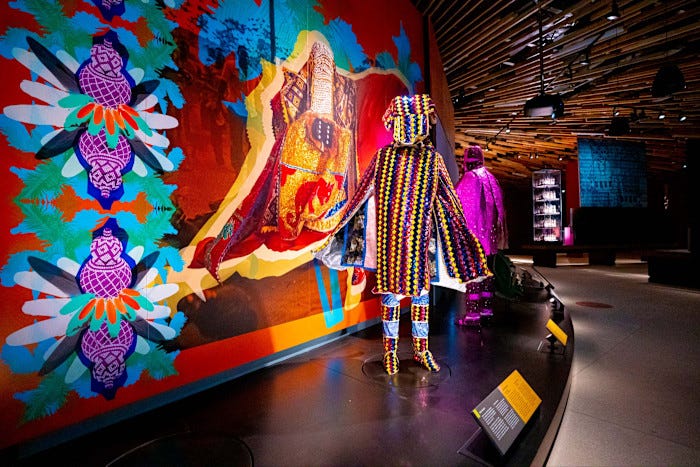
The first thing you notice when you visit the John Randle Centre for Yoruba Culture and History is an almost 40-foot-tall, faceless white figure that towers over the centre’s curving green fields and mud-red buildings. Holding a long ceremonial staff, its celestial whiteness contrasts strikingly with the earthy colours of the buildings behind it. The monument depicts an Eyo masquerader, one of the white-robed, masked participants who process through Lagos in honour of the city’s deceased kings and other prominent figures. It is a fitting starting point because the Eyo Festival is a distinctly Lagosian expression of Yoruba culture.Visitors to Lagos often don’t realise they are travelling through a region shaped by centuries-old Yoruba civilisation, thinking instead of Lagos primarily in terms of the modern nation state, Nigeria.
They are not wrong. But because Lagos grew within Yorubaland, the historical homeland of the Yoruba people, an awareness of this past offers a window into its modern culture. Many of the distinctive domains of the city — the music, the markets, the fashion — are intimately entangled with Yoruba traditions, and a visit to the John Randle Centre’s permanent exhibition space offers both a fascinating exploration of that history and a deeper insight into Lagos life today.First, it illuminates the larger-than-life attitude Lagos is known for. Although Lagos has developed through centuries of trade, migration and colonial rule, it is a city with a defiant sense of itself, engaging with these influences on its own terms. A city of extraordinary creative expression and equally extraordinary contradictions, Lagos seems determined to resist any straightforward definition. There is a Yoruba saying that people frequently use: Gedegbe L’Eko wa, which can be loosely translated as “There’s no place like Lagos.”