

Hope you have had a good summer break away from this newsletter. All good things must come to an end and so we are back today in a slightly abridged version.
If September turns out quiet on 1914 Reader, it is because we are working on a project that involves a lot of research work. We hope to begin sharing it with you next month.
Enjoy the usual selection below
Non-Nigerian Media
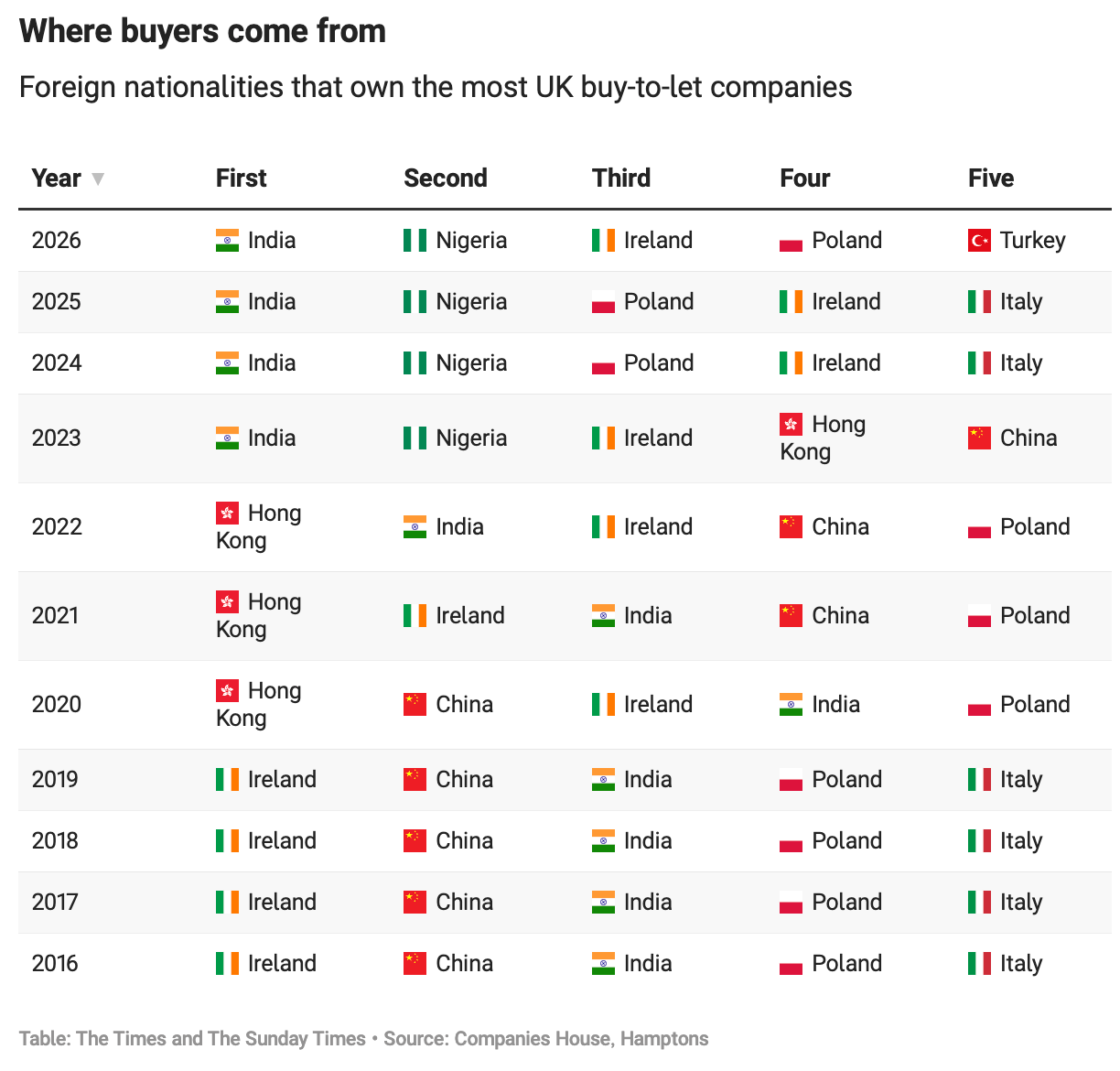
This story about Nigerians buying buy-to-let property in the UK featured on past editions of BTH. The 2026 data is now out and the story has not changed much:
One in five new buy-to-let businesses in the UK are being set up by overseas landlords, with Nigerian, Indian and Irish buyers driving a surge.
Figures from the estate agency Hamptons show 27,200 buy-to-let companies were set up in the first six months of the year and 19.5 per cent had at least one non-UK director.
This is 56 per cent higher than same period in 2016 when the figure was 12.5 per cent.
Indian investors are the nationality with the highest proportion of directors, with Nigerians the second highest, and Irish third.
[…]
The biggest increase in arrivals to the UK was among Indians and Nigerians between 2019 and 2023, according to the Office for National Statistics, with 127,000 more Nigerians arriving in 2023 than in 2019 and 178,000 more Indians.
Marketing video from DJI on how their drones were used in the construction of the Coastal Road in Nigeria
$2m book deal pulled due to ‘suspicions’ of AI usage in drafting it. This will look extremely foolish in a couple of years but unfortunately his head has fallen on the chopping block when publishers are still utterly confused about how to respond to AI (it is likely going to end their industry as we know it). Hopefully he self publishes:
A high-profile publishing deal for a debut crime novel has collapsed after doubts emerged over whether artificial intelligence played a role in writing it.
The hotly anticipated manuscript Call Me, I’ll Hide the Body, by Jerry Falade, was withdrawn from sale by its agent despite reportedly receiving an offer for more than $2m (£1.5m) from Minotaur, owned by Macmillan US, as part of a 14-way auction. The plan was to publish it in 2028.
An email sent to publishers by Falade’s agents and seen by the Guardian said: “Jerry Falade produced an incredible manuscript that dazzled us and the top publishing professionals around the world. Unfortunately, we are no longer able to authenticate how the manuscript fully evolved from origin to completion.”
It continued: “During the submission process we vetted the manuscript with Jerry for AI and felt trusting in his reassurance that it was written without utilising AI as a resource in the writing or editorial process. We can no longer substantiate that, and we are withdrawing the book.”
The US auction was run by the author’s agent Marc Gerald of Europa Content, according to the Bookseller. In the UK, Sandy Hodgman of Hodgman Literary is said to have secured several six-figure bids through a similarly competitive process. The Guardian has approached both agents for comment.
Gerald told the Bookseller he first read the book in June, and that it was “stunningly good, everyone fell in love with it. It’s a book that appeals to absolutely everyone.”
[…]
“We feel terrible for putting this into the universe and the firestorm it has caused,” Gerald added. “The book itself is genius – however it came to be drafted, it’s amazing.”
Interpol released a report about AI and cybercrime in Africa. Most interesting is that it portrays Nigeria as both a major victim of serious cyberattacks and a significant hub in Africa’s wider cybercrime ecosystem:
West Africa is observed as the most active region for BEC detections.19 Ransomware detections in 2025 provided by TrendAI reached record levels in Cabo Verde, with 16,997 detections, the second highest in Africa, while Nigeria recorded 5,822, reflecting the country’s dual role as an origin and target of cybercrime. Côte d’Ivoire is in ransomware detections of other countries and ranks third in sextortion IP senders, with 64,111 detections provided by TrendAI. Mali recorded the highest sextortion detections in West Africa, with 3,494 incidents, suggesting a growing infrastructure for automated blackmail campaigns. DDoS attacks, which had been prevalent in 2024, declined in the first half of 2025, although Mali registered 4,145 attacks,20 indicating a strategic pivot toward more profitable, less detectable vectors like BEC and crypto scams.
Mobile money fraud and crypto-related scams, including Ponzi schemes and romance baiting, were widespread, often linked to scam centres operating under the guise of fintech startups. The region’s high volume of French-language scams and the presence of cross-border money laundering networks underscore its position as a nexus between African and global criminal ecosystems. The Nigerian Bureau of Statistics (NBS) website was compromised in 2025, highlighting the vulnerability of key national institutions to cyber intrusion.21 The attack disrupted economic data collection and fuelled disinformation campaigns, demonstrating the strategic value of targeting public data infrastructure.
I missed the news that Alhaji Alhaji died in July. Telegraph has an obituary:
Alhaji Abubakar Alhaji, who has died aged 87, was one of Nigeria’s most influential and distinguished public servants, serving as Minister of Finance in the early 1990s, before appointment as Nigeria’s High Commissioner to the Court of St James’s from 1992 to 1996.
From 1990 Alhaji also held the traditional title of Sardaunan Sokoto, a title of the Sultanate of Sokoto (a formerly independent Sunni Muslim caliphate), previously held by Sir Ahmadu Bello, who served as the first premier of Northern Nigeria, which had fallen into abeyance after his assassination in 1966.
Universally known as “Triple-A”, Alhaji was a formidable negotiator who combined unusual charm with unusual stubbornness. He was credited with an ability to persuade western bankers to see things his way, but was also one of the few people able to convey the views of western financial institutions to Nigeria’s military leaders – and the only one with the political clout to get his way. A former colleague recalled how, as guest speaker at the National Press Club in Washington in 1990, Alhaji won over his American audience by joking that, after all, Nigeria and America had one thing in common: “We were both part of the British Empire.”
Solar usage in Abuja. I find stories like this quite painful to read. But it is what it is:
Sandra Ogbebor hunches over her softly humming refrigerator and scours through bottles before finally yanking out an orange juice. She hands it to a customer who has been waiting in her food stall, one of many informal shops tucked in an open-air food market in the Nigerian capital. The customer gulps it down in a single stretch and drops it into a bin – visible proof of his relief, at least for this moment, from the sweltering heat.
Ms. Ogbebor runs her cold-drinks business mostly off a rickety, gas-powered generator, as Nigerians are unable to rely on the country’s dodgy electric grid.
Some 90 million of Nigeria’s 242 million people live with limited access to electricity, a problem that the World Bank estimates costs the economy $29 billion annually. Decades of corruption and mismanagement of the power sector have forced many businesses to use alternative sources, such as generators.
But with war in the Middle East also sending fuel prices soaring, small businesses in Nigeria are bearing the brunt. In Abuja, creativity is the name of the game.
At beauty shops, for example, frequent power outages don’t stop the flow of commerce. Workers do their clients’ eyelashes by that 21st-century form of candlelight – their cellphone flashlights.
Plenty of ink has already been expended on Uber leaving Nigeria but I found this detail remarkable:
Drivers for the San Francisco-based multinational ride-hailing app said they learned of the decision in real time, with little warning. Some passengers told local media outlets they were en route via Uber when they received notice.
Online, people took to calling the day’s events the “Uber rapture,” a tongue-in-cheek reference to those left earthbound and blindsided by a sudden moment of Christian salvation.
The Osun Osogbo festival collides with gold mining. There can only be one winner:
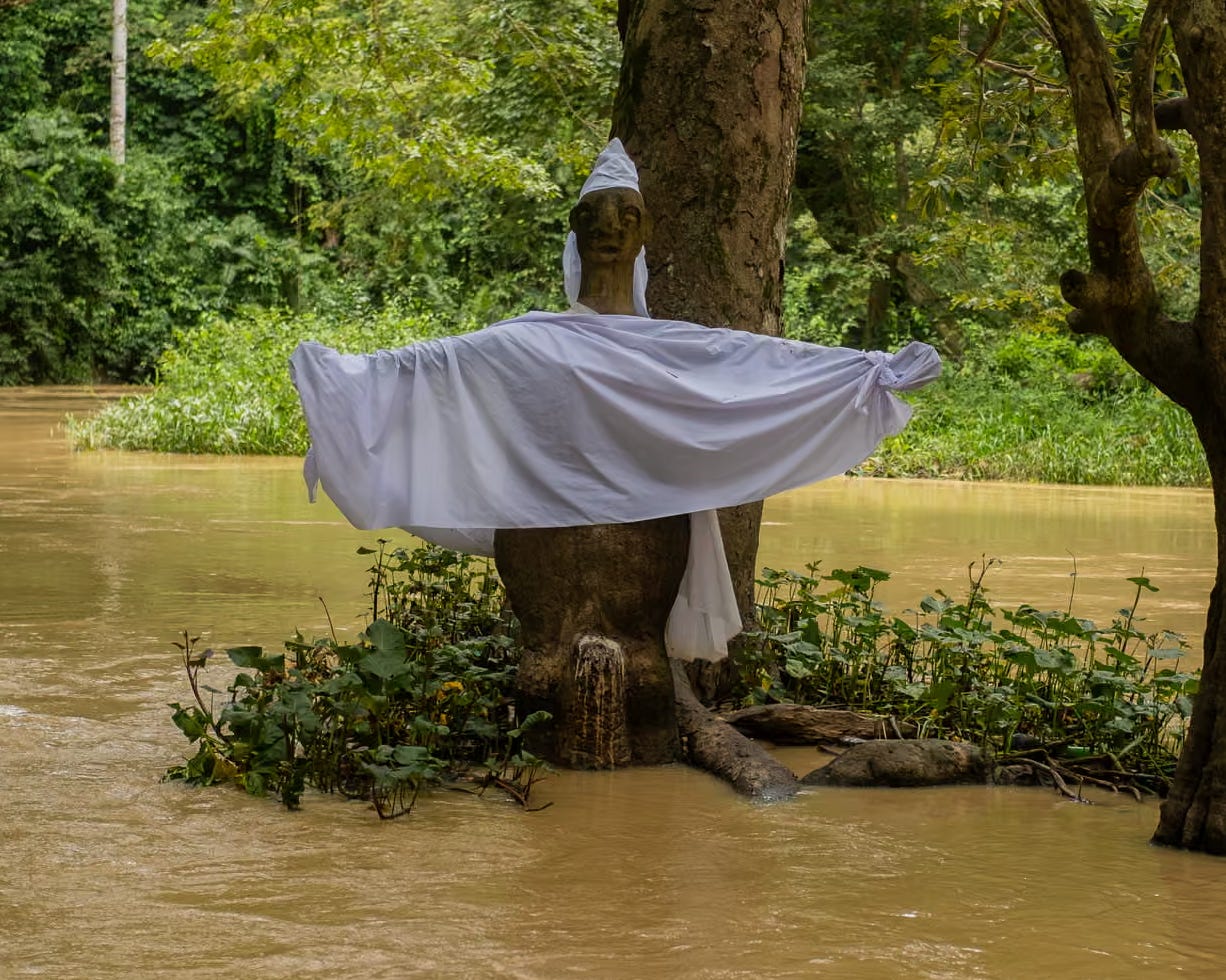
It is the final day of Nigeria’s annual Osun Osogbo festival in honour of the African deity, in a tradition that has existed for hundreds of years and draws people from across the diaspora.
Except this year the water was once again a discoloured brown. Until 2018, the river ran clear, but then mining several miles upstream began to pollute it, introducing heavy metals and sediment into the watercourse.
The river, named after the goddess, runs through the Osun-Osogbo sacred grove, a 75-hectare (185-acre) Unesco world heritage site since 2005. The water is believed to possess healing powers and women who have trouble conceiving, or people in search of promotion or prosperity, often come to pray at the riverbank; the water is drunk or used for bathing, depending on the “directions” of the goddess.
Yemi Elebuibon, a writer who is also the chief Ifá priest of Osogbo, is among those who have been campaigning against the mining and pollution.
“What we are telling them [those running the mining operations] is for them to turn the mining in another direction so it can stop polluting Osun. Osun is naturally pure; it should not be polluted,” he says.
Osun is a gold-rich state in Nigeria, where small-scale and artisanal miners often operate illegally due to lax enforcement. When they dig for gold along the 132-mile (213km) river, they let the runoff leach back into the water, polluting it.
Another feature on A7, the Russian payments startup. I remain intrigued by the fact that Nigeria was its first overseas office:
Russia’s war effort in Ukraine might be faltering, but the Kremlin has a high-tech superweapon to neutralize Western sanctions.
It is called A7. The state-backed payment network moves money in and out of Russia, defying U.S. and European efforts to isolate Moscow from the global banking system. A7 helps Russia pay for everything from military-drone parts to luxury cars to imported fruit, using a mix of cryptocurrency transactions and more-traditional banking methods, researchers say.
Behind its rapid rise is a convicted money launderer. A7’s founder, Ilan Shor, is best known for his role in one of the biggest bank heists in history: a complex scheme to extract $1 billion from three banks in Moldova, one of Europe’s poorest countries, in 2014. A Moldovan court convicted him of fraud and money laundering for helping orchestrate the theft, but he fled the country while under house arrest.
Shor has denied the allegations and called them politically motivated. The fugitive businessman, who is married to a Russian pop singer, now lives near Moscow. A boyish-looking 39-year-old, Shor goes by “Travolta” in A7’s internal company chat, according to leaked messages circulated by hackers last year.
Representatives of A7 and Shor didn’t respond to requests for comment.
Founded less than two years ago, A7 says it handles nearly 20% of payments in Russian foreign trade, or more than $100 billion annually. President Vladimir Putin gave it his blessing last year, taking part by video link in the opening of an A7 branch office.
Now, A7 is planning to take its services global and fulfill Putin’s vision of an alternative financial system outside the control of Washington or Brussels. Having recently opened its first offices abroad, in Nigeria and Zimbabwe, A7 says it is eyeing expansion into Latin America and the Middle East. Executives don’t hide their desire to serve countries seen as pariahs in the West.
I’m sorry I laughed at this:
Shenseea’s verse on Yung Miami‘s new international remix for “Spend Dat” is still turning some heads.
On the remix for the track, which arrived on Aug. 28 and also features Davido and Vybz Kartel, the Jamaican artist delivers the pre-chorus “Where my Nigerian scammers at? / Haitian mandem got that check / Got every currency in cash / Grown men and them YN’s.”
The lyric began circulating widely online immediately following release, drawing mixed responses from listeners.
This piece about Nikki Ogunnaike and Philippe Fonzin’s New York wedding comes with 82 photos. Please enjoy responsibly:
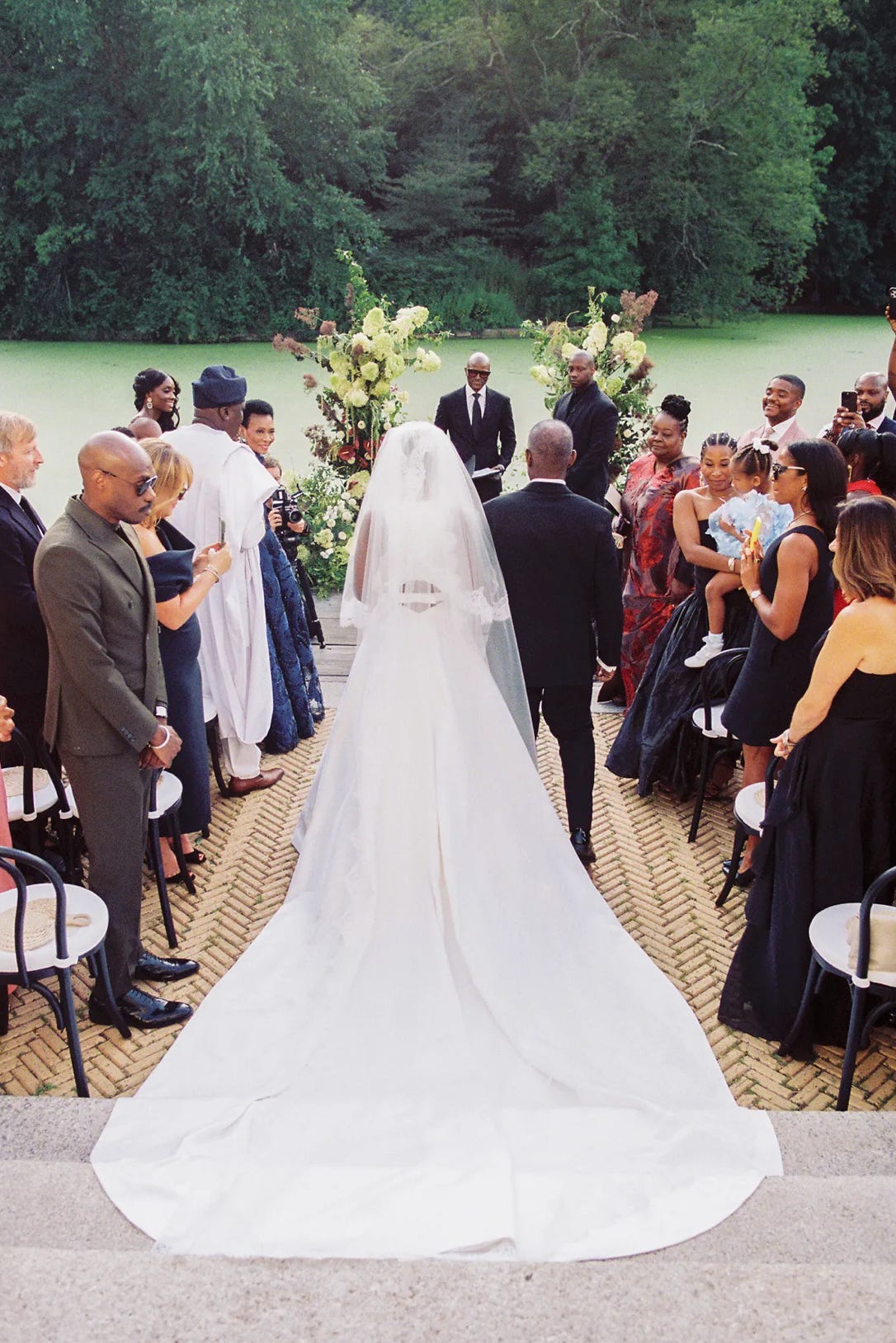
When Nikki Ogunnaike and Philippe Fonzin first met—in August 2014 at a birthday party in Manhattan—they had something in common: “Neither of us was actually invited by the host,” Nikki says. (They had been invited by another friend.) At the party, which was at the now-shuttered Hudson Hotel, Nikki saw Philippe sitting at a picnic table and introduced herself. They hit it off, and spent the rest of that summer and fall getting to know each other. “We’ve been together ever since,” Nikki says.
Within the first few months of their relationship, Nikki introduced Philippe to her sister, Lola, who “immediately put him to work building a crib for my soon-to-be-born nephew,” Nikki recalls. “While that may have been annoying to another man, it was one of the first moments when I knew that Philippe was a generous and genuinely wonderful man.” She adds: “My 12-year-old nephew still can’t believe that Philippe has known him literally his entire life.” In 2020, amid the pandemic, the couple moved in together in Brooklyn.
In September 2025, during New York Fashion Week, Philippe proposed to Nikki. He took the opportunity of her sister’s birthday party “to let her parents know his plan. After going to the Tibi show and lunch at the Odeon, she picked up balloons for the party. “Nikki was in the backyard struggling to untangle the balloons, so I was able to sneak in and brought her parents upstairs to let them know the plan. She had no clue I was even there,” Philippe says.
“Cut to the party a couple of hours later, and everyone was in the best mood ever,” Nikki says. “I thought it was just because we were throwing a great party, but as it turns out Philippe had told everyone that he’d be proposing the next day.”
Some data from the UK on surrogate fathers:
Applications for babies born to non-UK surrogates have increased by 136 per cent, more than doubling in the past decade from 151 in 2015 to 357 last year.
In contrast, parental order applications for children born from surrogacy arrangements based in the UK have risen by 23 per cent, from 113 in 2015 to 139 last year.
In England, between 2018 and 2024, there were more than 1,500 applications to become the legal parents of babies born to surrogate mothers abroad out of a total of 2,437, according to the official records.
The largest number of applications, 642, related to babies born to surrogates in the US, followed by 258 to those in Ukraine and 144 in Georgia. Applications have also been made for babies born in Colombia, Ghana, India, Canada, Kazakhstan, Mexico, Nigeria, Uganda and Russia.