

This we did a podcast with Carlos Barragán talking about his new and important book Yahoo Boys.

Get a copy of the book if you can. It comes with my highest recommendation. My WSJ review here.
Enjoy the week’s selection below.
Nigerian Media
What does one say to this?
Farmers in parts of northern Nigeria are increasingly turning to the use of oxen for ploughing their farms as soaring diesel prices drive up the cost of tractor services ahead of the current farming season.
Some farmers who spoke to Daily Trust said the high cost of diesel, coupled with declining prices of agricultural produce, has made tractor services unaffordable, forcing many to reduce the size of land under cultivation or return to traditional methods of land preparation.
A farmer in Lere Local Government Area of Kaduna State, Alhaji Sani Sulaiman Saminaka, said tractor operations had declined significantly this year because operators could no longer charge what they did last year.
He said a farm that was ploughed for about N50,000 last year could no longer be serviced at the same rate because diesel prices had risen sharply.
“Last year, a litre of diesel sold for about N1,000, but this year it costs more than N2,000. I used cattle to work on my farms this year, whereas last year I spent more than N1 million on tractor services.
“This year, some farmers have abandoned tractor services because of the cost. You will see tractors everywhere looking for work because only a few farmers can afford their services,” he said.
Another farmer, Alhaji Lawal Abubakar, said the cost of tractor ploughing had risen considerably due to the increase in diesel prices.
According to him, a farm that cost N100,000 to plough last year now costs about N150,000, while one that cost N40,000 now attracts about N60,000.
The first red flag for me would have been a prophet named ‘Koboko’. For those who doubt that “remote control” is real:
The Economic and Financial Crimes Commission has commenced an investigation into a self-acclaimed prophet, Godwin Sunday Ajuluchukwucheya, popularly known as Prophet Sunday Koboko, over allegations that he defrauded members of his ministry of N70.39m.
The anti-graft agency disclosed this in a statement posted on its official X handle on Wednesday.
According to the EFCC, operatives of its Enugu Zonal Directorate are investigating allegations that the suspect obtained money from church members through various schemes and promises of spiritual interventions and investment opportunities.
One of the petitioners, identified as Okey Uwakwe, alleged that Ajuluchukwucheya collected N6.23m from him for spiritual works aimed at persuading his brother, who had lived abroad since 1997, to return to Nigeria.
The petitioner further alleged that the suspect received N3.25m to perform spiritual works to help his childless sister-in-law conceive after over 15 years without a child.
The EFCC said Uwakwe also claimed that the cleric announced to members of his ministry that he had won N33bn in a lottery and encouraged them to contribute financially with assurances that they would receive dividends from the purported winnings.
According to the commission, the petitioner contributed an additional N3.35m to the scheme and another N500,000 towards a rice-processing business the suspect allegedly claimed was worth N1bn.
The EFCC said the petitioner claimed to have paid a total of N13.33m to the suspect without receiving any benefit.
The state of the Nigerian economy is bringing out the absolute worst in people:
The greed to make more profit in an excruciatingly biting economy that Nigerians are now witnessing is rising by the day. In the local Nigerian markets unscrupulous spice merchants are now exploiting the food inflation to heavily adulterate daily kitchen staples.
Some of the usually tied ground food items like egusi, pepper, pepper soup spices, turmeric powder, ginger powder and the likes are now pure poison. Some greedy food merchants now adulterate them with additives that are dangerous to health.
Economy&Lifestyle has discovered that even fresh tomato-pastes are also being adulterated with industrial powdered colouring.
This is as food ingredients like ground pepper are mixed with rejected plant husks, and finely milled wood charcoal to replicate authenticity and artificially inflate product volumes for maximum profit.
The new trend which wasn’t the case years back are said to be triggered by economic hardship coupled with low purchasing power.
For the traders, these dangerous, non-food additives help them mask low-grade produce and deceive shoppers.
Eye witness reports at grinding points in some markets showed that merchants gather cheap, low-quality, or rejected components, including rotten chilli seeds, fibrous plant straws, dried pear leaves, and starch powder as base materials to ground food staples.
The last paragraph is the worst part of this story:
The Chief Magistrate Court 2 sitting in the Adamawa State capital, Yola, has ordered the remand of two young boys for allegedly stealing a generator belonging to a mosque.
The court also remanded a scavenger, Auwalu Bashir in prison custody for allegedly receiving stolen property.
The minors who were ordered to be kept in a juvenile remand home are 14-year-old Saidu Alhassan, and 13-year-old Mamman, both of PZ Roundabout area of Jimeta, Yola North LGA.
The boys and the older defendant were arraigned before the court by the police prosecutor, Inspector Emmanuel Paul,, for alleged “criminal conspiracy, theft and receiving of stolen property.
The prosecutor told the court that a resident of Jambutu Primary School in Yola North LGA, Murtala Isa, reported the incident of theft at the Jambutu Police Station on the 13th June, 2026, after which investigations led to the defendants.
Arraigning the defendants on First Information Report, Inspector Emmanuel Paul, alleged that the minors at different times made away with the Perso Power Generator valued at N600,000 and sold it to the scavenger at N50,000 each.
Something really disturbing I see in stories about job scams is that everything would have been fine if the person took money and delivered the job as promised. I feel like I’m losing my mind sometimes:
Grace Enyidiya Awo, a nurse with a Lagos State primary healthcare centre who once worked with Seraphic Hospital & Maternity on the side at Ago Palace, Okota, collected N400,000 from former colleagues in 2024 and failed to deliver the primary healthcare jobs she promised each of them.
FIJ learnt that each person gave N100,000 to Awo without the knowledge of the other person. According to the victims, Awo approached them separately, presenting a claim that she could help them secure a healthcare job with the state government. All the victims preferred to be identified by first names only.
Onyinye, one of the nurses who paid N100,000, told FIJ that she discussed the possibility of getting a government job as a nurse with Awo and she said she could assist her.
Onyinye mentioned that she believed in Awo’s capacity because she was a civil servant attached to a primary healthcare facility in the state.
“She told me she had someone at Alausa [Lagos State Government Secretariat where many ministries and agencies operate from]. A few days later, she told me to forward my credentials and N100,000 if I was serious about the job,” Onyinye said.
“There is nothing you need to do that she would not say she has someone to assist you. Her usual remark that everyone came to discover was ‘I know someone at Alausa’ to create the impression that she’s influential within the system.”
Non-Nigerian Media
Bobby Ologun is in trouble in Japan. His Wikipedia is here:
The Chiba Prefectural Police arrested television personality Bobby Ologun on Sunday on suspicion of nonconsensual sexual intercourse with a female acquaintance.
Ologun, 60, whose real name is Bobby Konda, has denied the allegations. “The facts are completely different,” he was quoted as telling investigators.
He is suspected of sexually assaulting the woman at a house in the prefecture, which neighbors Tokyo, around 4 p.m. to 6 p.m. on April 21.
According to the police, the woman entered the house alone with Ologun after being called by him and then she was assaulted.
On the following day, she consulted with authorities. Ologun was identified as the suspect through an investigation, including through security camera footage.
Ologun, who lives in the city of Saitama, also near Tokyo, was arrested upon arriving at Tokyo’s Haneda Airport from overseas.
A different kind of Jollof war between Nigerian and Ghana:
Nigerians and Ghanaians have a long, lively debate about whose jollof rice is better. (Senegalese thieboudienne, which gave birth to jollof, arguably trumps both.) A more pressing question is whose is cheaper? The Jollof index, issued quarterly by a Lagos-based consultancy called SBM Intelligence, tracks the prices of 12 ingredients used to make the staple in both countries, from the tinned tomato purée that gives the dish its renowned orange hue, to the oil used to sauté the onions and spices.
In both countries ingredient prices have risen during the war over Iran. After the conflict began, in Nigeria, a pot of jollof for a family of five was soon going for n30,435 ($22.4), a whopping 40% of the monthly minimum wage. This 20% jump since October came mostly from diesel costs for the lorries moving tomatoes and peppers from north to south. In Ghana, tomatoes now cost 56% more than before the war; the average price of rice is up by 29%. The cost of cooking gas has risen by 31%, adding to the cost.
But the picture then diverges. In Ghana, where the government has steered a rocky return to single-digit inflation from a peak of 54% in December 2022, this average pot still works out in dollar terms cheaper than it was three years ago. Though its jollof basket depends more on imports, a stronger currency has cushioned families from the worst shocks. But in Nigeria that same pot is up by 50% in dollars terms over the same period. Though headline inflation has slowed over the past year, Nigeria’s bureau of statistics has just noted that prices are up by 16% on last year, the third monthly rise this year.
Who is Ayoade Bamgboye?
The success of the UK version of Saturday Night Live was in no way guaranteed. When the series’ arrival was confirmed in 2025, it was met mostly with groans, with the cynical British public proclaiming that SNL UK would be “too American” and “embarrassing”. As the first show crept closer, you could sense the 11 newly announced cast members steeling themselves.
Given the talent involved — and with the backing of the legendary Lorne Michaels, who pioneered the original US format — the cast understood that the project had potential, SNL UK star Al Nash tells me. Whether they’d be allowed to prove themselves was another matter. The 33-year-old first came to attention making comedy sketches for Instagram and TikTok, and knows better than most that “you will get clicks if you go, ‘Here’s 10 reasons why it’s going to be a flaming pile of shit’.”
But then the first episode dropped, with Tina Fey as a guest host, and the reviews were better — much better — than expected. Hype accumulated as the season progressed, with Michaels declaring that the UK show “keeps getting better every week”. A 12-week second season was commissioned for September before the first was even out.
[…]
Young isn’t the only cast member to have rapidly returned to the comedy circuit. Five days after the finale, Ayoade Bamgboye, 31, whose first season on SNL UK saw her in roles ranging from a pirate radio MC to Kemi Badenoch, had a UK tour to kick off. These dates, for her 2025 Edinburgh Comedy Award-winning debut hour Swings and Roundabouts, were booked in before the Nigerian-British comic was even cast in SNL UK. Bamgboye is speaking to me over video call having just returned to London from Glasgow. She has gigged in Newcastle, Leeds and Bristol over the past two weeks and is appearing on two different line-ups tonight, just to “get the juices flowing”.
Meet Silas Adekunle:
After a 25 year-old Silas Adekunle landed a global distribution deal with Apple in 2017 for his toy robots, he thought it was set to keep growing, but two years later, the company was dissolved.
Bristol-based Reach Robotics was founded by Adekunle straight after he completed his robotics degree at the University of West England. The company was creating Mekamon “battle robots” that players could control from their smart phones.
The agreement with Apple was struck after a presentation of his robots to a senior executive. The meeting, originally scheduled for 15 minutes, was extended to an hour when the executive was impressed by the spider-like robot.
“For the next phase of the business, we would have had to put quite a lot of operating capital into it. And at that time, the appetite of investors just didn’t quite match,” Adekunle, 34, said. “It was a lot of cutting your teeth, figuring out the complexity of the market, and then realising we weren’t quite a fit.”
Adekunle admitted that the price of the robots, which sold for £250, was also likely too high for the average consumer, saying he should have raised the price further to attract a smaller market of higher-end consumers before building the brand out further.
By 2019, Adekunle had started a separate educational company, Awarri, in Nigeria, where he was born. Without the cash to keep going, he wound down Reach Robotics, letting 30 people go, while the existing robots were sent to Awarri in Nigeria. The educational company, which Adekunle operates from the UK, has gone on to develop a Large Language Model (LLM) in collaboration with the Nigerian government and now has 150 employees.
More details on the conjoined Nigerian twins who were separated in the UAE last year in a groundbreaking operation. Includes photos which I find difficult to share. You may visit the link if you wish to see them:
Twins conjoined at the head have been separated by British surgeons in a “groundbreaking” operation.
The surgery, performed last year in the United Arab Emirates by a team from more than 20 countries, showed humanity coming together “to defy all odds”, medics said. It also employed pioneering techniques using artificial intelligence and augmented reality.
The girls, Mercy and Goodness, were born in Ekiti, southwest Nigeria, in June 2023 with fused skulls and intertwined brain tissue and blood vessels.
At six months old they were referred to the British charity Gemini Untwined, the only organisation in the world that focuses on research and operations for craniopagus twins.
Mercy and Goodness were separated at 19 months old, and have made full recoveries. They have now returned to their home in Nigeria.
[…]
Professor Noor ul Owase Jeelani, from GOSH, who was the lead paediatric neurosurgeon for the operation, said: “The separation of Goodness and Mercy is a landmark case planned and executed with a precision not encountered before. Building on the experience of our previous eight cases, using novel techniques and strategies, we are able to give these girls and their families a new future, where they can enjoy their childhood as intact but separated twins.”
The team used several groundbreaking techniques to make the operation at the PureHealth SEHA Sheikh Khalifa Medical City a success.
Usually in cranial separations, surgeons use traditional steel retractors on the skull to prevent brain collapse. In this case, they used an “open book” technique, essentially positioning the twins so that gravity would do this work for them — limiting potential injury.
The procedure was also meticulously planned beforehand by creating 3D models of the twins’ anatomies in virtual reality, with technology provided by the British firm XRLabs.
Before the final 12-hour surgery, doctors inserted silicone skin expanders into the twins’ heads. This allowed their skin to grow large enough to cover their new skulls. With the help of AI modelling, the team inserted the expanders earlier than in previous operations, removing the need for skin grafts.
An interesting tax story from Israel:
An Israeli District Court has ruled that an individual with a double life and two permanent homes – one in Israel and one abroad (Nigeria) – was resident and taxable in Israel on worldwide income. This followed a detailed examination by the court of his center-of-living indicators over many years (Chaim & Yona Zach vs Large Enterprises Assessing Officer, June 1, 2026, Judge Y. Seroussi).
The case reads like a textbook on Israeli fiscal residency and hence Israeli taxability. What’s in the textbook?
The main facts: The case mainly concerns a husband who was born in Israel in 1948, traveled to England in 1985, and to Nigeria in 1993, where he set up successful agricultural and chicken-breeding companies. He had a home in Nigeria and a home in Israel.
He allegedly separated from his wife. He filed tax returns for 2009-2017, the years in question, showing no income, as he claimed to be a foreign resident. The Israel Tax Authority (ITA) disagreed and claimed Israeli tax on his worldwide income.
Israeli residency: For Israeli tax purposes, an Israeli resident is defined as an individual whose center of living is in Israel, taking into account the individual’s overall family, economic, and social links. A rebuttable presumption of Israeli residency applies if: (1) the individual is present in Israel at least 183 days in a tax year ending December 31; or (2) the individual is present in Israel at least 425 days in any three years, including 30 days in the last year.
[…]
Fifth, he claimed he had “adopted” two children of his Nigerian CFO. The court ruled he was merely like a godfather to them. He gave his own Israeli children far more money.
Sixth, his business interests were only in Nigeria, but due to instability, he moved as much cash as possible out of Nigeria, meaning less economic interests there.
Seventh, his economic ties: Overseas bank accounts (some in Switzerland and Lichtenstein) reflected his Israeli home address and Israeli cellphone number, rather than those of, say, his parents or brother in Israel.
Eighth, his social life: His social ties to friends were stronger in Israel. He and his wife entertained people in Israel and traveled with Israeli friends on holidays abroad.
He had a Maccabee Tel Aviv basketball subscription. He had an Israeli driving license and two luxury cars in Israel. But he had a driver and chef in Nigeria. He donated to Israeli and Nigerian causes. He couldn’t remember if he voted in Israeli elections.
He had valuable works of art at his Israeli home. In Nigeria, he had more art in his office but not his home.
I came across an obscure book recently that explained the founding of this community. I bought it and for the life of me I can’t find it or even remember the name of the book anymore:
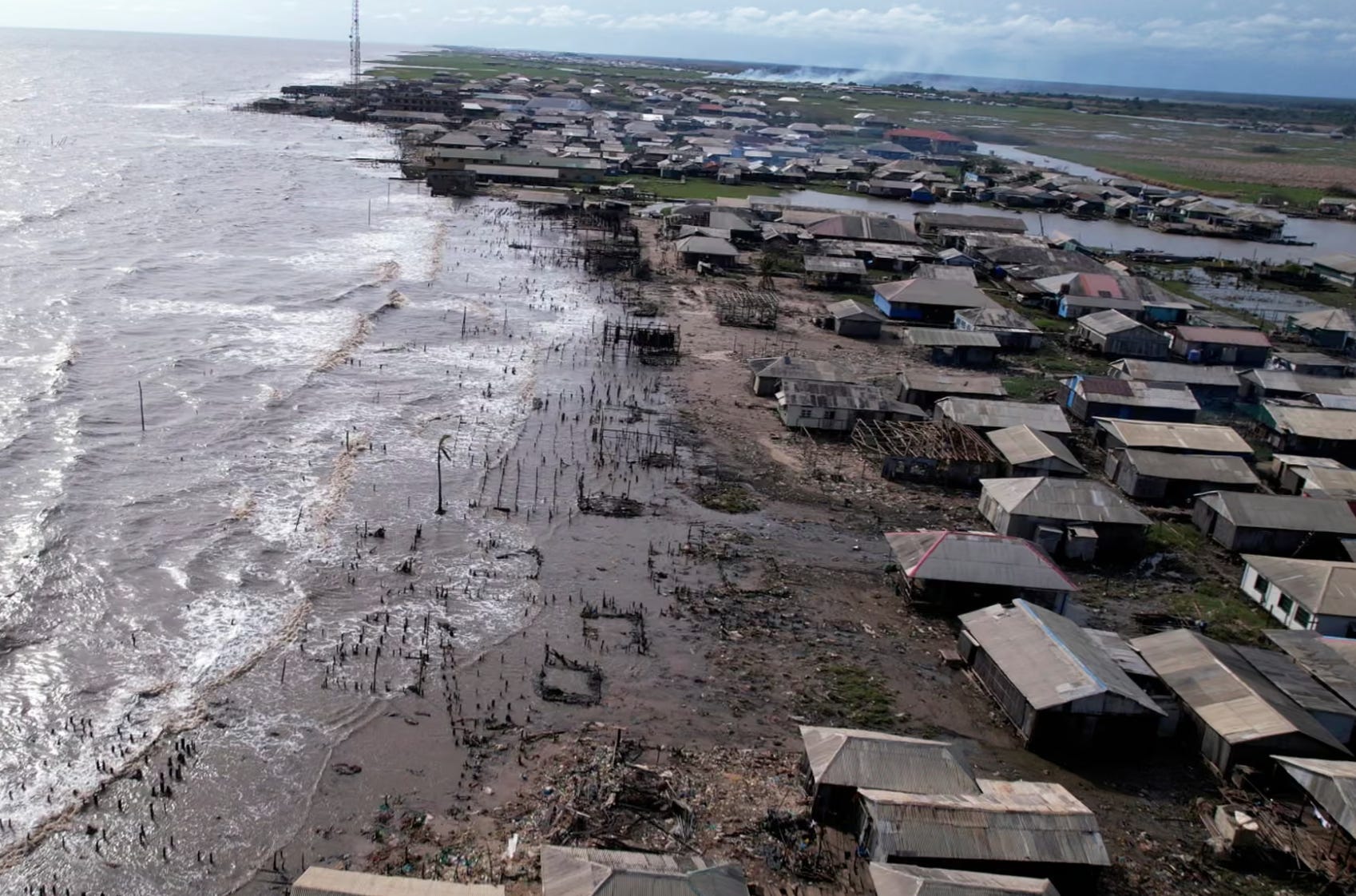
In the early hours of 15 February 2019, the Atlantic Ocean came for Arowo Victoria’s livelihood. The 60-year-old retired midwife was asleep when neighbours began banging on her door, shouting that the sea had started covering buildings along the nearby coastline.
By the time she got to her small shop, she discovered that the Atlantic had already swept it away, destroying the business she had built with borrowed money after retirement.
“There was nothing I could save,” she says, staring at the shoreline where her shop once stood. “The sea took everything away.”
After retiring from decades of helping women give birth, Victoria had taken out a loan to start a business that she had hoped would see her through retirement. Instead, the sea has left her with mounting debts and no business to help her repay it.
“I am paying for something that doesn’t exist any more,” she says. “They come to collect their money every month.”
Ayetoro was once known as Nigeria’s “Happy City” after it was founded by a Christian group in the 1940s who wanted it to operate on the basis of a communist-style society. Now, the historic coastal settlement, located in Nigeria’s south-western Ondo state, is gradually being eroded by tidal surges that people say have grown more severe over the past decade.
The Atlantic Ocean, according to people living there, has already swallowed more than half of the community, washing away hundreds of homes and other buildings, including schools and churches, over the past two decades.
While big cities such as Lagos are often in the headlines as some of the world’s most vulnerable coastal places, small settlements like Ayetoro are already vanishing. Those who live here can’t rely on money for infrastructure such as sea walls – they simply rebuild each time they are flooded.
Nigerians doing a wheat tour of the US:
One of the biggest buyers of Kansas wheat was in the state this week to check out this year’s crop and future growth.
Two leaders from one of Nigeria’s largest flour milling companies are going on a wheat tour of the United States.
They made stops at the Kansas State University IGP Institute, the Kansas Wheat Innovation Center and the Great Plains Analytical Laboratory.
The Kansas Wheat Commission said the representatives wanted to see the harvest, discuss global wheat trade relationships and check out advancements in wheat breeding technology.
Domenique Opperman, the U.S. Wheat Associates’ regional program and marketing specialist for the Sub-Saharan Africa Region, said the visit is beneficial for both the buyers and producers.
“In competitive markets like Nigeria, there is nothing more valuable than connecting the leading flour mills directly with the people working in the U.S. wheat supply chain,” Opperman said. “These face-to-face interactions allow global buyers to gain firsthand insights that reinforce the value that U.S. wheat brings to their operations.”
That Grenada matter (we covered it last week) is ongoing:
The Government’s recent decision to grant visa-free entry to Nigerian passport holders has been promoted as a measure designed to strengthen trade, tourism, investment, and diplomatic ties with Africa.
At first glance, these are noble objectives.
Grenada should absolutely pursue stronger relationships with Africa. We share historical, cultural, and ancestral ties that should be nurtured and respected. Africa presents opportunities for trade, investment, education, and cultural exchange.
However, responsible governance requires that we evaluate not only the potential rewards of a policy but also its potential risks.
Therefore, the issue is not whether Grenada should engage Africa. The issue is how.
Africa is comprised of 54 internationally recognised sovereign states.
Yet Nigerian passport holders currently enjoy visa-free access to only approximately 18 African countries, while Nigeria itself grants visa-free access to citizens of approximately 18 African nations, largely through the Economic Community of West African States (ECOWAS) arrangements.
In other words, the overwhelming majority of African states have not adopted unrestricted visa-free arrangements with Nigeria.
This reality should not be ignored. It should cause policymakers to ask a simple question:
What do dozens of African governments know or understand that Grenada appears willing to overlook?