

We are so back. You can read up on what I was up to in the last couple of weeks here. Hope you kept out of trouble while I was away.
Enjoy the week’s selection below
Nigerian Media
A story that contains every social ill:
A male adult identified simply as Golden has been confirmed dead after he was shot by unknown assailants in the Igando area of Lagos State.
PUNCH Metro learnt from a police source on Thursday that the incident occurred on Tuesday in the Fatoki area of the community.
It was gathered that the assailants, numbering about two, rode into the community on a motorcycle in search of the deceased.
The assailants thereafter located him in the area and allegedly shot him in the process.
“We got a report that someone was shot on Fatoki Street, and when our men were deployed to the scene, the deceased was found lying lifeless in a pool of blood. He was taken to the hospital, where he was confirmed dead and later taken to the morgue,” the source disclosed.
The police, however, could not disclose the cause of the incident, noting that an investigation was ongoing.
Meanwhile, an anti-cultism advocacy platform, Confra Naija, in a post on Thursday, noted that the incident was business-related.
It wrote, “The victim in that incident was identified as Golden. Although two cult groups (Aye and Vikings) were mentioned in this incident, sources confirmed that the attack was not cult-related but rather a case of a business dispute involving Yahoo money.”
The silliest story I’ve read in a while but you can get anything published in Nigerian papers these days:
A shocking scandal is currently unfolding in Lagos after a popular billionaire businessman from Southern Nigeria (names withheld) was allegedly caught with his lover’s used sanitary pad hidden inside his pocket.
According to sources familiar with the matter, the wealthy man had reportedly been in a relationship with the lady for over seven years with the businessman reportedly sponsoring her lavish lifestyle, trips, and even purchasing a house for her in Lagos.
Trouble, however, started early this year after the businessman said to be a highly influential player in Oil and Gas ecosystem in the country visited the lady at her residence in highbrow Ikoyi area of Lagos state while she was on her monthly period.
Sources claim that after the man, who reportedly lives in Banana Island, Lagos left the house, the lady slept off, only to wake up later and discover that the menstrual pad she had discarded in the waste bin inside her bathroom the previous night had mysteriously disappeared.
Suspicious, she reportedly contacted the billionaire and asked him to return to the house immediately.
When confronted over the missing sanitary pad, the businessman allegedly denied taking it. But the terrified woman reportedly searched his bag and allegedly discovered the soiled sanitary pad hidden inside one of his pockets. She claimed that the circumstances surrounding the incident led her to strongly believe it was connected to ritual purposes and she questioned the chief why he took the pad but his explanation was unsatisfactory.
This is the lowest price I’ve seen in many many years of tracking such prices:
An Akure Magistrate’s Court in Ondo State, has heard how two minors were allegedly sold for N18,000 each and forced to hawk goods on the streets of Benin City, Edo State.
Two men, John Ushie, 32, and Innocent Ushie, 50, along with a woman, Evelyn Innocent, 38, were arraigned on charges of child trafficking, abduction and slave.
Police prosecutor, Augustine Omheneimhen told the court the offences occurred about 9 a.m., at 1, Chama Street, Ute, Ondo State.
The defendants allegedly lured two boys, aged 15 and 17 at the time of trial, from a riverbank in November 2025 when they were 14 and 15.
They said the men deceived them by claiming their father wanted to see them in Ogbese.
The victims were first taken to Utesi, where they spent a night, before being transported to Benin City, Edo State.
They were allegedly sold for N18,000 each to the wife of one of the defendants’ brothers and given trays to hawk goods on the streets.
The victims testified that they spent about four months in captivity and were separated for two months before being resold to another person for N76,000.
The defendants later contacted their parents and collected N10,000 before police traced and reunited the boys with their families, the court heard.
Interesting article on tomato growing in Nigeria. It is a very stressful and high maintenance crop, attributes which make it really hard to grow successfully in a country that loves jollof rice and stews. I believe this to be another manifestation of Psychological Dutch Disease:
However, the Chairman, National Association of Tomato Growers and Processors and Marketers of Nigeria NATPAN, Kano Sani Danladi Yakadawari said the severe weather conditions with excessive heat are not conducive for tomatoes to grow in an open field.
He said even farmers with greenhouses must be equipped with heat extractors to be able to grow tomatoes under the prevailing extreme weather conditions.
“Every year between April and July tomato production is low because of the heat. Tomatoes do not thrive in hot weather and excessive water.
“What is happening is that the dry season cultivated tomato is gradually ending and farmers are getting set for Wet season cultivation, so scarcity is manifesting because only areas with moisture continue to grow tomato though not in a large quantity.
“In essence it is the excessive heat that is responsible for the shortage and the surge in price. It’s not a question of improved variety. Tomatoes cannot grow where there is excessive heat nor does it like too much water,” Yadakwari explained.
[…]
“Instead of using fresh tomatoes to prepare sauce or stew, I mix dried tomatoes with fresh ones and then add tomato paste so that the taste will satisfy our customers. Every year we experience the same shortage and rising prices of tomato but people must eat with or without tomato,” Hamza noted.
Muhammad Suji, a civil servant, said he only buys Tomato paste with onions which he said is cheaper for his wife to prepare meals while noting that the current price isn’t affordable to people like him.
Another consumer Abu Ammar said currently his wife prepares Jollof rice and local soups with fresh Tomato worth N1000 mixed with tomato paste weekly pending when price reduces and supply increases.
‘Monarchs’ in Osun are complaining about their allocations:
Traditional rulers, Baales, and elders in Ife North Local Government Area have appealed to the Osun State Government and relevant agencies to ensure proper administration of the statutory 5% local government allocation meant for traditional and chieftaincy institutions.
They added that some traditional functionaries reportedly receive as little as ₦1,000 monthly, a situation they said does not reflect the purpose of the allocation.
The call was made during a press conference convened by concerned custodians of cultural heritage in the council.
Speaking on behalf of the group, the Lodifi of Ipetumodu, Chief Orosanya Kehinde, said the briefing became necessary due to growing concerns over the transparency and disbursement of the funds under the local government autonomy framework.
The stakeholders cited the Supreme Court’s July 11, 2024 judgment in Attorney-General of the Federation v. Attorney-General of Abia State & 35 Others, which reaffirmed the financial autonomy of local governments and stressed accountability in the management of allocations.
They noted that traditional institutions play vital roles in peacebuilding, cultural preservation, security support, and community development at the grassroots.
The group expressed concern that the 5% allocation meant for traditional rulers, Baales, and chieftaincy affairs is not being fully and equitably administered within Ife North.
Funny story from Delta state:
Peaceful protesters in Enhwe Community, Isoko South Local Government Area of Delta State, have said they are not in support of the blockade of Urri Road and the alleged illegal collection of levy from a businessman, Victor Wayles Egukhawhore, purportedly by the son of the traditional ruler of Enhwe Kingdom.
The protesters, including Enhwe community’s elders, women and youth, led by the Secretary of the Elders’ Council, Michael Akpakpa, entirely condemned the act by the monarch’s son and the denial that the arrest of the King.
Their protest placards read, “Prince Larry Eduvie Efekodha is not representing Enhwe,” “Enhwe does not belong to Efekodha family,” “Prince Larry Eduvie Efekodha you are too greedy,” “Efekodha Children should let Enhwe breath,” “High Chief Victor Wayles Egukhawhore has done well for us,” and “High Chief Victor Wayles Egukhawhore is our beloved son”.
The forceful collection of development fees (popularly called deve) is specifically prohibited under the Delta State Public and Private Properties Protection Law, 2018.
Under this law, it is a crime for community leaders, youth groups, or individuals to demand or forcefully collect any levy, fee, or rates (such as 10% land sales fees) from property owners and developers.”
Non-Nigerian Media
Despite the current restrictions, Samuel Ugberaese has been able to obtain a visa to the US:
The FBI arrested Samuel Ugberaese after the US extradited him from Nigeria on charges relating to cross-border romance scams that targeted victims in the United States and elsewhere. A federal grand jury returned the indictment in the EDNC on January 22, 2021. United States Magistrate Judge Brian S. Myers ordered Ugberaese detained pending trial.
According to the indictment, Ugberaese and his co-conspirators used romance scheme techniques, including false stories and promises, to exploit and defraud victims into transferring money on their behalf. The indictment further alleges that Ugberaese conspired with a co-defendant Oluwadamilare Kolaogunbule, a naturalized U.S. citizen, to conduct financial transactions through his bank account network, including accounts registered to purported export companies, to conceal and disguise the nature, location, source, ownership, and control of the criminal proceeds.
Ugberaese is charged with one count of conspiracy to commit wire fraud and one count of conspiracy to commit money laundering. If convicted, he faces a statutory maximum penalty of 40 years in prison.
United States Attorney’s Office
Where does the zombie drug known as kush, that’s ravaging parts of West Africa, come from?
They come in blister packs of 10 like any normal painkiller, and you can buy them easily in roadside kiosks and street pharmacies across west Africa.
Millions of tapentadol tablets from India are helping drive a deadly opioid epidemic ravaging the region, with officials and researchers saying that they are also being added to the “zombie drug” kush.
The cheap pills are so strong that no regulatory authority in the world has approved them.
Yet an investigation found Indian pharmaceutical firms were flooding west Africa with the pills despite New Delhi vowing to crack down on the trade. Some shipments were even labeled “Harmless Medicines for Human Consumption.”
Customs records show millions of dollars’ worth of the high-strength synthetic opioid being shipped from India every month to Nigeria, Sierra Leone and Ghana, where even low doses of the drug are not permitted.
With opioids now heavily regulated in wealthier nations after being linked to 1 million deaths in the United States alone, some manufacturers in India — the world’s biggest producer of generic drugs — are pushing hard into Africa.
And in a frightening development, tapentadol is now being added to the “zombie drug” kush, health chiefs and researchers said.
Kush, infamous for the speed with which it hollows out its victims, has already been declared a national emergency in Liberia and Sierra Leone.
News from Ireland:
Uruemu Adejinmi, Ireland’s first black female mayor and a Fianna Fail councillor in Longford, said constituents contacted her to express concern after Bertie Ahern’s comments about African migrants. Adejinmi, who was born in Nigeria, said Ahern’s remarks “were not good to hear” but she was pleased he had apologised and made clear that he was “against victimisation of migrants”.
She said the former taoiseach’s comments caused anger among people in her constituency and across the country but she hoped they would accept his apology.
“I have accepted it,” she said. “I hope others will accept it. The focus should return to addressing the issues in the community — housing, healthcare, infrastructure — and supporting everyone to live with dignity.”
“Constituents are commenting from all walks of life, migrants and natives alike,” she added. “I’ve heard from people who are upset by it and who called for an apology. People are entitled to react in whatever way they see fit.”
Ahern singled out people arriving from the Congo as a particular concern for him. He also said he was worried about “the next generation of Muslims” during a doorstep conversation with a voter while canvassing with John Stephens, Fianna Fail’s candidate in the Dublin Central by-election.
After his remarks, which were secretly recorded by the voter, became public, Ahern said he had been wrong to single out Africans, but defended his right to speak about immigration, even if his words had not been “careful or polished”.
Adejinmi said the comments did not reflect the man she had encountered in her dealings with him.
Clarissa generated a lot of buzz at Cannes this last week:
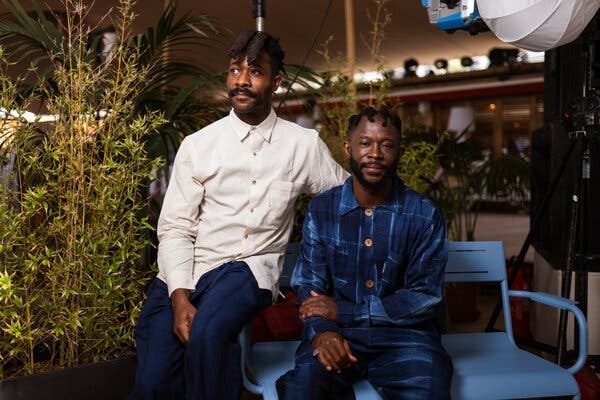
One of the most exciting movies playing during the Cannes Film Festival this year isn’t in the official lineup. Instead, “Clarissa” — a bold and wrenching adaptation of Virginia Woolf’s “Mrs. Dalloway” set entirely in Nigeria — is in Director’s Fortnight, the most prestigious of several smaller programs that run alongside the main event.
Independently run and housed in a theater several blocks from festival headquarters, this parallel event has a long history of showcasing new talent before the festival does. This is where the international film world first discovered Martin Scorsese, Chantal Akerman and Bong Joon Ho.
Since its premiere on Saturday, “Clarissa,” which stars Sophie Okonedo in the title role alongside David Oyelowo and Ayo Edebiri, has been rightly received with a chorus of wows. Directed by the filmmaking brothers Arie and Chuko Esiri, the movie counts as one of the few genuine discoveries in what has been a generally lackluster year.
[…]
If the American distributor Neon has its way, you will be hearing much more about Arie and Chuko — as they are billed in the film — who are 40-year-old fraternal twins. (Neon hasn’t set a date for the theatrical release, but “Clarissa” will be in rotation on the fall festival circuit.) Written by Chuko, this is the brothers’ second feature following “Eyimofe (This Is My Desire).” That critically lauded drama, about two Nigerians hoping to better their lives by emigrating to Europe, had its premiere at the Berlin International Film Festival in 2020. It was there at a screening with a festival moderator, and shortly before the world started to shut down, that Arie first learned what he and his brother were going to direct for their follow-up project.
Over in Sunderland:
Sunderland's Nigerian community is planning a peaceful protest as new councillors are inaugurated at City Hall this afternoon. The community is calling on Glenn Gibbins, who was elected to represent the Hylton Castle ward for Reform UK in local elections earlier this month, to resign after comments made on social media in 2024.
In the now-deleted post, Coun Gibbins complained about the "amount of Nigerians in the town", adding "should melt them all down and fill the potholes." He has been suspended by Reform UK, the party confirmed last Monday, and he is now standing as an independent councillor.
Sunderland Nigerian Community are planning to protest the inauguration of new councillors this afternoon. Chair Godwin Ejeh, who stood as a Liberal Democrat candidate in the Pennywell and South Hylton Ward but was unsuccessful, said that an apology issued to ChronicleLive by Coun Gibbins was "not remorseful" and that he "must resign".
Good feature on Nollywood past, present and future. Covers some of the themes we covered in our recent podcast recording with Chris Ihidero. Should be out in a couple of weeks:
Economic challenges and a low subscriber base saw the streaming giants pull funding for original content, a decision that left filmmakers pivoting and many observers asking: What’s next for Nollywood?
The answer lies in streamlining distribution. “We are encouraging regional sales,” says Ude. “If you are a filmmaker ready to work with sales agents and distributors to sell your films regionally, it’s more work, but you will make a lot more than you even made with the streamers coming on board. That way, when the streamers do come back, asking for your worldwide rights, it’s going to be a different story. We just have to take the hit now and work hard towards elevating ourselves.”
For Ude, the shift is a positive development, but “My Mother Is a Witch” and “Colours of Fire” director Niyi Akinmolayan, whose Anthill Studios was among those to ink a deal with Prime Video, warns of potential hurdles. “I’m gonna shock you,” he says. “Even in West Africa, it’s hard to sell a Nigerian film to Ghana, or to the Republic of Benin. They don’t get some of our jokes or subtleties. It’s also difficult to sell our films in South Africa. We may all look alike to the typical American or European, but culturally, we are very different.” His answer? Producing stories that close the gap. “I’ve told Nollywood filmmakers that one way forward is to develop films where you have a lot of cross-culture influences. When you do that, people might be excited because they can see someone like them in the story.”
Increasing access to cinemas is another effort, with the number of screens growing from 218 to 369 between 2019 and 2025. The ratio of Hollywood to Nollywood productions on those screens has shifted from 62-38% to 47-53% over that same period — highlighting the demand for local stories. “We didn’t have a lot of cinemas then as compared to now,” says Victoria Ogar, the head of distribution at FilmOne Entertainment, West Africa’s largest distributor. “We had Hollywood dominating our space, but then over time, we noticed that people started to react to Nollywood films. They speak to the value of the people, the culture.”
A leading Australian politician has found herself in a very interesting type of scandal:
Documents released under Freedom of Information laws also reveal Ms Allan’s office spent almost $128,000 in taxpayer funds boosting her social media posts on Facebook and Instagram over eight months, outpacing the digital advertising spend under her predecessor Daniel Andrews.
The internal documents shed light on a dramatic surge in followers in late February and early March, which inflated the Premier’s Instagram audience from about 34,500 to more than 100,000, with many suspected fake accounts still remaining.
“Analytics compiled by the Premier’s office show that following the surge, just 37.3 per cent of followers were based in Australia, with large cohorts in Bangladesh (18.6 per cent), Nigeria (7.3 per cent), Jordan (2.8 per cent) and Saudi Arabia (2.1 per cent), pointing to the likelihood of fake accounts.
Only 26.4 per cent of her followers were from Melbourne, compared with 4.7 per cent from Dhaka in Bangladesh, 4 per cent from Abuja in Nigeria, 2.8 per cent in Amman in Jordan and 2 per cent in Riyadh in Saudi Arabia.
There is no evidence in the material that Ms Allan or the Labor Party purchased followers, with a trail of emails instead revealing the extent of alarm inside the Premier’s office when the surge in followers began.
On the night of Saturday, February 28, a senior staffer in Ms Allan’s office emailed a Meta representative alerting him about the suspicious activity and seeking an urgent intervention.
“In the past hour, our followers have increased by more than 40,000 – and these accounts are all ‘new’ accounts,” he wrote. “Can this please be escalated for us? Conscious this activity could see our account suspended.”
If you have not signed up to the Berklee in Nigeria: Tiwa Savage Intensive Music Program, what exactly are you waiting for?
Tiwa Savage wants to ensure the next generation of Nigerian artists are well-equipped for the music industry.
Savage is a 2007 alumna of Berklee College of Music in Boston. Starting out as a backup singer at 17 for George Michael and many others, Savage attended the University of Kent in England to pursue a career in business administration. From there she landed a job at Royal Bank of Scotland, according to information shared by Berklee. But music was calling her back, and she returned to her first love.
“When I came to Berklee and saw a lot of the younger students, their drive and their passion, it recharged my batteries,” Savage told the college at the time she was attending. “[They’re] not thinking, ‘I’m going to save about $10,000 before I move,’ no, ‘I’m just going to get my backpack and move.’ I needed that fresh air, that atmosphere. I kind of felt like a 19-year-old.”
Savage is now recognized as a superstar, forging her own lane in the afrobeats genre. While she is grateful for her success over the decades from countless performances and awards, she admits that success has a different meaning to her nowadays.
“It’s great to perform in front of hundreds and thousands of people to win awards, but at some point, the thing that’s really gonna fulfill you is what’s going to outlive you or outlive your career,” she told CNN. “It was literally about 20 years ago when I walked through the halls of Berklee College of Music, but when I got to Berklee, I didn’t see many African students, and it was at that moment I knew that I was either going to bring Berklee to Nigeria or find a way to get more African students to be able to have this opportunity.”
She is now partnering with the college to establish the Berklee in Nigeria: Tiwa Savage Intensive Music Program, a four-day, no-cost program in Lagos, Nigeria. From a pool of more than 2,000 applications, 120 emerging musicians were selected nationwide, according to TRT Afrika.
Edikan Adiakpan (see BTH 100) has pleaded guilty:
A 34-year-old Nigerian national living in Houston pleaded guilty Tuesday to operating an illegal money-transmitting business that funneled proceeds from a sophisticated international email scam.
Edikan Adiakpan admitted in federal court that he used a company he controlled, Akama Lifestyle, to move funds for fraudsters between 2020 and 2022 while keeping a percentage as a fee. Federal prosecutors stated the funds originated from “business email compromise” (BEC) schemes that targeted more than 10 victims across at least eight states.
Among those targeted was a California research group dedicated to developing treatments for U.S. veterans.
The fraud relied on “spoofed” emails designed to mimic legitimate suppliers and creditors. Victims were tricked into diverting payments to bank accounts controlled by the fraudsters rather than their actual business partners.
According to court documents, the scope of the operation became clear when one victim wired $927,080 to the fraudsters. A portion of those proceeds was then sent to Adiakpan, who redeemed a $60,000 cashier’s check for himself as a kickback for his role in the scheme. The laundering process involved conspirators moving money rapidly between multiple bank accounts they controlled before converting the funds into cashier’s checks to be cashed by Adiakpan.
Update on John Fashanu:
The daughter of veteran Gladiators host and England footballer John Fashanu is set to marry a billionaire African businessman in a lavish wedding held over three days and spanning two continents.
Bride Amal Fashanu patched up a bitter feud with her famous father on the eve of her wedding that will see him walk her up the aisle when she marries Ghanaian tycoon Mohamad Odaymat.
Speaking publicly for the first time about the planned epic event, Ms Fashanu revealed how her wedding to an heir to one of Ghana’s most influential billionaire families will take place in both Africa and Europe assisted by private jets.
And thanks to her making up with her famous father, he is now set to play a prominent role in both legs - despite concerns about his declining health.
Amal, 37, told how she was moved to patch things up with the former England and Wimbledon striker when his health took a turn for the worse.
Amal revealed John, now 63, has been laid low by a mystery condition which she believes may be connected to him heading thousands of balls during his 17 years at the top of the professional game - as other former pro footballers have suffered.
Now she is hoping that John - who has been living in Nigeria for the past 13 years - will be fully recovered in time to be one of the guests of honour on the biggest day of her life.
Amal said more than 600 guests will be invited to their celebrations - exactly a year after their legal wedding - which will be held in Nigeria, where her father lives, and Spain - which is home to her mother, former model Marisol Acuna Duenas.
Boy, what a read! And I totally enjoyed it.💯😂👏🏽💐 I've told myself never to run away fro long reads. My attention span must not diminish 😭😭.
Now, to the major atticles that caught my interest:
1. Vampire drug (kush). I never knew about this until now. I guess it's proof that I'm a good boy. Anyways, this particular paragraph caught my attention;
"With opioids now heavily regulated in wealthier nations after being linked to 1 million deaths in the United States alone, some manufacturers in India — the world’s biggest producer of generic drugs — are pushing hard into Africa."
Sadly, Nigeria has the youth population to meet this supply 😪.
2. I think I just read one of the most racist post in my life💀💔.
"In the now-deleted post, Coun Gibbins complained about the "amount of Nigerians in the town", adding "should melt them all down and fill the potholes."
Omorrrr... how are y'all coping overseas?
3. This article about the Nigerian film industry really enlightened me about the challenges filmmakers face in Nigeria, especially regarding streaming.
"Akinmolayan, whose Anthill Studios was among those to ink a deal with Prime Video, warns of potential hurdles. “I’m gonna shock you,” he says. “Even in West Africa, it’s hard to sell a Nigerian film to Ghana, or to the Republic of Benin. They don’t get some of our jokes or subtleties. It’s also difficult to sell our films in South Africa. We may all look alike to the typical American or European, but culturally, we are very different.” His answer? Producing stories that close the gap."
However, Hollywood and Bollywood movies are not in line with our culture as Africans, yet the sell. Why? What does it actually mean to produce "stories that close the gap"? 🤔🤔
Overall, I enjoyed this post. Thank you for sharing.😁😁🥂💐💐👏🏽👏🏽👏🏽