

We started our read-along of Joe Studwell’s How Africa Works during the week. Next instalment will be out on Monday. Catch up on our podcast with Chude Jideonwo as well.

Enjoy the week’s selection below.
Nigerian Media
A story that left me astonished. Wells claiming lives in Kano. Everything is connected - if you are constantly defaulting to sub-optimal solutions and postponing the hard yards, you will always get stuff like this:
Findings by Weekend Trust show that between June 2024 and February 2026, no fewer than a dozen, many of them children and young adults, lost their lives in separate well-related accidents across nine local government areas of the state.
From Nasarawa to Danbatta, Dawakin Tofa to Gwale, the pattern is disturbingly similar: an uncovered or poorly secured well, a fall, sometimes accidental, sometimes during an attempted rescue and a desperate race against time that often ends in death.
One of the earliest recorded incidents within the period occurred on June 4, 2024, in Kawon, Alhaji Sani area of Nasarawa Local Government Area.
A 33-year-old man identified as Muhd Sagir reportedly fell into a dry well. Reports at the time noted that operatives of the Kano State Fire Service responded swiftly after receiving a distress call of the incident. Sagir was pulled out of the well unconscious and rushed for medical attention but was later confirmed dead.
The tragedy underscored the dangers posed, not only by water-filled wells but also by abandoned or dry wells left uncovered in residential areas.
In early November 2025, two families were thrown into mourning within 24 hours as two children died in separate well accidents. In Kashirmo village, Dawakin Tofa Local Government Area, an eight-year-old girl, identified as Zara’u Muhammad, reportedly slipped and fell into a deep well. Residents and local responders attempted rescuing her, but she was later confirmed dead.
Barely hours later, another tragedy struck in Dala Local Government Area, where a six-year-old boy fell into a well. He was rescued unconscious but did not survive.
In Edo, pineapple has last out to palm oil:
Two weeks ago, more than 400 pineapple growers in the Aduhanhan community of Uhunmwonde Local Government Area protested against Edo State’s purported intention to take over their farms in order to make way for an investment in palm oil.
Weekend Trust reported that the chairman of the All Farmers Association of Nigeria (AFAN) in Edo State, Alhaji Bako Dogwo, alongside leaders of other organisations, spearheaded the farmers’ protest on behalf of the Aduhanhan Taungya Farmers Association.
Speaking to reporters, Alhaji Dogwo said the farmers had been cultivating the land for over 60 years, and that the proposed eviction went against all levels of government’s efforts to combat food insecurity.
He said that when the government gave the community the forest reserves, they were required to grow only food crops – cassava, yams, maize, pineapple, etc – rather than cash crops.
Noting that Nigeria is the continent’s top producer of pineapple and the seventh in the world, Dogwo clarified that the ranking was attained because Edo State is the country’s top producer.
“If the plan to illegally evict the over 400 farmers from over 10 communities from the land is possible, it would amount to land grabbing, injustice, oppression of farmers and governments’ lip service to agriculture.
From Osun to Luxembourg? Anything can happen I suppose:
The Osun state Police Command has arrested a travel agent for allegedly defrauding two clients of N3.6 million under the pretext of securing Luxembourg visas.
This is contained in a statement by DSP Abiodun Ojelabi, the spokesperson for the command, in Osogbo on Thursday.
Ojelabi said in January 2025, the two victims were introduced by one of their friends to the suspect, who presented himself as a travel agent.
He said the victims thereafter gave the suspect the sum of N3.6 million to help them process visas and tickets to travel to Luxembourg in Europe
“Instead of processing the visas for them, the suspect absconded with their money.
“In the course of investigation, it was discovered that the suspect had also duped other victims to the tune of N4.8 million, totalling the sum of N8.4 million collected by the suspect from his victims.
The Paraga Lobby fought back really hard (with all sorts of wild claims about jobs and investment) and now seem to have won the fight against sachet alcohol. They are now raising their ambition by calling for the head of NAFDAC’s leadership:
The Coalition for Nigerian Change Movement has called for the immediate removal of the Director-General of the National Agency for Food and Drug Administration and Control (NAFDAC), Mojisola Christianah Adeyeye, over alleged abuse of public office and unlawful enforcement actions.
Addressing journalists at a press conference in Abuja, the coalition’s leader, Comrade Ogo Lincoln Otekevwe, accused the NAFDAC boss of enforcing an “arbitrary and illegal” ban on sachet alcohol and 200ml PET bottle alcoholic products in defiance of existing directives.
The group argued that the agency’s action contradicts the National Alcohol Policy approved by the Federal Ministry of Health and a presidential directive restraining NAFDAC from disrupting the operations of affected companies pending the outcome of a joint committee’s review.
According to the coalition, the enforcement also runs contrary to a resolution of the House of Representatives referenced as NAS/10/HR/CT.33/77c of March 14, 2024, which reportedly restrained NAFDAC from implementing the ban after a public hearing with key stakeholders and described the move as anti-people.
Otekevwe said the situation has created confusion among industry operators who are faced with conflicting directives from different arms of government.
A very strange story. My initial thought was an old undetonated bomb from the Civil War but that does not appear to be in consideration. There is a photo of the device in the article:
Residents of Ogbor Hill, Aba, Abia State, have been gripped by fear and confusion, following conflicting accounts over the alleged discovery of an explosive device at the United Evangelical Church, Ehere/Umuola.
The controversy erupted after eyewitnesses said a bomb was unearthed on January 30, 2026, while labourers were excavating a foundation for a new perimeter fence, following a government directive for the church to set back its structure due to road expansion.
However, the Abia State Police Command swiftly denied the claim. In a statement, the Police Public Relations Officer, DSP Maureen Chinaka, said no explosive was recovered at the church.
“I can authoritatively confirm that no bomb or explosive was recovered from the said area,” the statement read, adding that what was removed by soldiers was merely an iron rod from a church pillar during compliance with road construction directives.
But the church has strongly countered the police narrative, insisting that the incident was not a ruse.
When Vanguard visited the church, the Associate Pastor, Eleazar Onyenweaku, insisted that an explosive device was indeed exhumed and evacuated by the Army.
He expressed shock that the police dismissed the incident without initially visiting the church.
An ethical kidnapper?
A man accused of kidnapping four-year-old Muhammad Haruna in Kano has admitted that he carried out the crime to secure N100,000 to pay his debts.
The suspect, Aminu Tukur, who is still in the custody of the DSS, insisted that he acted alone and without influence from anyone else.
“I alone did what I did because I needed money to pay my N100,000 debt, although I requested for N15 million ransom, but I told myself that if they didn’t pay I would return the boy home without hurting him,” he said.
He explained that he went to the boy’s home in Minjibir Local Government Area under the pretext of measuring him for new clothes, and that was how he kidnapped him.
“I used my relationship with his father to go to the house to get the boy and I took him to my sister house, convincing her that his mother is sick and has gone to hospital. That was how I kept him for four days with me,” he added.
The boy’s father, Haruna Hamza, expressed relief and gratitude to the DSS for rescuing his son just four days after the abduction.
According to him, “I received my son who was rescued by the DSS on 12th February 2026 after being kidnapped and he is in good health.”
EFCC continues to defend the Naira’s honour:
A federal high court in Kano has sentenced Saadatu Mohammed Inuwa, the Kannywood actress popularly known as Samha Inuwa, to six months in prison for abusing the naira notes.
S.M. Shuaibu, the judge, delivered the judgment on Friday after the actress was convicted on a one-count charge of naira mutilation, an offence contrary to the Central Bank of Nigeria (CBN) Act of 2007.
The charge against Inuwa stated that she tampered with a N1,000 note by soiling it with her nose in 2022.
The charge against the movie star reads: “That you Saadatu Mohammed Inuwa sometime in 2022 within the jurisdiction of this Honourable Court tampered with Naira currency in the sum of N1000 (One Thousand Naira) note issued by Central Bank of Nigeria by soiling same using your nose and you thereby committed an offence contrary to section 21 (1) of the CBN Act. 2007”.
The defendant pleaded guilty when the charge was read to her in court.
Following her plea, Musa Isah, the prosecuting counsel, presented the facts of the case and urged the court to convict and sentence her accordingly.
Non-Nigerian Media
I had never heard of Oreoluwa Osoba, never mind his dog Duke, before reading this article:
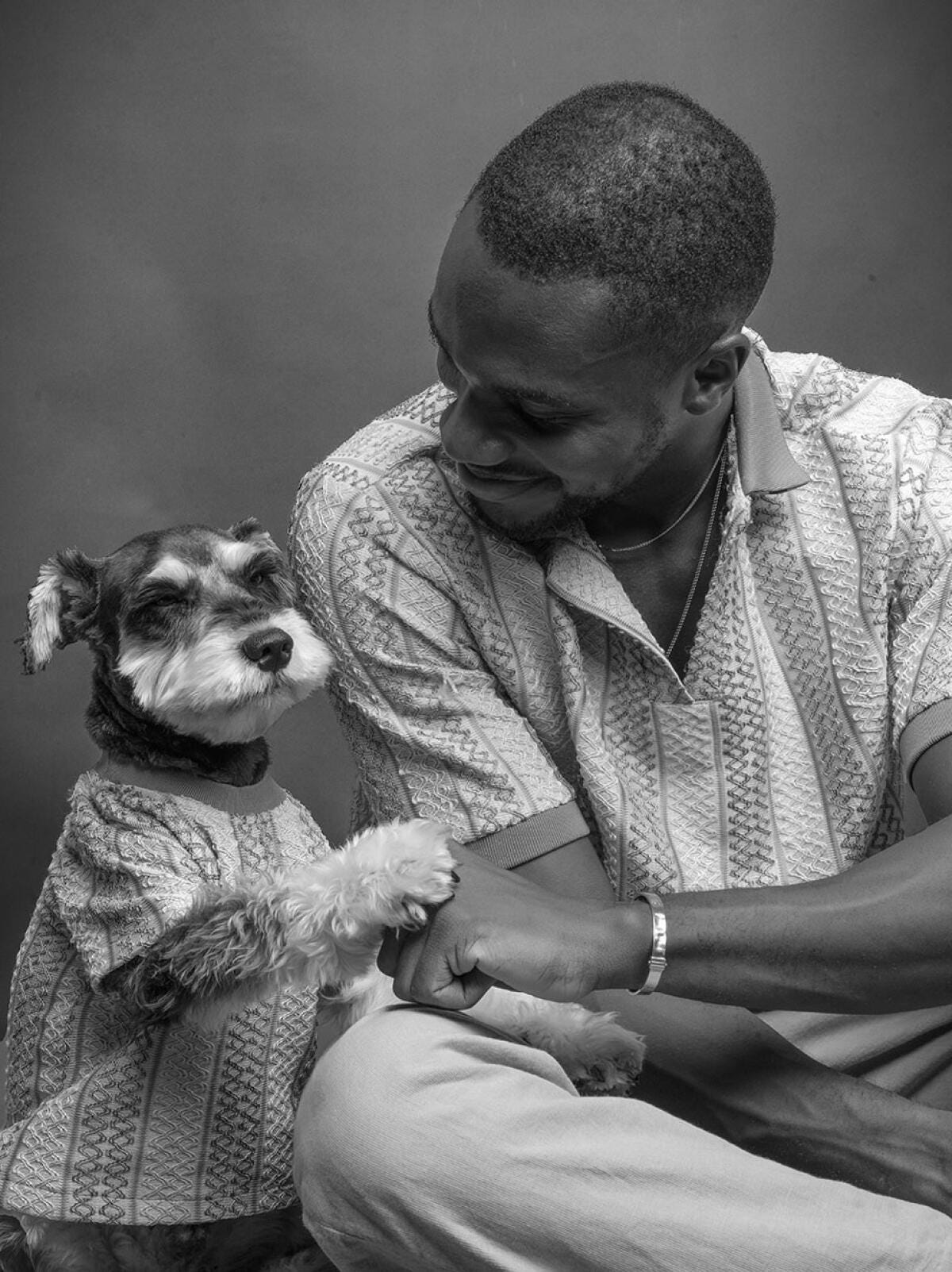
On TikTok and Instagram, @Ogaduke feels less like a pet account and more like a tiny family sitcom, starring one very serious dog and his very devoted dad. It’s the kind of feed you start watching for a minute and before you know it you’re twenty videos in. Behind the camera is Oreoluwa Osoba, whose videos with his dog, Duke, have become beloved for their affectionate “Nigerian dad” energy, gentle scolding and laugh-out-loud timing.
Osoba says that voice wasn’t something he ever sat down and planned. It was already there. “Duke and I have always had that bond,” he said. “I have always been a Nigerian dad with him… Growing up in Nigeria I was raised with the ‘Nigerian tone,’ the funny yet very loving and protective tone, so I guess it just grew on me naturally.” With Duke, he added, “I am an African father who just wants to love, care and protect him.”
Most of Osoba’s videos follow a familiar setup. He and Duke are usually on the couch, sitting close, the camera facing them straight on. It looks simple. Almost accidental. And then Osoba starts talking, launching into affectionate, mock-serious “lectures” that feel equal parts parenting and buddy comedy routine.
In his most popular video, which has been viewed more than five million times, Osoba gently scolds Duke for eating his chicken while he was on the phone in the other room. Duke is wearing a pink collared shirt and sits very still, like he knows he’s in trouble. Osoba reminds him, with exaggerated seriousness, that he “pays the bills in this house” and is disappointed in him. Duke lowers his head. Then he places a paw on Osoba’s knee. Then, eventually, he leans in for a hug, as if offering a formal apology. In the caption, Osoba jokes that this was the moment he realized he had fully become an African dad, giving his “son” a lecture about responsibility.
Who are the 5 women changing fashion according to the NYT?
Olivia Ozi-Oiza Chance, 32, has been fascinated by textiles since childhood, when she’d go to markets with her mother and aunts while on visits to Nigeria (her maternal grandparents live in Jos). “The process of touching fabrics and imagining what they could become made craft feel alive and immediate to me,” says Chance, who grew up in Chichester, England. She went on to study fashion design at Middlesex University in London, where she developed a labor-intensive practice that embraces both her Nigerian and British heritage, and founded her brand, Oiza, in 2022.
Lace figures prominently in Oiza’s offerings, which always include floor-scraping gowns composed of individual panels that are stitched together by hand. Several appeared in her spring 2026 collection, which she designed and developed while pregnant. For Chance, working on it was “a way of translating personal transformation into design, with emotion and instinct leading form,” and she considered the results a sort of tribute to Oshun, the Yoruba deity of fertility and love. One of the lace dresses was an alabaster hue, and had a mock neck and hand-applied florets made out of cowrie shells. There was also a long halter top that was worn over lace pants and made from meters’ worth of pendulous tassel trim, whose movements Chance thought of as symbolizing both the unpredictability and rhythm of motherhood. For her next collection, she’ll assemble a small group of intricate couture pieces.
Love is in the air in Kano, just in time for Valentine’s:
Aisha adjusted her beige veil over her circular-shaped headgear as a matchmaker scrolled through rows of dozens of pictures on a computer to find a man she could be interested in as a potential match.
Many young women in northern Nigeria’s conservative Muslim city of Kano marry as early as 18.
After waiting for years for a suitor, Aisha is frustrated and has turned now to enlist the services of an online matchmaker site to find a husband of her dreams: rich and educated.
Matchmaking websites are booming in Kano, blending traditional methods with artificial intelligence.
“This is the right place to ask for help in finding a person to marry,” Aisha, using a pseudonym, told AFP inside Northern Halal Marriage online matchmaking office. ”
“”It is not every man who sees you that will express his love,” said the soft-spoken college graduate, adding online is “the best way to find true love”.
She’s trying her luck after some of her friends found their dream husbands through online matchmaking.
The five-month-old site, one of several that have sprung up in the city, has attracted 1,000 clients and garnered around 10,000 followers across social media platforms, said Jaafar Isah Shanawa, its 27-year-old CEO.
With four staff, the platform accords clients privacy by modifying their pictures using AI and changing their real names.
The concealed details are only shown to interested clients when they visit the office in person after paying a registration fees.
I don’t think it was a good idea for Remi Tinubu to go on The Free Press as pat of her US lobbying tour.:
Father Galmi recalls a child he was helping who had witnessed his father’s hands being cut off. “This boy is struggling with coming to terms with the fact that his father has no hands because he’s a Christian, and he watched his father suffer that brutal attack by this Islamic terrorist,” he told me. To speak to him, it’s clear how soul-crushing it is to witness the suffering of the victims he works with. “They are not just traumatized,” said Father Galmi. “They are broken forever.”
I asked the First Lady if she had visited any sites of Islamist atrocities to speak with survivors, and she told me she had traveled widely across Nigeria, including to Plateau State, where Christians have been displaced and massacred by Islamist Fulani militants.
There, she said, she spoke to the elders of the community, who showed up in the hundreds, she said, and gave them over $1 million to rebuild their homes.
“I told them: ‘This will be the last time. . . . Why are you killing each other? I can’t be bringing money here, and then you’re squandering it,” she said.
[…]
Tinubu, however, insists on optimism. “You know, Nigerians are quite resilient. All these communities are still springing up. They believe in the faith. And we as a government, what we are supposed to do is to give them protection, and that is what this administration is trying to do.”
Tinubu says that the president “is working day and night to secure lives.” And “they’ve done a lot.”
But, she suggested, it’s not as simple as #BringBackOurGirls. “Even those girls kidnapped during Chibok, they are still trying to rescue them,” Tinubu said, “until they learned recently that most of them fell in love with their abductors, so that’s quite difficult. You know, they refuse to come back.”
The Economist covers the MOWAA fiasco:
Things came to a head in November, when protesters stormed a glitzy preview event for officials and foreign guests. The intruders, echoing the oba, demanded that the museum be suspended pending an “investigation” into its provenance, funding and legality, prompting an inquiry. But the dispute goes back further.
It begins with Benin’s famous bronzes, a stunning collection of plaques and statues looted by the British and bought by museums (and private collectors) across Europe and America. On February 8th the University of Cambridge became the latest institution to say it would return its collection of bronzes to Nigeria as part of a global drive for restitution. In 2018 Godwin Obaseki, then the governor of Edo state, which includes Benin City, announced plans for a new museum that could house them. That undercut the argument, made by opponents of returning the bronzes, that Nigeria has nowhere to keep them safe and on view for locals.
Yet not everyone was happy. In 2021 Ewuare II, the current oba, accused the team behind the project of attempting to hijack the restitution process. He was particularly exercised by the museum’s new name, which he believed severed the link between the bronzes and the palace. “It started as the Benin Royal Museum, not MOWAA—that is the foundation of the argument,” says his spokesman. In 2023 Muhammadu Buhari, then Nigeria’s president, declared the oba “the original owner and custodian of the culture, heritage and tradition of the people of Benin kingdom”. Any returning bronzes were to be handed to him rather than the government.
Nigerians are choosing chatbots for therapy, so says The Guardian:
On a quiet evening in her Abuja hotel, Joy Adeboye, 23, sits on her bed clutching her phone, her mind racing and chest tightening. On her screen is yet another abusive message from her stalker – a man she had met nine months earlier at her church.
He had asked Adeboye out; when she declined, he began sending her intimidating, insulting and blackmailing messages on social media, as well as spreading false information about her online. There were even death threats.
The experience is taking its toll on her mental health, leaving her struggling to cope. Family and friends she confided in did not take it seriously, and she cannot afford in-person therapy or counselling. As the feeling of panic rose at the sight of his words, she turns to an alternative: a WhatsApp chatbot called Chat Kemi.
“Good evening, Resilient Joy,” the bot types. “How are you today?”
Adeboye hesitates, then starts typing: “Someone is defaming me online and threatening to kill me, because I refused to date him. I am depressed and confused. What should I do?”The chatbot, which Adeboye had heard about at an event on gender-based violence run by an NGO, advises her to deactivate her social media accounts and provide all necessary information about the person making the threats to someone she trusts.
For the first time in months, Adeboye says, she felt less alone.
Who is Tolu Coker?
Rather than present her spring/summer 2026 collection on the runway, the British-Nigerian designer Tolu Coker made a short film. Codirected with her brother, Ade Coker, Unfinished Business sees Naomi Campbell and a cast of upcoming Black models quietly inhabiting a bedroom full of wooden toys and family photographs. The soundtrack is a recording of an intimate conversation that Campbell and the Coker siblings had about childhood and motherhood. “The story we wanted to tell wasn’t a story of spectacle,” explained Coker, who has previously directed music videos. “It was about the intimacy of mundane moments, like a family video.” Outfits from her namesake label, such as a butter yellow top with a fitted bodice and a voluminous, 1950s-style skirt, are worn by both Campbell and the younger models, as if they were heirlooms being passed down.
When we spoke on a Friday afternoon, Coker’s atelier at 180 Studios, a creative hub for artists in Central London, was in full flux. The hats usually pinned on the wall behind her desk—all of her collections include sculptural headwear, from towering bowlers to dramatic takes on traditional African filas—were en route to red carpet events and editorial shoots. Books as diverse as bell hooks’s All About Love and Issey Miyake monographs were haphazardly stacked on windowsills, beside family photos. “The British Fashion Awards are on Monday,” explained Coker. The 32-year-old had been nominated for the Vanguard Award, and she had also designed a look for the rapper Little Simz, who was nominated for—and ultimately won—the Cultural Innovator Award. To receive it, Simz wore a Tolu Coker tailored skirt suit in houndstooth, done in forest green as a nod to their shared Nigerian heritage.
Access Bank bought a UK fintech:
London-based fintech Zempler Bank has been snapped up by Nigeria’s biggest bank in a deal that has slashed the firm’s valuation, City AM can reveal.
The small business lender – formerly known as Cashplus – has been acquired by The Access Bank UK with a price tag of around £3.45p per share.
The sale represents a dramatic haircut for Zempler, which netted a valuation of £80m in its 2020 fundraising round.
The raise had priced shares at just over £9, with Access’ acquisition taking a mammoth chop to the fintech’s value.
In Zempler’s latest Companies House filing for the year ending March 31 2025, the digital bank’s profit grew 58 per cent to £5.2m.
I love the way celeb stories are written. This one made me LOL:
Jennifer Meyer bared her blossoming baby bump in a casual crop top when she was seen stepping out for lunch in Beverly Hills this week.
The 48-year-old, who is the daughter of movie mogul Ron Meyer, is expecting her first child by her fiancé Geoffrey Ogunlesi, whose father is the Nigerian billionaire Adebayo Ogunlesi, known to the press in his native country as ‘The Man Who Bought Gatwick Airport.’
She already shares two teenage children with her ex-husband Tobey Maguire, whom she split from in 2016 - her daughter Ruby, 19, and son Otis, 16.
Meyer ecstatically announced her current pregnancy in mid-December, gushing on Instagram; ‘Hey baby girl, We love love love you!!’
When she was glimpsed Tuesday emerging from a gleaming black SUV for lunch in the 90210 zip code, she radiated a blissful glow.
Meyer teamed her blue crop top with a set of navy maternity sweats, accessorizing with a gleaming pair of large black sunglasses.
Interesting read