

I love Thailand. Not just for the beautiful beaches and the great food, though those are excellent and reason enough to go back as often as I have. What I like is that it offers something like an intermediate step - a picture of what Nigeria and other African countries can be when the gap to rich countries (or China) feels insurmountable.
The best reminder of this is Thai street food in Bangkok. Almost nothing about Thai food is left to chance or Anyhowness. Pad Thai, perhaps Thailand’s most famous culinary export, came out of a deliberate government cultural project:
The year was 1938. Six years earlier, Phibunsongkhram, better known as Phibun in Western historical accounts, had played a prominent role as a military officer in a coup that stripped Thailand’s monarchy of its absolute powers. A year later, he became the equivalent of the Minister of Defense after crushing a rebellion launched by royalists, and in 1938, he became prime minister.
Yet Phibun worried as he assumed power. Thailand, which was then known as Siam, had never been colonized, but it was surrounded by French and British colonies. Siam was also an ethnically diverse country with strong regional identities, and Phibun had wrested power from the monarchy, the institution that had long held it all together.
Worried about his country’s independence, disintegration, and, most of all, support for his rule, Phibun decided to transform the country’s culture and identity. The European-educated Phibun saw his country as provincial and backward; he aimed to make Siam a strong, nationalistic, and modern country.
Like a drill sergeant breaking in new recruits, Phibun passed 12 Cultural Mandates that exhorted the Siamese people to be productive, well-mannered, and proud of their country.
Some of Phibun’s mandates—like his desire for everyone to wear hats in public—are now footnotes in history. Other edicts—like his decision to change the name of the country to Thailand—stood the test of time. And one changed culinary history, even if few people know it.
As part of his campaign, Phibun ordered the creation of a new national dish: pad Thai.
How to eat in Bangkok
In Bangkok, food carts are everywhere offering “street food”. The hit rate is so high that you can sample any one of them and eat something very tasty (trust me on this - have I ever lied to you?). But no cart is legally free to appear just anywhere. The system is best understood as managed informality, that is, the default rule is restrictive, but local authorities have latitude to designate, tolerate, or cancel vending areas.
The law regulates the cart in two ways: occupation of public space, and food and public-health safety. Under Thailand’s cleanliness and orderliness law, “road” covers the carriageway and pavements, alleys, lanes, bridges and similar public ways. Section 20 then bars cooking, selling goods, or selling from a wheeled vehicle on a road or public place, unless the activity is on a private road, or in an area and at a time announced by local officials with traffic-police approval. Violating section 20 carries a fine of up to 2,000 baht (about $60).
The public-health aspect is separate. The Public Health Act requires a licence to sell goods in public places or public ways, and gives local authorities power to set rules on hygiene, preparation, storage, utensils, water, food handling, vending times and related conditions.
For Bangkok today, the rules are fairly specific. The local authority’s criteria require enough pavement left over once a stall is placed: generally at least 2 metres on wider roads with three or more traffic lanes, and 1.5 metres on smaller ones. Trading areas must be reviewed every one or two years depending on road type, and they need traffic approval and local consultation. The physical stall is controlled too and is limited to about 3 square metres, must normally be arranged on one side only, must leave a buffer from the traffic surface, and must provide emergency gaps. Stalls are barred from bus stops, entrances to transit infrastructure, pedestrian bridges, crosswalks, intersections, busy building entrances, public toilets, fire hydrants, public phones and post boxes.
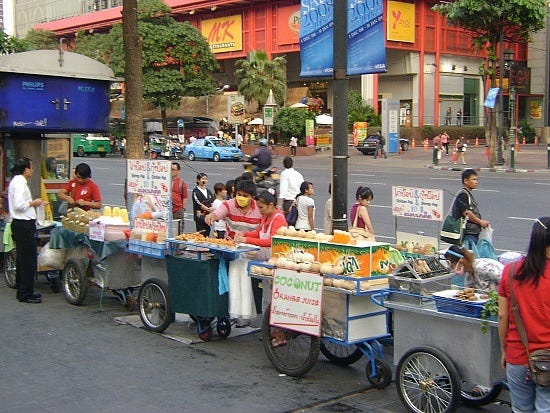
The vendor or street trader is regulated as closely as the cart. Under that same framework, sidewalk-vending eligibility is aimed at Thai nationals in specified welfare or low-income categories; one route is income not exceeding 300,000 baht (about $9,000) a year after deductible business expenses. Vendors must register, generally cannot hold multiple stalls, and the permission is personal rather than a tradable asset. Operational rules include annual tax filing, public-health permission, identification cards or QR display, one weekly non-trading day, food-sanitation training for food vendors, safe use of gas and electrical equipment, and bans on things like alcohol and tobacco sales and dumping food waste, oil or wastewater into public drains.
The First Lady and Akara
I am sorry to have revived Akara Discourse just as it was fading from public consciousness. But it annoyed me, and I finally think I know why. Her comments about akara - and the subsequent doubling down - represent an Intensification of Anyhowness. That is to say: if you take the First Lady at her word, and all that follows is an increase in every manifestation of disorder, chaos and the other things we have come to associate with Anyhowness.
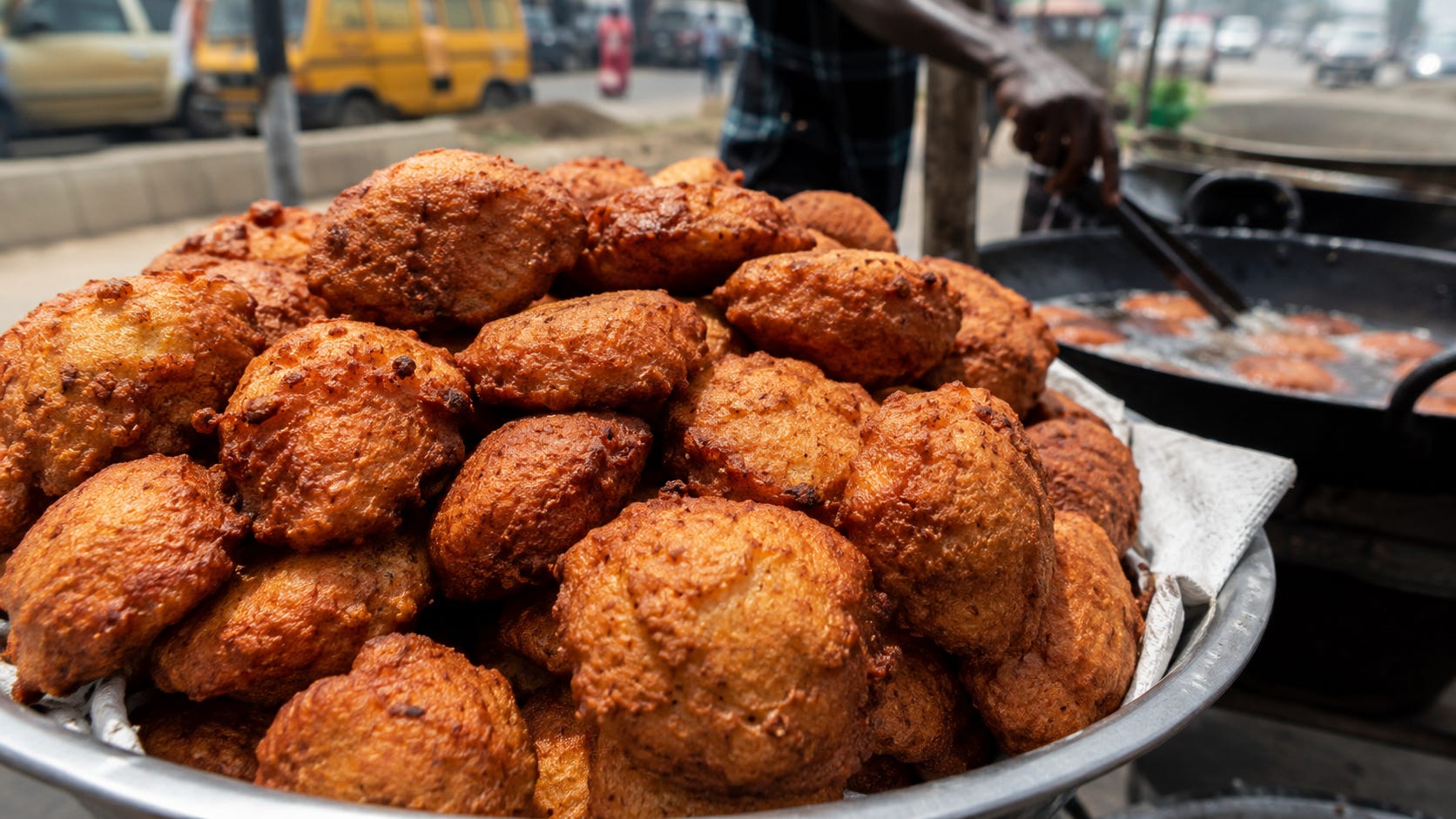
For the sake of non-Nigerians who read this Substack, a quick recap. Last month Nigeria’s first lady sparked outrage when she said they - presumably she and her husband - were “doing their best” by “empowering” Nigerian women to start small-scale businesses selling akara (fried bean cakes), roasted corn and kuli-kuli (a crunchy snack made from roasted peanuts). The ways of the internet are beyond my understanding, but suffice to say that of the three, it was akara that caught the public imagination:
Speaking on the activities of the Renewed Hope Initiative, the First Lady said the programme had been providing grants, rather than loans, to vulnerable Nigerians to help them start businesses and improve their livelihoods.
“We’re trying to give hope, and to start Akara business doesn’t take a lot of money. To start roasting corn, or somebody even said kuli kuli doesn’t take much. We didn’t give them a loan; we gave it to them as a grant.
“So we’ve encouraged Nigerians as best as we could. What is within our hands, I have given, and I keep giving,” she said.
The comments were about as close to a modern-day "let them eat cake" as you are likely to get. An obviously privileged person telling The Poors that their lot is to try their luck with akara. Staring down her critics, she later clarified that it was not just akara: her "empowerment" efforts extended to tomato sellers, boli (roasted plantain), pepper and vegetables. Never has Nigerian economic discourse reached the heights the first lady has now opened up to us. We are so blessed.
As should be obvious to anyone who has managed to spend five minutes in Nigeria, no more is required to start an akara business than a busy road corner and the will to start frying. Lagos is no Bangkok, to state the blindingly obvious. There is no designated area, no prescribed pan size, no rule about the kind of fire you may use or how often the same oil is used. And as the akara seller runs the gauntlet of periodic raids by some state "task force" or other, so you, the customer, run a gauntlet of your own: food bought from the roadside whose provenance you know nothing of. You just have to trust that the frying oil is hot enough to make life uncomfortable for any germs, so that none survive the journey into your system.
Akara is Anyhow. There is no structure behind it, and no attempt at any. So when the first lady says that she and her husband are "empowering" people by shunting them into this kind of disorganised space, ask what that looks like in practice. What would Lagos look like with another 50,000 akara and tomato sellers "empowered"? Every street corner would have one, and Anyhowness would be intensified.
When Anyhowness Intersects
Newspapers in Nigeria report on the intersection of akara with the wider Nigerian Anyhowness now and again, often in tragicomic ways. The result is an intensification:
A few years ago, Channels Television reported that a petrol tanker overturned at Upper Iweka Junction in Onitsha. A NEMA official blamed the explosion that followed on the fire a woman was using to fry akara beside the road. It spread to nearby shops and homes. Last year, Leadership reported that a Toyota Corolla left the road at Nnung Oku Junction in Ibesikpo Asutan LGA and struck bystanders and roadside traders. Among those killed was a popular bean-cake seller known locally as “Mma Akara”, who usually sold late into the night. The paper reported seven deaths. This past January, when a diesel tanker toppled on Liverpool Bridge in Apapa, the Nigerian Tribune reported that a motor-park official immediately chased away the women selling akara, roasted plantain and roasted corn, and ordered them to put out their fires. Last year, The Guardian reported that two women were killed by a bread-delivery van on the Alao-Akala Memorial Highway in Ogbomoso. One of them was identified as a local vendor who sold ekuru, a steamed bean dish. They were reportedly attempting to cross the highway when they were struck, and the driver allegedly fled. And in April, Punch reported that a roadside hawker in Lagos was killed in a collision with a Lexus SUV.
There are other non-traffic risks. A December 2025 Guardian report followed an akara seller in Yenagoa who cooked with firewood because gas cost too much against her working capital. Smoke irritated her eyes as she worked. The health burden of polluting fuels, the report noted, falls hardest on the women doing the cooking. A February 2026 Punch investigation found akara, roasted plantain and fish being sold in Lagos beside heavy traffic, open drains, refuse and dust, with doctors warning of contamination from flies, unsafe water, vehicle emissions and roadside debris. A Nigerian Institute of Medical Research study, reported by the Nigerian Tribune in April 2025, found dangerous contamination in sampled street foods, including akara.
When a country's leaders offer this disorder as the "best" they can do, and do nothing about what it costs, we are through the looking glass.
Renewed Hope giveth, Renewed Hope taketh away
In Abuja, where the first lady and her husband live, roasted corn-sellers are treated as a security problem and the corn they sell as an urban menace. In August 2023 Nyesom Wike - one of the most powerful ministers in the government - prohibited street trading in the capital, singling out corn-sellers and hawkers, whose presence he said contributed to insecurity and criminal activity.
The First Lady has been on this for a while. In August 2024 she launched ₦50,000 grants for 37,000 women petty traders, a thousand of them in the FCT. The FCT Minister of State, Mariya Mahmoud, praised the programme for helping women traders expand their businesses and improve their livelihoods. Eleven months later, Wike’s office launched Operation Sweep to remove street traders from the FCT. Then on 6 June 2026 the First Lady distributed grants and equipment to another thousand traders and small-business operators in the FCT, where Mahmoud described the intervention as a demonstration of President Tinubu’s Renewed Hope Agenda and its commitment to empowerment and self-reliance. The junior minister hands out the grants and praises them; the senior minister sends in the task force.
Nor is this an Abuja peculiarity. This month in Anambra, the OCHA Brigade ran a major enforcement operation against roadside trading, demolishing shanties, confiscating goods and targeting traders who displayed them on roads, walkways and unauthorised public spaces. You can find dozens of stories like this across the country.
On 24 June 2026, the Lagos State Task Force gave the street traders along the Alaba Rago section of the Mile 2–Badagry Expressway 72 hours to leave. The government said it was enforcing the ban in the Lagos State Environmental Management and Protection Law 2017, and would clear trading from highways, walkways, road medians and setbacks. Two days later, the first lady told Nigerian women that selling akara and roasted corn did not require much capital and urged them to go for it.
One arm of the government will give you ₦50,000 to fry akara. Another will evacuate you from the road you fry them on. Take her advice at your own risk.
Nigerian leaders are worse than Marie Antoinette in their disdain for their citizens who they see as subjects.
Thank you for your service as always Feyi! You’re a better man than most of us for putting this so nicely😅😅. Everyday the renewed hope agenda continues to look more like renewed poverty agenda.