

Wherever two or three Nigerians are gathered, you can be sure the country’s many dysfunctions will be part of the conversation. The rapacious corruption of politicians, the interminably unreliable electricity supply, the high cost of living and doing business, the absence of security for human lives and property- the list is endless. As a willing participant in many of these conversations, I sometimes find them a dull and exhausting sport. The feeling of constantly repeating Nigeria’s problems and the pervasive air of hopelessness around such conversations are indeed real and present. However, for anyone familiar with this setting, a wise solitary figure usually punctuates the hopelessness with a phrase that deserves to be canonised: “So, what is the solution?”
Over the years, this phrase has developed a personality of its own. For many people, it has taken the form that Nigerians are experts at talking about problems but not solutions. There is nothing really wrong with this conclusion. A country that has discussed unemployment, electricity, insecurity, inflation, corruption and poverty for decades can hardly be blamed for growing impatient with diagnosis. But when you press people who think Nigerians complain too much about their preferred solution, in my experience, it is always some version of something that’s already been tried and failed.
The weariness with explanations in the face of perpetual dysfunction is understandable, but the ease with which we default to the “what is the solution” thinking has created a peculiar epistemic trap: the pressure to produce an answer before we have done the harder work of understanding the problem. Over time, this has made intellectual inquiry easier to censure, so attempts to explain mechanisms, trace causes, or sit with complexity are dismissed as impractical or “too theoretical,” weakening the habits of curiosity and rigour needed to understand our most persistent social problems. The political consequence is that those who seek power rarely need to be serious merchants of ideas; they are rewarded instead for offering simple answers to complex problems, and the knowledge deficit this produces eventually reappears in government as poor judgement, policy failure and practical incompetence.
Description, Explanation, and Prescription
The problem is not that solutions are unimportant. It is that a solution is the last stage of the process, not the first. Before we decide what to do about unemployment, insecurity, electricity, or inflation, we need some account of what is happening and why. Description tells us what the problem looks like; explanation identifies the mechanisms producing it; prescription proposes an intervention based on that explanation. Much of our political discourse jumps from the first to the third.
This matters because a policy recommendation is not evidence of understanding. Two people can agree that electricity supply is unreliable and arrive at completely different prescriptions because they hold different theories about what causes the unreliability. One may think the binding constraint is pricing; another, transmission infrastructure; another, gas supply; another, theft and non-payment; another, regulatory design. The proposed solution makes sense only relative to the causal model underneath it. Once you make this distinction, the demand to “stop talking and give us solutions” looks less obviously practical. Sometimes practical action requires more diagnosis.
Why Politics Rewards Premature Certainty
Politics does not merely punish uncertainty; politicians themselves have good reasons to supply certainty whether or not they possess it. A slogan that survives an interview, circulates on social media and reassures supporters can be more electorally useful than a complicated account of why a problem exists. If saying “we will end insecurity,” “restore the economy,” or “fix power” is enough to signal seriousness, there is little immediate reward for exposing oneself to the harder questions about mechanisms, constraints and trade-offs. A politician who can win by producing simple answers has little incentive to cultivate the knowledge required for effective governance.
The institutions between politicians and the public reinforce the problem. Pressure groups, activists, journalists, commentators and voters do not simply receive political messages; they help determine which kinds of messages are rewarded. If their own theories of social problems are simple, the questions they ask will often be simple too. Candidates are then judged by whether they hold a position rather than whether they can explain the world in a way that makes the position sensible. The politician’s incentive to simplify and the public demand for simplicity begin to reinforce each other.
This is one reason I think the familiar complaint that Nigerian politics lacks ideology, while not wrong, misses something. INEC itself has recently criticised Nigerian parties for operating without clear or functional ideologies, and Nigerian political commentary has long made the same observation. But an ideology cannot substitute for knowledge. A politician may be a socialist, a social democrat or a market liberal and still have a very poor account of why electricity supply is unreliable, why food prices are rising or why firms remain small. Ideology tells us something about values, priorities and the kinds of institutions a politician is predisposed to favour. The ideas underneath particular policies, and the causal reasoning connecting those ideas to actual Nigerian conditions, tell us whether those policies are likely to survive contact with reality.
The same confusion appears in the importance we attach to manifestos. The demand that parties and candidates publish a manifesto is sensible. A manifesto can reveal priorities, permit comparison and create a record against which a government may later be judged. But once possession of a manifesto becomes the test of seriousness, the document itself can become ceremonial. Everybody learns to produce one. Nigeria has already had campaigns in which manifestos converged around familiar promises and commentators complained that the documents contained interchangeable platitudes rather than distinctive accounts of the country’s problems. The epistemic standard has then quietly fallen from “show us that you understand the problem” to “show us that you have a document saying what you intend to do.”
A manifesto can be very thick with information, and also dense, in the Nigerian sense - exhibiting the same emptiness as a campaign slogan. It can promise more electricity without explaining which constraints in the electricity market it regards as binding; industrialisation without showing why previous industrial policies produced the outcomes they did; jobs without a theory of what prevents firms from hiring and expanding. The presence of policy detail is not the same thing as the presence of a serious model of the problem. A document can contain a hundred proposals and still tell us remarkably little about whether the people who wrote it know what they are doing.
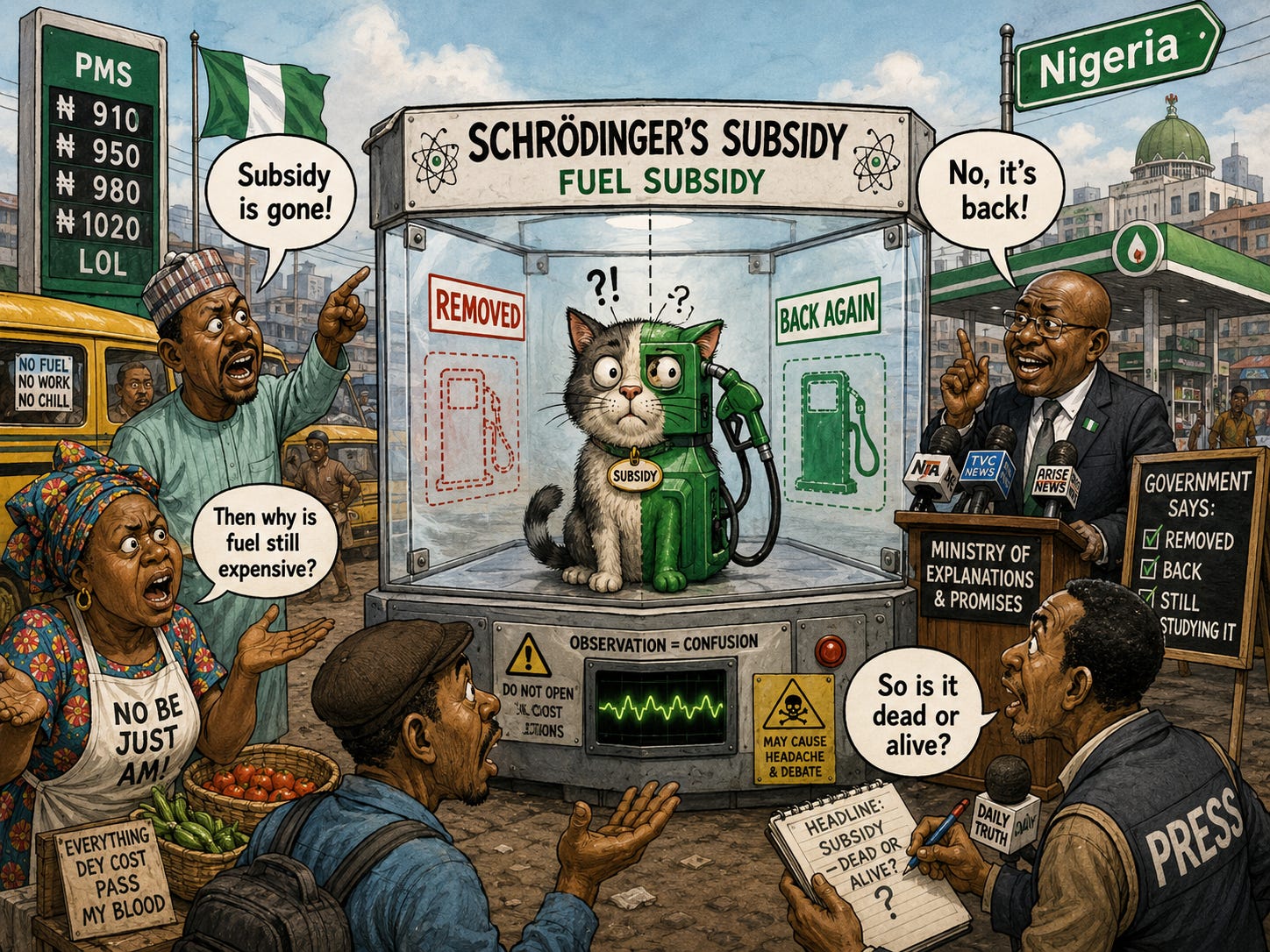
Fuel Subsidy and the Illusion of a Simple Answer
Few Nigerian policy debates illustrate this better than fuel subsidy. At the level of ordinary political argument, the question appears straightforward. Should subsidy be restored? Should it stay “gone”? Should government make it less corrupt? Should the savings be spent better? But each formulation deceptively simplifies the actual policy problem.
What exactly is being subsidised? Is the subsidy an explicit budget transfer, an under-recovery borne by a state-owned company, a foregone remittance to the Federation Account, or some combination of these? What benchmark price is being used? At what exchange rate? At what consumption volume? Who bears the fiscal cost? How is that cost distributed across the federal, state and local governments? What happens to public revenues if the subsidy is restored through one mechanism rather than another? What does it mean to say that money has been “saved” when the saving may exist only as counterfactual fiscal space rather than as a separate pot of cash waiting to be spent?
There is also the welfare question. A universal subsidy can be fiscally expensive and directly regressive because richer households consume more fuel. By contrast, removing it can still impose serious indirect costs (as it did) on poorer households through transport, food prices, and generator use. These conundrums are not contradictions. Rather, they are different parts of the same system.
So “bring back the subsidy” is not really one policy. It could mean direct price support, targeted transport support, a temporary price cap, a producer subsidy, a tax adjustment, a foreign-exchange concession, or something else entirely. Each option has different fiscal costs and budgetary implications, distributional consequences and implementation risks. A politician who says only that subsidy should return has not yet told us enough to know whether a policy stands behind the slogan.
Repetition without Learning
One reason Nigeria appears to have no shortage of solutions is that many of them are recycled. Policies disappear and return under new names. New agencies are created with duplicated functions of existing ones. The same ideas move in and out of fashion with little accumulation of knowledge about why the earlier version succeeded, failed or produced mixed results. There is no institutional learning.
A policymaking process that does not distinguish between a policy that failed because its underlying theory was wrong and a policy that failed because implementation collapsed cannot learn much from experience. Nor can a government improve if it explains every failure afterwards by corruption, lack of political will, or poor implementation. These explanations are not intrinsically wrong, but they are too elastic to teach us very much unless we specify the mechanism. What failed exactly? Which assumption proved false? Which actor behaved differently from what the policy required? Which constraint turned out to be binding? Which part of the intervention worked and which did not? Without questions like these, policy failure produces frustration and tired complaints rather than knowledge.
What We Should Ask of Political Leaders
Instead of asking and judging politicians only for their preferred solution, we should also ask for their theory of the problem. What do they think is causing it? What evidence supports that view? Which previous attempts do they believe failed, and why? What trade-offs do they expect? Which assumptions does their proposal depend on? What would count as evidence that the policy is not working? Under what conditions would they change course?
These are not merely academic questions. They are practical questions because they reveal whether any reasoning connects the problem and the prescription. A politician does not need to produce a journal article on every issue. But anyone seeking decision-making power should be able to explain how a policy is supposed to work. If they cannot, then the promise itself tells us very little.
The lack of depth extends all the way to the formulation of the policies and laws. It is always sadly so cursory. Worse still when the policies or laws are questioned or analysed , there is a politicized battle rather than a proper introspection and review of what the problem is and how the proposed laws or policies or initiatives will solve them. Half baked solutions, half baked implementation and the problem is still there decade after decade.
This article effectively moves the conversation to a meta level.